

Table of Contents
Picture this. You have pulled up a trip you have wanted to take for years, and the price is sitting right there on the screen. Your retirement accounts say you can afford it. So why does your stomach still tighten every time you get close to the book now button?
That tightness is common, and it usually is not about the math. Most people never work out how much to spend on travel in retirement. They just feel their way through each trip, swinging between guilt and overspending, with no real framework in between. There is a better way, one that gives you a specific answer instead of a feeling.
This post walks through a simple framework tied to the same Freedom Number you may have already calculated: what share of your retirement spending can reasonably go toward travel, what a safe withdrawal rate actually means for that spending, and three questions you can run before booking any trip. No guilt required, just a number you can trust.
Please note this page may contains affiliate links. If you purchase something through these links, I’ll receive a commission at no extra cost to you. Affiliate links help to support my website/blog and I only recommend products I love.
Why “Can I Afford This Trip” Is the Wrong Question
Most people ask the wrong question before they book a trip. They ask whether they can afford this one trip, as if every vacation were an isolated decision instead of part of a much bigger plan. That framing almost guarantees anxiety, because any single withdrawal from savings feels like a loss, even when the plan already accounts for it.
Behavioral finance has a name for this: loss aversion. Watching a number in an account go down triggers a stronger emotional reaction than watching an equivalent number go up, even when both changes were fully expected.
A July 2026 piece from the financial planning firm Suttle | Crossland, “The Psychology of Wealth Decumulation”, describes this exact pattern in retirees: a fear of spending down savings that were built specifically to be spent.
The fix is not more willpower. It is a different question. Instead of asking whether you can afford one trip, ask whether ongoing travel spending fits inside your Freedom Number, the same overall retirement number you already worked out once. A trip that fits inside that number is not reckless. That is the plan working exactly as intended.
How Much to Spend on Travel in Retirement: The 5-10% Rule
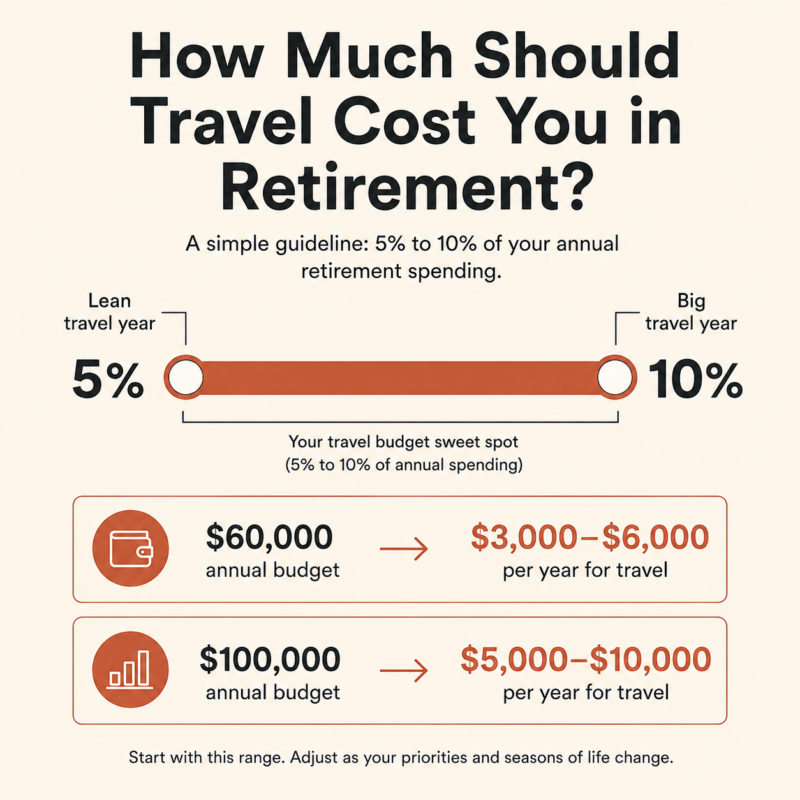
Most financial planners land in a similar range: 5% to 10% of annual retirement spending toward travel. Kiplinger’s guidance on budgeting for travel in retirement puts this in concrete terms, translating to roughly $10,000 to $50,000 a year depending on lifestyle, destination choices, and how often you travel.
That range is a starting point, not a ceiling and not a floor. A couple with a $60,000 annual retirement budget who wants to travel heavily might reasonably plan for $6,000, the low end of the range, if other expenses take priority elsewhere. A couple with a $100,000 budget and few other big ticket wants might comfortably spend $10,000, the high end, without touching their long term security at all.
The percentage is not static across retirement, either. Financial planners often talk about the go-go, slow-go, and no-go years: an earlier, more active stretch when travel spending tends to run higher, a middle stretch where the pace naturally slows, and a later stretch where health limits how much travel actually happens.
Building in room for that shift now saves you a harder conversation later, when the choice is not yours to make on your own timeline anymore.
What the Safe Withdrawal Rate Really Means for a Travel Budget
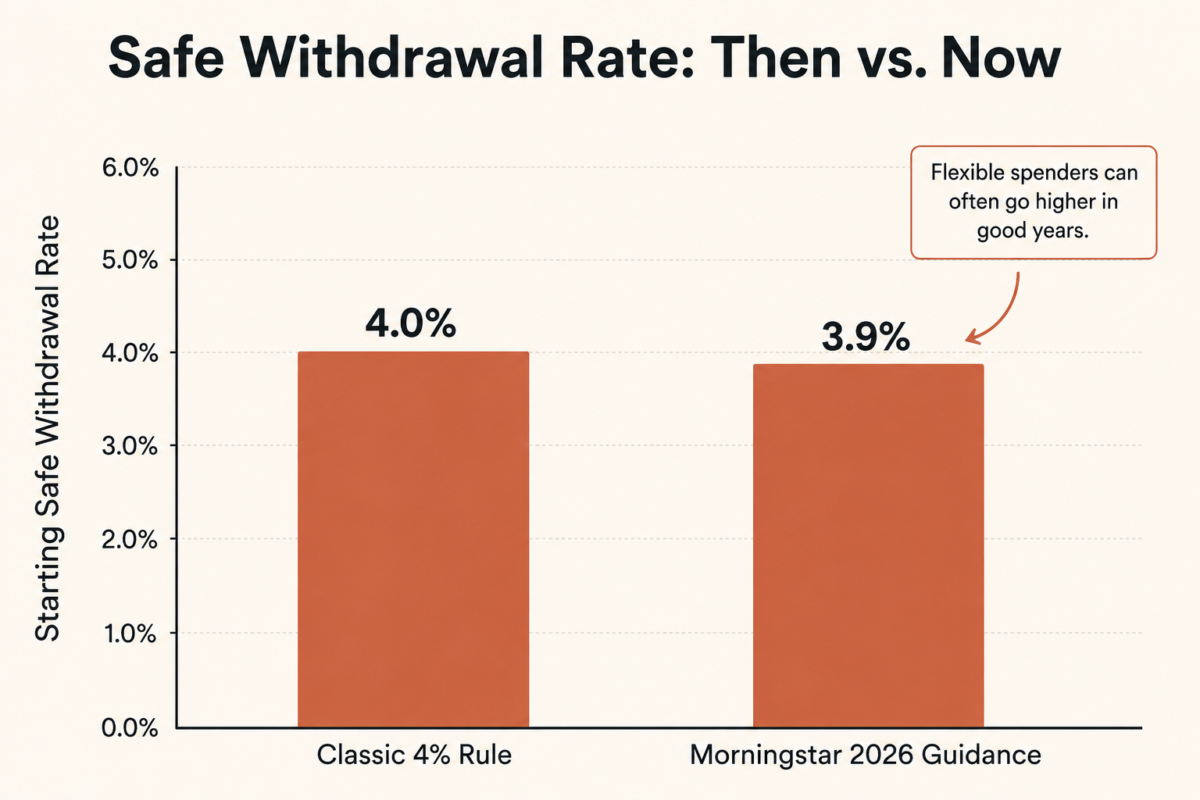
The classic rule of thumb for retirement withdrawals has always been 4%: pull 4% of your portfolio in year one, adjust for inflation each year after, and your money should reasonably last three decades. Morningstar’s 2026 guidance moved that number down slightly, to a 3.9% starting withdrawal rate, while also noting that flexible spenders, people willing to adjust spending in a down year, can often go higher.
Travel is exactly the kind of spending that can flex. Unlike a mortgage payment or a health insurance premium, a trip can be postponed, scaled back, or skipped in a year when the market has a rough stretch. That flexibility is what makes travel a reasonable place to apply a slightly higher percentage in good years, and the first place to pull back when a plan needs breathing room.
If you would rather run your own numbers than rely on someone else’s rule of thumb, this is exactly the kind of scenario modeling AI tools can help with. You can compare a few withdrawal rates against your actual portfolio and see how a bigger travel year in your 60s changes the picture ten or twenty years out, before you book anything.
The Three-Question Travel Spending Check
Rules of thumb are useful, but a specific trip still needs a specific answer. Before booking anything bigger than a weekend getaway, run through three questions.
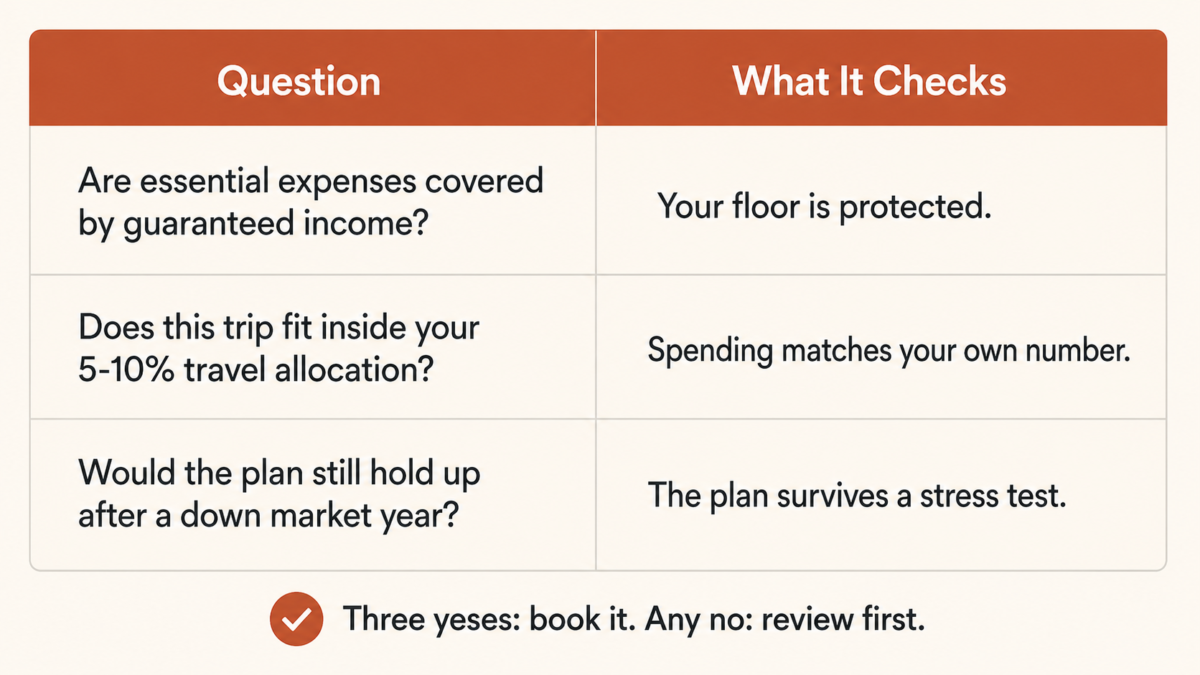
The first question is whether your essential expenses, the true floor of housing, food, insurance, and health care, are already covered by guaranteed income like Social Security, a pension, or an annuity. If that floor holds without touching your travel money, you have already cleared the biggest hurdle.
The second question is whether the trip fits inside your 5-10% discretionary travel allocation for the year. This is where the range from the last section earns its keep: add up planned travel spending for the year and check it against your own number, not a stranger’s average.
The third question is the one people skip: would your plan still hold up if this spending happened right before a down market year? Retirement plans that only work in good years are not retirement plans. They are best case scenarios.
If a trip still fits after that stress test, book it without a second thought, and if you keep waiting for a someday that never quite arrives, remember that the math will eventually stop cooperating too.
Give Yourself Permission (Without Being Reckless)
Here is the part the math alone will not fix. Even when the numbers check out, the guilt often does not disappear on its own. That gap between “the plan says this is fine” and “this still feels wrong” shows up constantly in retirement research.
Morningstar’s own research on retirement spending patterns, the same body of work behind the 2026 withdrawal rate guidance, has tracked a well documented pattern for years: retirees tend to underspend relative to what their savings can safely support, especially in the early, healthiest years of retirement.
The irony is hard to miss. People spend decades building a number specifically so they can eventually spend it, then hold onto it out of habit long after the original reason for saving has been satisfied.
A trip with your grandkids. A milestone anniversary trip. A destination you have put off for a decade. These carry a kind of value that does not show up on a balance sheet, and untouched savings do not carry forward the years or the health you need to enjoy them later.
Value based spending simply means weighing that reality honestly instead of defaulting to caution because caution feels safer in the moment.
If a trip clears the three question check but the price tag still stings, there are plenty of practical ways to bring the cost down without touching the destination itself.
When to Pull Back
Giving yourself permission to spend is not the same as ignoring the signals that spending has gotten ahead of the plan. A few warning signs are worth taking seriously.
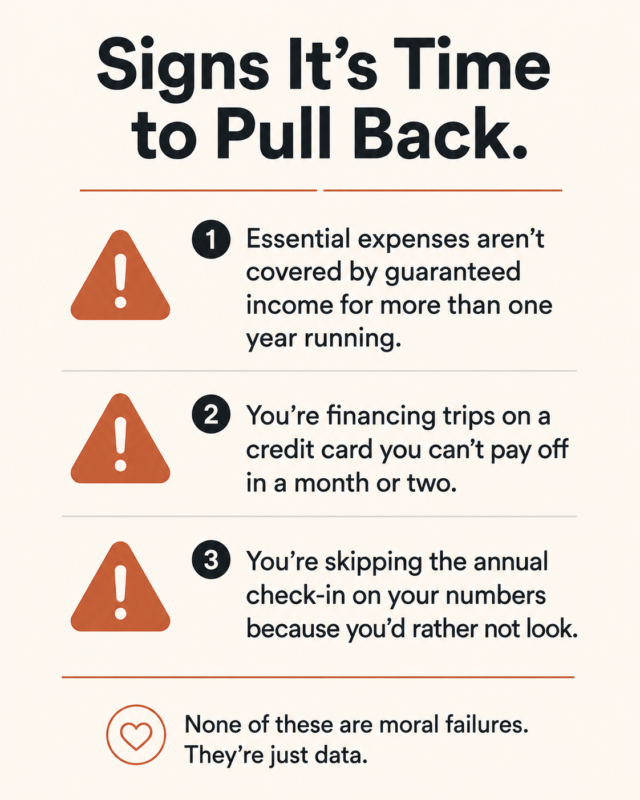
If your essential expenses stop being covered by guaranteed income for more than one year running, that is a signal to pause, not push through. The same goes for financing trips on a credit card you cannot pay off within a month or two, or skipping the annual check in on your numbers because you would rather not look. None of these are moral failures. They are just data, and data is a lot easier to act on than guilt.
Tie travel spending back to the broader, decade by decade plan, including what changes in the years right before retirement itself, and these warning signs become far easier to catch early instead of after the fact.
The Bottom Line
Travel spending in retirement is not something to feel guilty about, and it is not something to wing without a plan either. It is a line item, like any other, that either fits inside your numbers or it does not. The 5-10% guideline gives you a range. The three question check gives you a specific answer for a specific trip. Between the two, you should rarely need to guess.
If you have not calculated your own Freedom Number yet, that is the natural next step. It walks through the same math referenced throughout this post, so you end up with your own ceiling instead of someone else’s average.
What is one trip you have been putting off, not because the money is not there, but because it still feels wrong to spend it?
Frequently Asked Questions
How much should I budget for travel in retirement?
Most financial planners recommend 5% to 10% of annual retirement spending, often $10,000 to $50,000 a year depending on lifestyle and whether you are traveling solo or with family.
Will travel spending hurt my retirement savings?
Not if it is built into the plan. Travel is discretionary spending that can flex with a safe withdrawal rate, as long as your essential expenses are already covered by guaranteed income first.
What is a safe withdrawal rate for retirement in 2026?
Morningstar’s 2026 guidance puts the starting safe withdrawal rate at roughly 3.9%, down slightly from the traditional 4% rule, with room for flexible spenders to go higher in good years.
How do I know if I am ready to travel more without guilt?
Run the three question check: confirm your essential expenses are covered by guaranteed income, confirm the trip fits inside a 5-10% discretionary travel allocation, and confirm the plan still holds up after a down market year.
Should I use my Freedom Number to plan travel spending?
Yes. Your Freedom Number sets the ceiling for total spending, so travel works best as a percentage of that number rather than a decision made trip by trip. If you have not worked out yours yet, the Freedom Number framework is the place to start.