

Table of Contents
Most people hear about AI every single day. New tool, new headline, new app promising to change your life. What almost nobody tells you is how to point any of it at your own money.
That is the real gap. Financial independence is not a mystery. It comes down to a handful of levers: spend less, earn more, invest the difference, and keep your options open. AI for financial independence is not about replacing those levers. It is about removing some of the friction that keeps people from pulling them consistently.
If you are 40, 50, or 60 and trying to build more freedom into the next chapter, you do not need another app that tracks your latte spending. You need a way to see your money clearly, find the leaks, test a few income ideas, and make calmer decisions about the big tradeoffs. That is what this guide is for.
Here are seven practical ways to use AI for financial independence, plus the safety rules that keep it from becoming a liability instead of a tool.
Please note this page may contains affiliate links. If you purchase something through these links, I’ll receive a commission at no extra cost to you. Affiliate links help to support my website/blog and I only recommend products I love.
What AI for Financial Independence Actually Means
Using AI this way means treating it like a thinking partner, not a financial advisor. It can organize information, summarize patterns, compare scenarios, and help you ask better questions. It cannot guarantee a return, predict the market, or replace a licensed professional when the stakes are high.
That distinction matters more than any specific tool. A chatbot is good at structure and speed. It is not good at judgment calls that depend on your full financial picture, your risk tolerance, or your state’s tax rules. Treat it like a sharp assistant who has never met you and has no license to give advice, because that is exactly what it is.
How can AI help with financial independence? AI can help with financial independence by organizing spending, spotting patterns, brainstorming income ideas, comparing tradeoffs, and turning a vague goal into a clear next step. It works best as a planning assistant, not a financial advisor, and any investment, tax, legal, or debt guidance should still be verified with a trusted professional.
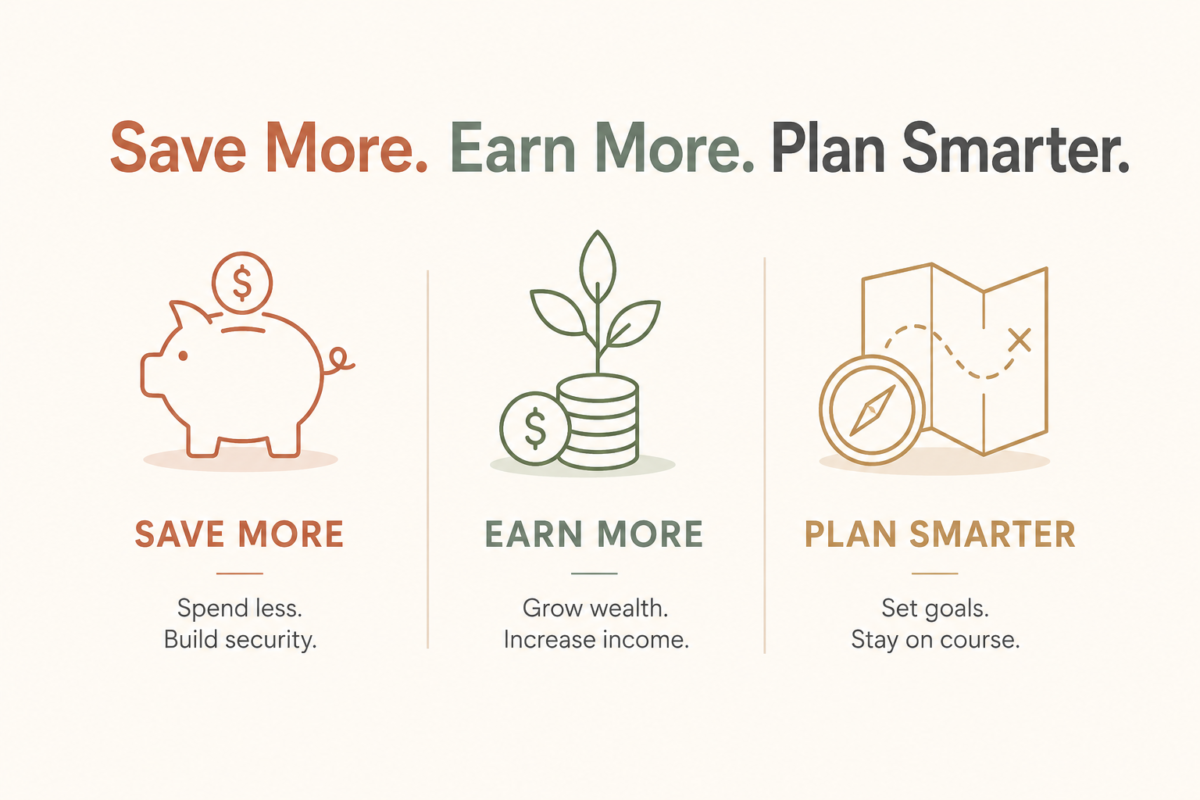
How AI Can Help You Save More
Saving more is the lever most people try first, and it is also the one where AI quietly earns its keep. The trick is feeding it the right kind of information without handing over anything sensitive.
Find Your Spending Leaks Without the Shame Spiral
You do not need to connect your bank account to get value here. Pull your last two or three months of spending into rough categories yourself: groceries, subscriptions, dining out, transportation, whatever applies. Then hand AI a prompt like this: “Here are my monthly spending categories and rough totals. Where might I be leaking money, and what questions should I ask myself about each one?”
You will usually get back a list of the obvious suspects: subscriptions you forgot you had, recurring charges that crept up, categories that grew without you noticing. None of it is magic. It is just a second set of eyes that does not get tired of looking at a spreadsheet, applied the way AI shows up in everyday life for plenty of other small, repetitive tasks.
Build a Savings Plan You Will Actually Stick To
Once you know where the leaks are, AI is useful for turning a fuzzy goal into something concrete. Instead of “I should save more,” try: “I want to save an extra $300 a month. Here are three ways I could find that money. Help me compare the tradeoffs of each.”
Keep the comparisons conservative. AI is decent at laying out options side by side. It is not reliable at predicting exactly how much a change will save you over time, so double check any math with a calculator or a tool you trust.
How Can AI Help You Earn More
Saving only gets you so far. At some point, financial independence depends on the income side of the equation too, and this is where a lot of people freeze up.
AI is genuinely useful here because it is good at brainstorming without judgment. Ask it for income ideas based on your actual skills, schedule, and energy level, not generic “side hustle” listicles. A prompt like “Based on these skills and this much free time per week, give me ten realistic income ideas sorted by effort level” tends to produce a far more useful list than scrolling another roundup article.
Sort what comes back into categories: low effort, skill building, local service, digital product, freelance work. Then throw out anything that smells like guaranteed income, high pressure investing, or “easy money.” If an idea sounds too good to be true coming from a chatbot, it is exactly as true as it would be coming from anyone else. This kind of brainstorming pairs well with thinking through how to reinvent yourself after 40, since a lot of new income ideas start with the same identity questions a career pivot does.
How AI Can Help You Plan Smarter
The biggest financial decisions rarely come down to one number. Should you pay off debt or save more aggressively? Relocate to cut your cost of living? Go part time? Delay retirement by a year? These are the decisions where AI for financial independence earns its place, not by making the choice for you, but by helping you see it clearly.
Ask AI to lay out the risks, the assumptions baked into each option, and the questions you still cannot answer on your own. Use it for decision preparation, not the decision itself. If you are wondering whether it’s too late to start over in your 50s, this kind of structured comparison can make the conversation with yourself, or with a partner, a lot less circular.
This same approach works well if you are mapping out what to do in the years before retirement. AI cannot tell you when to retire. It can absolutely help you organize the pile of variables, savings rate, expected expenses, healthcare costs, part time income, so the decision feels like a plan instead of a guess.
Use AI Safely: Privacy, Scams, and Bad Advice Rules
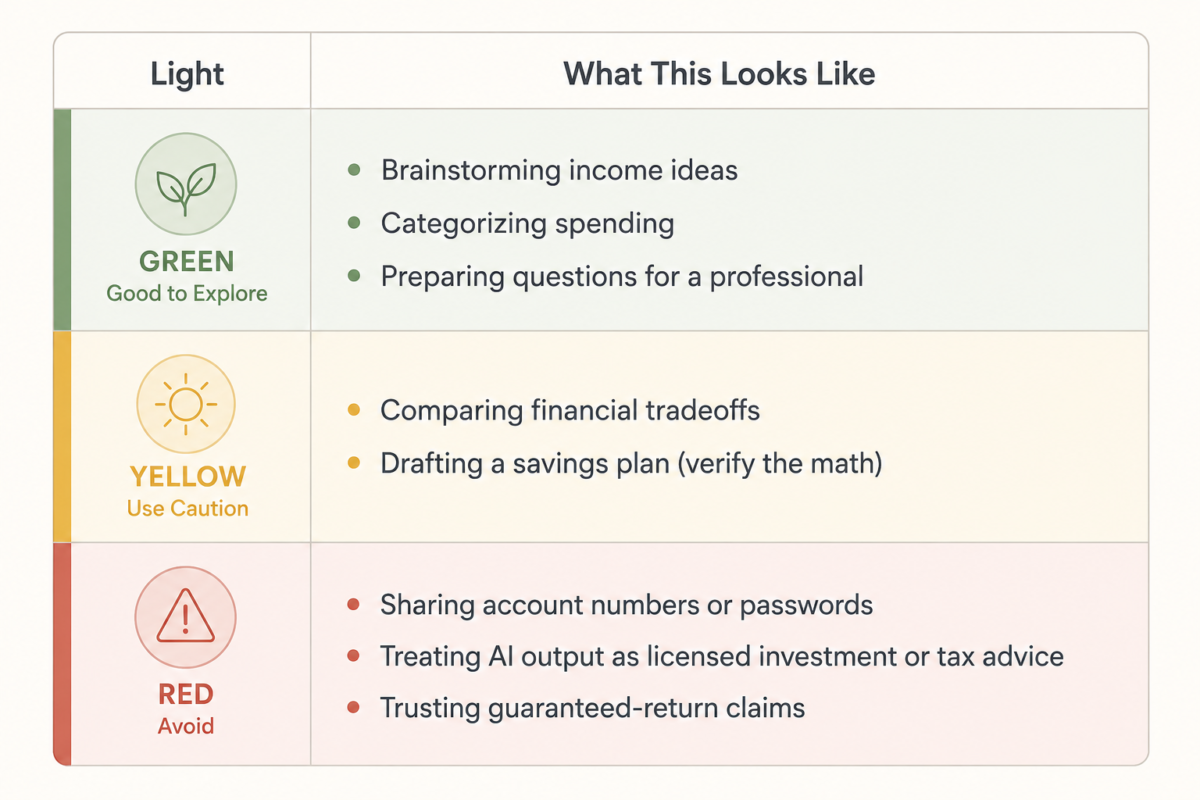
None of this works if you trade convenience for risk you didn’t sign up for. A handful of rules keep AI useful instead of dangerous when money is involved.
Do not feed AI tools your account numbers, passwords, full bank statements, tax documents, or Social Security number unless you fully understand the privacy settings of that specific tool. Investopedia has flagged growing concern over AI tools that ask users to link financial accounts directly, since that convenience comes with real privacy tradeoffs (Investopedia, 2024).
Never treat AI as your only source for investment, tax, legal, or debt advice. A 2023 study testing chatbots like ChatGPT and Bard on real personal finance questions found their answers fluent and plausible, but with critical gaps in accuracy, which is a dangerous combination when real money is on the line (Lakkaraju et al., 2023). Watch for AI washing too: fake AI investment tools, deepfake celebrity pitches, and guaranteed-return claims that use the word “AI” to sound credible. Regulators have already fined investment firms for misleading AI claims, which tells you how common the problem has become (Reuters, 2024).
The safest habit is using AI to generate better questions for your financial professional rather than replacing them. That single shift turns a risky shortcut into a genuinely useful prep tool.
A Simple 30-Day Starter Plan
You do not need to overhaul your entire financial life this weekend. A slower, steadier rollout works better and is a lot less overwhelming.
In week one, clean up your spending categories and ask AI to help you spot three likely money leaks. In week two, build a small savings sprint and pick one debt or emergency fund action to pair with it. In week three, brainstorm income ideas and choose exactly one small test to try, nothing bigger. In week four, run one real life planning scenario, the debt versus savings question, the relocation question, whatever applies to you, and walk away with a short list of questions for a professional or a trusted source.
By the end of the month, you will not have solved financial independence. You will have a clearer picture of your money, a tested idea or two, and a shorter list of real questions instead of a long list of vague worries. That is genuine progress, even if it does not feel dramatic.
The Bottom Line
AI will not hand you financial independence. It will not save the money, earn the income, or make the hard call for you. What it can do is clear away some of the noise: organize your spending, surface a few real income ideas, and help you ask sharper questions before a big decision. That is not nothing. For a lot of people, the gap between “stuck” and “moving” is exactly that kind of clarity.
Start with one piece of this guide. Clean up a single spending category, or ask AI to brainstorm three income ideas based on what you already know how to do. Small, specific moves add up faster than another all-or-nothing plan that never gets started.
Grab a copy of our FREE AI Starter Guide for People Over 40
What is the one financial decision you have been putting off because you were not sure how to even start thinking about it?
Frequently Asked Questions
Can AI help me become financially independent?
AI can help you organize information, spot patterns, brainstorm income ideas, and build action plans. It cannot guarantee wealth or do the actual saving, earning, and investing for you. Think of it as a planning partner, not a shortcut.
Is ChatGPT safe for personal finance?
It can be useful for general budgeting and planning prompts, but be careful about what you share. Avoid account numbers, passwords, tax documents, and full bank statements unless you understand exactly how that specific tool handles your data.
Can AI give investment advice?
AI can explain investing concepts and help you prepare smarter questions, but it should never be treated as a licensed financial advisor. Verify anything important with a qualified professional or a source you trust.
What should I use AI for first if I want financial independence?
Start small. Categorize your spending, identify a recurring expense you forgot about, build one savings sprint, or brainstorm a single income idea. One low risk task is enough to get started.
What are the biggest risks of using AI for money decisions?
The biggest risks are privacy exposure, confidently wrong answers, overreliance, and fake AI investment tools designed to look legitimate. Treat anything involving real money as a draft to verify, not a final answer.