

Table of Contents
Something changed the day I stopped using the free version of ChatGPT.
I had been dabbling with it the way most people do. Typing vague questions, getting vague answers, wondering what the fuss was about. I knew there were handy ways to use AI in everyday life, but I wasn’t seeing the massive leverage everyone was talking about. Then version 3.5 came out and I paid the $20 monthly subscription. Not because I had a plan. Because I figured if money was on the line, I’d actually take it seriously.
That’s when I figured out how to use AI to reinvent yourself after 40 in a way that does something real. The shift was learning to prompt with a role and context instead of just typing a question like it was Google. The responses got specific. They got useful. They started to feel like talking to someone who knew what I was asking and why.
What I’ve learned since then has changed how I work and, honestly, what I’m clear about regarding what I want. I’m going to show you exactly how.
Please note this page may contains affiliate links. If you purchase something through these links, I’ll receive a commission at no extra cost to you. Affiliate links help to support my website/blog and I only recommend products I love.
Why AI Feels Different After 40 (And Why That’s an Advantage)
There’s a stat that surprised me. PwC’s 2025 Global Workforce Survey found that 34% of older workers cite “I don’t know how to use it” as their reason for skipping AI. That’s double the rate of Gen Z at 14%.
The people with the most to gain from AI tools for midlife reinvention are the least likely to be using them.
| How Workers Feel About AI | Data | Source |
|---|---|---|
| Older workers who say “I don’t know how to use it” | 34% | PwC, 2025 |
| Gen Z workers who say the same | 14% | PwC, 2025 |
| U.S. workers worried about AI’s impact on their future | 52% | Pew Research, 2025 |
| Daily AI users who report significant productivity gains | 92% | PwC, 2025 |
| Infrequent AI users who report the same gains | 58% | PwC, 2025 |
Here’s the thing people miss. AI doesn’t reward speed or technical knowledge. It rewards the ability to ask a specific, well-framed question. And that’s a skill that gets better with experience, not worse.
Compare these two prompts:
Vague: “How do I change careers?”
Specific: “Act as a career coach for someone who is 51, has 20 years in IT project management, is burned out from corporate life, and wants to build an income stream that doesn’t require showing up to an office every day. What are 3 realistic paths worth exploring, and what’s the honest downside of each?”
The second prompt gets a completely different answer. It’s specific because the person writing it has context, their age, their situation, their actual constraints. That context is exactly what most 25-year-olds don’t have yet. It’s what you’ve built over decades.
The gap isn’t age. It’s knowing how to use what you already know.
The 3-Part Prompt That Changes Everything
When I first paid for ChatGPT and started using it seriously, I still got generic responses for a while. Then I figured out the three-part structure that fixes that.
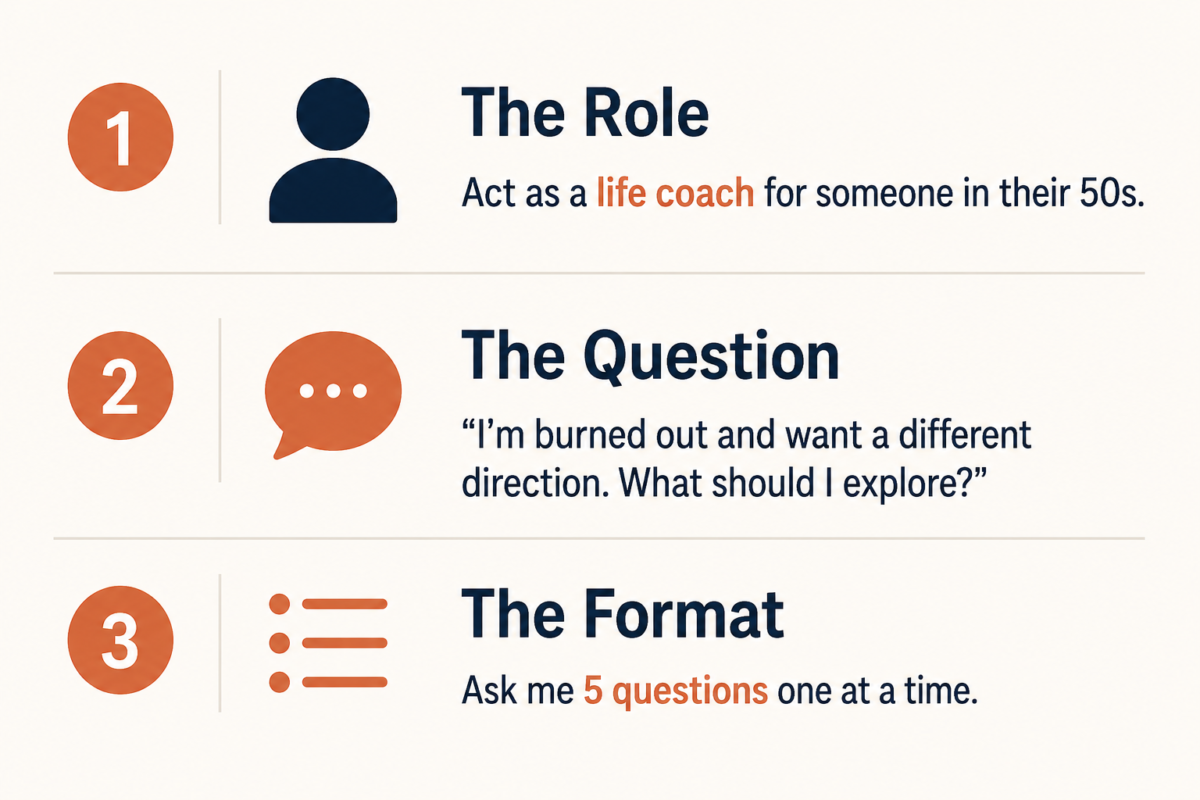
Every prompt you write should include three things:
1. The role. Tell AI who you want it to be. “Act as a financial advisor for someone who is self-employed and in their early 50s.” “Act as a life coach helping someone identify what they actually want to do next.” When you give it a role, it stays in character and the responses get more useful.
2. The question or problem. Be specific. I’m 52, I’ve been in marketing for 20 years, I’m burned out, and I want income that doesn’t require me to show up somewhere every day. What should I look at?” is better than “what should I do with my life.” The more you put in, the more you get out.
3. The format. Tell it how to respond. “Ask me questions one at a time to help me figure this out” is the format I use more than any other. That’s because it leads to the use case nobody talks about.
The Use Case Nobody Talks About
The most useful thing AI has ever done for me has nothing to do with writing, research, or getting tasks done faster.
It interviewed me.
One day I sat down with ChatGPT and typed something like:
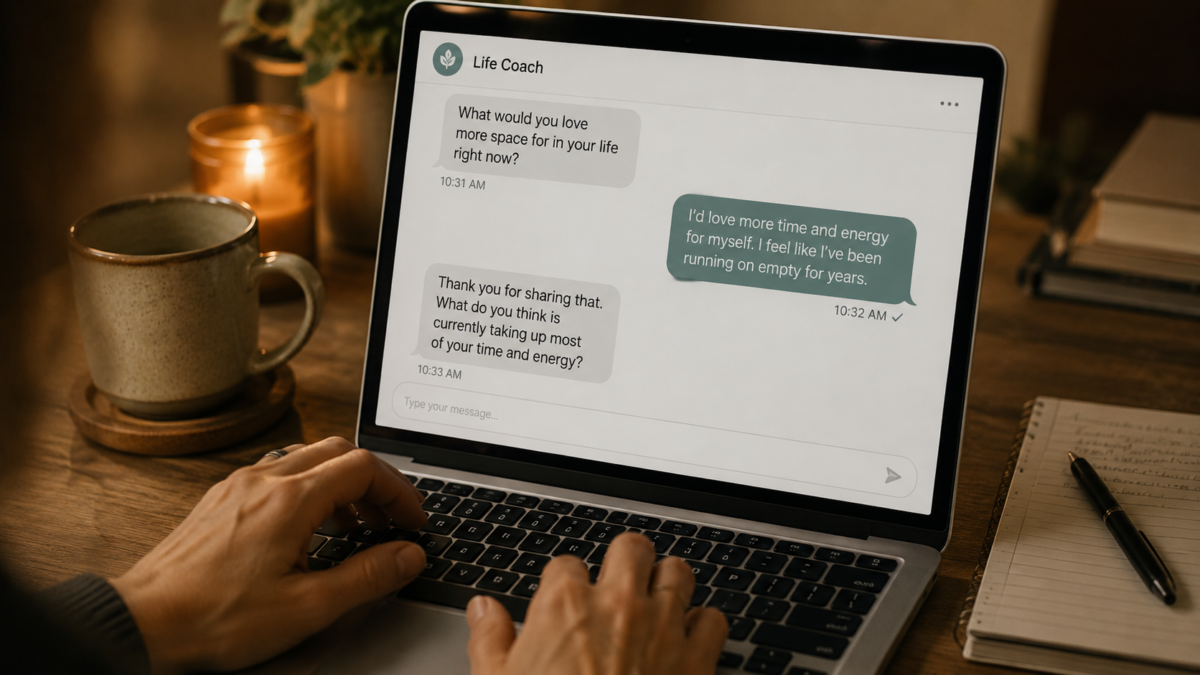
“I want to figure out what I actually want my life to look like in 5 years. Ask me questions one at a time to help me get clear on that. Don’t ask the next question until I’ve answered the current one.”
What happened over the next hour was surprising. The questions built on my answers. They pushed me to be specific where I usually stay vague. And things surfaced that had been sitting unexamined for a long time.
One of them: I realized I had been waiting on conditions that weren’t going to change. I was frustrated about not getting help with the content side of my business, and that frustration was slowing me down more than the actual workload was. The AI questions helped me see that I was treating a solved problem like an unsolved one. Once I named it, I stopped waiting.
That’s what I mean by using AI to reinvent yourself after 40. Not replacing your thinking. Extracting it. If you have ever wondered why people over 40 reinvent their lives, it rarely starts with a grand, cinematic plan. It usually starts with that exact feeling of needing to extract the truth that has been sitting unexamined for years.
If you’ve ever felt stuck, like you know you want something different but can’t quite name it, try this. Tell AI: “I’m at a point in my life where I want to make some real changes. Ask me questions one at a time to help me figure out what I actually want. Start with the first question.”
Answer honestly. See what comes up.
It won’t do the reinvention for you. But it might help you finally name what you’re reinventing toward. And if you want to go deeper on that, this post on setting purposeful goals is a solid companion read.
How to Use AI for Research Without Getting Overwhelmed
The other area where AI has saved me real time is research, specifically the kind where I don’t even know what questions to ask yet.
I’ll give you a concrete example. When I wanted to understand how affiliate marketing actually works for someone running a blog, I didn’t search for “affiliate marketing tutorial.” I told ChatGPT:
“Act as someone who has been running a successful affiliate marketing blog for 5 years. I’m just starting out and have no background in this. Explain how affiliate marketing actually works, what the realistic income timeline looks like for a beginner, and tell me the 3 biggest mistakes people make in the first year.”
That’s a completely different experience than reading ten different articles. I got a specific answer to my specific situation without having to synthesize ten different perspectives myself. I could fact-check the details I wanted to verify and move on.
You can do this with anything you’ve been too overwhelmed to explore, careers, investments, health topics, how to start a YouTube channel. The “it’s too complicated” feeling usually disappears once you’re talking about something instead of trying to read your way through it.
And if the bigger question underneath all of this is whether it’s actually too late to change course, I wrote an honest answer to that here.
The One Thing Most AI Content Won’t Tell You
I’ll say the thing most AI articles skip.
AI makes things up sometimes.
It’s called hallucination. You ask a specific question, AI gives you a confident, detailed, completely wrong answer. Not constantly. But often enough that you need to know about it before you start making real decisions based on what it tells you.
I’ve caught it. A statistic that turned out to be fabricated. A description of a product or program that didn’t work the way it was described. The response was specific and confident. It was also wrong.
The fix is straightforward: fact-check anything that matters before you act on it. Statistics, program details, claims about specific products or services, go verify from the original source. Treat AI as a starting point for thinking and research, not the final word.
This doesn’t mean AI isn’t useful. It means you use it the same way you’d use a smart friend who reads a lot but occasionally misremembers details. You trust the framework. You verify the specifics.
Your First 30 Minutes with AI
Here’s the practical on-ramp if you want to actually start, not just think about starting.
Open ChatGPT. The free version works. The Plus subscription at $20 a month gives you better responses once you figure out prompting, it’s worth it when you get there.
Type this:
“Act as a life coach helping someone who is [your age] and feeling stuck in their current life. They want to figure out what they actually want the next 5 years to look like. Ask me one question at a time to help me get clear on what I want. Start with the first question.”
Answer it honestly. See what happens.
When you want to go beyond that, remember the three-part structure: role, question, format. That framework will get you through most of what you need without any additional training.
The World Economic Forum projects that 39% of current skill sets will be outdated or transformed by 2030. I’m not putting that statistic here to scare you. I’m putting it here because the people who figure out AI tools for midlife reinvention now will have a head start that compounds over the next several years. And the people who wait will have a harder ramp at a worse time.
Thirty minutes today changes what your next year looks like. That’s not motivational language. It’s just the math of getting started earlier.
If you want to read more about why we stopped waiting on “someday” to start designing a different kind of life, that post goes deeper on the thinking behind this.
The Bottom Line
Using AI to reinvent yourself after 40 is a skill. You build it by using it.
What it does well is help you think clearly when you’re stuck, research efficiently when you’re overwhelmed, and pull things out of your own head that you’ve been circling around for years. That’s a lot. Those are real problems it can help with.
What it won’t do is replace your judgment. Keep that in the loop. Fact-check anything important. And when AI gives you an answer you’re going to act on, verify it.
But if you’re over 40 and wondering whether AI has something real to offer you, practically, this week, in your actual situation, the answer is yes. You just have to know how to ask.
At the end of the day, that’s all this is. Knowing how to ask.
Have you tried using AI to figure out what you actually want next? Or is there something specific that’s been stopping you from starting? Leave a comment, I’m curious what the real barrier is for people in this space.