

Table of Contents
There was a moment a few years ago when my wife and I looked at each other and said, “We can’t keep doing this the way we’re doing it.”
We wanted to travel more. We knew that. But every time we started adding up the cost of a real trip, our current expenses made it feel impossible. The house, the bills, the whole structure of the life we had built was eating every dollar before travel even got a seat at the table.
For anyone who has been trying to figure out how to afford travel in your 50s without gutting your savings or waiting until retirement, this article is for you. I’m not going to hand you a list of senior discounts or tell you to book flights on a Tuesday. This is about the bigger picture and what actually worked for us over the past three years.
Please note this page may contains affiliate links. If you purchase something through these links, I’ll receive a commission at no extra cost to you. Affiliate links help to support my website/blog and I only recommend products I love.
Why Most People Never Afford the Travel They Want
The problem is not income. Most people I talk to who want to travel more are not poor. They are paying for a life that doesn’t match what they actually want.
The house is bigger than they need. The subscriptions, the car payments, the eating out, the stuff. It all adds up to a lifestyle overhead that leaves nothing left for experiences.
And then there is the someday thinking. “We’ll travel when the kids are grown.” “We’ll go when I retire.” “We’ll do it when we have more money.” If you have caught yourself in that loop, I wrote about exactly why that thinking costs you so much in The Someday Trap: Why We Prioritized Travel Before Retirement.
The truth is, if travel isn’t already built into how you spend money, it won’t magically appear later. You have to make the decision before the money is there, not after.
What the Freedom Budget Actually Is (It’s Not What You Think)
A lot of people hear the word “budget” and picture restriction. Like you’re going to start clipping coupons so you can afford a cruise every three years.
That’s not what this is.
The freedom budget is not about squeezing harder on your current life. It’s about designing a different life, one where what you actually value shows up in how you actually spend money. For us, that meant travel and experiences had to be a real line item, not an afterthought that gets whatever is left over at the end of the month (which is usually nothing).
It’s a mindset shift before it’s a spreadsheet. The numbers follow the decision. If you’ve never made the decision, no amount of budgeting will get you there.
What We Cut, Including the Hard Stuff
I’ll be real with you. We sold the house.
That was the biggest move. We had a garden we loved, chickens, a hot tub, the whole setup. It was a little hard to leave behind. But honestly, it wasn’t as painful as I expected.
I think the reason for that is simple. We kept our eyes on what we were building toward, not on what we were walking away from. When you are focused on the future you want instead of the comfort you’re leaving behind, the hard choices get easier to make.
Here’s roughly what the redesign looked like for us:
- Sold the house and reduced housing costs significantly
- Downsized our possessions (you’d be surprised how little you miss most of it)
- Cut lifestyle overhead that was serving the old version of our life, not the new one
- Made a consistent choice to prioritize experiences over material items
The goal was not to live worse. The goal was to redirect money from things that didn’t matter to us toward things that do.
If you’re thinking about starting that process, our journey to intentional living covers the mindset behind it in more detail.
How to Afford Travel in Your 50s: The Income Side
Cutting expenses gets you halfway there. The other half is making sure money is actually flowing in, and that you’re making the most of what’s already going out.
Here is how we handle the income side of the freedom budget.
Travel rewards are a serious force multiplier. If you are not using a travel credit card as your primary spending card, you are leaving real money on the table every month. We run most of our everyday spending through travel cards, and over the course of a year, that adds up to flights, hotel nights, and onboard credits that would have otherwise cost us real cash.
The couples strategy matters. Each partner holding a different travel card and combining points can get you to a free round-trip faster than most people realize. The Chase Sapphire Preferred and the Capital One Venture Rewards Card are two of the best starting points for this. Pay them off monthly, treat them like debit cards, and let the points stack.
For international trips, we also carry World Nomads travel insurance because original Medicare stops at the US border and evacuation coverage is not optional in our opinion.
But the bigger play, the one most people aren’t talking about, is building an income that travels with you.
My wife and I are building a content business (this blog, our YouTube channel, a podcast, and our Substack) that is designed to be location-independent. It doesn’t fully fund our travels yet. But the direction is clear. The goal isn’t to retire and then travel. The goal is to build something that lets you work and travel at the same time.
That changes the whole math of how to afford travel in your 50s. Instead of drawing down savings, you’re building toward something that funds the lifestyle long-term.
I wrote more about that philosophy in Why I Chose a Freedom Lifestyle Instead of Retirement.
What 3 Years of the Freedom Budget Has Actually Funded
Here is the proof that this works.
Since redesigning our life around the freedom budget, we have taken one big international trip every year and several cruises on top of that. That is not a rich-person lifestyle. That is a deliberately designed one.
And we’re not alone in wanting this. The data on travel among people in our age group is clear.
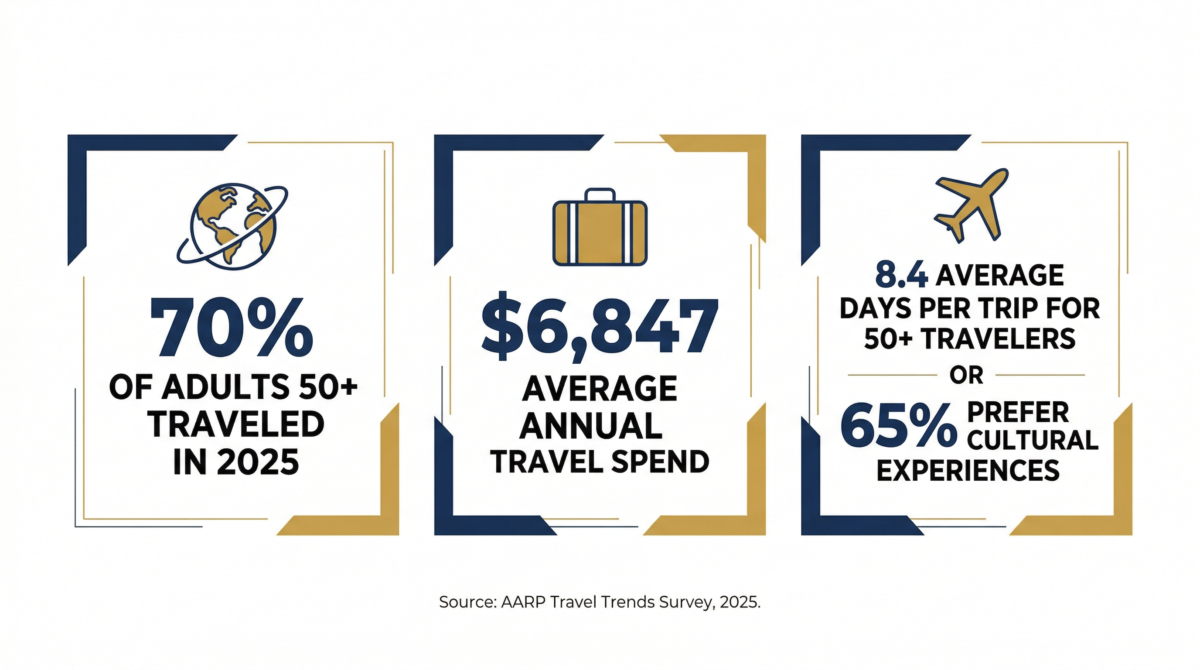
| The Travel Picture for Adults 50+ | |
|---|---|
| Adults 50+ who planned trips in 2025 | 70%, up from 65% in 2024 (AARP Travel Trends Survey) |
| Average travel spend for adults 50+ | $6,847 per year (AARP, 2025) |
| Annual leisure travel spend by Americans 50+ | Over $236 billion (AARP) |
| Baby Boomers’ planned travel spend in 2025 | $12,462, up 52% over 2024 (Beach.com Travel Survey) |
| Extra savings needed to fund $10K/year in travel via 4% rule | $250,000 (GoBankingRates / Yahoo Finance, 2024) |
That last number is why building travel into your life now (through a redesigned budget and growing income) beats waiting to fund it from retirement savings. If you need $250,000 set aside just to spend $10K a year on travel in retirement, the math is a lot friendlier when you build the habit while you’re still earning.
How to Build Your Own Freedom Budget (Starting This Week)
You don’t have to sell your house to start. Here is a stripped-down version of the framework you can begin right now.
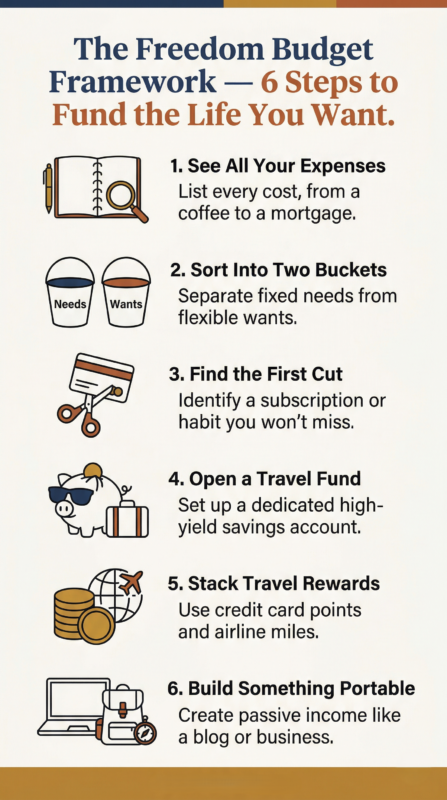
- List every monthly expense. No judgment, just visibility. You can’t redesign what you can’t see.
- Sort into two buckets. Expenses that serve the life you want, and expenses that serve the life you used to want (or someone else’s idea of what your life should look like).
- Find the first cut. There is always something in bucket two that you won’t miss. Start there.
- Open a dedicated travel fund. Even a small amount each month makes a difference. The psychological effect of watching it grow is real.
- Stack travel rewards on top. Set up a travel card for everyday spending, pay it off in full monthly, and let the points work.
- Start building something portable. A side income that could eventually be run from anywhere changes the long-term equation in a way that expense-cutting alone never will.
This process takes time. But after three years, it has given us a life we used to think required either being rich or waiting until 65.
Final Thoughts: The Budget Is Not the Point
The freedom budget is infrastructure. It is not the goal.
The goal is the Tuesday afternoon in a coastal town somewhere, no meeting on the calendar, nowhere you are required to be. The goal is a life where work and travel coexist instead of compete. The goal is getting to your 60s and looking back at your 50s without regret.
The budget is just the tool that gets you there.
If you are sitting in a comfortable but unsatisfying life right now, I want to be real with you: it takes an actual decision to change it. It is not a small tweak. But it is also not as painful as you think it will be, especially when you stay focused on where you are going.
What is the biggest thing standing between you and building a travel budget that actually works for your life? Drop it in the comments. I read every one.