

Table of Contents
A financial planner in California asked ChatGPT to check a client’s tax return as a sanity test. The tool looked at roughly $2 million in income and came back with a tax bill of $26 million. Not a typo. Not a rounding error. A confident, fully formatted answer that was wrong by a factor of thirteen, as CNBC reported in March 2026.
That is the trouble with AI and money. It never sounds unsure. It writes in the same calm, complete-sentence tone whether it is right or catastrophically wrong, and most of us have no built-in way to tell the difference until the damage is done.
If you are 45, 55, or 62, that matters more than it did at 25. A twenty-something with a bad AI-generated tax answer has decades to earn the money back. You may not. This post walks through the specific AI money mistakes worth avoiding: where AI genuinely helps, where it quietly gets people into trouble, and how to tell the two apart before it costs you.
Please note this page may contains affiliate links. If you purchase something through these links, I’ll receive a commission at no extra cost to you. Affiliate links help to support my website/blog and I only recommend products I love.
Can you trust AI with your money? AI can help you draft a budget, explain financial terms, or prepare questions before meeting an advisor, but it should never be trusted with tax filing, investment picks, retirement withdrawal rates, or any decision requiring your full financial details. AI has no fiduciary duty and can sound confident while being wrong.
The AI Money Mistakes Hiding Behind a Confident Answer
Every large language model has the same core flaw when it comes to money. It is optimized to sound fluent, not to be correct. Ask it a tax question and it will answer in the same authoritative voice whether it pulled the right rule or an outdated one. There is no built-in warning light.
That is a different problem than most people assume. It is not that AI is bad at finance the way a calculator would be bad at poetry. It is that AI is good enough, often enough, that people stop double-checking it. A wrong answer delivered with total confidence is more dangerous than an obviously bad one, because nothing about the tone tells you to be suspicious.
We have written before about our full walkthrough on using ChatGPT for everyday money questions, and most of that use case is genuinely fine. Budgeting drafts, expense categorizing, explaining what a Roth conversion actually means: AI handles these well because getting them slightly wrong doesn’t cost you anything real. The mistakes below are different. They involve decisions where a wrong answer is expensive, hard to reverse, or both.
Where AI Fails on Your Taxes
Mistake #1: Letting AI File or Double-Check Your Return
The $2 million to $26 million miscalculation above wasn’t a one-off glitch. CBS News reported in 2026 that tax professionals are seeing a pattern of AI tools confidently producing wrong numbers, outdated deduction rules, and misapplied brackets, then presenting all of it with the same polished certainty as a correct answer.
Here’s the part that matters most: you are still legally liable for every number on your return, regardless of what generated it. The IRS does not accept “the chatbot told me” as an excuse for an error. If you use AI to explain a concept before you file, that’s low risk. If you use it to calculate your actual liability or double-check a preparer’s work, you are trusting a tool with no accountability for getting it wrong.
Mistake #2: Assuming Its Tax Answers Are Current
Tax law changes every year, sometimes mid-year. AI models are trained on data with a cutoff date, and depending on the tool, that cutoff can be a year or more old. CNBC’s reporting on AI tax pitfalls found the tools frequently cite thresholds, deduction limits, or filing rules that were accurate for a previous tax year and present them as if they still apply.
The fix here is simple and doesn’t require giving up AI entirely. Use it to understand what a term means or how a rule generally works. Don’t use it as your source for this year’s exact numbers. A five-minute check against the current IRS.gov page or your preparer’s software closes this gap completely.
Where AI Fails on Investing and Retirement Money
Mistake #3: Asking AI How Much to Keep in Emergency Savings
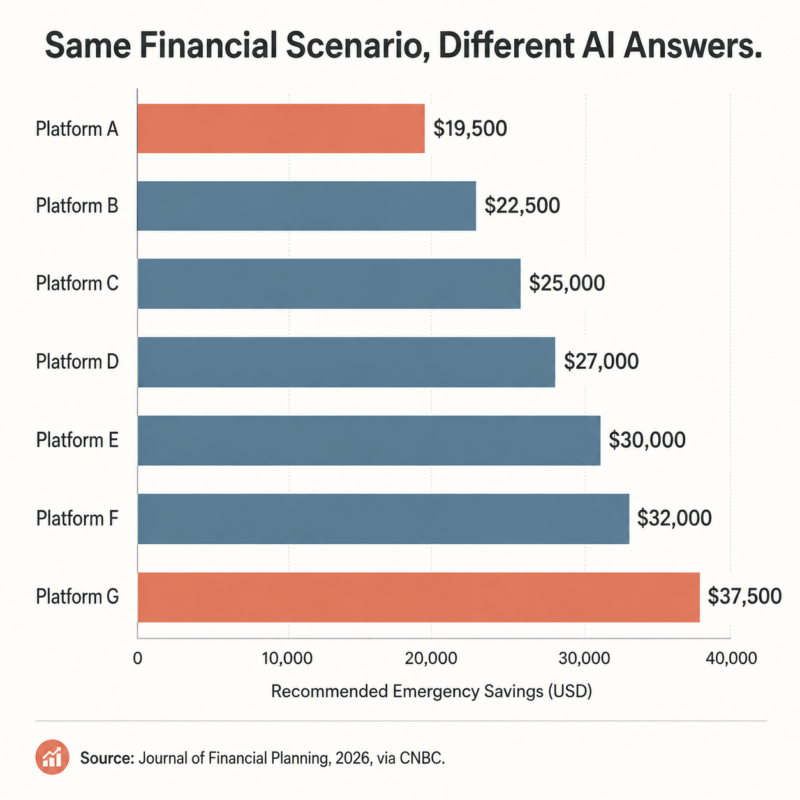
This is the mistake most people don’t see coming, because it looks like a harmless, generic question. A 2026 study published in the Journal of Financial Planning, conducted by researchers at the University of Rome Tor Vergata and the University of Georgia, tested seven major AI platforms with identical financial scenarios and varied only the implied race and gender of the person asking.
The recommended emergency savings amounts ranged from $19,500 to $37,500 for the same income, same expenses, same household situation, according to CNBC’s July 7, 2026 report. Nearly double, depending on details that should never have factored into the math at all. If you’ve asked an AI tool “how much should I have saved,” the number it gave you may reflect something closer to bias than sound financial planning.
Mistake #4: Asking AI to Pick Investments or Set Your Withdrawal Rate
A Certified Financial Planner has a fiduciary duty, a legal obligation to act in your best interest. AI has none. It can explain what a withdrawal rate is or summarize the arguments for and against a 4% rule, and it does that reasonably well. What it cannot do is weigh your specific tax situation, your spouse’s pension, your risk tolerance after a bad year in the market, and your actual retirement date the way an advisor bound by fiduciary duty would.
We’ve covered how AI can support a financial independence plan in more detail, and the short version is the same one that applies here: AI is a strong research assistant for this kind of decision and a poor substitute for the person who is legally accountable for getting it right.
Where AI Becomes a Fraud Risk, Not Just a Bad Guesser
Mistake #5: Trusting Investment Tips It Generates Unprompted
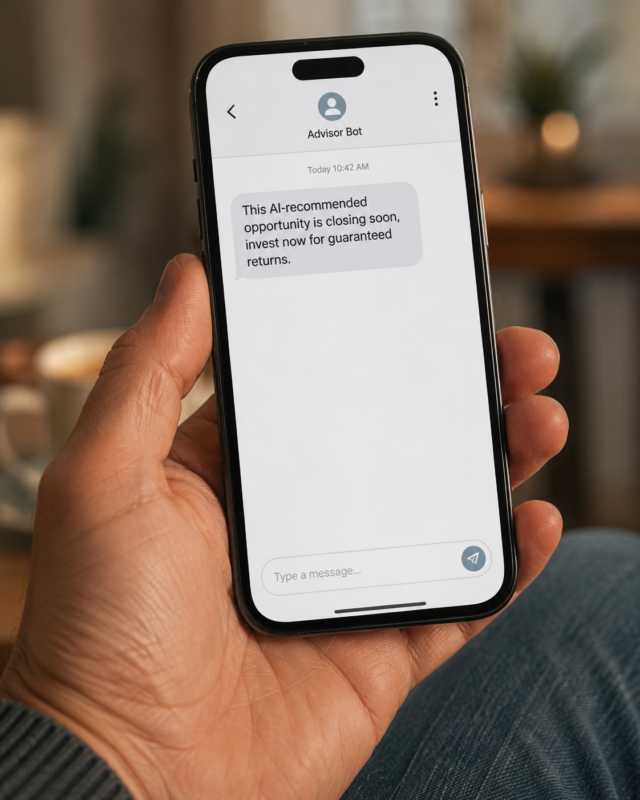
There’s a difference between asking AI a question and an AI tool, or a bad actor using AI, pushing an answer at you that you didn’t ask for. FINRA has published specific warnings about AI-generated investment fraud, including chatbots and social media content engineered to recommend specific stocks, coins, or “opportunities” with the same confident tone as a legitimate financial explanation.
The tell is usually the specificity. A tool explaining what an index fund is in general terms is doing its job. A tool, or a message claiming to be from one, telling you to put money into a named ticker or a private opportunity right now is behaving like a tip sheet, not an educational assistant, and tip sheets are exactly where investment fraud usually starts.
Mistake #6: Trusting an AI-Generated “Advisor” Video or Voice
This is the mistake that has genuinely surprised even cautious people. The SEC’s Investor.gov has issued alerts specifically covering AI-generated deepfake videos of real financial figures and fabricated “advisors” recommending investments that don’t exist. FINRA has documented the same pattern with cloned voices used in scam calls.
If this sounds familiar, it should. It’s the same underlying technology behind the deepfake scams targeting grandparents and older adults with a fake grandchild’s voice, which we’ve written about in detail. The money version works the same way: a familiar face or voice, total confidence, and a request that only makes sense if you don’t stop to verify who you’re actually talking to.
The One Money Mistake That Has Nothing to Do With Accuracy
Mistake #7: Typing Your Full Financial Picture Into a Chat Window
This last one isn’t about AI being wrong. It’s about what happens to the information after you hit enter. FINRA’s guidance on AI and data privacy notes that most consumer AI chat sessions are stored, and depending on the platform and its settings, that data can be reviewed by employees, used for model training, or exposed in a breach.
A simple rule solves this one completely: never type your account numbers, Social Security number, full birthdate, or login credentials into an AI chat, no matter how conversational or private it feels. Ask the question in the abstract instead. “What’s a reasonable savings rate for someone earning $85,000” gets you the same useful answer as typing in your actual account balance, without creating a record of your financial details sitting on someone else’s server.
| AI Money Mistake | Why It’s Risky | What to Do Instead |
|---|---|---|
| Letting AI file or double-check your taxes | You remain legally liable for every number | Use tax software or a licensed preparer to finalize your return |
| Assuming its tax answers are current | Training data can lag a year or more behind current law | Confirm specifics against IRS.gov or your preparer |
| Asking AI your emergency savings target | Recommendations varied by $19,500 to $37,500 based on bias, not math | Use a fixed formula (3 to 6 months of expenses) instead of an AI-generated number |
| Asking AI to pick investments or a withdrawal rate | AI carries no fiduciary duty | Bring the decision to a CFP who is legally accountable |
| Trusting unsolicited investment tips | A common vector for AI-generated investment fraud | Treat unprompted “opportunities” as a red flag, verify independently |
| Trusting an AI-generated advisor video or voice | Deepfake videos and cloned voices are documented scam tools | Verify through a second, known channel before acting |
| Typing your financial details into a chat | Sessions can be stored, reviewed, or exposed | Ask questions in the abstract, keep account numbers out entirely |
What AI Is Actually Good for With Your Money
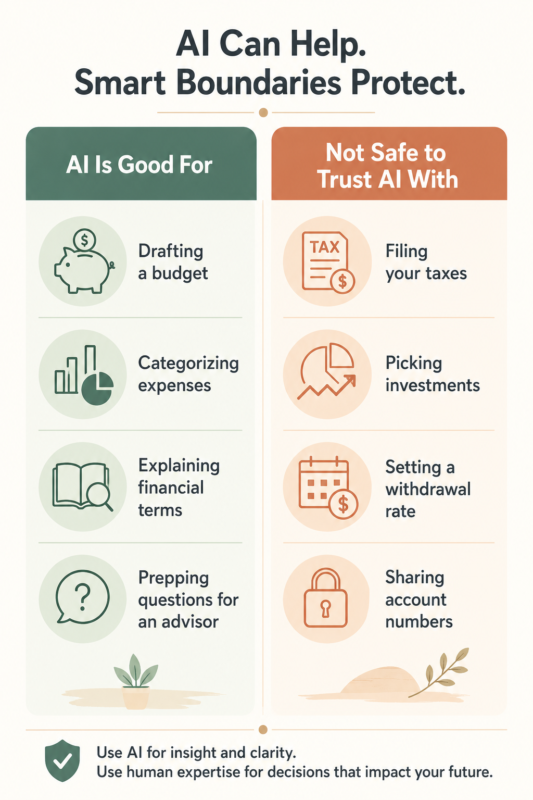
None of this means you should close the app and go back to a spreadsheet alone. AI is genuinely useful for a specific set of money tasks: drafting a first-pass budget, categorizing a month of expenses, explaining what a term like “cost basis” or “Roth conversion” actually means, and prepping sharper questions before you sit down with a financial planner or tax preparer. It works here for the same reason it’s the exact opposite of the six mistakes above: getting a budget category slightly wrong costs you nothing, and you’re the one making the final call either way.
We’ve rounded up 25 everyday ways we already use ChatGPT, and the money-related ones follow this same pattern. Use it to prepare, translate, and organize. Keep the decisions that carry real financial weight and real legal consequences with a human who is accountable for getting them right.
The Bottom Line
AI is a tool you can trust to hand a budget draft to. It is not a tool you can hand your tax return, your investment picks, or your Social Security number to. The seven mistakes above aren’t reasons to avoid AI. They’re the line between the parts of your financial life where a wrong answer costs nothing and the parts where it costs thousands, and midlife is exactly the wrong time to blur that line.
If you’re trying to figure out where you actually stand financially before you make any of these bigger decisions, start with figuring your Freedom Number. It’s a clearer, more personal number than anything a chatbot will generate for you, because it’s built from your actual numbers, not a guess shaped by whatever the model assumed about you.
What’s the money question you’ve been tempted to just ask AI instead of a real advisor?
Common Questions About AI and Money Mistakes
Can I use ChatGPT to do my taxes?
No. AI tools can explain tax concepts, but they have made errors as large as miscalculating a $2 million income as owing $26 million (CNBC, 2026), and you remain legally responsible for every number on your return. Use tax software or a preparer to finalize it.
Is AI biased when giving financial advice?
Yes. A 2026 Journal of Financial Planning study found leading chatbots recommended different emergency savings amounts, in some cases $19,500 to $37,500 apart, based on race and gender details in otherwise identical financial scenarios (CNBC, July 7, 2026).
Can AI pick my investments or set my retirement withdrawal rate?
AI can explain investment concepts, but it isn’t a fiduciary and carries no legal duty to act in your best interest, so investment selection and withdrawal-rate decisions belong with a licensed advisor.
Is it safe to enter my bank account or Social Security number into an AI chatbot?
No. Most AI conversations are stored and can potentially be accessed by third parties, so keep account numbers, birthdates, and Social Security numbers out of any AI chat (FINRA, Investor Insights).
What is AI actually useful for with money?
AI is a solid tool for drafting a budget outline, categorizing expenses, translating financial jargon, and preparing sharper questions before a meeting with a financial planner or tax preparer.