
Table of Contents
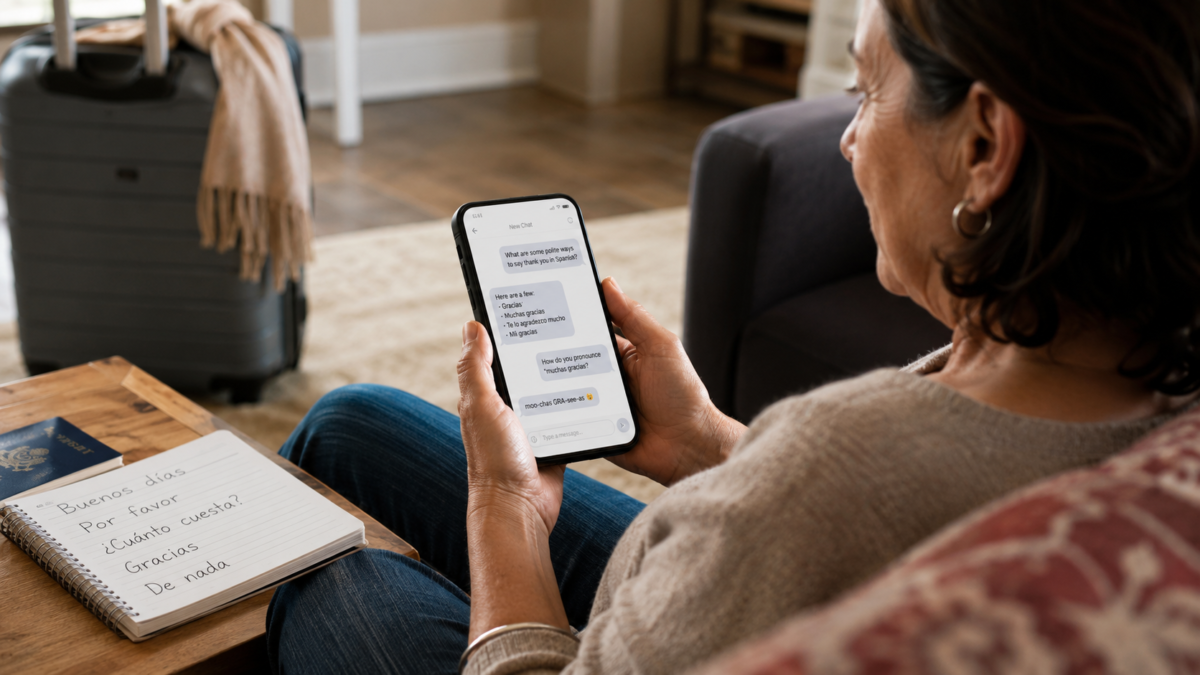
You don’t need six months of Duolingo streaks to feel less lost off a plane. You need a handful of phrases, a little nerve, and about two weeks of focused practice before you go. That is genuinely how to use AI to learn a language before a trip, without signing yourself up for another subscription you’ll abandon by week two.
Most language-learning advice treats every trip like the start of a new hobby. Buy the app, commit to daily lessons, maybe get fluent in a year or two. That’s a fine goal if you actually want to learn a language for its own sake. It’s a rough plan if your flight leaves in three weeks and you just want to order dinner, ask for directions, and not feel like a burden to every local you meet.
AI changes the math here. You already have free tools sitting on your phone that can build you a short, specific practice plan built around your actual trip, not a generic curriculum. Here’s what that looks like, step by step.
Please note this page may contains affiliate links. If you purchase something through these links, I’ll receive a commission at no extra cost to you. Affiliate links help to support my website/blog and I only recommend products I love.
Here’s the short version, if you only read one paragraph: pair a structured app like Duolingo or Babbel for daily vocabulary with a free AI chatbot like ChatGPT for real conversation practice.
Ask it to roleplay everyday travel scenarios, request phonetic pronunciations, and build a short list of trip-specific phrases. Even twenty minutes a day for two to three weeks makes a real difference.
Why “Just Enough” Beats Fluency for a Trip
Locals don’t expect you to be fluent. They notice when you try.
That distinction matters more than most language apps let on. A few correctly pronounced words, a genuine “please” and “thank you,” and the willingness to attempt a full sentence instead of pointing and grunting change how a conversation goes. You’ll get patience instead of impatience, and often a little more warmth than a tourist who never bothered.
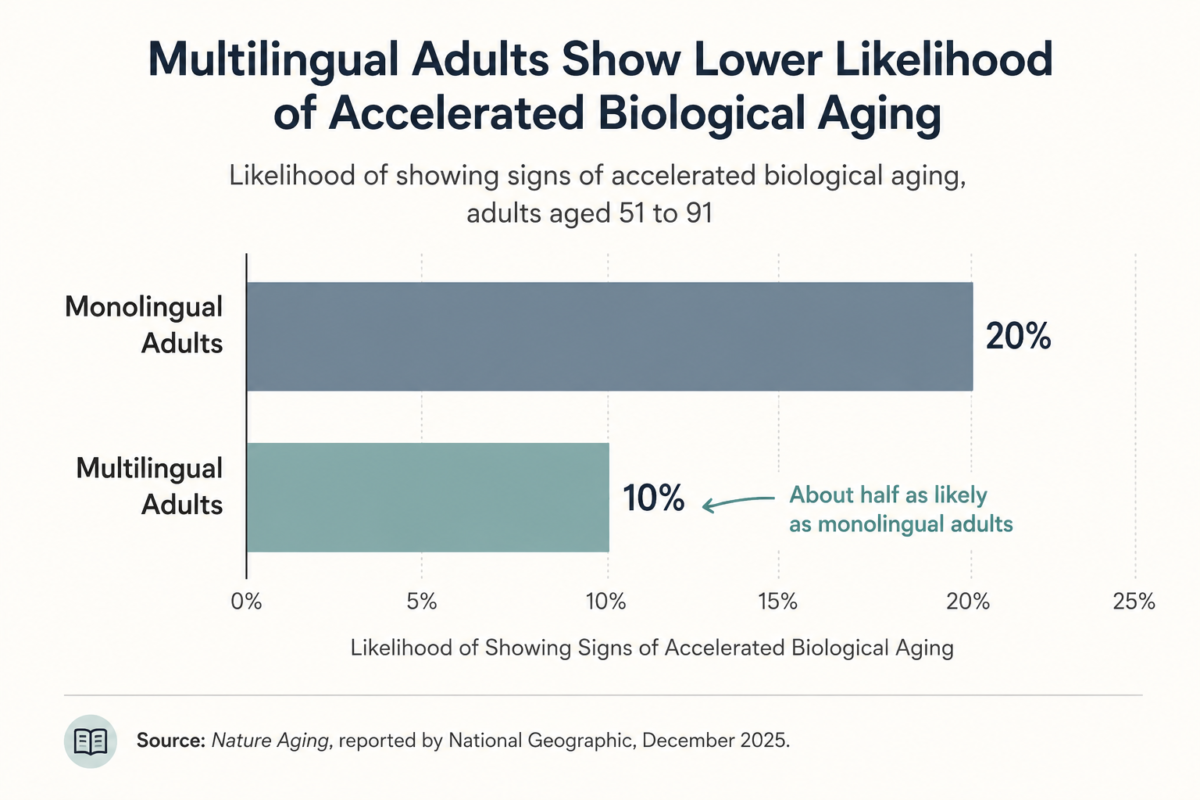
There’s also a quieter reason to do this, one that has nothing to do with your trip. A December 2025 study published in Nature Aging, reported by National Geographic, followed more than 86,000 adults between the ages of 51 and 91 across 27 European countries and found that people who spoke multiple languages were about half as likely to show signs of accelerated biological aging.
You’re not going to become bilingual in two weeks. But the cognitive benefit of language learning appears to start compounding almost immediately, long before fluency, which makes even a short, intensive burst worth the effort on its own.
AARP’s guide to learning a language later in life makes a similar point: starting later doesn’t put you at the disadvantage people assume, and a realistic, low-pressure goal beats an ambitious one you’ll quit.
If you’ve never touched an AI tool before, the good news is that the same starting-from-zero approach that works for learning AI as a beginner applies here. You don’t need to understand how the technology works under the hood. You just need to know what to type.
The AI Tools That Actually Help (and the Ones That Don’t)
Not every AI tool does the same job, and mixing them up wastes the little time you have before a trip.
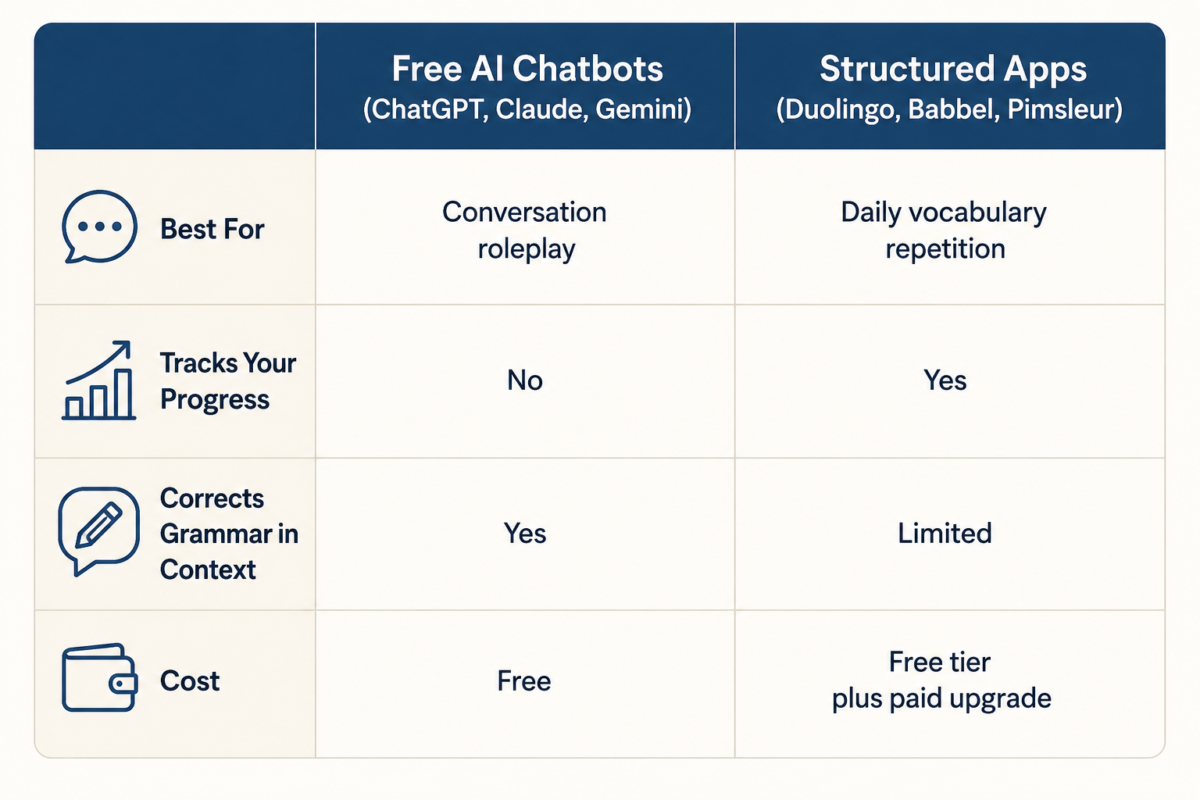
Free-tier chatbots, ChatGPT, Claude, and Gemini all included, are best at conversation practice. You can describe a scenario (checking into a hotel, ordering off a menu with no pictures, asking a pharmacist for something for a headache) and have the chatbot play the other role, correct your grammar, and explain why a phrase works the way it does. This is the closest free substitute to an actual conversation partner most people will find.
Structured apps like Duolingo, Babbel, Mondly, and Pimsleur do something different. They build vocabulary through repetition, which chatbots aren’t well suited for. A chatbot will happily have the same conversation with you fifty times, but it won’t track what you’ve already learned or nudge you to review it tomorrow the way a structured app will.
The combination that actually works: one structured app for five to ten minutes of daily repetition, and one chatbot for real conversation practice a few times a week. Neither replaces the other. It’s the same pairing logic behind how we use ChatGPT for everyday tasks: a general tool handles the flexible, messy parts, and a purpose-built one handles the repetitive parts.
How to Use AI to Learn a Language Before a Trip: The Exact Prompts That Work
This is where most advice stays vague. Here’s exactly what to type.
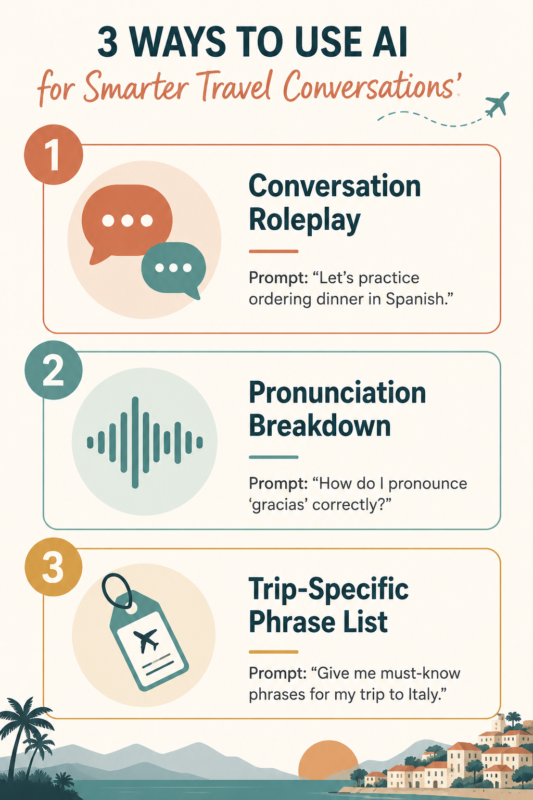
For conversation practice, try something like: “I’m traveling to [city] in [number] weeks and know almost no [language]. Roleplay a conversation where I’m checking into a hotel and you’re the front desk clerk. Correct my grammar after each response and tell me the natural way a local would actually phrase it.”
For pronunciation, ask: “Give me a phonetic breakdown of these five phrases in [language], written the way an English speaker would sound them out, not using the International Phonetic Alphabet.”
For a trip-specific phrase list, be as specific as your actual itinerary: “I have dietary restrictions (no dairy) and I’m traveling with someone who uses a wheelchair. Build me a list of 15 essential phrases in [language] for a trip to [city], grouped by situation: restaurants, transportation, and asking for help.”
The pattern across all three prompts is specificity. A vague request like “help me learn some Italian” gets a vague, generic answer. Forbes Advisor’s reporting on using ChatGPT for travel planning makes the same point about AI prompts generally: the more specific the ask, the more useful the answer.
A request that names your actual trip, your actual limitations, and your actual timeline gets something you can use tomorrow. It’s the same principle behind building a simple AI system for anything worth remembering: the more specific the input, the more useful the output.
A Realistic Timeline (So You Know If It’s Worth Starting)
Here’s what daily practice actually gets you, based on how quickly most adult learners move through basic material:
- Two weeks out: You can recognize common words, handle greetings, and order food without pointing at the menu.
- One month out: You can read simple signs and instructions, and follow slow, deliberate speech.
- Three months out: You can hold a basic back-and-forth conversation about simple topics.
If your trip is two weeks away, don’t aim for the three-month outcome. Aim for greetings, food, and directions, and let that be enough. If you have two or three months before you leave, you have room to build toward something closer to a real conversation.
Either way, twenty minutes a day beats two hours once a week. The consistency matters more than the volume, the same beginner mindset that works for picking up AI tools in general applies just as well here.
What This Actually Looks Like on a Real Trip
Say your flight leaves in three weeks. Week one, you spend ten minutes a day with a structured app building greetings, numbers, and food words, and you have one longer chatbot conversation roleplaying a restaurant order.
Week two, you add a hotel check-in scenario and a directions scenario to your chatbot practice, and you start actually saying the phrases out loud instead of just reading them silently. Week three, you run through your full trip-specific phrase list one more time and stop worrying about it.
You’ll still mess up plenty once you land. You’ll mix up a verb tense, mispronounce a word so badly a shopkeeper looks briefly alarmed, and default to English out of nerves more than once. None of that erases the fact that you tried, and trying is what actually changes how a trip feels.
Why This Effort Pays Off Even After You’re Home
The Nature Aging research mentioned earlier isn’t a one-trip benefit. The cognitive advantages tied to multilingual exposure appear to build the more you keep at it, which is a real, research-backed reason to keep a short daily habit going even after you unpack.
You don’t need to chase fluency. You just need to not let the momentum disappear once you’re back home, especially once you’ve already built the pre-trip habit of tackling the rest of your travel prep checklist the same way.
The Bottom Line
You don’t need fluency to make a trip feel easier. You need a plan, a couple of free AI tools, and about two to three weeks of showing up for twenty minutes a day. Pair a structured app for repetition with a chatbot for real conversation practice, use prompts specific to your actual trip, and let “good enough” be the goal instead of “perfect.”
If this is the year you finally stop landing somewhere new and immediately reaching for a translation app, this is a good place to start.
Sign up for our newsletter and we’ll keep sending you the practical stuff as we figure out midlife travel, and midlife everything else, right alongside you.
What’s the one phrase you wish you’d learned before your last trip?
Frequently Asked Questions
Do I need to be fluent before I travel?
No. A handful of core phrases, plus a willingness to try, covers most tourist interactions and signals respect to the people you meet.
Which AI tool is best for learning travel phrases?
Free tiers of ChatGPT, Claude, or Gemini all work well for conversation practice. Pair one with a structured app like Duolingo or Babbel for daily repetition.
How long before my trip should I start?
Two to three weeks of daily 20 to 30 minute sessions is enough to get functional. If your trip is sooner, start today. Even a few days of focused practice helps.
Can AI actually teach correct pronunciation?
To a point. Voice-based tools and apps built around listening and repeating, like Pimsleur, are more reliable for pronunciation than text-only chat.
Is it worth doing this for a trip that’s only a week long?
Yes. The effort itself changes how locals respond to you, and the cognitive benefits of language learning appear to start compounding almost immediately, even from a short, intensive burst.