

Some days you finish everything that needed doing and still feel as if you were barely there. The email got answered. The appointment got booked. Dinner happened. But if someone asked what you wanted from the day, you might need a minute.
That is where small mindset habits can be useful. You do not need a two-hour morning routine to pay closer attention to your life.
Midlife often means several people’s needs share the same calendar. These five practices give you a few places to pause within that calendar, with a smaller version for days when even five minutes feels ambitious.
Useful mindset habits help you notice what is happening, check harsh assumptions, choose one meaningful priority, make room for ordinary good moments, and connect with another person. Start with one small practice attached to an existing routine. These habits support everyday well-being; they do not replace practical help or mental health care.
Please note this page may contains affiliate links. If you purchase something through these links, I’ll receive a commission at no extra cost to you. Affiliate links help to support my website/blog and I only recommend products I love.
Table of Contents
1. Begin Your Mindset Habits With an Honest Check-In
Before you decide what kind of day you should be having, notice the one you are actually having. Are you tired, worried, annoyed, looking forward to something, or simply hungry? Start there.
Try this while the coffee brews or before you open your first message. Ask yourself, “What am I feeling, and what do I need to take into account today?” Thirty seconds is a suggested starting point, not a research-backed dose. No journal entry or special breathing technique is required.
Suppose you slept poorly because you were helping a parent late into the evening. “I am tired, and I have less patience available” is useful information. You might postpone a difficult conversation, ask your partner to handle one errand, or leave more time between appointments.
“I need to stop being so negative” gives you much less to work with.
This check-in is an everyday attention practice. It should not be sold as the equivalent of a structured mindfulness program. The National Center for Complementary and Integrative Health’s review of meditation and mindfulness describes possible benefits alongside mixed evidence, study limitations, and potential unwanted effects. A quick pause cannot borrow all the results of those programs.
If focusing inward makes you feel more distressed, leave the exercise alone. You could notice something around you, talk with someone you trust, or choose a different habit. There is no reward for forcing a practice that makes the morning harder.
On a crowded day, the smaller version is one honest word: “Tired.” “Hopeful.” “Overloaded.” Mindset habits should help you respond to your situation, including the times your situation calls for less.
2. Check One Harsh Thought Before You Believe It
A short email arrives from your manager: “Can we talk tomorrow?” Before you have any more information, your mind writes the entire meeting. You made a mistake. They are disappointed. Something bad is coming.
That is a hypothetical example, but the gap between the message and the story is the part worth noticing.
The NHS Every Mind Matters guidance on reframing unhelpful thoughts suggests catching the thought, checking the evidence, and considering a different interpretation. A neutral thought is allowed. You do not have to replace every worry with a sunny prediction.
In the email example, the evidence is that your manager wants a conversation. You do not yet know why. A fairer sentence would be, “There is a meeting tomorrow, and I can ask whether I should prepare anything.”
Then send that question if it makes sense. The thought check has produced a practical step.
Try this with one thought rather than inspecting your entire inner life. “I ruined the day” could become, “That conversation went badly, and I can decide whether to repair it.” “Nobody wants to hear from me” could become, “I have not reached out, so I do not know.”
These mindset habits work best as invitations to be more accurate. They should never become instructions to explain away mistreatment, ignore a financial problem, or pretend a difficult diagnosis is fine. Sometimes your concern is supported by the facts. Then the next question is what help or action fits.
If your thought is specifically about being unable to learn a skill, our guide to learning without making ability a permanent label goes deeper into that separate problem.
For today, choose one harsh sentence and ask, “What do I actually know?”
3. Choose One Priority That Makes the Day Yours
A calendar can be full without containing much that matters to you. There is the work meeting, the prescription pickup, the laundry, the call you promised to make. All legitimate. All capable of filling the available space.
Before you enter that space, name one priority you would like to protect.
Be specific enough that you can recognize it when it happens. “Be more present” is hard to find on a Tuesday. “Sit with my partner for ten minutes after dinner, with the phone put away” gives you an actual moment.
Your priority might be preparing a meal you enjoy, getting outside, practicing a song, calling your sister, or spending fifteen minutes on a creative project. Choose something that fits today’s responsibilities. A priority that requires a different life by lunchtime will probably add pressure.
D and I spent months talking before we spent a single dollar on the change that eventually took us into a fifth-wheel full-time at 54. That is part of how starting over looked for us. The conversations mattered before the move happened.
Your next meaningful moment can be smaller than a move. It can be a conversation about the weekend you keep postponing or a half-hour spent exploring an interest that has been sitting at the edge of your life.
A useful test is whether your chosen priority reflects something you care about or simply another thing you think you should accomplish. If the answer is unclear, our guide to a life that fits your current priorities can help you look at the bigger question.
Among these mindset habits, this one asks the most concrete thing: where will the priority go? Put it beside an existing event, tell someone if their cooperation matters, and decide what the smaller version will be if the day changes.
Five minutes of conversation can still be a real conversation.
4. Notice One Good Thing Without Canceling the Hard Thing
Gratitude gets awkward when it sounds like an instruction to stop complaining. You are worried about money, exhausted from caregiving, or grieving, and someone tells you to focus on your blessings.
That is a lot to ask of a sentence about gratitude.
The National Institute of Mental Health’s self-care guidance, reviewed in April 2026, recommends noticing specific things you appreciate. Specificity gives this habit somewhere ordinary to land.
Maybe your neighbor returned the trash cans when you were away. Maybe the appointment started on time. Maybe you ate lunch outside and the weather was comfortable. You do not need to declare your life wonderful to acknowledge one decent moment.
Try finishing this sentence: “One thing I appreciated today was _____.” If it helps, add why. “My friend called, and I did not have to explain why I was quieter than usual.”
You can write that in a phone note, say it while washing a plate, or keep it to yourself. The format matters less than whether the moment means something to you.
A hard feeling can stay in the same sentence. “Today was lonely, and I appreciated the conversation with the cashier.” Neither half erases the other.
Keep the exercise voluntary. You are not obligated to feel grateful for a harmful relationship, a situation you need to leave, or a lesson someone insists your suffering should have taught you. Some days there may be nothing you want to record. Skip it.
Mindset habits should not become another way to judge yourself for having a human reaction. The practical point is to leave room for the good moment when there is one, rather than make gratitude a test you must pass.
5. Make One Real Connection Beyond the Feed
Seeing a friend’s vacation photos can tell you where they went. It does not tell them you miss them. Reading family updates can keep you informed while leaving the actual conversation for another day.
Choose one person and make the next contact a little more personal.
Instead of a general “We should catch up,” try, “Would you have time for a call Thursday after dinner?” Instead of waiting until you have a proper update, tell your brother that something reminded you of him and ask how his week is going.
The NHS guidance on five steps to mental wellbeing includes connecting with others, being active, learning, giving, and paying attention to the present. It describes relationships as a source of belonging and support. It also advises against relying entirely on social media or technology for relationships.
That does not mean a video call is second-rate. Distance, disability, caregiving, work hours, and travel can make shared tables hard to arrange. Choose the form of contact that lets you exchange something real.
You might sit with a partner without the television, call a friend while folding laundry, invite a neighbor for a short walk, or arrange a regular phone call with a relative. Ask one question and give the answer some room.
If you are reaching out after a long silence, keep the invitation simple. You do not need a polished explanation of the last six months. “I have been thinking about you and would like to hear how you are doing” is enough to open the door.
You cannot control whether someone replies. These mindset habits concern what you can practice, including an invitation, rather than a guaranteed response.
If scrolling keeps using the time you meant to spend connecting, our article on the ways screen time can drain your energy offers a useful next place to look.
6. Fit One Practice Into the Week You Already Have
You have five options now. Choose one.
Doing all of them tomorrow may sound satisfying, but it also gives you five new things to remember on a day that already has a list. Pick the practice that addresses the moment you find hardest.
If the morning starts with self-criticism, try the honest check-in. If requests swallow the day, protect one priority. If you keep feeling disconnected, make one invitation. There is no need to choose the habit that sounds most impressive.
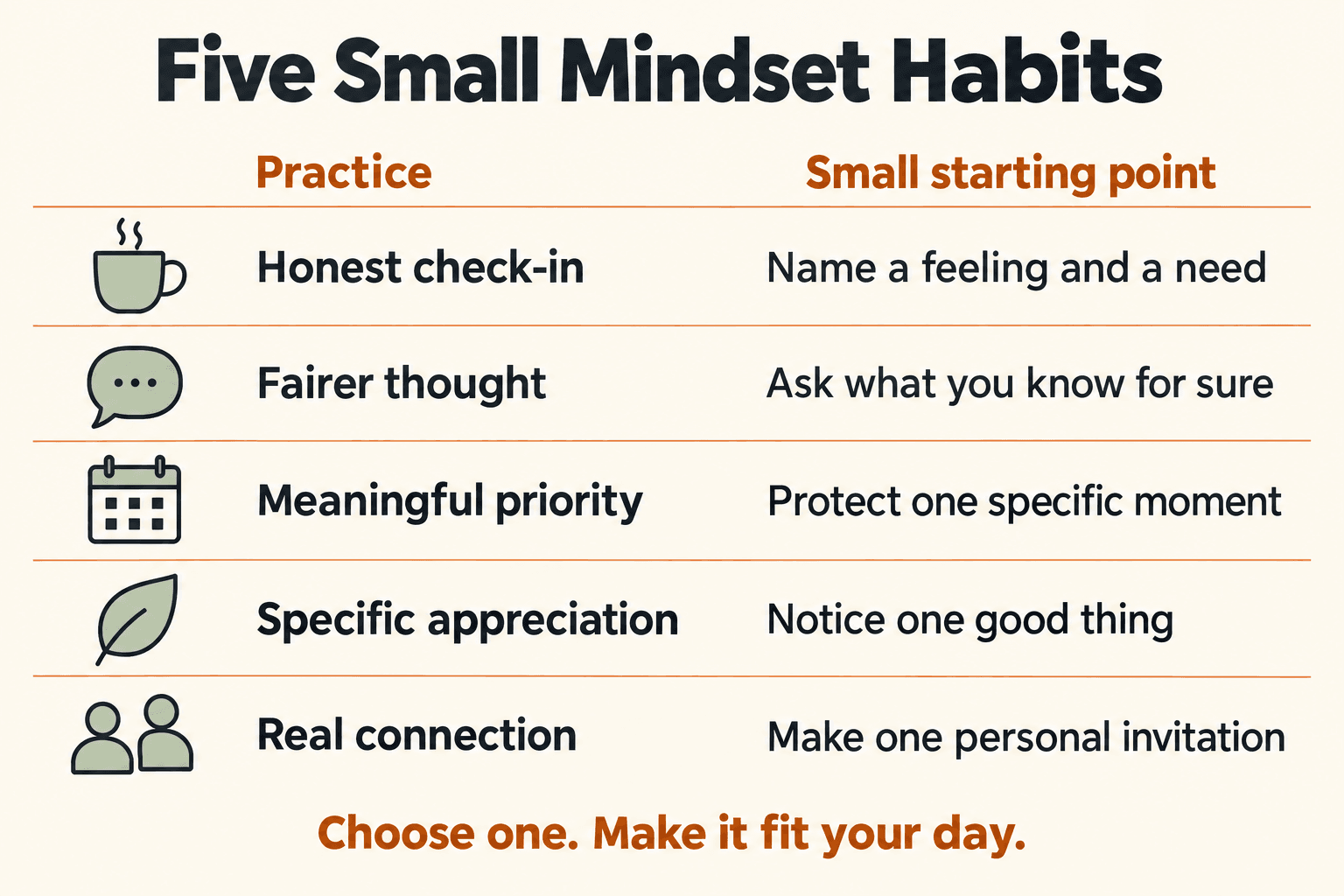
Use the table below as a starting point. The cues and smaller versions are suggestions you can change, not a tested mental health program.
| Practice | An existing cue | Small starting version | Hard-day version |
|---|---|---|---|
| Honest check-in | Coffee or first glass of water | Name a feeling and a need | Name one feeling |
| Fairer thought | A message that sets off worry | Separate the fact from the prediction | Ask what you know for sure |
| Meaningful priority | Looking at today’s calendar | Protect one specific moment | Choose five minutes |
| Specific appreciation | Clearing a meal or closing your laptop | Name one thing you appreciated | Skip it without self-judgment |
| Real connection | A familiar break in the day | Make one specific invitation | Send a brief personal message |
Test your choice for a week. At the end, ask whether you remembered it, whether it was useful, and what made it awkward. Seven days is a convenient review window. It is not a promise about how quickly a habit forms or how soon your mood should change.
Keep the habit if it helps. Change the cue if you kept forgetting. Shrink the practice if it felt like homework. Leave it behind if it added pressure without giving you anything useful.
The goal of mindset habits is a little more attention in the life you have. A streak is optional.
Find What Is Draining Your Energy
Use the free Midlife Energy Audit to track sleep, movement, stress, connection, and daily rhythm for seven days so you can see what is actually helping and what is draining you.
When the Problem Needs More Than a Habit
You cannot gratitude-note your way out of inadequate support or solve severe symptoms with a morning pause. Practical help, medical care, counseling, rest, and changes to your circumstances may be what you need.
NIMH’s April 2026 guidance recommends professional help for severe or distressing symptoms lasting two weeks or more, including sleep or appetite changes, difficulty concentrating, loss of interest, or difficulty doing ordinary tasks. You can seek help sooner. Two weeks is not a waiting requirement.
What to Do After an Interrupted Day
Return to the next ordinary cue. You do not owe the routine a longer session because you missed yesterday.
Suppose your planned call fell through because an appointment ran late. Offer another time. If you forgot the morning check-in, notice how you feel when you pour water at lunch. Small mindset habits can have more than one doorway into the day.
Give One Ordinary Moment More Attention
A more fulfilling life still contains dishes, inconvenient appointments, and days that get away from you. These mindset habits give you a few chances to notice what you need, question a harsh assumption, protect a priority, appreciate a good moment, or reach another person.
You get to decide which chance matters today.
If you are coping with a major upheaval, our guide to finding steadiness during a life change addresses the different needs that can come with it. For an ordinary busy week, one useful practice is a reasonable place to begin.
Which moment in your day keeps getting used up before you have paid attention to it?
Frequently Asked Questions
What are mindset habits?
Mindset habits are small, repeatable ways of directing your attention and responding to thoughts. Examples include checking an assumption, naming a meaningful priority, noticing something you appreciate, and making time for a real conversation.
Which mindset habit should I start with?
Choose the practice that addresses the moment you find hardest. If you judge yourself before breakfast, start by naming how you feel. If your day disappears into other people’s requests, choose one meaningful priority before opening your inbox.
Do mindset habits mean staying positive all the time?
No. You can acknowledge grief, frustration, or a real problem while looking for a fairer interpretation or a useful next step. Forced gratitude and cheerful slogans are not requirements.
How long does it take for mindset habits to work?
There is no reliable deadline for this particular set of practices. Use a week to test whether one habit fits your day, then adjust it. A small useful change matters more than a perfect streak or a promised result by day 21.
Can these habits replace therapy?
No. Everyday habits can support well-being, but they are not treatment for a mental health condition. Seek professional support when symptoms are distressing, persistent, or affecting daily functioning, and sooner when you are concerned about your safety.