

The Tuesday evening on your calendar looked free until it became a committee call, a favor, and the night you were finally going to work on your own idea. None of those things is ridiculous. Together, they leave you wondering why your life has so little room in it.
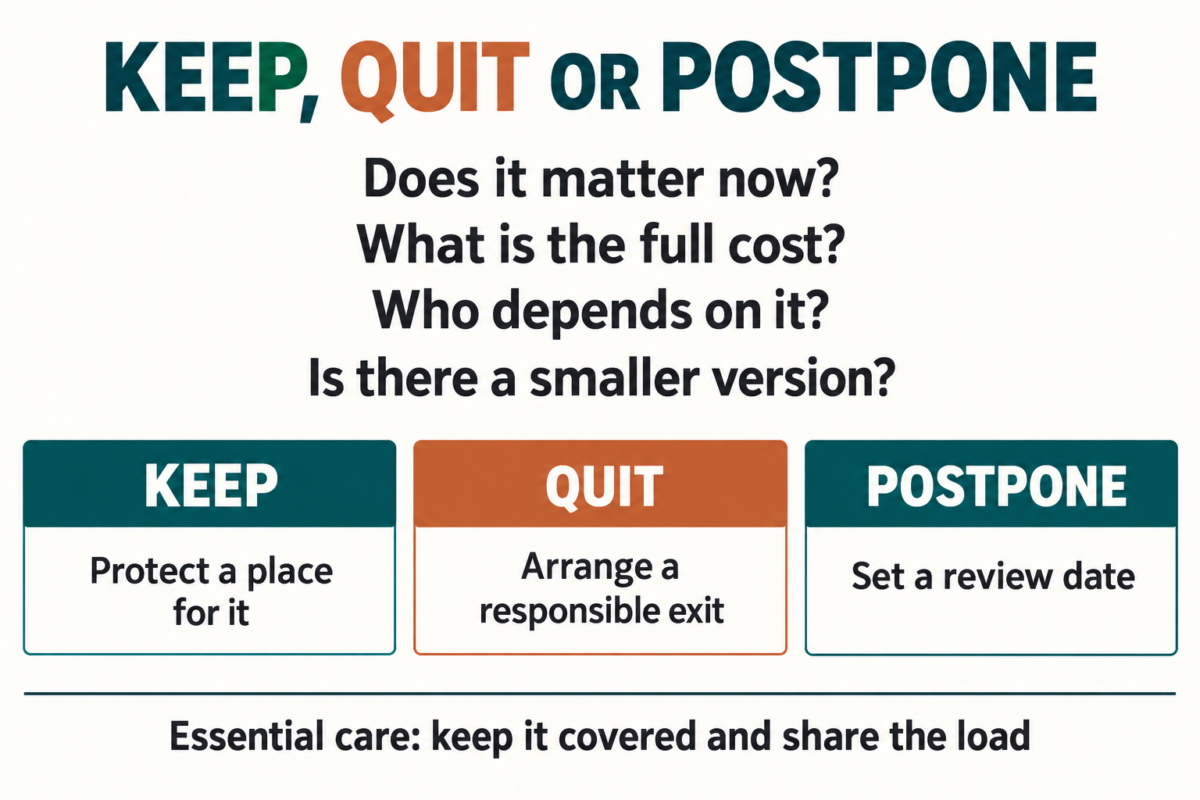
Use a midlife decision filter to check four things: whether a commitment matters now, what it will cost, who else depends on it, and whether you can try a smaller version. Then choose keep, quit, or postpone, with a next step and review date. Protect essential responsibilities before cutting optional ones.
Please note this page may contains affiliate links. If you purchase something through these links, I’ll receive a commission at no extra cost to you. Affiliate links help to support my website/blog and I only recommend products I love.
You do not need to make every part of your week more efficient. You need a way to decide which parts still deserve to be there. This midlife decision filter is a practical planning exercise for existing commitments, with room for responsibilities you cannot simply drop.
Table of Contents
Your Calendar Needs a Reason for Each Yes
A commitment can be perfectly reasonable and still be wrong for your week. The volunteer role matters. The weekly dinner is pleasant. The course might teach you something. But each one uses the same evenings, attention, and recovery time.
Start by looking at what you have already agreed to, rather than shopping for a better routine. Open the last two weeks of your calendar. Include the things that never became appointments: arranging rides, answering group messages, ordering supplies, and remembering everyone else’s next step.
This is an inventory, not a list of things you failed to handle.
D and I learned something similar with possessions. In the personal side of letting go, I wrote about my sports cards and D’s Disney memorabilia. They held memories, but much of that stuff was stored away instead of being part of our everyday lives.
A calendar can hold its own version of stored possessions. You keep an old role because it once mattered, or a standing appointment because nobody ever asked whether it still fits. That does not make the original yes a mistake. It means the current yes deserves another look.
The midlife decision filter asks about the life you have now. A commitment that worked before a parent needed help, before your job changed, or before you wanted more time with your partner may need a different shape today.
For your first pass through the midlife decision filter, choose one optional commitment. Leave emergencies and essential care out of the first pass. A monthly group meeting is a better place to practice than a decision about someone’s medical treatment.
The Midlife Decision Filter: Four Questions
Write the commitment at the top of a page. Be specific: “Organize the neighborhood fundraiser again” gives you more to work with than “Be less busy.” Then answer these four questions in ordinary sentences.
This is an original planning framework, not a clinical test. You are looking for a defensible next step, not a score that can decide your life for you.
Does it matter now, and what does it cost?
First, name what the commitment serves. Connection? Income? A person who needs you? A skill you actually want? If the answer is only “I have always done it,” keep asking.
The NHS problem-solving guide suggests beginning with the areas of life that matter to you and focusing on problems you can address practically. That is a useful starting point here: name the priority before choosing the task.
You might decide that being involved in your community matters, but running every event does not. Or that learning photography matters, while finishing a course you no longer enjoy does not. Keep the value separate from the particular arrangement.
The Open University’s Midlife MOT decision exercise also uses values to help people weigh options. Its lesson is useful beyond work: the attractive part of an opportunity and the everyday cost both belong in the decision.
Second, count the full cost. In a hypothetical example, a 90-minute meeting also requires 30 minutes of preparation and a 20-minute drive each way. That is two hours and 40 minutes before you answer the follow-up messages.
Money and time are only part of it. Does the commitment leave you pleasantly tired, tense, interested, or unable to settle afterward? Write what you notice without pretending you can measure every feeling precisely.
A difficult activity can still be worth keeping. A good workout, an important conversation, or helping someone through a hard week might take energy and serve something you care about. “Draining” is a clue to investigate, not an automatic instruction to quit.
Who depends on it, and is there a smaller version?
Third, identify who would be affected by a change. Distinguish an optional expectation from a responsibility you have accepted. A friend’s disappointment about a dinner is different from a parent having no ride to an appointment.
Ask what a responsible exit or adjustment would require. Notice, a replacement, a shared rota, or one final task? A boundary is clearer when the other person knows what happens next.
Fourth, look for a smaller version before choosing all or nothing. Attend the group once a month instead of every week. Help with setup instead of organizing the whole event. Take one class before buying a long program.
The midlife decision filter becomes useful when it makes the actual choices visible. “Carry on exactly as before” and “walk away forever” are rarely the only possibilities for an optional commitment.
If you still lack information, name the missing fact. You may need to ask how many hours the role really takes, what another family member can cover, or whether a deadline can move. That question is your next action.
Choose Keep, Quit or Postpone
Now give the commitment an outcome. Use the words keep, quit, or postpone, then add the specific action that makes the choice real.
Keep means you can explain why it belongs and where it will fit. Quit means you can leave an optional commitment responsibly. Postpone means it still matters, but the timing is wrong and you have a condition for reconsidering it.
Here is a hypothetical worksheet. The examples are prompts for thinking, not instructions about your family or job.
| Commitment | What the questions reveal | Choice and next step |
|---|---|---|
| Weekly walk with a friend | Connection matters, the time fits, and both people enjoy it | Keep. Protect Thursday’s slot. |
| Running the annual fundraiser alone | The cause matters, but organizing exceeds available capacity | Quit the lead role. Offer a handoff meeting. |
| Starting a photography course | Learning matters, but the next month is already full | Postpone. Review after the current work deadline. |
| Driving a parent to appointments | Essential care needs coverage, but one person is carrying every trip | Keep care covered. Ask family to share the journeys. |
The last row is the exception that deserves attention. Sometimes the responsibility stays, while the way you carry it changes. “I cannot keep doing all of this alone” is a different decision from “Nobody needs to do this.”
The National Institute on Aging’s guidance on sharing caregiving responsibilities recommends identifying care needs, discussing who can contribute, and recognizing your own limits. That supports a conversation about coverage rather than an abrupt withdrawal of care.
Quit without treating the past as a bill
A course you paid for can be hard to leave. So can a role you spent years building. You may feel that stopping would prove the time was wasted.
Psychologists Hal Arkes and Catherine Blumer described this pull in their February 1985 paper, The Psychology of Sunk Cost. Their research examined the tendency to continue an activity because time, money, or effort had already been invested.
For an optional commitment, ask what the next month earns. The past investment cannot tell you whether another month is worthwhile. You can appreciate what something gave you without renewing it indefinitely.
Still, check the real exit costs. A cancellation fee, an agreed deadline, or someone else’s need for a replacement belongs in the decision. The point is to separate the cost of leaving now from the discomfort of admitting your priorities changed.
Postpone with a date and a condition
“I will do it when things calm down” leaves the decision open forever. A useful postponement names both a review date and something that needs to change.
For example: “On November 1, I will reconsider the course if the current project has finished and I can protect one evening a week.” The date prompts a review. The condition stops the review from becoming another automatic yes.
If nothing has changed, you can postpone again or let the idea go. You do not owe every once-interesting possibility a permanent place in your future.
This is where the midlife decision filter can keep a worthwhile idea from becoming background pressure. You have given it a place to wait and a reason to return.
Put the Choice Into an Ordinary Week
Do one commitment first. A complete calendar overhaul gives you too many moving parts to understand what helped.
Write a next step you can finish: send the handoff message, ask about shared transport, cancel the unused membership, or protect the walk on your calendar. Then check whether the space you freed actually went where you intended.
If you leave a two-hour meeting and immediately accept another two-hour obligation, you have changed the label on the time. You may have made a good trade, but make it consciously. Name what gets the space before offering it away.
The midlife decision filter should produce a visible change in your week. That might be a free evening, a smaller role, fewer coordination messages, or a clearer agreement. It does not need to produce a dramatic new identity.
Say the choice in one clear sentence
You can be kind without writing a defense brief. For a new request, try: “I cannot take on the whole event, but I can help with setup on Saturday.”
For an existing role: “I need to step down after this month. I can document what is due and meet with the next person before then.” Only offer a handoff you have time to complete.
For a postponement: “I want to consider this, but I cannot add it before the current deadline. I will review it on November 1 and let you know.”
Those are example scripts. Change the details so they are true. A tidy sentence is no use if it quietly promises another month of work you cannot do.
You may feel guilty afterward. That feeling does not automatically settle whether the choice was fair. Return to the facts: what you agreed to, who needs coverage, what you can carry, and what you communicated.
Review what actually changed
After a week, look at the result. Did you keep the time you meant to protect? Did the handoff work? Did a smaller role still give you the connection you wanted?
Adjust the arrangement if it missed the problem. Leaving a meeting will not fix an unclear job expectation, and canceling a course will not resolve a family conflict. Be honest about what the change can do.
Our guide to building steadier footing during a life change offers more support when the adjustment itself feels unsettling. You can make a reasonable choice and still need time to get used to it.
Use the midlife decision filter again when a new commitment arrives or an old one changes. You do not need to put every ordinary choice through a worksheet.
If you are unsure what is taking the biggest toll, notice patterns before cutting more. Track which days leave you flat and what happened around them. The Midlife Energy Audit below is a useful place to gather those observations.
Find What Is Draining Your Energy
Use the free Midlife Energy Audit to track sleep, movement, stress, connection, and daily rhythm for seven days so you can see what is actually helping and what is draining you.
When a Filter Needs Another Person’s Help
A crowded calendar is not the explanation for every kind of exhaustion or distress. If ordinary tasks feel unusually difficult, or sleep, mood, and concentration have changed, give that problem its own attention.
The National Institute of Mental Health’s self-care and support guidance, reviewed in April 2026, advises professional help for severe or distressing symptoms lasting two weeks or more. That includes difficulty concentrating or completing usual activities. Seek help sooner if symptoms are severe or you are worried about your safety.
For major decisions, use the midlife decision filter to organize questions. Bring health-treatment decisions to your clinician, legal commitments to a qualified lawyer, and financial consequences to someone qualified to assess your situation. A page of thoughtful answers cannot replace the missing expertise.
Likewise, an employment change needs more than a bad week and a strong feeling. If your question is about work, our guide to testing a possible second act while keeping your paycheck gives that larger decision a separate process.
The same care applies when other people depend on you. Discuss a proposed change with them and arrange necessary support before stepping away. Some things can leave your calendar quickly. Others need a plan.
Make Room for One Thing That Matters
You do not have to earn a less crowded life by becoming better at carrying everything. Start with one commitment and ask whether it still fits.
Use the midlife decision filter to name the value, count the full cost, account for the people affected, and consider a smaller version. Then make one choice concrete enough that next Tuesday looks different.
Keep the walk. Share the driving. Hand over the role. Give the course a real review date. The right answer depends on your week, but it deserves more thought than another automatic yes.
Which commitment would you decline today if you had not already said yes years ago?
Frequently Asked Questions
What is a midlife decision filter?
A midlife decision filter is a short set of questions for checking a commitment against your current priorities, available time, responsibilities, and options. It helps you choose what to keep, quit, or postpone. The framework here is a practical planning tool, not a clinical test.
How do I know whether to quit or postpone something?
Quit when an optional commitment no longer has a useful role and you can leave responsibly. Postpone when it still matters but current timing or capacity is wrong. Give postponed items a specific review date and name what needs to change before you reconsider.
What if an important responsibility drains my energy?
Look at changing how the responsibility is carried. Ask whether tasks can be shared, hours reduced, outside help arranged, or the standard simplified. Keep essential care covered while discussing changes with the people involved.
How do I say no without feeling guilty?
You may still feel guilty. Give a clear answer, acknowledge the other person’s need, and state what you can realistically offer. If you made a prior promise, arrange a reasonable handoff instead of disappearing.
Should I make a major life decision with this filter?
Use the filter to organize your questions and identify missing information. For decisions involving health treatment, contracts, retirement money, employment, or dependent care, discuss the details with the appropriate qualified professional and the people affected before acting.