

A major life change can make a capable person feel unfamiliar to themselves. The calendar still moves, the bills still arrive, and everyone still expects answers. Meanwhile, your old routines and roles may no longer fit.
Mental resilience during life transitions grows when you name what changed, separate what you can control from what you cannot, keep a few stabilizing routines, ask for specific support, and take one manageable next step. Resilience does not mean feeling fine. It means adapting while stress and grief are still present.
Please note this page may contain affiliate links. If you purchase something through these links, I’ll receive a commission at no extra cost to you. Affiliate links help support this website, and I only recommend products I believe may be useful.
In This Article
- What Mental Resilience During Life Transitions Really Means
- Start by Naming What Changed and What You Lost
- Build a Small Stability Floor Before Big Decisions
- Sort Control, Influence, and Uncertainty
- Ask for Specific Support Instead of Saying You Are Fine
- Know When Resilience Advice Is Not Enough
- Frequently Asked Questions
- The Bottom Line
Some transitions are chosen. You retire, move, start a business, or decide the old version of life has run its course. Others arrive without permission through job loss, illness, divorce, caregiving, or the death of someone you love. Either kind can leave you relieved and frightened at the same time.
That mixed reaction is not a character flaw. It is your mind trying to update its map while you are still standing on moving ground.
You do not need to solve the next ten years this week. You need enough steadiness to make the next honest decision.
What Mental Resilience During Life Transitions Really Means
The American Psychological Association describes resilience as adapting well when facing adversity, trauma, tragedy, threats, or major sources of stress. Its guidance also makes an important point: resilience does not mean that you avoid pain or distress.
That distinction matters because people often use the word as a polite way to say, “Keep going and do not make anyone uncomfortable.” That is not mental resilience during life transitions. It is pressure to perform normalcy.
Real resilience can look messy. You may sleep badly one night, cancel a plan, ask the same question three times, or cry in the grocery store parking lot. You can still be adapting. The measure is not whether you stay calm every minute. It is whether you keep finding safe ways to respond, recover, connect, and choose your next step.
It also helps to separate resilience from endurance. Endurance says, “I can take more.” Resilience asks, “What needs to change so I can keep living well?” Sometimes the answer is rest. Sometimes it is a hard conversation, a new boundary, practical help, or professional care.
If change itself is keeping you frozen, our guide to why fear can make a reasonable midlife change feel dangerous explains what may be happening underneath the hesitation.
Mental resilience during life transitions is not a personality label. It is a set of responses you can practice, especially when the old response is no longer working.
Start by Naming What Changed and What You Lost
The event is usually easy to name. “I retired.” “My daughter moved out.” “The doctor called.” “The company eliminated my role.” The harder part is naming what disappeared with it.
A job loss may also remove status, daily contact, confidence, and a predictable paycheck. Retirement may bring freedom while taking away structure and a clear answer to, “What do you do?” A move can be right for your future and still mean losing a familiar street, a trusted mechanic, and the friend who could meet for coffee with ten minutes’ notice.
Try writing two short headings on a page: “What changed” and “What I am afraid this means.” Keep facts on the first side and predictions on the second.
“My position ended Friday” is a fact. “Nobody will hire me at 56” is a prediction. The prediction may feel true, but treating it as a settled fact closes options before you have examined them.
This is not positive thinking. You are giving each concern the right label so you can decide what deserves action now.
We know chosen changes can carry real uncertainty too. D and I sold our house, downsized what we owned, and moved into a fifth-wheel full-time at 54. The fuller story of what starting over in our 50s looked like includes the financial and practical fears behind that decision. Choosing the change did not make every concern disappear.
That is a useful truth for mental resilience during life transitions: gratitude for a new chapter does not cancel grief for the old one.

Build a Small Stability Floor Before Big Decisions
When everything feels urgent, your first job is not to create a perfect new routine. It is to keep a few parts of the day from becoming new decisions.
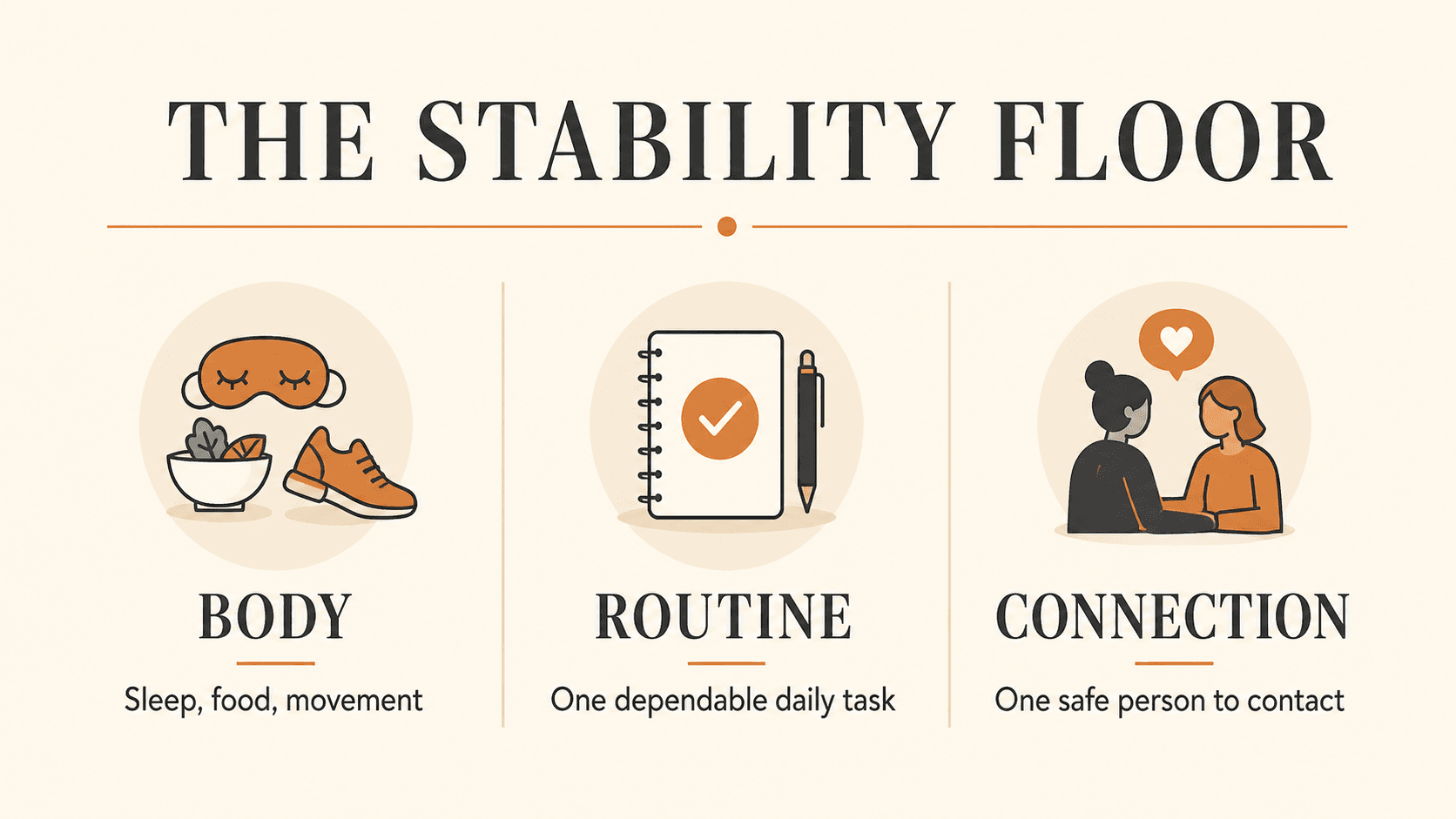
I think of this as a stability floor. It has three simple anchors:
- Body: Keep a reasonable sleep and wake window, eat at regular times, take prescribed medication as directed, and move in a way that fits your health.
- Routine: Choose one dependable daily task, such as making the bed, walking the dog, opening the mail, or writing tomorrow’s top priority.
- Connection: Have one planned point of contact with someone safe, even if it is a ten-minute phone call or a walk around the block.
These basics do not cure grief, anxiety, burnout, or a difficult financial reality. They give your nervous system and attention a little less chaos to manage while you deal with the real problem.
A stability floor gives mental resilience during life transitions something steady to rest on while the larger questions remain open.
The National Institute of Mental Health’s 2025 guidance on mental health symptoms includes regular exercise, healthy food, seven to nine hours of sleep, time with loved ones, and low-stress activities among the steps that may help with mild symptoms lasting less than two weeks. The word mild matters. Basic habits are support, not a substitute for care.
Keep the floor low enough to use on a bad day. “Walk for forty-five minutes” may become another failure. “Step outside after lunch” is easier to repeat. Repetition is more useful than ambition when your life already feels unstable.
You may also need a small source of meaning that is not tied to the role you just lost. Our article on building purpose after 50 offers a practical place to start without demanding a grand new mission.
Sort Control, Influence, and Uncertainty
Big transitions create dozens of open loops. Some require action. Some need another person’s cooperation. Others cannot be settled yet.
Put each concern into one of three circles.
| Circle | What belongs here | Your next move |
|---|---|---|
| Control | Your call, application, appointment, boundary, budget, or morning routine | Pick one action that takes less than 20 minutes |
| Influence | A family decision, hiring process, medical plan, or shared timeline | Make a clear request and set a follow-up date |
| Uncertainty | An outcome, another person’s reaction, or a future you cannot know yet | Name it, stop treating it as today’s task, and return on a set review date |
This exercise prevents uncertainty from borrowing the urgency of a controllable task. You cannot know today whether a new career will work. You can spend twenty minutes updating the first paragraph of your resume.
A 2020 study by Selin Gayen and Frédérick Raes examined coping and resilience in 502 adults ages 18 to 64. Social support, active coping, goal efficacy, and planning were important bridges between the two. The study was cross-sectional, so it does not prove that one small plan causes resilience. It does support using practical action alongside support rather than relying on attitude alone.
Healthy thinking also needs room for revision. A fixed response says, “This setback proves I cannot handle change.” A learning response asks, “What part of this is new, and what can I practice?” Our explanation of fixed and growth mindset patterns can help you hear the difference without turning every hard moment into a lesson.
Mental resilience during life transitions grows through many ordinary corrections. You make a plan, learn something, adjust, and try again.
Ask for Specific Support Instead of Saying You Are Fine
“Let me know if you need anything” is kind, but it puts another decision on the person whose decision capacity may already be spent.
If you are the one in transition, make the request small and specific. Support usually falls into four forms:
- Emotional: “Can I talk for fifteen minutes without trying to solve it?”
- Practical: “Could you bring dinner Thursday or drive me to the appointment?”
- Informational: “Will you review this benefits letter with me?”
- Professional: “Can you help me find a therapist, support group, financial counselor, or legal resource?”
Specific requests give the other person a real choice. They also remind you that needing help is not evidence that your resilience has failed.
The CDC’s May 2024 overview of social connection says supportive relationships give people help with stressful life challenges and can improve their ability to manage stress, anxiety, and depression. A 2007 review by Fatih Ozbay and colleagues also found that high-quality social support can strengthen resilience to stress, while noting that support and stress responses are complex.
Connection is not measured by how many names are in your phone. One reliable person who knows what you need may be more helpful than a crowd that only knows you are “going through a lot.”
This is one reason mental resilience during life transitions should never be framed as a solo achievement. People adapt inside families, workplaces, neighborhoods, health systems, and financial realities. Personal habits matter, but so do the resources around you.
If you want practical tools for designing your second act without pretending every change is easy, join our newsletter below. We share the systems, questions, and honest lessons that help you make the next decision with more clarity.
Know When Resilience Advice Is Not Enough
There is no prize for waiting until you are falling apart.
The NIMH says it may be time to seek professional help when severe symptoms last two weeks or more, symptoms worsen, or you have trouble completing ordinary tasks and activities. Its examples include hopelessness, difficulty concentrating or making simple decisions, major changes in sleep or appetite, losing interest in things you usually enjoy, and feeling unable to keep up with daily responsibilities.
The two-week mark is guidance, not a rule that says you must wait. Reach out sooner if you are worried about your safety, substance use is increasing, you cannot care for yourself or someone who depends on you, or your symptoms feel unmanageable.
If you are in the United States and thinking about suicide or hurting yourself, call or text 988 for the Suicide and Crisis Lifeline. Call 911 in a life-threatening emergency.
Professional care can be part of mental resilience during life transitions. A therapist, primary care clinician, support group, or other qualified professional may help you understand symptoms, build coping skills, and address problems that a blog article cannot assess.
You can also read our four-part midlife anxiety reset for related context, but use it as education, not a replacement for personal care.
The Bottom Line
Mental resilience during life transitions is not a demand to become your old self as quickly as possible. Some changes alter you. The work is learning how to carry what happened while rebuilding enough routine, connection, and choice to move through today.
That is what mental resilience during life transitions looks like in practice.
Start with two decisions. Pick one part of your stability floor that you can protect tomorrow. Then name one person you can contact with a specific request.
What part of your life feels least steady right now: your routine, your sense of control, or your connection to other people?
Frequently Asked Questions
Can mental resilience be learned?
Yes. APA describes resilience as behaviors, thoughts, and actions that people can learn and practice. It is not a fixed trait that you either have or lack. Practice can include flexible thinking, planning, connection, healthy routines, and asking for help.
Why do life transitions feel harder in midlife?
Midlife changes often affect several roles at once, such as work, caregiving, marriage, health, home, or retirement plans. Even a welcome change can remove familiar routines and certainty. The strain comes from adapting to several losses and decisions, not from failing a test of toughness.
How long does it take to adjust to a major life change?
There is no universal timeline. Cleveland Clinic notes that resilience develops at a personal pace, and some people need more time or professional support. Look for a gradual return of daily function rather than demanding that you feel like your old self by a fixed date.
What daily habits help build mental resilience?
Keep the basics small and repeatable: a consistent sleep and wake window, regular meals, gentle movement, one manageable task, and contact with someone supportive. These habits create a stability floor. They support coping, but they do not replace therapy or medical care when symptoms are severe.
When should I seek professional help during a life transition?
NIMH recommends professional help when severe symptoms last two weeks or more, symptoms worsen, or you struggle to complete daily tasks. If you are thinking about suicide or hurting yourself, call or text 988 in the United States. Call 911 in a life-threatening emergency.
Want more practical ideas for building a freer, more intentional life after 50?