

The values grandchildren remember rarely arrive as a speech. They show up while you cook dinner, return extra change to a cashier, keep a promise, or admit that you were wrong.
Grandparents pass values to grandchildren most effectively by living the value where the child can see it, telling one honest story about why it matters, and practicing it together in a small tradition or shared task. Ask what the child noticed, then leave room for them to make the value their own.
Please note this page may contain affiliate links. If you purchase something through these links, I’ll receive a commission at no extra cost to you. Affiliate links help support this website, and I only recommend products I believe may be useful.
In This Article
- Start With One Value You Actually Live
- To Pass Values to Grandchildren, Let Them See It in Motion
- Tell the Story Behind the Rule
- Build a Tradition That Practices the Value
- Respect the Parents and the Grandchild’s Right to Choose
- Use the One-Value Method at Any Age or Distance
- Frequently Asked Questions
- The Bottom Line
Wanting to pass down what matters can make a grandparent try too hard. A warm visit turns into a lesson. A story gets stretched until the moral is impossible to miss. A simple difference of opinion starts feeling like proof that the family is losing its way.
That pressure usually works against the relationship. Values are not family heirlooms that you can hand over intact. A grandchild has to see them, test them, and decide how they fit into a life that belongs to them.
Your role still matters. It just works better through attention, example, and repetition than through control.
Start With One Value You Actually Live
Do not start with a list of twelve virtues. Pick one value that already shows up in your ordinary choices.
Maybe it is generosity. Maybe it is curiosity, reliability, fairness, faith, courage, hospitality, or care for the natural world. The best choice is not the word that looks good on a family crest. It is the one a grandchild could recognize from watching you for a weekend.
Suppose you choose generosity. What does that mean on a Tuesday afternoon? It might mean bringing soup to a neighbor, tipping a tired server well, or giving someone your full attention when your phone is buzzing.
That is where a value becomes visible.
Our article about the most meaningful legacy you can leave your children makes the same distinction. A living legacy is not mainly what you leave behind. It is what people experience from you while you are here.
Try this quick test: finish the sentence, “In our family, we try to be people who ______.” Then name one recent moment when you actually did it. If no moment comes to mind, the value may still be an aspiration. That is fine, but honesty about the gap teaches more than pretending you have mastered it.
An older grandchild will spot the difference between a slogan and a pattern. A six-year-old will too, even if they cannot explain it yet.
To Pass Values to Grandchildren, Let Them See It in Motion
If you want to pass values to grandchildren, put the value inside something real.
Imagine you are finishing lunch when the cashier gives you ten dollars too much in change. You walk back, explain the mistake, and return it. On the way out, you can say, “I would have thought about that ten dollars all day if I kept it.”
That sentence is enough. The moment did most of the teaching.
The same approach works with less obvious values. If curiosity matters, let your grandchild see you say, “I don’t know. Let’s find out.” If responsibility matters, keep the small promise you made even when it is inconvenient. If respect matters, speak kindly about someone who is not in the room.
A 2025 PLOS ONE study of 5,183 people across 1,285 family and peer networks found that attitudes and behaviors did not move through every relationship in the same way. The pattern varied by topic and relationship, and the authors did not claim simple cause and effect.
That is useful news. You do not need to make every value stick, and you cannot force it anyway. Your job is to make the value honest and available inside a relationship that feels safe.
That is the quiet work behind trying to pass values to grandchildren. You show what the value costs as well as what it gives.
There is another benefit to modeling first. It keeps you accountable. You cannot tell a teenager that patience matters while snapping at everyone in traffic. If you do snap, the repair can become the better lesson: “I handled that badly. I am sorry.”
Grandchildren do not need flawless grandparents. They need adults whose words and behavior keep finding their way back to each other.
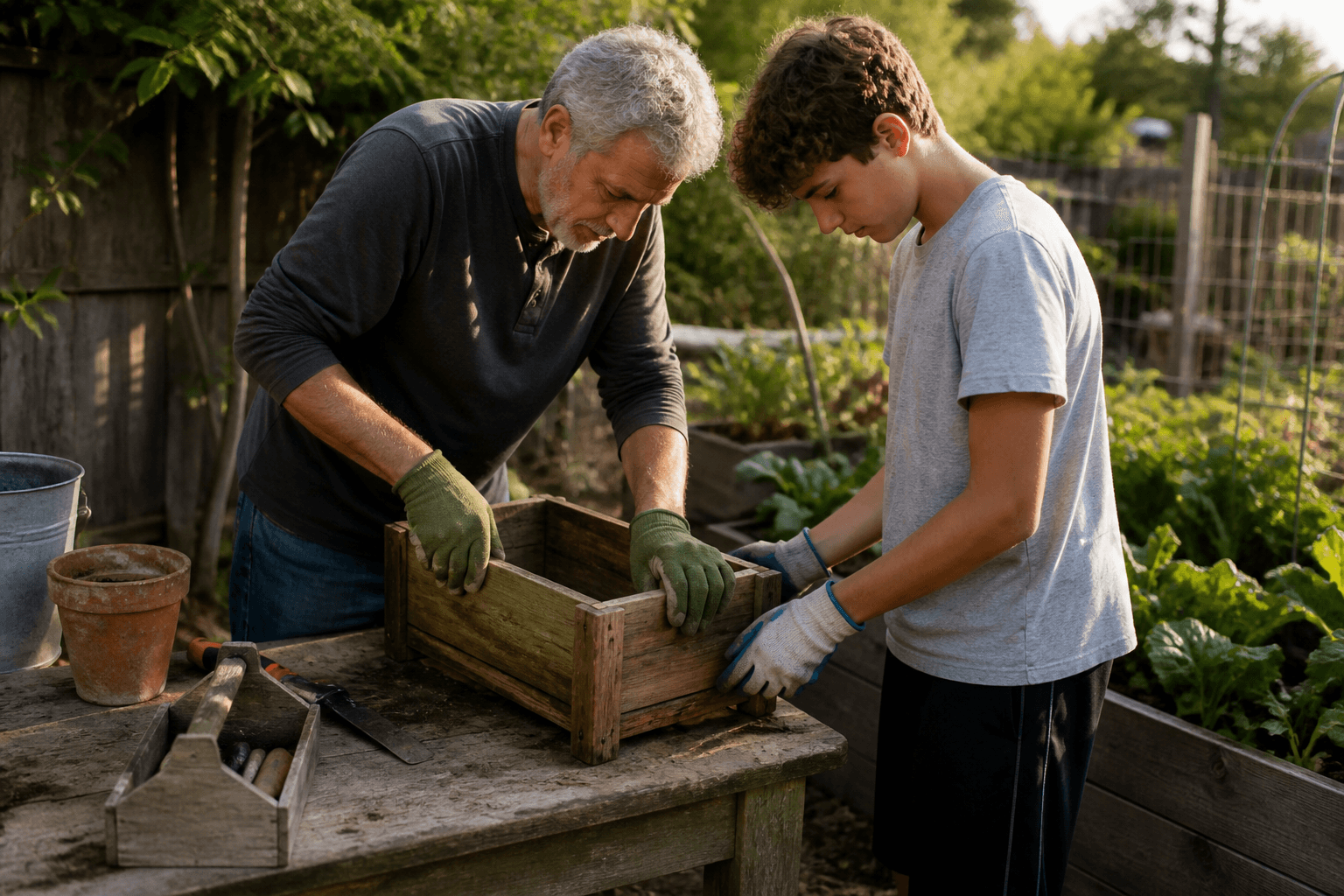
Tell the Story Behind the Rule
Rules tell a child what to do. Stories show why a choice mattered to a real person.
You might tell a grandchild about the first time you admitted a mistake at work, even though you were afraid it would cost you the job. Do not polish yourself into the hero. Include the part where you considered staying quiet, the knot in your stomach, and what happened next.
Specific details make the value memorable. “I learned that honesty matters” is a conclusion. “I sat in the parking lot for twenty minutes before walking back inside” is a story.
Family narrative research gives this idea some weight. In a 2008 longitudinal study, psychologist Michael Pratt and his colleagues examined how parents used family stories to teach values during adolescence. Their work connected the way values appeared in family narratives with later identity development.
It does not prove that one good story changes a life, but it supports what many families notice: stories give young people a place to think about choices before they face the same kind of choice themselves.
The PBS KIDS guidance on storytelling and traditions also recommends using stories to invite questions and problem-solving. The invitation matters. After your story, ask something real:
- “What do you think you would have done?”
- “Was there another choice I could have made?”
- “Have you ever felt caught between telling the truth and staying out of trouble?”
Then listen. Do not correct the first answer or rush to explain the point again.
If you want help finding stories worth telling, our guide to what a legacy interview is gives you a simple way to record the memories. You can also use the free 30 Living Legacy Questions PDF to find one story that carries the value you want to share.
The goal is not to create a perfect family legend. It is to let your grandchild meet the younger, uncertain version of you who had to make a choice.
Build a Tradition That Practices the Value
Stories give a value meaning. Traditions give it somewhere to live.
Traditions also make it easier to pass values to grandchildren because the practice returns without needing another speech.
The word “tradition” can sound grand, but the most useful ones are often small. A monthly soup afternoon for a neighbor can practice generosity. Taking care of one garden bed can teach patience and responsibility. A standing Saturday phone call where each person shares one new thing can make curiosity part of the relationship.
North Dakota State University Extension’s 2025 guide to grandparenting describes grandparents in roles such as mentor, storyteller, teacher, and family historian. Those roles work well because they grow from time spent together. They do not require a formal lesson plan.
Choose a practice with a visible action and a reasonable rhythm. Weekly may be too much if everyone is busy. Twice a year may be too rare to become part of the relationship. Monthly, seasonal, or tied to a familiar family event often works.
Here are a few examples that do not need special supplies:
- For generosity, choose one small cause together and give time before giving money.
- For responsibility, maintain a recipe book, photo archive, tool, garden bed, or family calendar together.
- For curiosity, trade one question before each visit and bring back what each of you learned.
Let the grandchild help shape the practice. A teenager may not want to bake the same holiday cookies, but they might want to record the recipe and interview the person who always made them. An adult grandchild may prefer a quarterly call about one family story rather than another physical keepsake.
That is still tradition. It is repetition with meaning, not repetition for its own sake.
ZERO TO THREE’s guide to sharing family traditions with grandchildren focuses mainly on young children, but its central idea travels well across ages: tell the story behind the practice so the child knows why it matters.
A tradition should never become a loyalty test. If the grandchild misses a month, changes the ritual, or outgrows the original version, the value can remain even when the format changes.
Respect the Parents and the Grandchild’s Right to Choose
Grandparents have influence, but parents carry the daily responsibility. Respecting that line is part of passing on values well.
You can pass values to grandchildren while making it clear that their parents are not your competition.
Start with a plain conversation: “We would love to share some family stories and traditions with Sam. Are there any values or boundaries you especially want us to support?”
That question does two things. It tells the parents you are not trying to run a second household, and it gives you useful context about what the child is hearing at home.
Sometimes you will disagree. A parent may handle faith, money, discipline, food, politics, or technology differently than you did. Sharing your experience is reasonable. Recruiting the grandchild to your side is not.
Do not use gifts, money, access, or affection as a reward for agreement. Do not criticize the parents in front of the child. Do not turn a value into a demand that the grandchild choose your career, church, political party, partner, or version of a good life.
You can say, “This has mattered in my life, and here is why.” That leaves the door open without blocking the exit.
The boundary matters just as much with adult grandchildren. They may listen closely and still choose differently. If the relationship can survive that difference, your example keeps its credibility. If love becomes conditional, the value underneath the message gets lost.
There is some humility in this. The people who influenced you probably did not control every conclusion you reached either.
Use the One-Value Method at Any Age or Distance
The One-Value Method is a simple way to pass values to grandchildren without turning the relationship into a class.
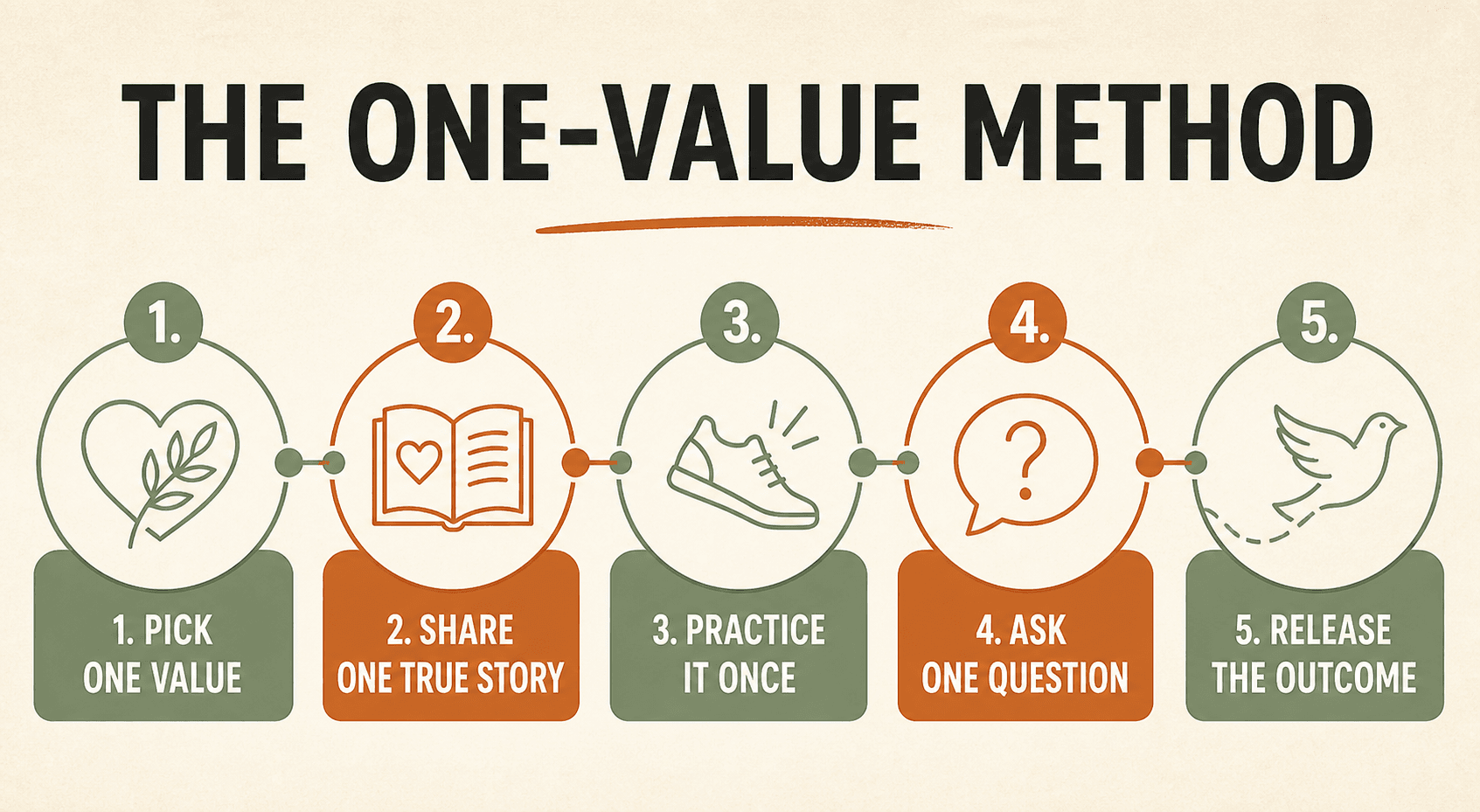
It has five parts:
- Pick one value. Choose something you live and can name in plain language.
- Share one true story. Include a choice, a cost, and your honest imperfections.
- Practice it once. Put the value inside a shared task or small tradition.
- Ask one open question. Make room for an answer you did not expect.
- Release the outcome. Let the grandchild decide what the value means in their life.
With a young child, the whole method might happen while returning a lost wallet and talking about how the owner probably feels. With a teenager, it could be a drive, a story about a hard work decision, and one question before you change the subject.
With an adult grandchild, you can be more direct: “I have been thinking about the values I hope our family carries forward. Could I tell you where my ideas about generosity came from?”
Distance changes the activity, not the method. Cook the same family recipe over video. Choose a local cause in each city and compare what you learned. Text a photo of an old object, explain why you kept it, and ask what the grandchild would preserve from their own life right now.
Small, steady contact can pass values to grandchildren across a state line just as naturally as a project at the kitchen table.
You can also record a three-minute voice message with one story. That feels more personal than a long email and less formal than scheduling a major family-history project. If the story opens a conversation, follow it. If it does not, let it rest.
Our guide to recording your parents’ life stories can help if the conversation makes both of you curious about the generations before you. The act of asking can become its own shared value: this family pays attention to where people came from.
The method stays small on purpose. One value and one moment are easier to remember than a complete speech about how life should be lived.
The Bottom Line
You do not need a family mission statement to pass values to grandchildren. You need one value, one true story, and one small chance to practice it together.
The best way to pass values to grandchildren is to keep the relationship bigger than the lesson.
Pick a twenty-minute moment this week. Make a recipe, return something that is not yours, help a neighbor, care for a family keepsake, or ask a question that lets your grandchild think out loud.
Then release the result.
That last step may be the hardest. It is also what turns a value from an instruction into a gift.
If you want to look more closely at what your everyday choices are already teaching, try our living legacy audit. It takes about ten minutes and gives you a clear place to begin.
Which value did your grandparents teach you without ever sitting you down to teach it?
Frequently Asked Questions
How do grandparents pass values to grandchildren?
Grandparents pass values to grandchildren by modeling one value in ordinary life, telling honest family stories, and practicing the value through a shared task or tradition. The relationship matters more than the lecture. Ask open questions, respect the parents’ role, and let the grandchild decide how the value fits their own life.
Which values should grandparents try to share?
Choose values you genuinely live, such as honesty, generosity, curiosity, responsibility, courage, faith, hospitality, or care for others. Start with one value that a grandchild can see in your behavior. A short list practiced consistently carries more weight than a long list you mostly talk about.
How can I share values without criticizing their parents?
Ask the parents which values and boundaries they want you to support. Speak from your own experience instead of comparing households, and never recruit the child into an adult disagreement. You can explain why a value matters to you without suggesting that the parents are doing life the wrong way.
What if my grandchildren live far away?
Use short, repeatable practices over video, phone, text, or voice messages. Cook the same recipe, trade one question each month, share a photo with its family story, or choose similar volunteer tasks in two cities. Consistency and attention matter more than being in the same room every week.
Do family stories really help children learn values?
Family stories can give children and teens a concrete way to think about choices, consequences, and identity. Research on family narratives supports their role in value teaching, but no story guarantees a certain outcome. Honest details, open questions, and a close relationship make the story more useful than a polished moral.
Want more practical ideas for building a freer, more intentional life after 50?