

You can have a respectable life and still feel as if everyone else received a head start. A friend retires early. A former coworker starts a business. Someone you knew in high school posts photos from another long trip, and suddenly your steady Tuesday afternoon feels like evidence that you missed a deadline.
That feeling gets sharper in midlife because the comparisons stack. Career, savings, relationships, health, travel, and purpose can collapse into one harsh conclusion: I should be further ahead by now.
The good news is that confidence is not reserved for people with cleaner timelines. You can rebuild it without pretending the gap is imaginary or making one dramatic move to prove you are brave.
To build confidence when you feel behind, stop measuring your whole life at once. Choose one area you can influence, make a small promise you can finish this week, complete it, and record the result. Repeated proof builds self-trust faster than trying to catch up to somebody else’s public milestones.
Please note this page may contain affiliate links. If you purchase something through these links, I’ll receive a commission at no extra cost to you. Affiliate links help support this website, and I only recommend products I believe may be useful.
Table of Contents
- Why Feeling Behind Hits Confidence So Hard in Midlife
- Decide Whether You Are Behind or Following the Wrong Clock
- How to Build Confidence When You Feel Behind
- Use the Seven-Day Proof Plan
- Change the Comparison Before It Changes You
- Know When Confidence Advice Is Not Enough
- Frequently Asked Questions
Why Feeling Behind Hits Confidence So Hard in Midlife
At 25, feeling behind might center on one question: When will I land a decent job? At 50, the question can touch six parts of life before breakfast. You may be thinking about retirement savings, an aging parent, your own energy, a career that feels stale, a relationship that changed, and the trips you keep postponing.
That is too much information for one emotional scorecard. Yet the mind often turns it into one anyway.
Psychologists separate self-esteem, your broader sense of worth, from self-efficacy, your belief that you can perform a particular action. That distinction matters. “I do not know how to change careers” is a problem you can investigate. “I am a failure because I have not changed careers” turns one unfinished task into a verdict on your entire life.
Social comparison makes that verdict feel convincing. In a 2018 meta-analysis covering more than 60 years of research, psychologists Jerry Suls, Ladd Wheeler, and Jennifer Gerber found that comparisons often produce a contrast effect.
When we look at someone who appears ahead, our estimate of our own ability and our mood can drop. The comparison does not simply provide information. It can change how we see ourselves.
That helps explain why fear can make any midlife change feel dangerous. Once your confidence takes the hit, even a small step can feel like a test of whether you still have what it takes.
The first correction is simple: stop grading your whole life. Name the one area that hurts today.
| The global verdict | The useful question |
|---|---|
| I am behind in life. | Which area feels behind right now? |
| Everyone else figured it out. | Whose result am I using as my reference point? |
| I have wasted too much time. | What can I still influence this month? |
| I am not confident enough. | What specific action do I want confidence to take? |
Specific questions give you somewhere to place your feet. The practical question is how to build confidence when you feel behind without making the comparison your identity.
Decide Whether You Are Behind or Following the Wrong Clock
Before you work on confidence, check the clock you are using. Many midlife deadlines were inherited so early that they feel like facts: own a home by this age, reach a certain title by that age, retire on the same schedule as your peers, and have a clear second act before anybody sees you hesitate.
Try the Borrowed Clock Check. Write down the milestone that is bothering you. Then ask who set the deadline, whether you still want the goal, and what would count as honest progress for your life now.
You may discover a real gap. Maybe your savings need attention, your body needs more movement, or your work situation cannot continue as it is. Naming a real gap is not an admission of failure. It is far more useful than carrying a foggy sense that everything is wrong.
You may also discover that the goal is no longer yours. There is no prize for reaching a destination you stopped wanting ten years ago.
D and I had to face that when we looked at the conventional life we had built. At 54, we sold our house, let go of most of what we owned, and moved into a fifth-wheel full-time. That sentence sounds bold when compressed into one line. The real process was quieter. We spent months talking and sat at the kitchen table more than once running the numbers.
We were not erasing the previous 54 years. We were using them. As J wrote in our honest look at why starting over in your 50s does not erase what you built, the career, responsibilities, and experience come with you.
Your version may be much smaller. It might be one class, one honest budget, one conversation with your partner, or one weekend spent testing a different routine. The size of the change is not the measure of your courage.
How to Build Confidence When You Feel Behind
If you want to know how to build confidence when you feel behind, start with evidence. A pep talk can help for an hour. A completed promise gives your mind something solid to remember tomorrow.
This is the Confidence Proof Loop:
- Choose one domain. Pick career, money, health, relationships, creativity, or another specific area. Do not choose “my life.”
- Make one small promise. It should take 15 to 30 minutes and be fully under your control.
- Complete the action. The goal is follow-through, not a perfect result.
- Record the proof. Write one sentence that begins, “This shows I can:”
- Repeat once, then raise the difficulty slightly.
Suppose you feel behind professionally. “Get a better job” is too large and depends on other people. “Spend 20 minutes listing the five problems I solve well” is small, specific, and yours. Tomorrow, you might update three lines of your resume. Later, you might ask one former coworker for a conversation.
The action is small on purpose.
In a 2016 meta-analysis of 204 experimental tests, psychologist Paschal Sheeran and colleagues found that changes in self-efficacy were linked with changes in intentions and behavior. The research does not say that one tiny task will remake your life. It supports a more grounded point: what you believe you can do and what you go on to do affect each other.
That is also the difference between a fixed verdict and a learnable skill. Instead of asking, “Am I a confident person?” ask, “What would give me one piece of evidence in this situation?”
Keep a proof log for two weeks. It can be a note on your phone or a sheet of paper. Record what you promised, what you did, and what it showed. On a rough day, read the record. Mood is loud, but evidence is patient.
Use the Seven-Day Proof Plan
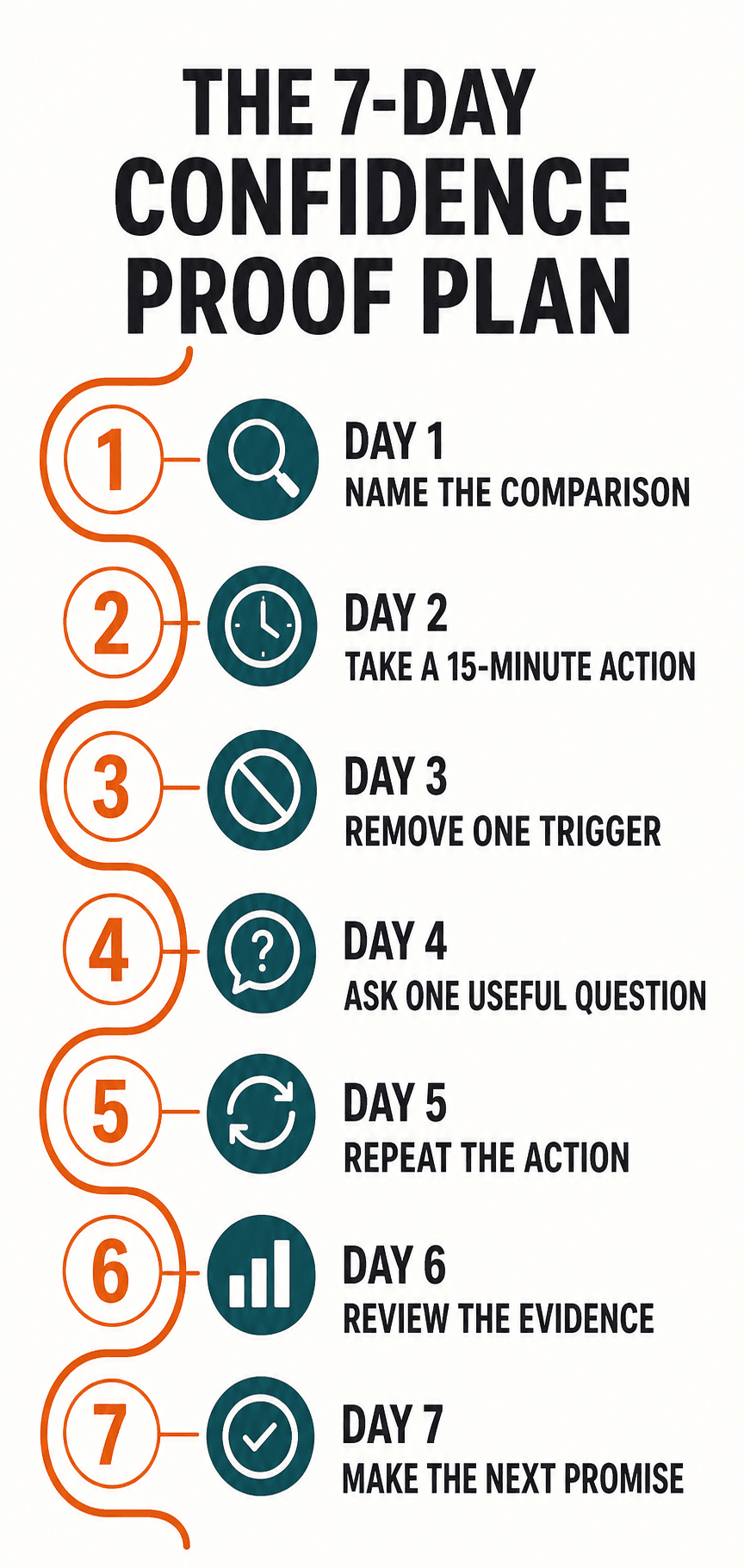
You do not need a new identity by next Friday. You need a week that produces enough evidence to change the next decision.
Day 1: Name the comparison. Finish this sentence: “I feel behind in ______ when I compare myself with ______.” Be exact. “Money when I compare myself with my brother” is workable. “Life compared with everyone” is not.
Day 2: Choose a 15-minute action. Open the retirement account you have avoided. Walk around the block. Draft the first paragraph. Send the message. Stop when the task is complete, even if you could do more.
Day 3: Remove one trigger. Mute an account for a week, move a social app off your home screen, or leave one conversation that always turns into a scoreboard. You are changing the conditions around the habit.
Day 4: Ask one useful question. Talk with someone who understands the area, but do not ask whether you are too late. Ask what their first small step looked like, what surprised them, or what they would do with 30 minutes this week.
Day 5: Repeat the action. Confidence likes familiarity. Do the same 15-minute task or the next obvious piece of it.
Day 6: Review the evidence, not the mood. You may still feel uncertain. That is allowed. Count what you completed, what you learned, and what became less confusing.
Day 7: Make the next promise slightly harder. Add five minutes, make one phone call, share the draft, or put a date on the calendar. The increase should be noticeable but manageable.
This is how to build confidence when you feel behind without turning your week into another performance. You are practicing follow-through, not racing a stranger.
Change the Comparison Before It Changes You
You will not eliminate comparison. Humans use other people to understand what is possible and where they stand. The goal is to make the comparison fairer and more useful.
A 2026 meta-analysis of 54 independent samples involving 36,583 participants found that upward comparison on social media was associated with poorer psychological outcomes, including lower self-esteem and well-being.
The authors also noted limits in the research, including the mix of cross-sectional and longitudinal designs. So the honest conclusion is not “social media ruins confidence.” It is that repeated comparison with people who appear better off can be a costly input, especially when you already feel vulnerable.
Start with your feed. Which three accounts leave you informed or encouraged? Which three leave you agitated, ashamed, or frantic? Keep the first group. Mute the second group for two weeks and notice what changes.
Then choose closer reference points. A celebrity entrepreneur is not a useful comparison for starting a local service business. A lifelong athlete is not the right clock for your first month back at the gym. Look for a near peer who started from a similar place, or compare this week’s actions with last month’s actions.
The most honest comparison is often you versus the version of you who kept postponing the first step.
This is where a larger sense of direction helps. Our guide to building a life that fits the person you are now can help when the old milestone no longer deserves your energy.
If you are trying to design a second act that fits your actual life, join our newsletter. We share the real decisions, useful tools, and honest course corrections behind our own midlife freedom plan.
Know When Confidence Advice Is Not Enough
Low confidence is common, but it does not explain every struggle. Sometimes the real issue is grief, depression, anxiety, trauma, burnout, an unsafe relationship, discrimination, or a health problem. A proof log cannot carry a job it was never meant to do.
Pay attention when hopelessness, harsh self-judgment, avoidance, sleep changes, or worry persists and interferes with work, relationships, or daily tasks. A licensed mental health professional can help you sort out what is happening and what kind of support fits.
Seeking help is not evidence that you failed to fix yourself. It is a specific action taken in response to a specific problem, which is exactly the approach this post argues for.
The Bottom Line
Learning how to build confidence when you feel behind does not require you to deny a real problem. It asks you to stop turning one unfinished area into a judgment on your worth.
Choose one domain. Check whether the deadline is truly yours. Make one small promise, finish it, and keep the evidence. Then do it again with a slightly harder step.
You do not need to catch every person you can see. You need enough self-trust to take the next honest step in your own direction.
Which timeline are you ready to stop treating as a deadline?
Frequently Asked Questions
Why do I feel behind everyone else?
You are likely comparing your private uncertainty with other people’s visible milestones and treating several life areas as one score. Name the exact area that bothers you before judging your whole life.
Can you build confidence after 40 or 50?
Yes. Confidence is often specific to a task or decision, and adults can build it by practicing skills, completing manageable actions, and keeping evidence of progress. A longitudinal study published by the American Psychological Association also found that self-esteem changes across adulthood rather than becoming fixed early in life.
What is the fastest way to rebuild confidence?
Keep one small promise today. Choose an action you can finish in 15 minutes, complete it, and write down what it proves about your ability to follow through.
How do I stop comparing my life to other people?
Reduce repeated triggers, compare within a similar context, and use your own past behavior as the main reference point. You do not need to eliminate every comparison to choose a fairer one.
When should I talk to a therapist about low confidence?
Consider professional support when hopelessness, anxiety, depressed mood, avoidance, or harsh self-judgment persists and interferes with work, relationships, sleep, or daily functioning.