

KOA’s 2026 camping report found that 48% of campers say they’re very likely to rent an RV this year. Right behind that number sits a less encouraging one: lack of operational knowledge is one of the top reasons people who want to try RVing never book the rental. They want to go. They just don’t know how to plan it without getting something wrong.
Here’s the part that makes that gap easier to close than it looks. If you want to plan your first RV trip with AI, you don’t need a dedicated app, a subscription, or a weekend lost in RV forums. You need a free AI tool you probably already have open in another tab, three specific prompts, and permission to keep the trip small.
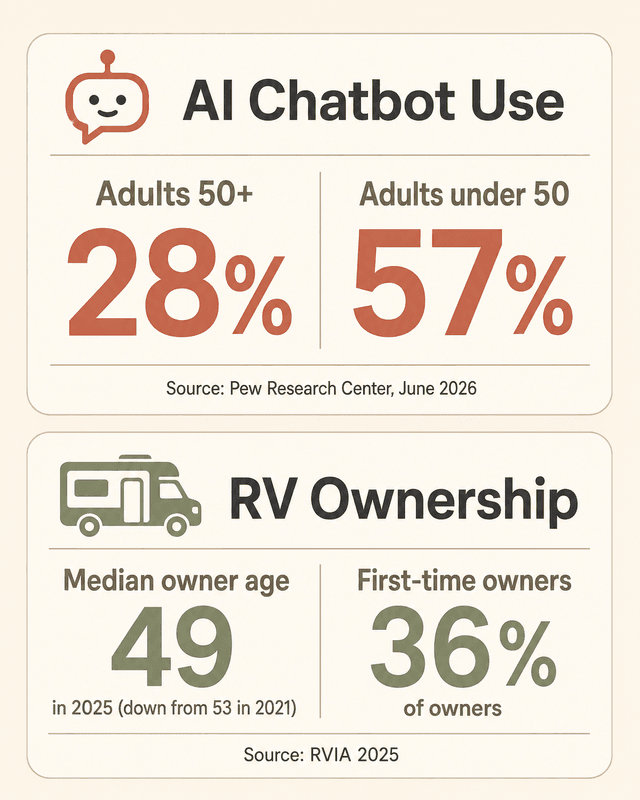
The catch is that most people in this exact situation haven’t tried either half of that equation. Pew Research found in June 2026 that only 28% of adults 50 and older use ChatGPT, compared to 57% of adults under 50. So if you’re RV-curious and AI-skeptical, you’re not behind. You’re the norm.
By the end of this post you’ll have a route sized to your actual rig, a packing list that won’t overpack your storage, and a loose two or three night plan with room to breathe, all built with a tool that costs nothing to try.
Please note this page may contains affiliate links. If you purchase something through these links, I’ll receive a commission at no extra cost to you. Affiliate links help to support my website/blog and I only recommend products I love.
Table of Contents
Why You Should Plan Your First RV Trip With AI (and Keep It Boring on Purpose)
Before you type a single prompt, decide on the constraints. A good AI answer is only as good as what you feed it, and “keep it small” is the input that matters more than any other on a first trip.
The beginner advice that shows up again and again across RV forums and lifestyle sites boils down to the same handful of rules. Keep your driving days short, somewhere around 200 miles or two to three hours. Book two or three nights, not a week. Choose a pull-through site so you’re not backing a rig you’ve never driven into a tight spot on day one. Reserve every night in advance instead of winging it. Plan to arrive in daylight.
None of that requires AI. What AI is good for is turning those constraints into an actual, usable plan without you doing the research yourself. That’s the shift in this post: instead of treating those bullet points as advice to remember, feed them to your AI tool as instructions, and let it do the legwork of building a route, a packing list, and a day-by-day plan around them.
You’re Not Behind. Most People Your Age Haven’t Tried This Yet
If part of you feels like you’re arriving late to both RVing and AI, the numbers say otherwise.
RVIA’s 2025 Go RVing Owner Demographic Profile found the median age of an RV owner dropped from 53 in 2021 to 49 in 2025, and 36% of current RV owners are first-timers. RVing skews younger than most people assume, and a huge share of the people doing it are figuring it out for the first time, same as you would be.
The AI side tells a similar story. Pew’s research puts chatbot use at 28% among adults 50 and older, against 57% for adults under 50. Only 49% of all U.S. adults have used an AI chatbot at all. If you’ve never opened ChatGPT before this post, you’re standing next to most of your peer group, not behind them.
Put those two facts together and the real barrier isn’t age or experience. It’s that nobody has shown this exact audience how to use the tool they already have access to for the trip they’re already curious about. If you’re still getting comfortable with AI tools generally, that’s a fine place to start before you come back to this one.
The Exact Prompt That Builds a Route Sized to Your Rig
This is the first of three prompts you can copy directly into ChatGPT or whatever AI tool you’re using.
“I’m planning my first RV trip. My RV is [height] feet tall, [length] feet long, and weighs [weight] pounds loaded. I’m starting from [city/state] and want a route to [destination], driving no more than 200 miles or 2 to 3 hours per day. Build me a route that avoids low bridges, weight-restricted roads, and steep mountain grades, with a pull-through campsite recommendation for each overnight stop.”
Why the dimensions matter isn’t abstract. The Federal Highway Administration sets a 16-foot minimum vertical clearance standard on the rural Interstate system, with 17 feet recommended for new construction, but that’s a minimum, not a guarantee, and plenty of local roads and older bridges sit lower than that.
Weight limits follow the Federal Bridge Gross Weight Formula, which caps most single axles at 20,000 pounds, tandem axles at 34,000 pounds, and total weight at 80,000 pounds on most highways, with real variation by road and bridge age.
A general AI tool can factor all of that in if you give it the numbers, but treat the output as a strong first draft, not gospel. Before you leave, run the same route past a state DOT clearance map or call ahead to the campground to confirm the last mile in.
We covered the same double-check habit in our post on using AI to plan a trip after 50: AI gets you 90% of the way there, and a five-minute human check catches the rest.
Run your own numbers through the Trip Budget Calculator before you book the next one. It takes five minutes and it’s the same tool that pressure-tests the split above.
The Packing List Prompt That Stops You From Overpacking
Overpacking shows up constantly in first-timer RV advice, and it’s a different problem than packing for a car trip. A trunk has a hard limit you can see. RV storage has compartments, weight limits, and a driving experience that changes when you load it wrong.
Here’s the second prompt to copy:
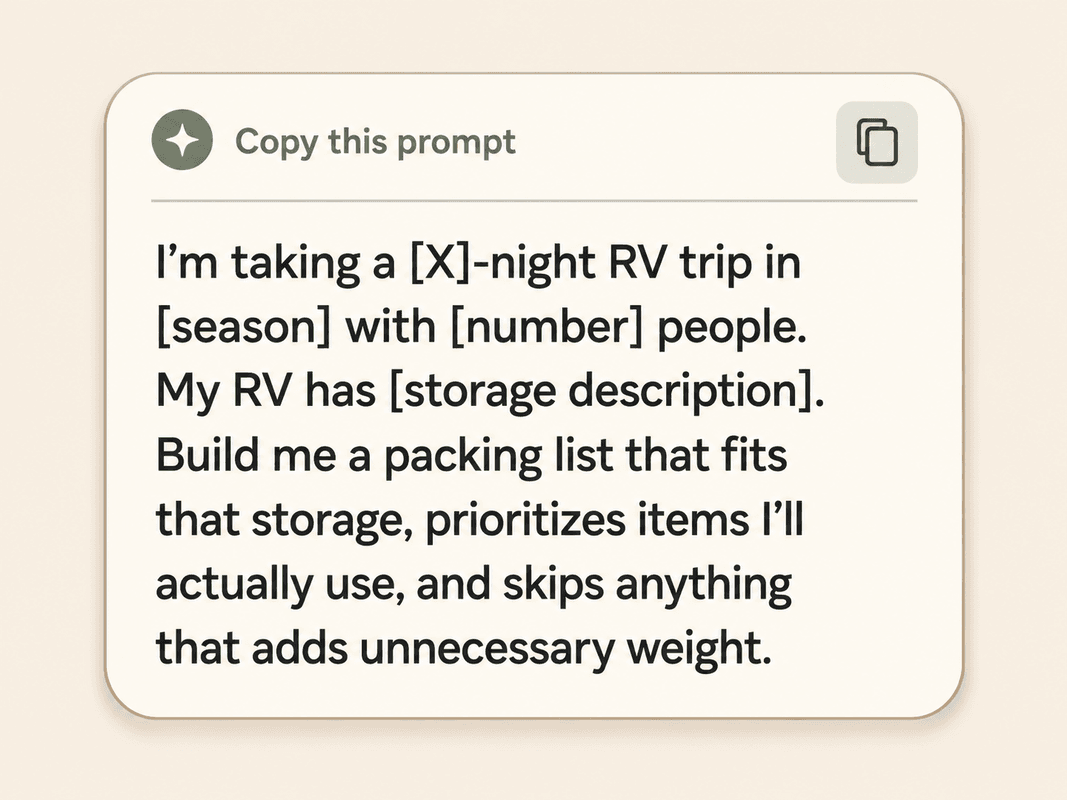
“I’m taking a [X]-night RV trip in [season] with [number] people. My RV has [describe storage: small basement bays, no basement, etc.]. Build me a packing list that fits that storage, prioritizes items I’ll actually use on a short trip, and skips anything that adds unnecessary weight.”
The difference between this and a generic “RV packing list” search is that a generic list is built for nobody in particular. This prompt forces the AI to work backward from your actual storage space and trip length instead of handing you the same 40-item list everyone else gets.
If you’ve been trying to keep the rest of your life simpler too, the same instinct applies here: fewer things, chosen on purpose, beats more things chosen out of anxiety.
Turning It Into a Day You Won’t Overbook
The third prompt takes the route and the packing list and turns them into an actual day-by-day plan, with one instruction that matters more than the rest: build in slack.
“Using this route [paste your route] over [X] nights, build me a simple day-by-day plan. Leave buffer time each day for setup, rest, and the unexpected. Don’t schedule more than one major activity per day, and make sure we arrive at each site before dark.”
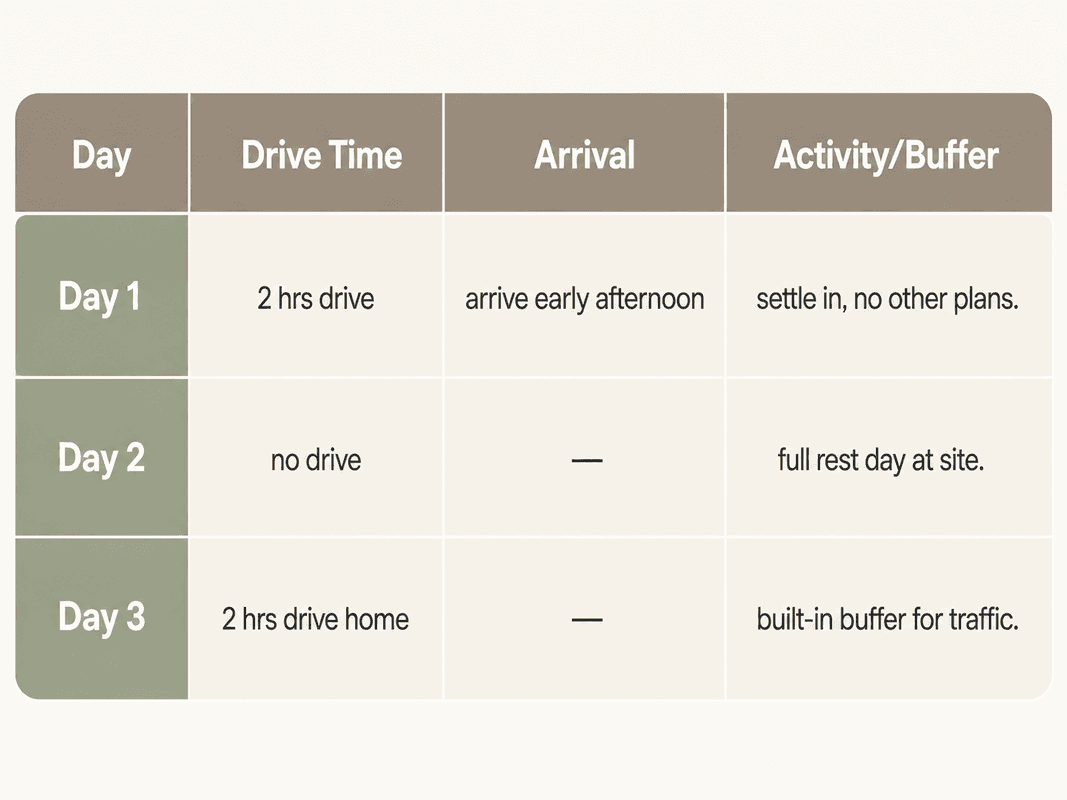
A three-night version of this might land somewhere like driving two hours to your first stop and doing nothing else that day, a full second day at the site to actually relax, and a shorter drive home on day three with time to spare if traffic runs long. The point isn’t to see more. It’s to prove to yourself that the trip is manageable before you commit to a longer one.
We wrote about RV life as a lifestyle shift rather than just a logistics problem, and the same idea holds here: an unhurried first trip tells you more about whether this fits your life than a packed one ever will.
When Free AI Isn’t Enough Anymore
Free AI is enough for one trip. It’s honest to say where it stops being enough.
If you don’t own an RV yet and you’re not sure this is even for you, Outdoorsy lets you rent one peer-to-peer instead of buying anything. There’s no subscription, you pay per booking, and it’s the lowest-risk way to find out if RV travel actually suits you before you spend real money.
The tradeoff is that quality and cleanliness vary by owner, so it’s worth comparing two or three listings instead of booking the first one you see, and prices climb fast on popular dates.
If you already know you’ll RV more than once, a free AI prompt eventually stops being the right tool for live navigation. RV LIFE Pro checks every turn against your rig’s exact height, weight, and length in real time, which is a meaningfully different job than the one-time route-building this post just walked you through.
It’s a subscription on top of something you just did for free, so it only makes sense once you know you’re doing this again, not for a single trip.
Neither of these is required to use the method in this post. They’re the honest next step for the two situations where free AI stops being the whole answer.
The Bottom Line
You don’t need a garage full of gear or a paid app to plan your first RV trip with AI. You need three prompts, your rig’s actual dimensions, and the discipline to keep the first trip short enough that nothing has to go perfectly for it to go well.
Before you book anything, run the numbers on what this trip will actually cost using our Trip Budget Calculator. Seeing the real total, gas, campground fees, food, before you commit to a longer trip later, takes as much of the guesswork out of the budget as the AI prompts above take out of the route.
What’s actually stopped you from trying a first RV trip: the cost, the logistics, or just not knowing where to start?
Frequently Asked Questions
How do I plan my first RV trip with AI?
Give a free AI tool like ChatGPT your RV’s height, weight, and length, your starting point, and a short trip length. Ask it to build a route that avoids low bridges and weight-restricted roads, a packing list sized to your storage space, and a loose day-by-day plan with buffer time built in. Three prompts cover the whole trip.
What is the best AI RV trip planner?
For a single trip, free general AI like ChatGPT is enough, and it costs nothing to try. Dedicated tools like RV LIFE Pro add live turn-by-turn navigation that checks your route in real time, which is worth paying for once you know you’ll RV more than once, not before.
How many miles a day should a beginner RV drive?
Around 200 miles or two to three hours is the working target for a first trip. Shorter driving days leave room for setup, rest, and the inevitable thing that takes longer than planned, and they’re the single most repeated piece of advice across beginner RV guides.
How do I avoid low bridges and weight-restricted roads with an RV?
Give the AI your rig’s exact height, weight, and length when you ask for a route, then double-check that route against a dedicated RV GPS or your state DOT’s clearance data before you leave. The federal standard is a 16-foot minimum vertical clearance on the rural Interstate, but many local roads sit lower and aren’t required to meet it.
Is it too late to start RVing after 50?
No. RVIA’s 2025 data puts the median RV owner age at 49, down from 53 just four years earlier, and 36% of all RV owners are first-timers. Most people doing this are figuring it out for the first time too.