
Table of Contents
Picture this. The application is open in another tab. The “book it” button on the RV listing is one tap away. The record button on your camera has that little red dot sitting there, waiting, and your thumb just won’t move.
That freeze has a name, and it isn’t weakness. Fear of change in midlife is one of the most common reasons people stay stuck in situations they’ve outgrown, and it tends to show up right when the stakes feel highest: a mortgage, a marriage, kids who still need you, a reputation you spent twenty years building.
Here’s the good news. What’s happening in your brain when change feels scary after 40 has a real explanation, and once you understand it, you can work with it instead of against it.
This post walks through why the fear shows up, what the research actually says about changing course in your 40s and 50s, and a simple way to figure out what you’re really afraid of before you decide to move (or not).
Please note this page may contains affiliate links. If you purchase something through these links, I’ll receive a commission at no extra cost to you. Affiliate links help to support my website/blog and I only recommend products I love.
Why Change Feels So Much Harder After 40
In 2010, researchers Fleming, Thomas, and Dolan published a study in the Proceedings of the National Academy of Sciences showing that the brain treats the status quo as the safer default, not because it’s actually safer, but because changing course requires more mental effort to evaluate and justify. The familiar path gets a pass. The new one gets cross-examined.
On top of that, your amygdala doesn’t wait for something bad to happen before it reacts. It fires in response to the possibility of a bad outcome, which is why even thinking about a big change can trigger the same physical response as the change itself: the tight chest, the racing thoughts at 2 a.m., the sudden urge to research the decision for the fortieth time instead of actually doing anything about it.
None of this is new. What’s different at 45 than it was at 25 is what’s actually on the table. At 25, a bad decision usually means moving back in with your parents for a few months. At 50, it can mean a mortgage, a marriage, kids who are watching how you handle pressure, and a professional reputation you’ve spent two decades building.
The brain’s “stick with what you know” setting doesn’t get weaker as you get older. The bet just gets bigger.
The Specific Things People Are Actually Afraid Of in Midlife
Fear of change in midlife rarely shows up as one big, nameable thing. It usually shows up as a tangle of smaller fears, and most people never separate them out enough to deal with any of them directly.
The first is money. Will this decision wreck what we’ve spent twenty or thirty years building? Even people with a healthy financial cushion can freeze here, because midlife money fears aren’t really about the number in the account. They’re about what happens if that number starts moving the wrong direction with fewer years left to fix it.
The second is identity. If you’ve spent two decades being “the person who does X,” whether that’s a job title, a role in your family, or a reputation in your community, stepping away from it can feel like losing a piece of yourself, not just changing your schedule.
The third is what other people will think. Family, friends, former coworkers. Will they see this as a midlife crisis? A failure? An overreaction? This fear carries more weight than most people admit out loud, and it’s worth naming directly instead of pretending it doesn’t factor in.
If you’ve ever wondered why so many people seem to hit their 40s and start questioning everything at once, why people over 40 reinvent their lives breaks down what’s actually driving that shift, and it usually traces back to one of these three fears.
What the Research Actually Says About Changing Course in Midlife
For a long time, the cultural story was that midlife comes with a built-in dip: the so-called midlife crisis, a U-shaped curve of happiness that bottoms out somewhere in your 40s before slowly recovering. That idea shaped how a lot of people think about big changes at this age, as something to survive rather than something to choose on purpose.
A 2025 population study published in PLOS One found that this dip is becoming less pronounced in more recent generations, and in some groups it’s disappearing altogether. Researchers are increasingly describing midlife less as a crisis to get through and more as a window where people have both the resources and the self-knowledge to make deliberate changes.
That distinction matters. If you’re treating a potential change as evidence that something has gone wrong, of course it feels scary. But if midlife is actually a reasonable window for reinvention, the fear is just the toll for doing something well within normal range. For more on what that looks like in practice, my honest answer on whether it’s too late to start over in your 50s digs into exactly that question.
The Fear Audit: A 10-Minute Way to See What You’re Really Afraid Of
Here’s a simple exercise that takes about 10 minutes and does more than most people expect. Grab a piece of paper, or open a blank note, and write down the specific change you’re considering. Not “make a change,” but the actual thing: leave this job, sell this house, start this YouTube channel, book this trip.
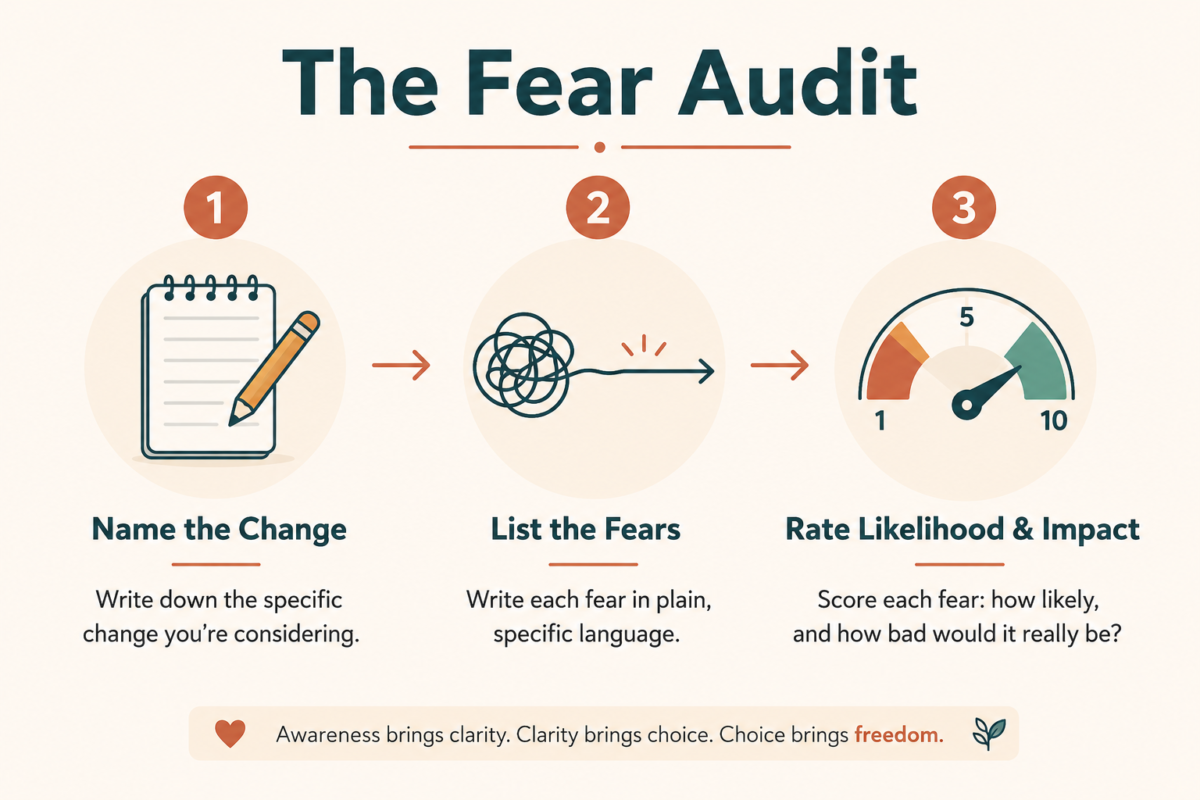
Underneath it, list every specific fear connected to that change. Not “I’m scared,” but “I’m afraid we won’t be able to afford health insurance” or “I’m afraid my parents will think I’ve lost it” or “I’m afraid I’ll fail publicly and have to explain it to everyone.”
Then rate each one on two things. How likely is it to actually happen, on a scale of 1 to 10? And if it did happen, how bad would it really be, also 1 to 10? Most people find that the fears they’ve been carrying around for months turn out to be either unlikely, survivable, or both, once they’re written down in plain language instead of left as a vague cloud in the back of their mind.
This kind of structured reflection works the same way the exercise that helped us figure out what we actually wanted does. It takes something abstract and overwhelming and turns it into something specific enough to actually work with.
Small Moves That Make Big Change Feel Less Scary
Not every change has to be all-or-nothing. One of the most useful things you can do with a scary decision is shrink it down to something you can test at a small scale before you commit to the full version.
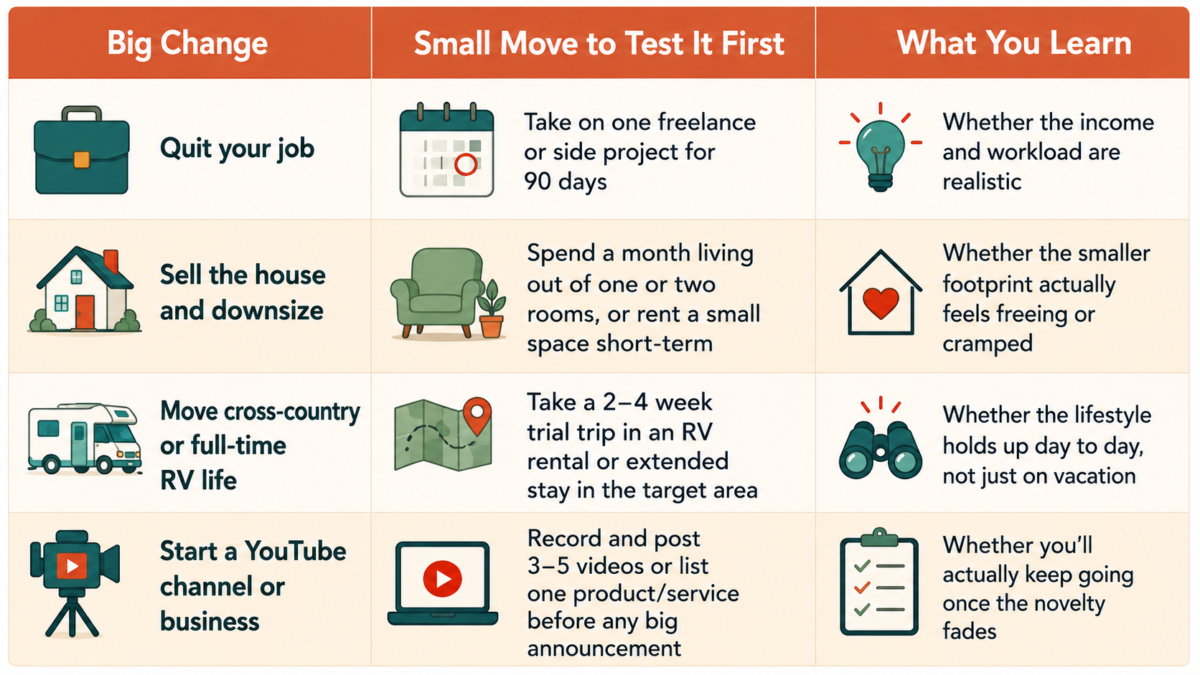
AI tools have made this kind of low-stakes testing more accessible than it used to be. How we used AI to test a new direction without quitting anything walks through how people are using AI to explore a new direction, whether that’s freelance writing, a side business, or a creative project, without quitting a job or making any big announcements first.
The same logic applies outside of work. The someday trap that almost kept us from traveling sooner is about a different kind of small move: choosing to do something now, at a smaller scale, instead of waiting for the “right” time that may never actually arrive.
The point isn’t to avoid the big decision forever. It’s to gather real information instead of imagined information before you make it.
What It Costs to Not Change Anything
Fear of change in midlife usually gets framed around the risks of acting. What gets left out is the cost of not acting, and that cost is real, even when it’s quieter.
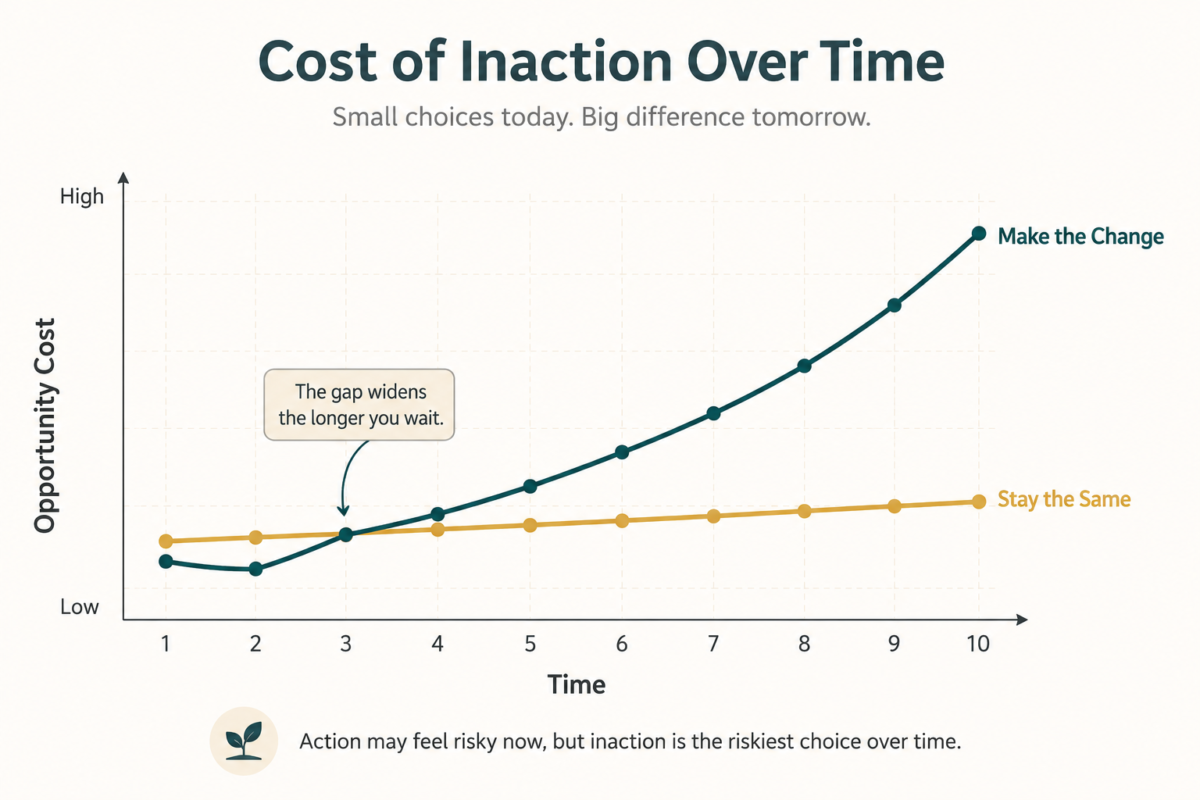
This is loss aversion at work. The brain weighs the potential losses from a change more heavily than the potential losses from staying still, even though staying still has its own price tag: years that don’t come back, opportunities that close, energy and health that don’t improve on their own.
If you’re within striking distance of retirement, this math gets sharper. What to think about in the years before you retire lays out just how finite that window actually is, and why “someday” stops being a safe default once you can count the years left on two hands.
The goal isn’t to talk yourself out of being afraid. Fear of change in midlife doesn’t disappear just because you understand where it comes from. But it doesn’t have to be the deciding vote either.
Where This Leaves You
Fear of change in midlife is real, it’s explainable, and it’s not a sign that something is wrong with you. It’s your brain doing what brains do: protecting what you’ve built by making the unfamiliar feel riskier than it usually turns out to be.
If money is the fear sitting underneath everything else for you, that’s worth tackling on its own, separately from whatever change you’re weighing right now. Start by getting honest about your actual numbers instead of the version of them living in your head.
What’s the change you keep almost making? What’s actually stopping you?
Subscribe to the newsletter below and we’ll send you the posts and tools that walk through exactly how to do that.
Frequently Asked Questions
Why is change so scary in midlife?
Change feels scarier in midlife because the brain treats stability as the safer, lower-effort choice, a pattern researchers call status quo bias. Add in real stakes like income, identity, and family roles built over decades, and the fear isn’t weakness. It’s biology meeting circumstance, and it can be worked through with small, deliberate steps.
Is it normal to feel paralyzed before a big life decision after 40?
Yes. Fear of change in midlife is common because the same brain systems that once kept early humans safe by favoring the familiar are still active today, and they get louder when more is at stake, which is exactly the position most people are in by their 40s and 50s.
What is status quo bias?
It’s a well-documented tendency to prefer things staying the same, even when a change would likely be an improvement, because the brain treats the current path as the lower-effort option (Fleming, Thomas, and Dolan, PNAS, 2010).
Ho do you start making a change when you’re scared?
Start by writing down the specific change and the specific fears connected to it, then rate each fear for how likely it is and how bad it would actually be. Most fears shrink once they’re written down in plain language instead of left vague.
Is it too late to make a major life change in your 50s?
Research increasingly frames midlife as a window for reinvention rather than something to survive. For more on this, see this post on starting over in your 50s.