
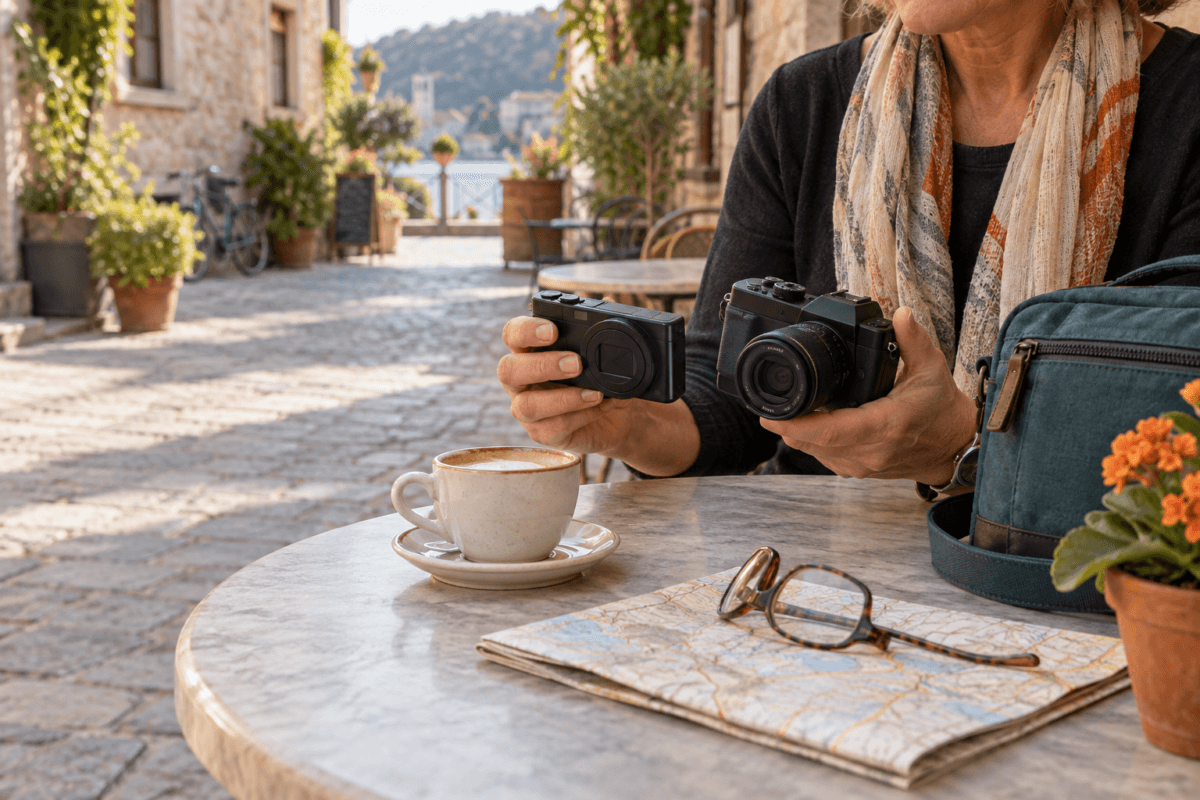
The best travel cameras for midlife photographers solve a specific problem without rebuilding the heavy bag. For most people, the answer is the Sony RX100 VII. Its pocketable body and 24–200mm equivalent zoom cover city walks, portraits, landscapes, and distant details without a lens change. Choose another only when you know exactly what the Sony cannot do for you.
We own, use, and love the products we recommend here. This post contains affiliate links, which help support The Real Life with D & J at no extra cost to you. As an Amazon Associate I earn from qualifying purchases.
Table of Contents
There is a moment on almost every trip when the big camera loses the argument. You look at the body, the two lenses, the charger, the spare batteries, and the bag that holds all of it. Shopping for the best travel cameras for midlife photographers starts when you look at the day ahead and leave the whole kit in the hotel.
I know that problem because we have spent years trying to remove friction from the way we document life. The heavier the setup becomes, the more likely it is to miss the ordinary moments that end up mattering most. A technically better camera does no good if you are tired of carrying it by lunch.
This is a research-based guide, not a claim that we have personally tested every camera below. To choose the best travel cameras for midlife photographers, I checked current manufacturer specifications, current travel-camera coverage, and the practical compromises that show up after the spec-sheet excitement wears off. The goal is simple: find the smallest camera that solves a problem your phone cannot solve.
What Matters More Than Megapixels on a Real Trip
Camera shopping gets silly fast. One model has more autofocus points. Another shoots a burst so fast it sounds like a tiny machine gun. A third promises video settings most travelers will never touch. The best travel cameras for midlife photographers earn their place through use, not through a longer feature list.
None of that answers the first question: will you carry it for eight hours?
Complete carry weight matters more than body weight. A 400-gram camera can become a heavy system once you add a long zoom, a second lens, a charger, and a padded bag. That is why compact cameras with built-in lenses deserve a serious look, even when a mirrorless body wins on pure image quality.
A viewfinder matters if bright sunlight makes a rear screen hard to see or if reading glasses turn every quick photo into a small production. Stabilization matters if you photograph church interiors, evening streets, or quiet museums where a tripod is not practical. USB-C charging matters when you want one cable and a small power bank instead of another brick in the suitcase.
Weather resistance can be worth more than resolution on a wet walking tour. It is not permission to soak a camera, and it usually depends on using a sealed lens. It does mean you are less likely to panic over a little rain or trail dust.
Then there is the grip. A tiny camera that feels slippery or cramped may be harder to use than one that weighs a few ounces more. If possible, handle your final choice before buying it. Controls that look clean in a product photo can feel microscopic after an hour in your hand.
The right camera is not the one with the most features. It is the one whose compromises you can live with.
The Five Best Travel Cameras for Midlife Photographers
Any honest list of the best travel cameras for midlife photographers needs different winners for different kinds of trips. These five cover the choices that change what you can photograph or how much you have to carry.
Sony RX100 VII: Best Overall for a One-Camera Trip
The Sony RX100 VII is the easiest answer for a traveler who wants more reach than a phone without carrying lenses. That is why it leads this list of the best travel cameras for midlife photographers. Sony lists a 20.1-megapixel 1-inch sensor, a built-in 24–200mm equivalent f/2.8–4.5 zoom, a pop-up electronic viewfinder, and a ready-to-shoot weight of 302 grams. Those numbers add up to something useful: one small camera can photograph a wide plaza, a dinner-table portrait, and a detail high on a cathedral without a lens swap.
The long zoom is the reason to buy it. A phone can handle the wide end of a trip very well, but distant architecture, wildlife, shipboard views, and compressed street scenes are where optical reach still earns its place. You can confirm the current technical details on Sony’s RX100 VII specification page.
The compromise is physical. The controls are small, the menu system takes time to learn, and the camera uses an older charging connection. The 1-inch sensor is also smaller than the APS-C sensors in several cameras below. Low-light image quality is good for the size, but it will not rewrite the laws of physics.
Buy it if you want a real zoom in a jacket pocket. Skip it if you enjoy large controls, want interchangeable lenses, or mostly photograph in very low light.
Ricoh GR IV: Best for a Camera That Truly Fits in a Pocket
The Ricoh GR IV is for the traveler who would rather move closer than twist a zoom ring. It is the smallest stills-first choice among the best travel cameras for midlife photographers. Ricoh lists a loaded weight of 262 grams, an APS-C sensor, and a fixed 28mm-equivalent lens. That is a wide, natural view for streets, markets, cafés, family tables, and the ordinary scenes that give a trip its texture.
Its biggest strength is also its biggest limitation. The lens never changes and it does not zoom. There is no built-in viewfinder either. Ricoh’s own GR IV specifications list about 250 shots under the CIPA test standard, so a spare battery makes sense for a full day.
This is the most specific recommendation here. It suits a stills-first photographer who already knows that a 28mm view feels right. It is a poor fit if you photograph distant subjects, depend on a viewfinder, or hate framing on a rear screen in bright sun.
Buy it because you want one focal length and almost no bag. Do not buy it because a fixed-lens compact looks fashionable. A camera that fights the way you see will not stay fun for long.
Canon EOS R50: Best First Step Into a Smaller Lens System
The Canon EOS R50 with the RF-S 18–45mm kit lens is the friendly choice for someone leaving a DSLR but not ready to give up interchangeable lenses. Canon lists a 24.2-megapixel APS-C sensor and a body weight of about 375 grams with battery and card. The kit lens retracts to keep the package small, and the automatic modes make it approachable without shutting the door on manual control later.
The grip and viewfinder make it feel like a familiar camera, only smaller. That can matter if a flat compact body feels awkward or if you prefer bracing the camera against your face. Canon’s official R50 kit page has the current specifications.
There are two catches. The body lacks in-body image stabilization, and the system is not built around serious weather sealing. The kit lens is pleasantly small but not especially bright, so dim restaurants and evening streets will push the camera harder.
Buy it if you want a gentle, affordable move into mirrorless photography. Skip it if you know you will immediately add three lenses. That is how the small-camera plan quietly becomes another full bag.
OM SYSTEM OM-5 Mark II: Best for Walking Trips and Uncertain Weather
Among the best travel cameras for midlife photographers, the OM SYSTEM OM-5 Mark II with the 12–45mm kit lens makes the strongest case for a small system camera outdoors. OM SYSTEM lists a 418-gram body with battery and card, IP53-certified weather sealing when used with a compatible sealed lens, USB-C charging, and up to 7.5 stops of synchronized stabilization with a supported lens. The Micro Four Thirds lens lineup also includes genuinely small travel options.
That combination matters more than the 20-megapixel number. Stabilization helps in dim streets and interiors. Weather resistance makes a rainy walk less stressful. Small lenses let the system stay small after the first purchase, which is where many APS-C and full-frame travel kits lose the plot.
Read the sealing conditions carefully on the OM-5 Mark II product page. Weather resistant does not mean waterproof, and the protection depends on the lens and the way the ports are closed.
Buy it if your trips involve hiking, long days on foot, or unreliable weather. Skip it if your highest priority is the cleanest possible files in very low light or the simplest possible menu system.
Sony a6700: Best Premium Choice for Stills and Video
The Sony a6700 is the camera here for someone who wants serious autofocus, strong video, and room to grow. Sony lists a 26-megapixel APS-C sensor, a weight of 493 grams with battery and card, USB Power Delivery, and roughly 550 to 570 still photos under the CIPA standard, depending on whether you use the viewfinder or rear screen.
It is smaller than a traditional enthusiast DSLR, but it is not pocketable. Add a big zoom and you have rebuilt the problem this article is trying to solve. Pair it with a genuinely compact lens, and it becomes a powerful one-camera setup for people, movement, travel video, and still photography.
Sony’s a6700 specification page documents the body weight, battery figures, sensor, and charging support. The real buying question is not whether it is capable. It is whether you need enough of that capability to carry a larger body.
Buy it if you shoot both photos and video, photograph moving subjects, and know which one or two lenses you will carry. Skip it if you want the smallest setup or suspect the system will grow every time you watch another gear review.
The Quick Comparison
| Camera | Ready-to-shoot body weight | Lens approach | Best reason to carry it | Main compromise |
|---|---|---|---|---|
| Sony RX100 VII | 302g | Built-in 24–200mm equivalent zoom | One pocket camera covers almost everything | Small controls and smaller sensor |
| Ricoh GR IV | 262g | Fixed 28mm equivalent lens | The least likely to be left behind | No zoom or built-in viewfinder |
| Canon EOS R50 | 375g, plus lens | Small interchangeable-lens system | Friendly first mirrorless camera | No in-body stabilization or weather sealing |
| OM SYSTEM OM-5 Mark II | 418g, plus lens | Compact Micro Four Thirds system | Stabilization and weather protection | More menus and a smaller sensor |
| Sony a6700 | 493g, plus lens | APS-C E-mount system | Best autofocus and hybrid photo-video ability | Highest cost and easiest kit to overbuild |
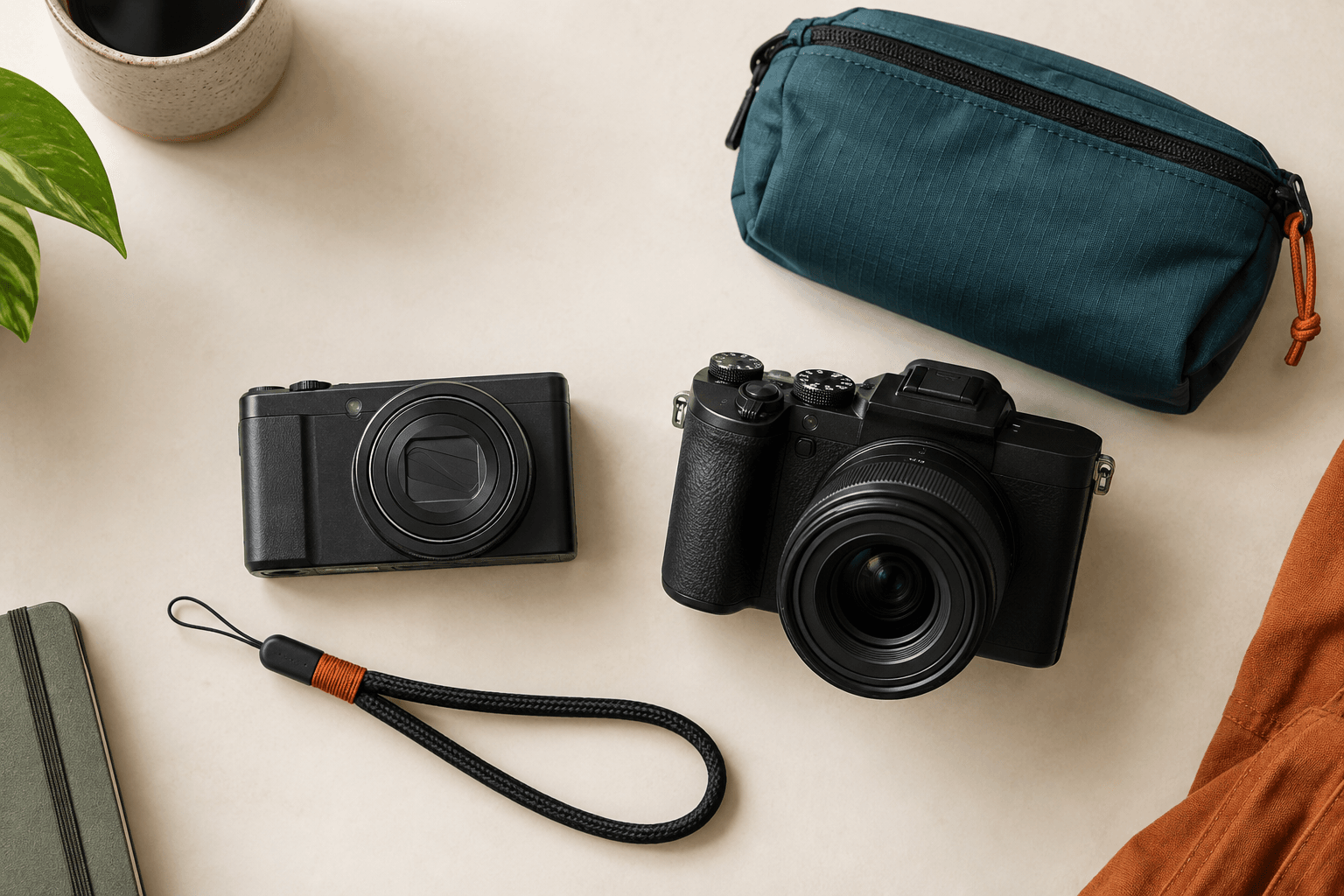
This is the practical split among the best travel cameras for midlife photographers. The RX100 VII wins for most travelers because its lens is already attached and covers a useful range. The Ricoh wins on pocketability, the Canon on approachability, the OM SYSTEM on outdoor confidence, and the a6700 on advanced hybrid performance.
That does not make any of them an automatic purchase. It gives you a clean way to match the camera to the one problem you actually want to solve.
Want more like this? Join our newsletter and discover more midlife tools and knowledge we’re actually using.
The Honest Case for Keeping Your Phone
Even the best travel cameras for midlife photographers have to beat the phone already in your pocket. Your phone may still be the right travel camera. In fact, it probably is unless you can name the shot it keeps missing.
If the problem is distant subjects, the RX100 VII’s optical zoom is a real answer. If the problem is bright sun and awkward framing, choose a camera with a viewfinder. If the problem is wet trails and shaky low-light scenes, the OM-5 Mark II offers tools a typical phone does not.
If the problem is only that a dedicated camera feels more serious, save your money. Our guide to smartphone photography for travelers over 40 covers the habits that improve most travel photos without adding a single item to your bag.
The phone has three advantages no camera can erase: it is already with you, it backs up easily, and it lets you share a photo instantly. Its weak points are handling, optical reach, battery competition, and the temptation to check email five seconds after taking a picture.
There is also a middle path. Carry the phone every day and take the dedicated camera only when the day’s plan gives it a job. A wildlife excursion, an evening city walk, or a long landscape day may justify it. A casual lunch and museum visit may not.
What to Pack With the Camera
The best small-camera kit is boring. That is a compliment.
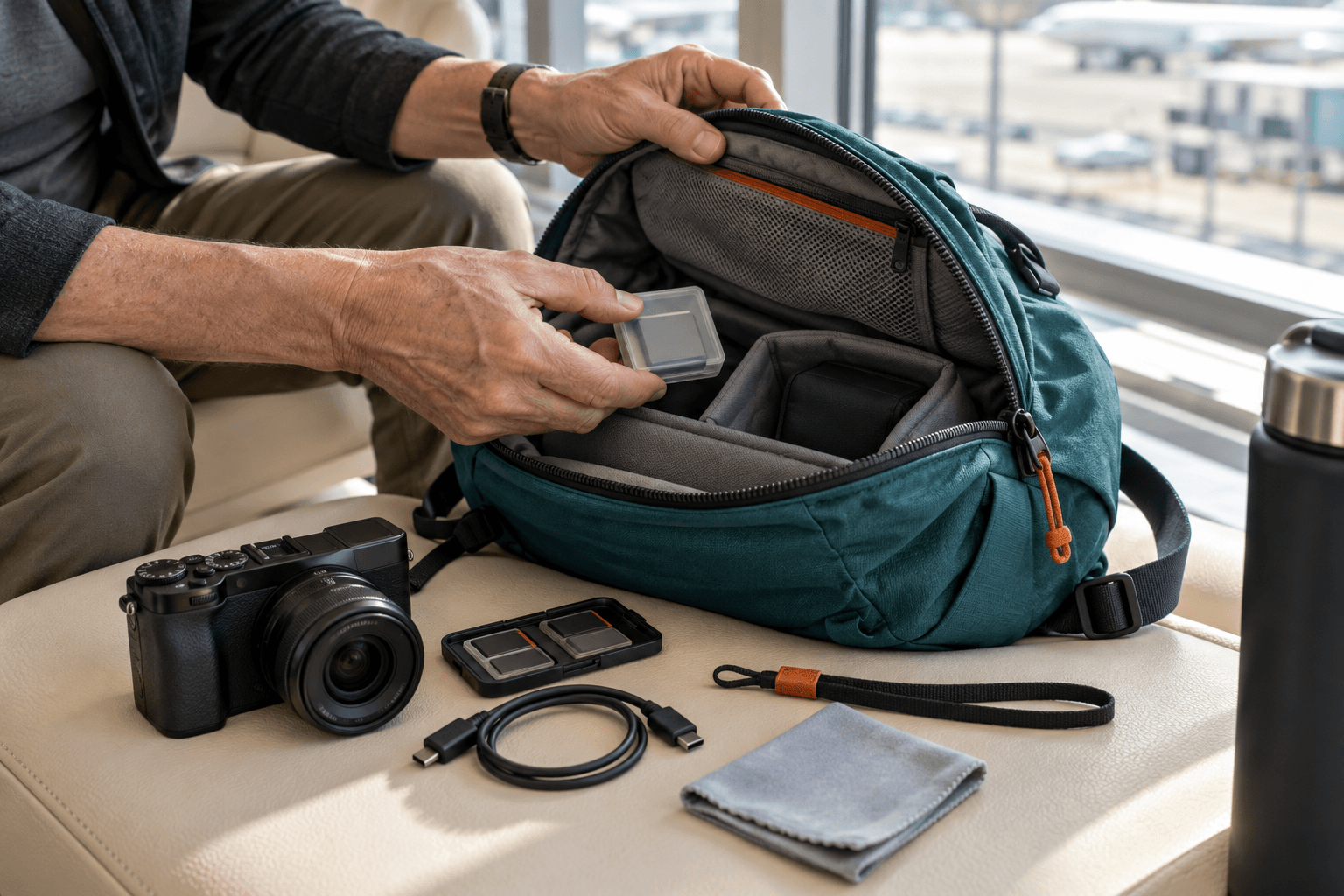
- One spare battery with its terminals protected, one reliable memory card, one wrist or cross-body strap, one small lens cloth, and one charging cable.
- A nightly routine that copies the day’s keepers to a second place. Our photo backup system for travelers explains how to make that habit repeatable.
- One lens, if you choose an interchangeable-lens camera. Add another only when the day’s subject gives you a clear reason.
The FAA’s current lithium-battery guidance says spare lithium batteries and power banks belong in carry-on baggage, not checked bags. Protect the terminals from short circuits. The FAA also recommends keeping battery-powered devices in the cabin when possible and protecting them from accidental activation.
Do not turn a lighter camera into a heavy accessory project. A compact tripod, flash, microphone, cage, and three filters may all be useful at home. On an ordinary travel day, they are five more reasons to leave the camera behind.
That is the same principle behind our broader minimalist gear for documenting life: remove the steps between noticing a moment and keeping it.
Choose the Camera You Will Still Carry
Of the best travel cameras for midlife photographers, the Sony RX100 VII is the cleanest answer for most people leaving a heavy DSLR bag. It gives up some sensor size and control comfort, but the built-in long zoom solves a real travel problem without rebuilding a lens collection.
The Ricoh GR IV is better if pocketability matters more than zoom. The Canon EOS R50 is the friendliest first mirrorless system. The OM-5 Mark II is the most sensible outdoor companion. The Sony a6700 is the strongest choice when serious video and autofocus justify a larger kit.
You do not need the best camera in the abstract. You need the camera that makes you want to bring it downstairs when the group is already waiting in the hotel lobby.
If you want to do more than collect technically good files, our guide to turning travel photos into a story is the next step.
Which problem are you actually trying to solve: reach, low light, weather, handling, or simply the weight of the bag?
Frequently Asked Questions
These are the practical questions that help you narrow the best travel cameras for midlife photographers to a short list.
Is a compact camera or mirrorless camera better for travel?
A compact camera is better when the priority is carrying less and avoiding lens changes. A mirrorless camera is better when you need a specific lens, stronger low-light performance, better video tools, or room to grow. The best travel cameras for midlife photographers can be either type. The honest test is whether you will carry the mirrorless body and lens all day.
Do I need a viewfinder on a travel camera after 40?
You do not need one, but many travelers find it useful in bright sunlight and when reading glasses make the rear screen inconvenient. A viewfinder also creates a steadier shooting position because the camera rests against your face. Try both styles in a store before deciding.
What is the best one-lens setup for travel photography?
For most trips, a small standard zoom is the safest choice. It handles wide scenes, people, food, and ordinary street details without constant lens changes. If distant wildlife or architecture matters, choose a longer all-in-one zoom and accept the added size and weight.
Is weather sealing worth paying for?
It is worth considering for hiking, coastal trips, dusty roads, and destinations where rain is part of the plan. Weather sealing reduces worry, but it is not waterproofing. The lens must usually be sealed too, and every port and door needs to be closed correctly.
Can a phone replace a travel camera?
For most daylight landscapes, meals, family moments, and social sharing, yes. A dedicated camera still earns its place when you need real optical zoom, a viewfinder, better handling, longer shooting sessions, stronger subject tracking, or more control in difficult light.
Should I choose a new camera based on my old DSLR lenses?
Only if you genuinely plan to carry those lenses. An adapter can save money, but it may keep the same size and weight problem you are trying to escape. Price the smaller native lens you would actually travel with before letting an old lens collection make the decision.