

An AI tool can hand you a polished workout in seconds. That feels useful until you notice it never asked what equipment you own, how many days you can train, or whether your knees object to the exercise it placed first.
The hard part is not getting an answer. It is knowing whether the answer fits your actual life.
To build an AI strength training plan after 40, give the tool your goal, experience, schedule, equipment, preferences, and limitations. Ask for a short full-body plan with sets, repetitions, rest, effort, and progression rules. Then compare the draft with current resistance-training guidance and have a qualified person review pain, injury, or medical concerns.
Please note this page may contains affiliate links. If you purchase something through these links, I’ll receive a commission at no extra cost to you. Affiliate links help to support my website/blog and I only recommend products I love.
Table of Contents
This guide gives you the intake, prompt, and five-part check that most AI workout advice skips. It is for a generally healthy adult who wants a sensible starting draft. It is not a diagnosis, a form assessment, or a way to program around an injury without professional help.
What an AI Strength Training Plan Can and Cannot Do
AI is good at arranging information. Tell it that you have two 35-minute windows, a pair of dumbbells, and no interest in complicated gym machines, and it can turn those limits into a tidy weekly schedule.
It can also explain unfamiliar terms, suggest a bodyweight version of an exercise, and rewrite a session when your available time changes. That makes an AI strength training plan useful as a first draft.
The problem starts when fluent writing gets mistaken for good judgment.
A 2024 study indexed in PubMed evaluated the completeness, accuracy, and readability of individualized exercise recommendations from an AI chatbot. The researchers found enough promise to keep studying the approach, but the work also shows why a readable answer is not the same as a complete prescription.
A 2026 systematic review of AI exercise recommendations described the same tension: these tools can help, yet missing context and safety limits still matter.
An AI tool cannot watch your squat, see your shoulder shift during a press, or tell whether soreness is ordinary training fatigue or a warning sign. It does not know your medical history unless you share it, and pasting private records into a general chatbot creates a separate privacy problem.
Think of the tool as a fast organizer. You remain the person who has to test the schedule, notice what your body says, and bring the right questions to a qualified human.
Give AI a Real Intake Before Asking for Exercises
Most weak plans begin with a weak request: “Make me a workout.” The model has to fill every blank, so it often invents a schedule for an imaginary person with unlimited time, perfect joints, and a fully equipped gym.
Your intake does not need to be clinical. It needs to be honest.
Write down these eight details before asking for an AI strength training plan:
- Your main goal, stated in ordinary language.
- Your recent training experience, including a long break.
- The number of days you can repeat most weeks.
- The minutes you truly have for each session.
- The equipment and space already available.
- Movements you enjoy and movements you dislike.
- Your current walking, cardio, sport, or physical-work load.
- Any movement a clinician has told you to avoid or modify.
Do not ask the chatbot to diagnose pain. If an exercise hurts, record where and when it happens, stop that movement, and take the information to a trainer, physical therapist, or clinician who can assess you.
If you are completely new, our realistic starting point for strength training after 50 explains the squat, hinge, push, pull, and carry patterns in plain English. Those same patterns give you a useful checklist when AI produces an exercise list that looks more complicated than it needs to be.
The goal is not to feed the tool your whole life story. Give it the constraints that change the plan, without adding your full name, birth date, medical-record number, or other identifiers it does not need.
Use This Prompt to Build an AI Strength Training Plan
The prompt below asks for a draft that can be checked. Replace every bracketed item with a real answer.
I am a generally healthy adult over 40. My goal is [goal]. My recent strength-training experience is [experience]. I can train [days] days per week for [minutes] minutes. I have [equipment]. My other weekly activity is [activity]. I prefer [preferences] and need to avoid [movements a qualified professional has already told me to avoid].
Build a simple full-body strength plan. Include exercise order, sets, repetition range, rest time, and an effort target that leaves a few good repetitions in reserve. Give one easier substitution for each movement. Add a conservative progression rule and explain what to do after a missed session. Ask follow-up questions instead of inventing missing information. State your assumptions and do not diagnose pain or a medical condition.
Ask for one week first. A 16-week master plan looks impressive, but it multiplies assumptions before you have tested the first session.
Read the AI strength training plan once for basic fit. Can you perform the exercises with your equipment? Does the session fit the requested time? Did the tool quietly add a third day, a cable machine, or an exercise you said you cannot do?
Then ask it to estimate the session length. If it claims eight exercises with three sets each will fit into 25 minutes, make it show the math for work and rest. An AI strength training plan should respect the clock, not merely mention it.
Finally, ask for definitions. Terms such as RPE, repetitions in reserve, tempo, and progressive overload should be explained before you use them. If the tool cannot explain a choice in plain English, the choice has not earned a place in a beginner plan.
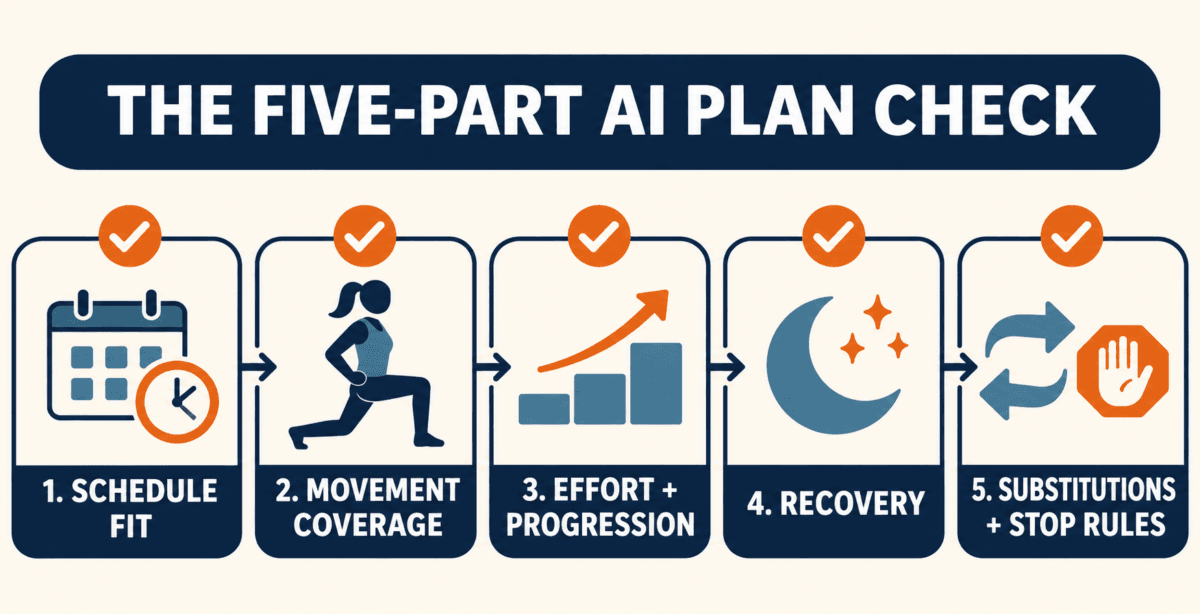
Run the Five-Part AI Strength Training Plan Check
The American College of Sports Medicine’s April 2026 position stand reviewed resistance-training evidence for healthy adults. Its practical message is reassuring: regular training matters more than fancy programming for most people.
A specific equipment type, training every set to failure, and elaborate periodization did not consistently produce better results for the average healthy adult.
That gives you permission to keep the check simple.
1. Schedule fit
The U.S. Physical Activity Guidelines recommend muscle-strengthening activity on at least two days each week. Two full-body sessions can be a reasonable starting structure for many beginners because they cover the major muscle groups without taking over the calendar.
Check that repeated full-body sessions have recovery time between them. If the plan demands four days when you reliably have two, it is not personalized. It is wishful thinking in table form.
2. Movement coverage
Look for a knee-dominant movement such as a squat or sit-to-stand, a hinge, a push, a pull, and some form of carry or trunk work. The exact exercise can change. The patterns are the useful part.
A plan does not need six kinds of curls while skipping the legs and back. It also does not need an advanced variation merely because that exercise is popular online.
3. Effort and progression
Sets and repetitions are incomplete without an effort target. A beginner plan can ask you to finish a set while you still feel capable of two or three controlled repetitions. That is easier to apply than chasing failure.
The progression rule should be just as clear. For example: when you reach the top of the repetition range with controlled form for every set in two sessions, add a small amount of resistance or choose a slightly harder variation.
The rule should also say what happens on a rough week. Holding steady or doing less is a valid adjustment. Progression is not a command to add weight every Monday forever.
4. Recovery
Check whether the plan accounts for your other activity. A hard leg session placed the day before a long hike may be a scheduling problem, even if both sessions make sense alone.
Food and sleep do not need to become a second optimization project. Our guide to how much protein you need after 40 offers a food-first way to check the basics without turning every meal into math.
5. Substitutions and stop rules
Every main movement should have an easier alternative that uses equipment you actually own. The plan should also tell you to stop for sharp pain, dizziness, chest pain, unusual shortness of breath, or symptoms that concern you.
Those rules are not decorative disclaimers. They are part of the plan.
Test One Week and Report Back With Useful Notes
Do not rate the plan after reading it. Rate it after trying the sessions, assuming you are clear to exercise and no warning sign appears.
Record five things: the load or variation, completed sets and repetitions, effort near the end of each set, any pain or unusual symptom, and the actual session length. Add one sentence about what made the workout easier or harder to complete.
That short log gives AI better material for the next revision. Instead of saying “Make it better,” you can say, “The session took 48 minutes instead of 35. The floor press felt controlled, but the split squat irritated my left knee. Do not diagnose the knee. Remove that movement and give me two supported alternatives to discuss with a trainer.”
Change one variable at a time when you can. If you replace half the exercises, add another day, increase every load, and shorten every rest period together, you will not know which change helped.
Strength is one part of a complete week. A sustainable walking plan after 40 can cover much of the aerobic side, while a few minutes of balance work after 40 trains steadiness that regular walking may miss.
Find What Is Draining Your Energy
Use the free Midlife Energy Audit to track sleep, movement, stress, connection, and daily rhythm for seven days so you can see what is actually helping and what is draining you.
When a Human Needs to Take Over
The National Institute on Aging recommends starting at an intensity that fits your current ability. It also suggests working with a trainer or class when you need help learning proper form.
That advice matters at 42 as much as it does later. A few sessions with a qualified trainer can answer questions a text box cannot: Is your range of motion appropriate? Is the load changing your technique? Is the exercise choice sensible for your body and goal?
Use a physical therapist or clinician when persistent pain, an injury, recent surgery, unexplained symptoms, or a medical condition affects exercise. Chest pain, fainting, dizziness, or unusual shortness of breath is not a prompt-writing problem.
An AI strength training plan can still help you prepare for that conversation. Bring the plan and your one-week notes. Ask which movements are appropriate, what should be modified, and which warning signs apply to you.
The best use of AI here is human plus machine. Let the machine organize. Let a qualified person assess what requires eyes, hands, clinical context, or real-time judgment.
Bottom Line
A good AI strength training plan is short enough to test, clear enough to audit, and modest enough to revise. Give the tool an honest intake. Ask for effort, rest, progression, substitutions, and stop rules. Then compare the draft with current guidance and your real schedule.
You do not need the cleverest plan. You need one that fits two ordinary weekdays and leaves you capable of coming back next week.
Which constraint changes your plan most right now: time, equipment, recovery, or confidence?
Frequently Asked Questions
Can AI make a safe strength training plan?
An AI strength training plan can be a reasonable draft for a generally healthy adult when the tool receives enough context, but it cannot watch your form, examine pain, or review your medical history. Check its exercise selection, effort, progression, and recovery, then use a certified trainer or clinician when your situation needs individual assessment.
What information should I give AI for a workout plan?
Give it your goal, training experience, days per week, minutes per session, available equipment, current activity baseline, exercise preferences, and movements you need to avoid. State that it should ask follow-up questions, explain assumptions, include substitutions, and use a conservative progression rule instead of inventing missing details.
How many days should adults over 40 strength train?
The U.S. Physical Activity Guidelines recommend muscle-strengthening activity on at least two days each week. A beginner can often cover the major muscle groups with two full-body sessions separated by recovery days. Your experience, schedule, health, and total activity can change the best structure for you.
Can AI replace a personal trainer?
No. AI can organize a first draft, explain terms, and suggest alternatives. A qualified trainer can watch how you move, correct technique, adjust load in real time, and notice problems a text tool cannot see. A physical therapist or clinician is the better choice when pain, injury, surgery, or a medical condition affects exercise.
How often should I update an AI workout plan?
Do not rewrite the whole plan after every hard session. Test a simple plan long enough to collect useful notes, then change one variable at a time. Ask for a review when the sessions no longer fit your schedule, progress has stalled, equipment changes, or an exercise causes a problem that needs a safe substitution.