

Walking sounds almost too ordinary to count as a workout. There is no class to book, no complicated equipment, and no need to punish yourself before breakfast. That simplicity can make walking after 40 easy to dismiss. It can also make walking one of the most repeatable ways to build a healthier week.
Walking after 40 is enough to cover much of your weekly aerobic exercise if you reach a brisk, moderate intensity for about 150 minutes a week. Start below that if needed. Walking does not replace the two weekly strength sessions or balance work recommended for a complete fitness routine.
Please note this page may contains affiliate links. If you purchase something through these links, I’ll receive a commission at no extra cost to you. Affiliate links help to support my website/blog and I only recommend products I love.
Table of Contents
- Why Walking After 40 Counts as Real Exercise
- Use Two Lanes: Daily Movement and Brisk Minutes
- How Many Minutes of Walking Do You Need?
- How Many Steps Should You Get After 40?
- A Four-Week Walking Plan That Starts Small
- What Walking Does Not Fully Train
- When to Slow Down and Ask for Help
- Bottom Line
- Frequently Asked Questions
The useful answer to walking after 40 is not a magic daily step number. It is learning the difference between moving more, walking briskly enough to train your heart and lungs, and adding the kinds of exercise that walking does not fully cover.
This guide gives you a practical way to do all three. No fitness identity required.
Why Walking After 40 Counts as Real Exercise
Walking is not the consolation prize you choose when you cannot handle a “real” workout. Done at a moderate effort, it is aerobic activity. The Centers for Disease Control and Prevention recommends at least 150 minutes of moderate-intensity aerobic activity each week for adults, along with muscle-strengthening activity on at least two days.
Brisk walking is one of the examples the CDC gives for moderate activity. That matters because many adults can repeat it without learning a new sport, paying a membership, or blocking out an hour at a time.
Walking also has a low setup cost. You can start at your front door. Ten minutes before work, after lunch, or while dinner is in the oven can count toward a weekly total. A walk can fit into a life that would reject a complicated workout plan by Wednesday.
Consistency is the part that changes the math. One heroic Saturday does not have the same practical value as movement you can repeat. If you are rebuilding your routines, connect walking to a simple longevity routine you can repeat instead of treating every walk as a test of willpower.
The goal is not to make walking impressive. The goal is to make it regular enough to matter.
Use Two Lanes: Daily Movement and Brisk Minutes
People often ask, “How much walking is enough?” as if every walk serves the same purpose. It helps to separate walking after 40 into two lanes.
Lane one: total daily movement
This lane is about spending less of the day completely still. Parking farther away, walking while you take a call, taking the stairs, and making a loop around the block all add movement.
An easy walk still counts here. So does standing up and moving for five minutes between long stretches at a desk. If screen-heavy days leave you flat, try using a short walk to break up long screen blocks. You are changing the shape of the day even if the walk never becomes brisk.
This lane is especially useful when your current activity is low. Going from very little movement to a bit more is real progress. You do not need to earn the right to begin with a harder workout.
Lane two: intentional brisk minutes
This lane is where walking becomes moderate-intensity aerobic exercise. You move with purpose, your breathing increases, and the effort feels noticeable.
The CDC offers a simple talk test for moderate intensity: you can talk, but you cannot sing. You do not need a smartwatch to use it. Say a full sentence out loud. If conversation is possible but a song would be uncomfortable, you are probably near the right effort.
Your brisk pace will not look exactly like someone else’s. Hills, heat, fitness, medications, health conditions, and terrain can all change the speed that produces a moderate effort. The test is how the pace feels in your body, not the number on another person’s treadmill.
Both lanes matter. Daily movement reduces the long inactive stretches that can take over work and home life. Brisk minutes help you work toward the weekly aerobic target. A good plan uses both without pretending they are identical.

How Many Minutes of Walking Do You Need?
For many adults, 150 minutes of moderate activity per week is the clearest target. You could reach it with 30 brisk minutes on five days. You could also use fifteen 10-minute walks across the week. The total matters more than making every session look like a formal workout.
That does not mean you must jump straight to 150 minutes. If a 30-minute brisk walk feels unrealistic today, begin with five or ten minutes at a pace you can manage. The Office of Disease Prevention and Health Promotion advises people returning to activity to start slowly, even with five-minute bouts.
Here are three workable weekly versions:
- Five 30-minute brisk walks
- Ten 15-minute brisk walks
- A mix of longer weekend walks and short weekday walks that reaches about 150 minutes
Your easy walks can sit around those sessions. A ten-minute stroll after lunch may help you add movement even when it does not reach a moderate effort. It can also create a natural reset if the afternoon energy crash tends to arrive with your second cup of coffee.
If you are already walking 150 brisk minutes and recovering well, the CDC says additional activity can provide more health benefits. More is an option, not a moral grade. The right amount is one you can recover from and continue.
How Many Steps Should You Get After 40?
Ten thousand steps is a familiar target, but it is not a universal pass-fail line for walking after 40. A person averaging 3,000 steps does not need to leap to 10,000 before walking becomes worthwhile.
A 2025 systematic review by Ding and colleagues in *The Lancet Public Health* combined evidence from 57 studies. Compared with 2,000 daily steps, 7,000 steps was associated with a 47 percent lower risk of death from any cause. Several outcome curves changed most around 5,000 to 7,000 steps.
That is an association from observational research, not a guarantee and not proof that 7,000 is the perfect number for every body. The more useful lesson is that benefits appeared well below 10,000 and followed a gradual pattern.
Use your own baseline instead of borrowing a stranger’s finish line:
- Track an ordinary week without trying to perform for the number.
- Find your average daily steps.
- Add an amount you can repeat, such as 500 daily steps or one 10-minute walk.
- Hold that level long enough to learn how it fits your energy, schedule, and recovery.
- Add again only when the current level feels stable.
A phone can estimate steps if you already carry it, but step tracking is optional. Minutes, route landmarks, or completed walks work too. The best measure is the one that helps you act without turning your day into a scoreboard.
Steps and brisk minutes answer different questions. Steps show total movement. Brisk minutes show how much intentional moderate aerobic work you are getting. You can improve either one without waiting for both to be perfect.
A Four-Week Walking Plan That Starts Small
This plan is for a generally healthy adult who can walk comfortably and wants structure. Adjust the pace and duration to your current ability. If five minutes is the honest starting point, use five.
Week 1: Learn your baseline
Take a comfortable 10-minute walk on four days. Notice when the walk fits best and what makes it easier to start. Do not force the pace yet.
If 10 minutes is too much, turn around after two or three minutes. The win is completing a repeatable session, not rescuing an imaginary streak.
Week 2: Add frequency
Keep the walks around 10 minutes and aim for five days. Use an existing cue, such as finishing lunch, closing your laptop, or returning from the school run.
You are changing one variable: frequency. Keeping the duration steady makes it easier to tell whether the new schedule is sustainable.
Week 3: Make part of each walk brisk
During four or five walks, spend five minutes near the talk-test pace. The rest can stay easy. If five brisk minutes is too much, alternate one brisk minute with two easy minutes.
You are changing pace now, not pace and duration at the same time. This is how a plan becomes informative instead of merely difficult.
Week 4: Build the weekly total
Add five minutes to two or three walks, or add one more short brisk walk. Work toward a total that fits your current capacity. Reaching 150 brisk minutes may take longer than four weeks, and that is fine.
An example week might include five 20-minute brisk walks, two short strength sessions, and two or three five-minute balance practices. That is not the final destination. It is a solid week that can grow.
If the plan starts competing with sleep, recovery, or an existing health need, reduce it. Fitness that only works during an unusually calm week is not a useful system.
Find What Is Draining Your Energy
Use the free Midlife Energy Audit to track sleep, movement, stress, connection, and daily rhythm for seven days so you can see what is actually helping and what is draining you.
What Walking Does Not Fully Train
Walking does many things well. It does not ask your major muscle groups to work against enough resistance to satisfy the strength part of the activity guidelines. It also does not challenge balance in varied directions the way targeted practice can.
The CDC recommends muscle-strengthening activity on at least two days each week. That can include weights, resistance bands, body-weight movements, or other exercises that work the major muscle groups.
If strength work feels like a completely separate fitness world, this practical guide to strength training after 50 can help you find a reasonable starting point. The goal is not to replace walking. It is to cover a capability walking leaves undertrained.
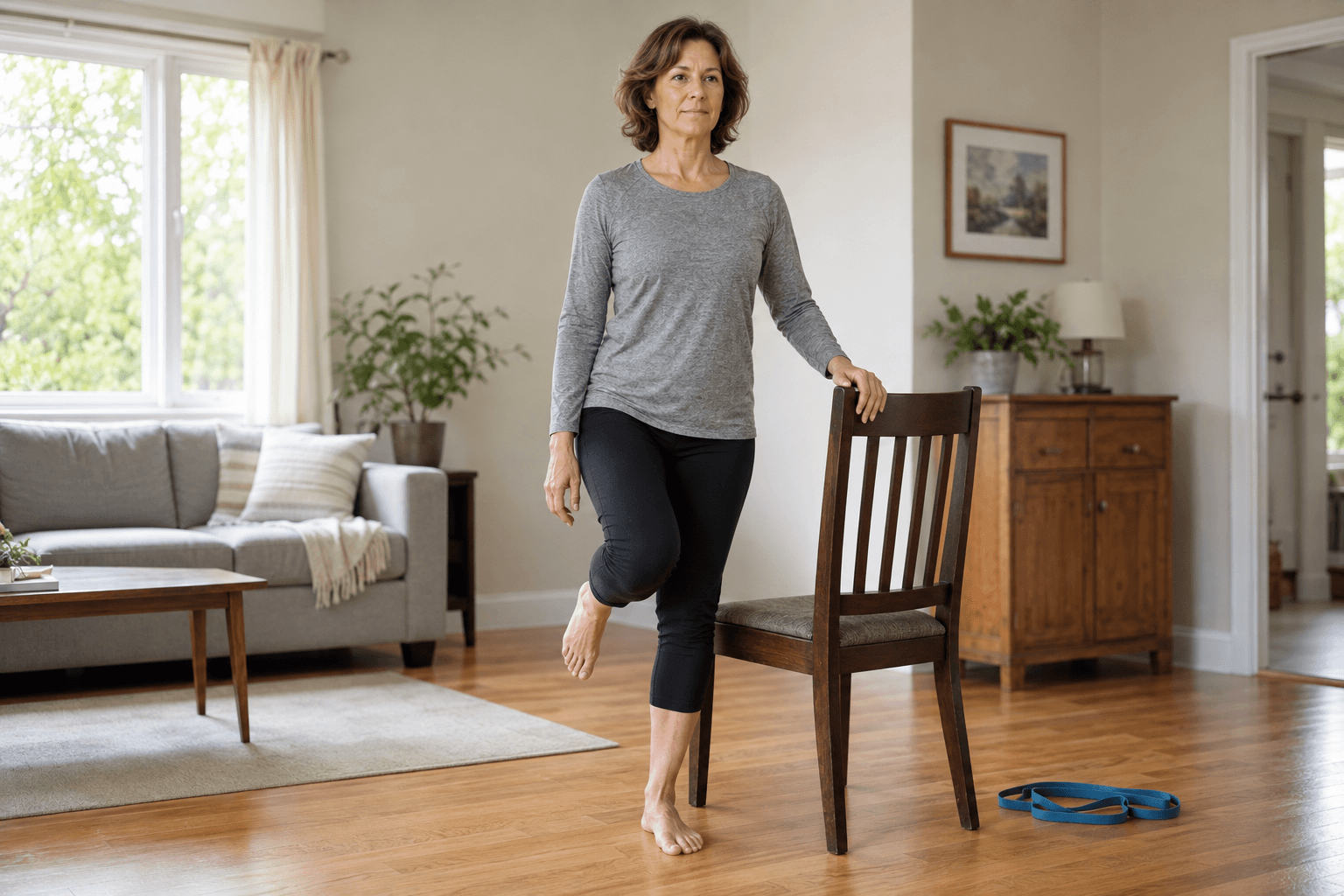
Balance deserves its own small place too. A few minutes can be attached to something you already do, such as waiting for coffee or brushing your teeth. Start with support nearby and use a few minutes of balance practice to make the habit less intimidating.
Think of the complete routine as three pieces:
- Walking for aerobic activity and daily movement
- Strength work twice a week for muscles and function
- Brief balance practice for steadiness and control
You do not need to do all three in every session. You need room for all three across the week.
When to Slow Down and Ask for Help
Some effort is normal. You may breathe faster, feel warmer, and notice your leg muscles working. Pain that changes your stride, dizziness, or symptoms that worry you are different.
The Office of Disease Prevention and Health Promotion advises talking with a clinician about warning signs including chest pain, unusual shortness of breath, and unplanned weight loss. If you have a health condition, take medications that affect exercise response, or are returning after an illness or injury, ask a qualified clinician what starting point makes sense for you.
Walking after 40 should build confidence in your capacity, not train you to ignore useful signals. Slow down, shorten the route, choose a flatter surface, or stop when the situation calls for it.
Bottom Line
Walking after 40 is not a lesser workout. It can be the aerobic foundation of a routine you can actually repeat. Count easy walks as movement, use the talk test for intentional brisk minutes, and build from your baseline instead of chasing a magic step number.
Then give strength and balance their own small places in the week. A complete plan does not have to be complicated to be complete.
Which feels more realistic this week, adding ten minutes to one walk or making one familiar walk a little brisker?
Frequently Asked Questions
How much walking after 40 is enough?
Aim toward 150 minutes of moderate-intensity aerobic activity each week. Brisk walking can supply those minutes, and shorter walks count when they add up.
Is 30 minutes of walking every day enough after 40?
Thirty minutes on five days reaches the 150-minute aerobic target if the pace is moderate. Daily walking can add more movement, but a complete routine still needs strength and balance work.
How many steps should adults over 40 walk per day?
There is no universal pass-fail number. A 2025 systematic review found benefits across a range, with several curves changing most around 5,000 to 7,000 steps. Start from your baseline and build.
Does a casual walk count as exercise?
It counts as movement. It counts toward moderate aerobic minutes when the effort is high enough that you can talk but not sing.
What should I add to walking after 40?
Add muscle-strengthening work on at least two days each week and brief balance practice. Those cover abilities that steady walking alone does not fully train.