
Table of Contents
The first time you really notice your balance is usually small. You step off a curb wrong, catch yourself on a railing you didn’t think you needed, or wobble pulling on a pair of pants while standing on one leg. It passes in a second, so you laugh it off and keep moving.
That’s exactly the problem. Balance training after 40 rarely gets attention because nothing about it feels urgent yet. Most people in their 40s, 50s, and early 60s are focused on walking more, lifting weights, or eating better, all of which matter. Balance just sits quietly in the background, getting a little worse every year, until a fall or a scare forces the issue.
This is not fall-prevention advice for “old people.” It’s about keeping the steadiness and confidence that everything else in midlife depends on: stairs, curbs, hiking trails, cruise gangways, grandkids who want to be chased around the yard. Below is a simple 10-minute routine you can start today, plus the reasoning behind it and a few honest notes on what balance training is not.
Please note this page may contains affiliate links. If you purchase something through these links, I’ll receive a commission at no extra cost to you. Affiliate links help to support my website/blog and I only recommend products I love.
Why Balance Training After 40 Matters More Than You Think
Balance training after 40 is a simple way to improve steadiness, coordination, and confidence before balance problems become limiting. It usually includes supported moves like single-leg stands, heel-to-toe walking, sit-to-stand control, and side steps. Done consistently, it helps protect mobility, independence, and everyday movement.
Balance is not one single skill. It depends on muscle strength, eyesight, the inner ear, reaction time, and something called proprioception, which is your body’s sense of where it is in space without looking. All of those systems work fine on autopilot for years. Then, sometime in your 40s, the margin for error gets a little thinner.
The CDC’s fall-prevention research mostly tracks adults 65 and older, but the patterns behind it, slower reaction time, weaker stabilizing muscles, less varied movement, start showing up well before then. That’s the case for starting balance work now instead of waiting until it becomes a medical conversation. A few small habits, paired with the kind of small, sustainable changes that protect long-term health, go a long way.
Why Balance Starts to Feel Different in Midlife
A few things shift quietly in midlife. Strength declines if it isn’t actively maintained. Desk jobs and long commutes mean less varied movement throughout the day. Ankles and hips get stiffer. And after one too many almost-falls, confidence takes a hit, which makes people move more cautiously and, ironically, lose practice at recovering from a stumble.
“Use it or lose it” applies to your nervous system just as much as your muscles. If you never ask your body to balance on one leg, walk heel to toe, or catch a wobble, those skills fade the same way an unused muscle does. This is part of why the strength training that often gets the credit for protecting mobility after 50 pairs so well with balance work. Strength gives you the power to recover from a stumble. Balance gives you the skill to know you’re stumbling in the first place.
Neither one works as well without the other. Plenty of strong adults still have shaky balance because strength and balance are coordinated by different systems in the body. You can be perfectly capable of a heavy squat and still wobble stepping off a curb in the dark.
Harvard Health Publishing has noted that better balance is linked to better overall function and independence as people age, not just fewer falls. That’s the real prize here. It’s not about avoiding a worst-case scenario. It’s about staying steady enough to keep doing the things you actually enjoy.
Think about the last few times you traveled. Uneven cobblestones, a rocking cruise deck, a curb with no ramp, a hiking trail with loose gravel. None of that is exotic. It’s ordinary travel terrain, and it’s exactly where weak balance shows up first, long before it shows up anywhere else.
The 10-Minute Beginner Balance Routine
Before starting, set up for safety. Stand near a wall, countertop, or sturdy chair you can grab if needed. Use a flat, non-slippery floor. Stop immediately if you feel dizzy, lightheaded, or sharp pain.
Here is a simple six-move routine, done with light support at first:
- Tandem stance. Stand heel-to-toe, like on a tightrope, for 20-30 seconds per side.
- Single-leg stand. Lift one foot slightly off the floor and hold for 10-20 seconds per side.
- Heel-to-toe walk. Walk in a straight line, placing the heel of one foot directly in front of the toes of the other, for 10-15 steps.
- Sit-to-stand control. Stand up and sit down slowly from a sturdy chair, five to eight times, focusing on control rather than speed.
- Calf raise hold. Rise onto your toes and hold for 5-10 seconds, three to five times.
- Side steps. Step sideways 10 times in each direction, keeping your steps controlled rather than rushed.
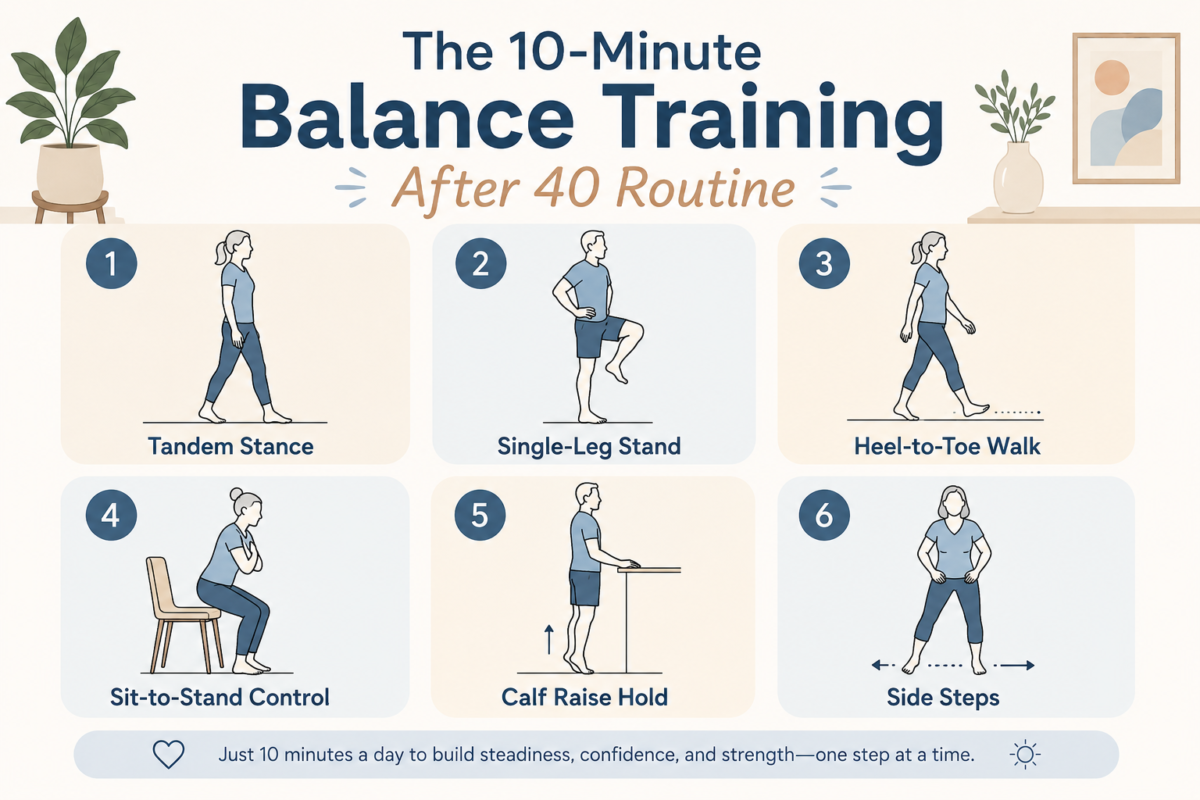
Start every move with your hand resting on a counter or chair back. As balance improves over a few weeks, use lighter fingertip support, then no support at all, and only consider an unstable surface like a folded towel or balance pad once the basics feel solid.
Most people notice the single-leg stand is the hardest move at first and the one that improves the fastest. Don’t skip it just because it feels shaky in week one. That shakiness is the whole point. It means your stabilizing muscles and nervous system are finally being asked to do something they’ve been coasting past for years.
How to Add Balance Work Without Starting a New Workout Plan
Nobody needs another 45-minute commitment squeezed into an already full week. The easiest way to make this stick is to attach it to something you’re already doing.
Try a 2-2-2 rhythm: two minutes in the morning, maybe right after brushing your teeth, two minutes in the evening, and two slightly harder moves twice a week after a walk or workout. Consistency matters more than intensity here. Three short sessions a week will do more for you than one long, sporadic one.
This is the same logic behind setting goals that are actually small enough to keep. The habit succeeds because it’s attached to something that already happens every day, not because it requires more willpower.
What This Routine Is Not
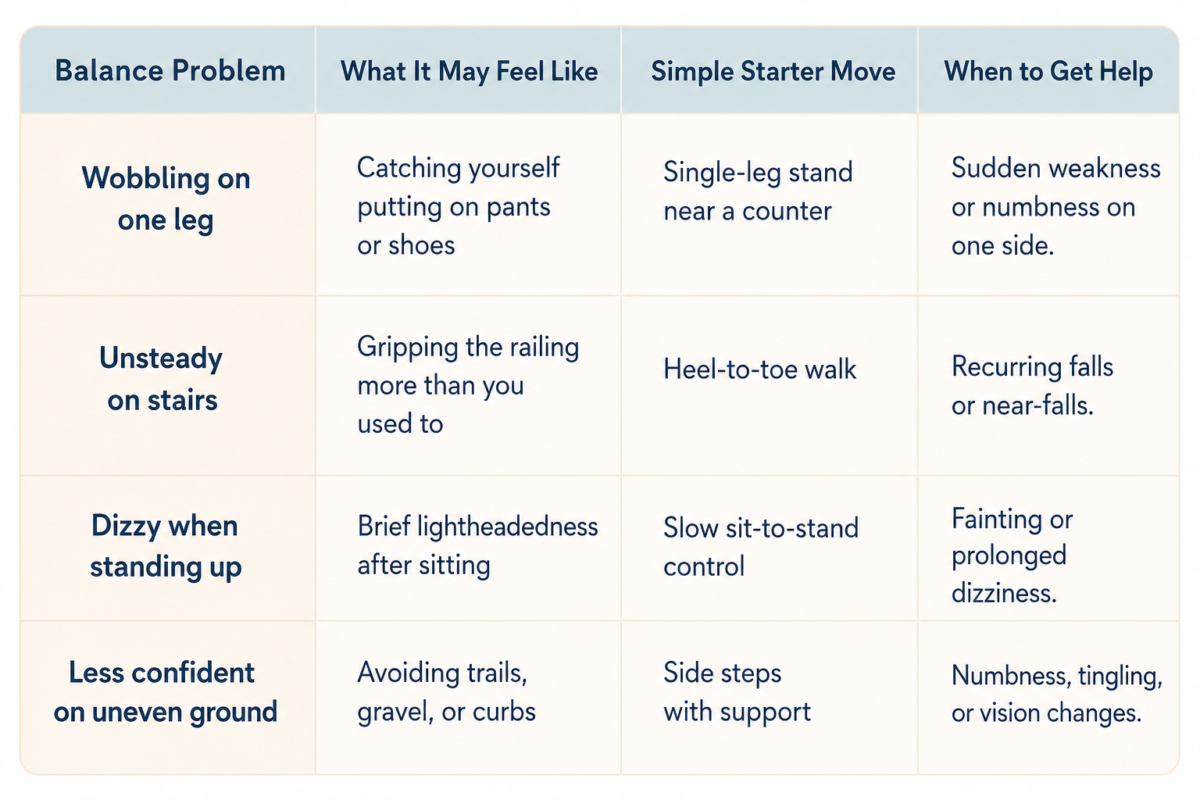
A few honest boundaries are worth setting. Balance training is not a replacement for medical care. If you’re dealing with dizziness, fainting, numbness, sudden weakness, or you’ve had a fall you can’t explain, see a doctor before starting anything new. The NHS and Cleveland Clinic both note that unexplained balance changes deserve a proper evaluation, not a YouTube workout.
It’s also not a circus act. You don’t need a wobble board, a yoga handstand, or an advanced single-leg deadlift on day one. Start with the basics above and let your body earn the harder variations.
And it isn’t only for “old people.” That label keeps a lot of active, capable people in their 40s and 50s from taking balance seriously until it’s already a problem. Treat it as maintenance, the same way you’d rotate your tires before they go bald, not as an admission that something is wrong.
How to Know It’s Working
Progress with this kind of training shows up in small, practical ways before it shows up on any test. You’ll notice steadier steps on stairs, less hesitation getting out of a low car seat, and more confidence catching yourself if you trip on uneven pavement.
If you want a simple baseline, time how long you can hold a supported single-leg stand and retest every two to four weeks. Most people see a real, noticeable improvement within a month of consistent practice. It’s a similar kind of small-pattern tracking to what helped us figure out our own afternoon energy crashes: you don’t need a lab test to notice when something is working, you just need to pay attention for a few weeks.
Keep your expectations realistic. This isn’t about becoming a gymnast. It’s about regaining a little more control and confidence in the ordinary moments of your day.
A lot of people also notice they stop avoiding things without realizing it. Fewer hesitations at the top of the stairs. Less gripping the cart at the grocery store. More willingness to step onto a boat, a trail, or an uneven sidewalk without scanning for something to hold onto first. Those small shifts add up to a noticeably more confident way of moving through the world.
The Bottom Line
This kind of training doesn’t need to be dramatic, expensive, or time-consuming. Ten minutes, a sturdy chair, and a little consistency is enough to start protecting the independence that everything else in midlife is built on, including the travel, the hikes, the grandkids, and the everyday confidence of trusting your own footing.
Try the routine above three times this week. Notice what feels hardest and start there.
What’s one moment lately where your balance surprised you, in a good way or a bad one?
If you found this useful, consider joining our newsletter for more realistic, no-nonsense midlife health guidance. We share what’s actually working for us, not just what sounds good in a headline.
Frequently Asked Questions
Can balance improve after 40?
Yes. Balance can improve with consistent practice because the body adapts through strength, coordination, proprioception, and confidence. Start with supported exercises near a counter or chair.
How often should I do balance training after 40?
Most beginners can start with 5-10 minutes, three times per week. Shorter daily practice can also work well if it stays safe and consistent.
What is the easiest balance exercise to start with?
A supported single-leg stand is one of the simplest. Stand near a counter, lift one foot slightly, hold for a few seconds, then switch sides.
Do I need equipment for balance training?
No. Beginners can start with bodyweight moves and a sturdy support surface. Equipment like balance pads should wait until basic control feels solid.
When should poor balance be checked by a doctor?
If balance problems come with dizziness, fainting, numbness, sudden weakness, repeated falls, or unexplained changes, see a doctor before continuing on your own.