
Table of Contents
At some point after 50, something shifts. Maybe it’s the second trip you suddenly need to make to carry groceries in from the car. Maybe it’s your knees having an opinion about the stairs, or that little grunt that escapes when you push yourself up off the floor after playing with a grandkid. None of that means you’re falling apart. It means your muscles have been quietly losing strength for years, and nobody told you there was something simple you could do about it.
That something is strength training after 50, and most of the advice out there gets it wrong in one of two directions. Either it’s so gentle it amounts to seated arm circles, or it assumes you already own a barbell and know what “progressive overload” means. If you’ve never lifted anything heavier than a suitcase, neither version is much help.
This guide splits the difference. We’ll look at what’s actually happening to your muscles after 50 (it has a name: sarcopenia), why this kind of training is one of the most effective ways to slow or reverse it, and exactly how to start at home with little or no equipment. No gym membership required, and no assumption that you already know what you’re doing.
Please note this page may contains affiliate links. If you purchase something through these links, I’ll receive a commission at no extra cost to you. Affiliate links help to support my website/blog and I only recommend products I love.
What Actually Happens to Your Muscles After 50 (And Why It Matters)
There’s a word for what’s happening, and once you know it, the whole picture makes more sense: sarcopenia. It’s the gradual loss of muscle mass, strength, and function that comes with aging. According to the Cleveland Clinic, this loss tends to accelerate after age 60 if nothing is done to counter it, though the process actually begins much earlier, often in your 30s and 40s.
This isn’t only about how your arms look in a t-shirt. Less muscle means a slower metabolism, weaker bones, worse balance, and a higher risk of falls and fractures down the road. The National Institute on Aging notes that maintaining muscle mass and strength is one of the biggest factors in staying independent later in life. That means carrying your own bags, getting off the floor without help, and keeping up on a walk without thinking twice about it.
Here’s the part that should feel like good news: sarcopenia is not a one-way street. Unlike some aspects of aging, this one responds directly to what you do with your body. If you’ve already started taking your midlife maintenance seriously, like adding creatine to your daily routine, strength training is the piece that makes everything else work harder for you. Creatine without the muscle work that creates demand for it is a bit like buying premium fuel for a car that never leaves the driveway.
Why Strength Training Is Your Best Defense Against Muscle Loss
Strength training, also called resistance training, is the single most effective tool available for slowing sarcopenia and, in many cases, partially reversing it. The CDC recommends that adults do muscle-strengthening activities that work all the major muscle groups, including legs, hips, back, chest, shoulders, arms, and core, at least two days a week.
Two days a week. That’s the whole recommendation. Not five days, not two hours a day. Training at that frequency has been shown to support bone density, balance, and metabolic health, which happen to be the same three things sarcopenia chips away at over time.
It also tends to be one of the more sustainable habits you can build, because the payoff shows up fast. Most beginners notice they can carry groceries in one trip, or stand up from a low chair without using their hands, within a few weeks of starting. If you’re working on building habits that actually stick for the long haul, strength training is a strong candidate, because the feedback loop is so immediate. You feel the difference before you see it.
How to Start Strength Training After 50 If You’ve Never Lifted Before
If the words “strength training” make you picture a gym full of mirrors and people who already seem to know what they’re doing, let that image go. Strength training can start in your living room, with nothing but your own bodyweight, and that’s a completely legitimate place to begin.
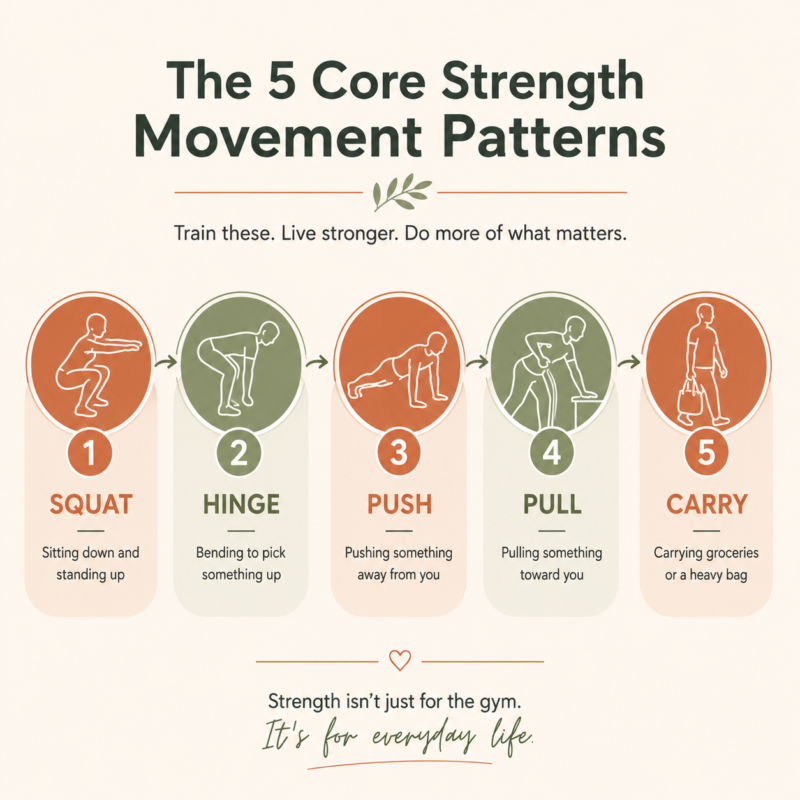
The goal at the start isn’t to lift heavy. It’s to learn five movement patterns that show up constantly in everyday life: squatting (sitting down and standing back up), hinging (bending to pick something up off the floor), pushing (pushing open a heavy door, pressing yourself up from the ground), pulling (opening a drawer, a rowing motion), and carrying (literally, carrying things from one place to another). Once your body can do these well using just its own weight, adding resistance later becomes simple.
One more thing before you start. If you’ve been inactive for a while, manage a heart condition, have joint issues, or have any condition your doctor watches closely, a quick check-in before you begin is worth the ten minutes. For most healthy adults, though, starting with light bodyweight movements is considered safe. The biggest risk at this stage isn’t doing too much too soon. It’s doing nothing at all, for another year.
Bands vs. Dumbbells vs. Bodyweight: What to Actually Use First
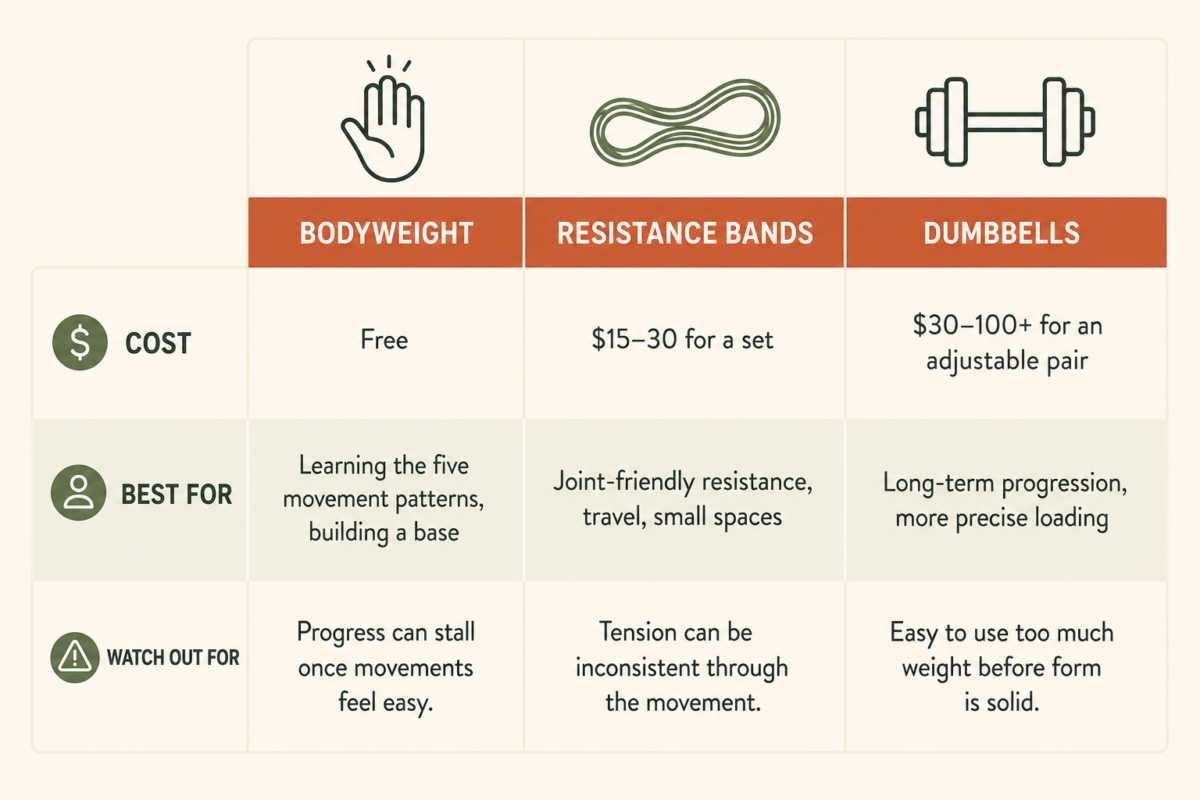
Most articles about getting started jump straight to a workout plan and assume you already own equipment. Before buying anything, it helps to know what each option actually does well, because the right starting point depends on your space, your budget, and how your joints feel on a given day.
Bodyweight exercises cost nothing and travel with you, which makes them the obvious starting point. Resistance bands are inexpensive, take up almost no space, and tend to be forgiving on joints because the resistance increases gradually as the band stretches. Dumbbells, especially a single adjustable pair, are the most versatile long-term option, but they’re also the easiest to misuse if your form isn’t solid yet.
A reasonable progression looks like this: spend two to four weeks on bodyweight only, add a light set of resistance bands once squats and push-ups feel controlled, and bring in dumbbells once you’re comfortable adding load to those same patterns. There’s no prize for skipping steps, and skipping them is usually how people end up with a sore shoulder and a reason to quit.
A Simple Starter Routine You Can Do at Home
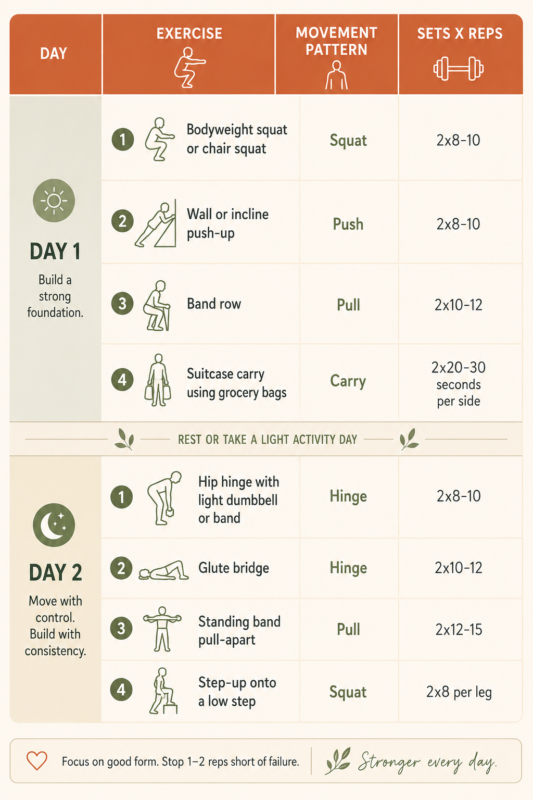
This routine covers all five movement patterns across two short sessions, and most people can get through either day in under 30 minutes, including a short warm-up.
For the first few weeks, focus on form over reps. Two sets of eight to ten repetitions per exercise is plenty. Once that feels manageable, add a third set, and only then start adding light resistance.
Consistency matters more than intensity here. If you respond well to having a plan, pairing this routine with a goal-setting approach that’s actually realistic can be the difference between a routine that lasts two weeks and one that lasts two years.
Staying Consistent: Recovery, Realistic Timelines, and What Comes Next
Recovery matters more after 50 than it did at 25, and that’s not a bad thing. It just means rest days are part of the plan, not a sign you’re falling behind. Give your muscles at least one full day off between strength sessions that work the same muscle groups.
As for timelines: in the first two to four weeks, most of what you’ll notice is that everyday movements feel more controlled and small tasks feel a little easier. Visible strength gains, and changes in how your clothes fit, tend to show up around the two to three month mark.
A 2025 review in Frontiers in Physiology found that older adults who stick with resistance training consistently for several months see measurable improvements in muscle strength and function, even when starting from a sedentary baseline.
If recovery is already on your mind, there’s a case for what’s actually worth adding to a recovery routine, beyond just rest days and protein.
And if starting this kind of training in your 50s feels like part of something bigger, you’re not imagining it. A lot of people quietly wonder whether 50 is too late to start over on something new, and the honest answer is the same for your muscles as it is for the rest of your life. It’s not too late, but the sooner you start, the more runway you give yourself.
The Bottom Line
This isn’t about chasing the body you had at 30, and it isn’t about becoming a “gym person” if that’s never been you. It’s about making sure that getting up off the floor, carrying your own bags, and keeping up on a long walk stay easy for as long as possible.
Two short sessions a week, built around five movement patterns you already use every single day, is enough to start reversing muscle loss that’s been happening quietly for years. The hardest part isn’t the exercises. It’s starting before you feel like you need to.
Find What Is Draining Your Energy
Training works better when recovery is part of the plan. Use the free Midlife Energy Audit to track movement, sleep, stress, connection, and daily rhythm for seven days so you can see what supports your energy and what may be getting in the way.
What’s one everyday task, like carrying groceries, climbing stairs, or getting up off the floor, that feels harder than it used to? That’s usually the best place to start.
Frequently Asked Questions
How often should you do strength training after 50?
At least two days a week, working all major muscle groups including legs, hips, back, chest, shoulders, arms, and core, according to CDC guidelines for older adults. Beginners can start with bodyweight movements or resistance bands and add load gradually as form and strength improve over time.
Is it too late to start strength training at 50 or 60?
No. Research from the National Institute on Aging shows older adults can still build meaningful strength and muscle mass, and consistent training at any age helps slow age-related decline.
What’s the best equipment for strength training beginners over 50?
Resistance bands and bodyweight exercises are ideal starting points because they’re affordable, joint-friendly, and naturally self-limiting. Dumbbells can be added once the basic movement patterns feel comfortable and controlled.
How much muscle do people typically lose after 50?
Muscle mass naturally declines with age. The Cleveland Clinic notes that this loss, known as sarcopenia, tends to accelerate after age 60 if left unaddressed, which is part of why starting resistance training in your 50s has such an outsized protective effect.
Do you need a doctor’s approval before starting a strength training program in your 50s?
If you’ve been inactive for a while or manage an existing health condition, a quick check-in with your doctor is a smart idea. For most healthy adults, starting with light bodyweight movements is considered safe without one.