

Most adults need at least 0.8 grams of protein per kilogram of body weight each day. How much protein do you need after 40 though? A practical planning range is often 1.0 to 1.2 grams per kilogram when preserving muscle and staying active matter. Your health, training, and clinician’s advice can move that number.
Please note this page may contains affiliate links. If you purchase something through these links, I’ll receive a commission at no extra cost to you. Affiliate links help to support my website/blog and I only recommend products I love.
Table of Contents
- Forty Is Not a Magic Protein Cutoff
- Calculate Your Protein After 40 Target
- Choose the Right Part of the Range
- Start With an Ordinary-Day Protein Audit
- Spread Protein Across Meals Without Chasing Perfection
- A Food-First Day Around 85 Grams
- Do You Need Protein Powder?
- Pair the Number With Strength, Movement, and Enough Food
- When to Ask a Professional Before Increasing Protein
- Bottom Line
- Frequently Asked Questions
Forty Is Not a Magic Protein Cutoff
Let’s clear up the first confusing part. Nothing happens on your 40th birthday that suddenly assigns you a new protein number.
The official adult Recommended Dietary Allowance, or RDA, is 0.8 grams per kilogram of body weight per day. That recommendation comes from the National Academies’ Dietary Reference Intakes. It applies across adulthood. There is no separate federal RDA labeled “after 40.”
Then why do you keep seeing higher numbers?
Because researchers and clinical nutrition groups have asked a different question: What intake may better support muscle and function as people get older? The PROT-AGE Study Group and an ESPEN expert group recommended roughly 1.0 to 1.2 grams per kilogram per day for healthy adults over 65. Those are expert recommendations for older adults, not a new legal minimum for every 40-year-old.
That distinction matters. The 0.8 number is a sound adult baseline. The 1.0 to 1.2 range is a useful planning tool if you are thinking ahead about muscle, strength, and an active life. It is not permission to treat every meal like a bodybuilding contest.
Our take on protein after 40 is fairly boring, which is probably a good sign: know your baseline, pick a reasonable range, and spend more time building repeatable meals than arguing over the perfect number.
Calculate Your Protein After 40 Target
You need two pieces of math. Neither requires a fitness app.
- Divide your weight in pounds by 2.2 to estimate kilograms.
- Multiply that number by 0.8 for the adult baseline, or by 1.0 to 1.2 for the practical planning range.
Here is the quick-reference version. The numbers are rounded so you can use them in real life.
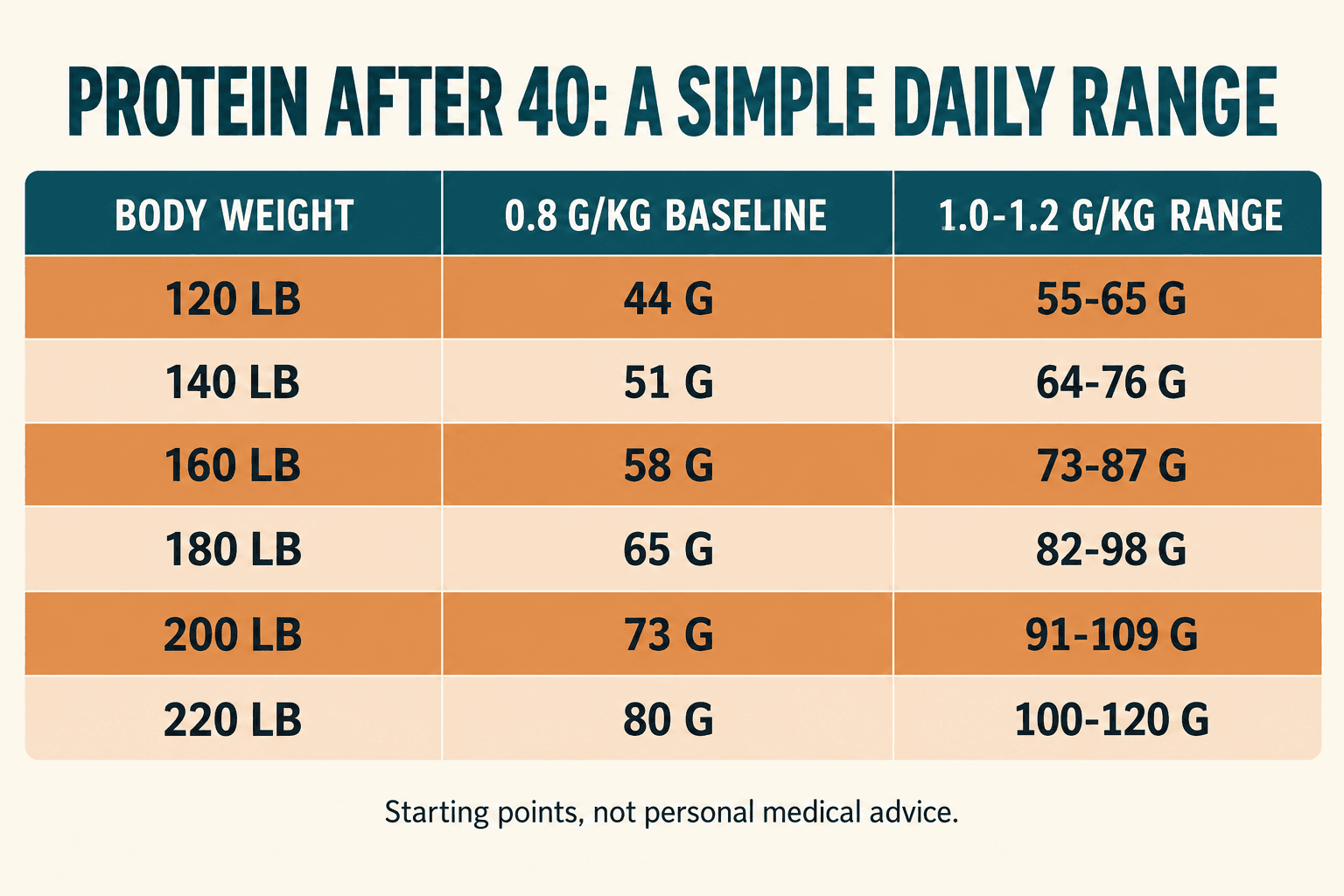
For example, a 165-pound adult weighs about 75 kilograms. The baseline calculation is 75 times 0.8, or 60 grams. The planning range is 75 to 90 grams.
That gives you a lane instead of a single bull’s-eye. Your protein after 40 target does not have to land on the same gram every day. If you eat 82 grams one day and 75 the next, the protein police will not arrive at your door.
What if your current body weight is not a useful guide?
Body-weight formulas are convenient, but they are not personal nutrition assessments. A clinician or registered dietitian may use a different weight when someone has substantial excess weight, is underweight, is losing weight without trying, or is recovering from illness.
The same is true during pregnancy, after surgery, and with some chronic health conditions. A calculator can give you a starting point. It cannot read your medical chart.
Choose the Right Part of the Range
If you are generally healthy, less active, and eating enough food, start by seeing whether you meet the 0.8 g/kg adult baseline. You may discover that you already do.
If you are lifting weights, trying to maintain muscle while losing weight, or planning for active older years, the 1.0 to 1.2 g/kg range is a reasonable conversation starter. It lines up with older-adult expert guidance without jumping straight to athlete-level intake.
People doing serious strength or endurance training may choose a higher target with qualified guidance. A 2018 systematic review and meta-analysis found small additional gains in strength and fat-free mass when protein supplementation accompanied resistance training. In the studies analyzed, protein above about 1.6 g/kg/day did not add further fat-free-mass gains.
That does not mean everyone needs 1.6 g/kg. It means “more” eventually stopped producing another measurable benefit for that outcome in that research.
If keeping your muscle is the goal, protein works best as one part of the plan. Our guide to strength training after 50 explains why the training signal matters. Food supplies building material. Your muscles still need a reason to use it.
Start With an Ordinary-Day Protein Audit
Before you change anything, write down what you ate yesterday. Do not pick your most virtuous Tuesday. Pick an ordinary day.
Look up the protein on labels or in a reliable food database, then total the day. You are not signing a lifetime contract with food tracking. You are gathering one useful piece of information.
Ask three questions:
- Did I meet my baseline?
- Which meal had almost no protein?
- What is the smallest food change that would close the gap?
Breakfast is often the easiest place to find a gap. Toast and coffee may get you out the door, but they do not contribute much protein. Adding eggs, Greek yogurt, cottage cheese, soy food, or leftovers can change the total without rebuilding your whole morning.
Lunch can be another quiet miss. A salad becomes more substantial with chicken, tuna, lentils, beans, tofu, tempeh, eggs, or a scoop of cottage cheese. The vegetables do not need to leave. They need a teammate.
Dinner is where many people pile most of the day’s protein. That is not automatically wrong. It can simply make the rest of the day harder than it needs to be.
Spread Protein Across Meals Without Chasing Perfection
You will often see advice to eat exactly 25 or 30 grams at every meal. That can be a useful template, but it is not a law of human biology.
A small controlled feeding study found higher 24-hour muscle protein synthesis when participants ate a more even protein distribution rather than saving most of it for dinner. A later eight-week trial in older adults did not find an advantage for an even pattern across its muscle and function measures. The research is interesting, not final.
Use meal distribution as a practical tool. If your protein after 40 target is 80 grams, getting roughly 20 to 30 grams at three meals is easier for many people than trying to rescue the day with 60 grams at dinner.
Try this loose pattern:
- Breakfast: 20 to 25 grams
- Lunch: 20 to 30 grams
- Dinner: 25 to 35 grams
- Snack, if needed: 10 to 15 grams
Those numbers are examples, not a test. Your appetite, culture, schedule, and preferred foods all count.
This is also where protein after 40 stops being an abstract calculation. You can see whether the target fits your day before buying a tub of anything.
A Food-First Day Around 85 Grams
Here is one ordinary example. Portions and nutrition labels vary, so treat these numbers as estimates.
Breakfast: about 24 grams
Have one cup of plain Greek yogurt with berries, oats, and nuts. If dairy is not your thing, use a higher-protein soy yogurt and adjust the portion based on the label.
Lunch: about 25 grams
Build a lentil bowl with one cup of cooked lentils, chopped vegetables, a whole grain, and a lemon-tahini dressing. A little feta can add more if you eat dairy.
Dinner: about 30 grams
Serve a modest portion of salmon with roasted vegetables and potatoes. Chicken, lean meat, tofu, tempeh, or a bean-based dish can fill the same role.
Snack: about 8 grams
Pair fruit with a small serving of cottage cheese, roasted edamame, or another food you genuinely like.
Total: roughly 87 grams.
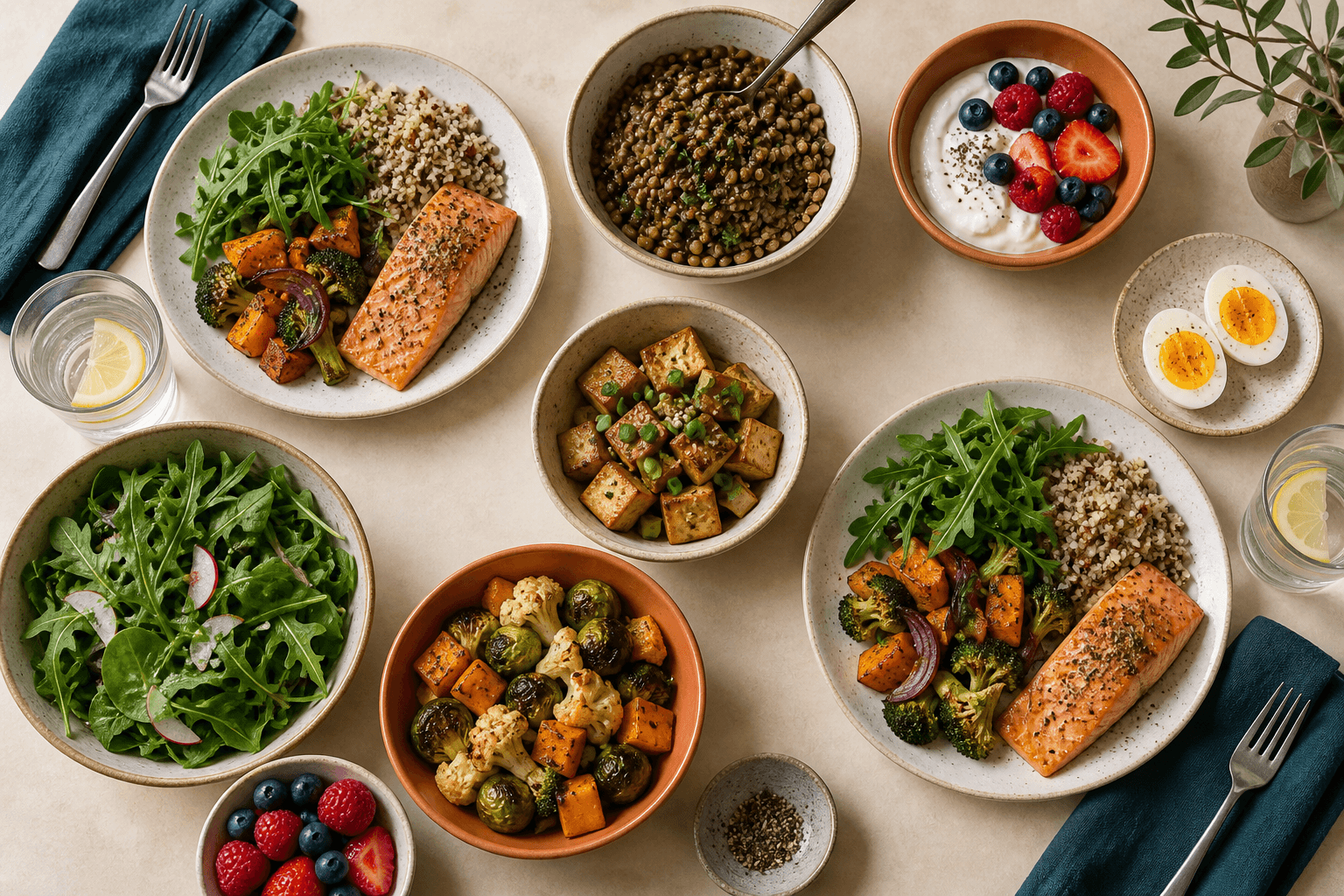
You do not have to eat these foods. The point is that an 80- to 90-gram day can look like meals, not a stack of bars and shakes.
Plant-forward eaters may need to pay a little more attention to portions and variety because protein density varies. Beans, lentils, soy foods, peas, nuts, seeds, and whole grains all contribute. Combining different plant foods across the day is enough for most people. You do not have to pair complementary proteins at every bite.
The current Dietary Guidelines for Americans emphasizes nutrient-dense, minimally processed foods. That is a useful filter here. Protein matters, but so do fiber, healthy fats, vitamins, minerals, and the simple fact that you enjoy eating the meal.
Do You Need Protein Powder?
Probably not. Powder is a convenience food, not a requirement for protein after 40.
It can help when appetite is low, breakfast is rushed, or your target is difficult to reach with your usual meals. It can also be an expensive answer to a problem that eggs, yogurt, tofu, beans, fish, or leftovers would solve.
If you use one, read the serving size, protein amount, added sugar, and ingredient list. Choose a product that fits your dietary needs and budget. If you compete in tested sports, look for independent sport certification.
Collagen powder deserves a separate note. It contains protein, but it is not a complete replacement for varied dietary protein when muscle is the goal. Count it if you track your day, but do not let a collagen scoop crowd out the rest of the food picture.
We are not recommending a product here because the useful decision comes first: Do you have a consistent gap that a convenience option would actually solve?
Pair the Number With Strength, Movement, and Enough Food
Protein cannot carry an entire health plan on its back.
Resistance training tells your body that muscle is still needed. Walking supports daily movement, stamina, and health, but it does not fully replace progressive strength work. If you are building a routine, start with our practical guides to walking after 40 and longevity habits after 40.
Enough total food matters too. If you are chronically under-eating, adding protein while ignoring overall energy can still leave you tired and make training recovery harder. If afternoons are where your plan falls apart, our guide to the 3pm energy crash after 40 can help you look beyond one nutrient.
Sleep belongs in the conversation. So does consistency. A decent target you can meet most days is more useful than a heroic target that makes eating feel like a second job.
Find What Is Draining Your Energy
Use the free Midlife Energy Audit to track sleep, movement, stress, connection, and daily rhythm for seven days so you can see what is actually helping and what is draining you.
When to Ask a Professional Before Increasing Protein
If you have chronic kidney disease, do not use a general online range as your prescription. The National Institute of Diabetes and Digestive and Kidney Diseases says protein amount and sources may need adjustment, and people with CKD should work with a dietitian or health professional. Dialysis can change needs again.
Get individual guidance if you have liver disease, a prescribed medical diet, major digestive limitations, unexplained weight loss, a history of an eating disorder, or a recent serious illness or surgery. The right number may depend on lab work, medications, appetite, and treatment goals.
This article is education, not a diagnosis or personal nutrition plan.
Bottom Line
Protein after 40 does not need to become a personality.
Calculate your baseline. Look at the 1.0 to 1.2 g/kg planning range. Track one ordinary day, then improve the meal with the clearest gap. If you are strength training and eating a varied diet, that one adjustment may be all you need.
Keep the range flexible, keep the food recognizable, and ask for individual advice when your health makes the simple calculator too simple.
Frequently Asked Questions
How much protein should a 40-year-old eat each day?
The adult RDA is 0.8 grams per kilogram of body weight per day. For a healthy adult focused on muscle preservation and active aging, 1.0 to 1.2 g/kg can be a practical planning range, though that higher range comes mainly from guidance for adults over 65.
Is 100 grams of protein too much after 40?
It depends on your body size, activity, total diet, and health. For a 220-pound adult, 100 grams is about 1.0 g/kg. For a 120-pound adult, it is about 1.8 g/kg. The same number can mean very different things for two people.
Can I get enough protein without meat?
Yes. Soy foods, beans, lentils, peas, nuts, seeds, whole grains, eggs, and dairy can all contribute, depending on how you eat. Plant-forward meals may require more attention to portions and variety, but meat is not required to meet a reasonable daily target.
Should I eat protein at every meal?
You do not have to hit an identical number at every meal. Spreading protein across breakfast, lunch, and dinner can make your daily target easier to reach and may support muscle protein synthesis, but total intake and consistent strength training still matter.
Who should talk with a clinician before eating more protein?
People with chronic kidney disease, liver disease, prescribed medical diets, recent serious illness or surgery, unexplained weight loss, or other complex health concerns should ask a clinician or registered dietitian for an individual target before making a large change.