
Table of Contents
Figuring out how to write your life story feels more complicated than it should. Most guides assume you want a finished book, a professional editor, or something worthy of a publisher’s shelf. But that’s not what most people actually want.
What most people want is for their kids to know who they really were. The address of the house they grew up in. The way their grandmother said their name. The sound of a voice before it became something they have to work to reconstruct.
By the time most people get around to starting, some of those details are already gone. Not because of illness or age. Just because life stays busy, the right moment never quite arrives, and the quiet assumption that you’ll remember holds until the day it doesn’t.
This post is about how to write your life story without making it a project. No memoir required. No writing experience needed. Just a framework for getting the right details captured before they start to slip.
Please note this page may contains affiliate links. If you purchase something through these links, I’ll receive a commission at no extra cost to you. Affiliate links help to support my website/blog and I only recommend products I love.
Why Midlife Is Exactly the Right Time
There’s a window for this kind of project. Most people don’t realize it’s closing.
You’re old enough to have genuine perspective on the choices you made. Old enough to see which decisions actually shaped things and which ones only felt important at the time. Young enough that the details are still vivid: the sensory ones, the specific ones, the ones that anchor a memory to something real rather than a general impression.
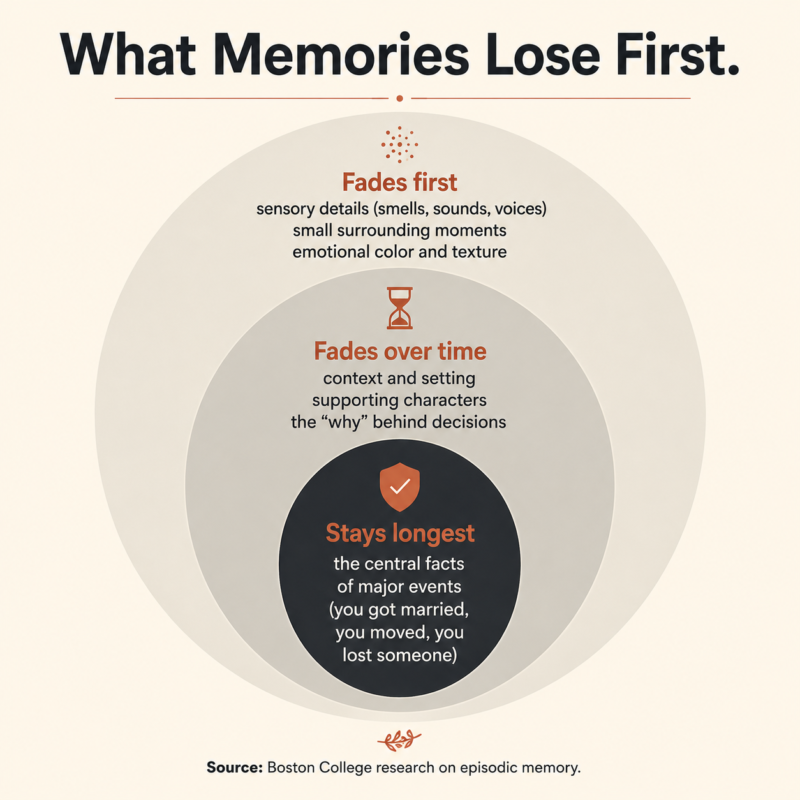
Research from Boston College shows that memories lose their specific details first: sensory color, emotional texture, the small surrounding moments. The central facts of big events tend to stay. What goes is the context around them.
By your 60s, you may remember that you had a childhood home, but the address, the smell of it in summer, the exact view from your bedroom window. Those are what fade first.
Midlife is when those details are still available. It’s also when most people start thinking about legacy for the first time, nudged by a parent’s illness, a milestone birthday, or a quiet afternoon when the house is empty and you realize your kids are nearly the age you were when you thought you had everything figured out.
There’s a reason why midlife is the perfect time to think about legacy: it’s the window where both the perspective and the specifics still coexist. Waiting doesn’t give you more time. It costs you more of what makes the story real.
This Isn’t a Memoir. Here’s What It Is Instead.
The biggest obstacle to writing your life story is the assumption that you’d need to write a book.
You don’t.
A life story doesn’t need a publisher, an agent, a formal structure, or even particularly good grammar. What it needs is to exist in a form your family can access. The simplest version is a collection of stories. Not 300 pages. Not a chronological autobiography. Just the fragments that answer the questions your kids and grandkids will wish they had asked.
Think of it as a minimum viable life story. The goal isn’t completeness. The goal is capture.
The format can be whatever you’ll actually finish. Some people write well: a handwritten journal, a Word document, a private blog. Others talk better than they write. Voice memos recorded on a phone are completely legitimate.
NPR Life Kit’s 2023 guide on telling your own story makes the point plainly: the medium matters far less than the decision to start. So does a video diary, if that’s what gets words out of your head.
What matters is not the container. What matters is that the story exists somewhere your family can find it.
The 10 Stories That Actually Matter
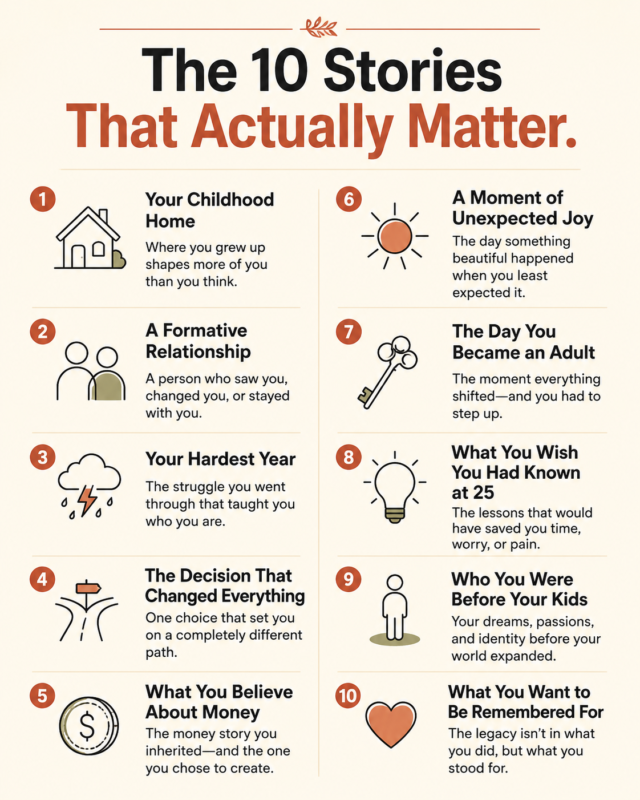
Here’s the framework: not the biggest events of your life, but the most revealing ones. Not your résumé. The stories that answer questions no résumé covers.
Write honest versions of these 10 and your family will know you in a way most families never get to experience.
Your childhood home. The address, what it felt like inside, what your room looked like at night. This is the story most people assume they’ll always remember and most often can’t fully reconstruct at 75.
A formative relationship. A teacher, a friend, or a neighbor who shaped how you see the world. Someone outside your immediate family who had a quiet, lasting effect on who you became.
Your hardest year. Not for pity. Because hard years are often where character gets made, and your kids will understand you better for knowing you lived through one.
The decision that changed everything. The one you still think about, whether you made the right call or not.
What you believe about money. Where that belief came from and how it shaped your choices. This one surprises people to write. It surprises families to read.
A moment of unexpected joy. Something small and specific. Not a wedding or a graduation. The kind of moment you’d normally forget if you didn’t write it down right now.
The day you became an adult. Not a birthday. The day something shifted inside you, usually without ceremony.
What you wish you had known at 25.
Who you were before your biggest responsibilities arrived.
What you want to be remembered for.
These are the questions your kids will wish they had asked. The questions you probably never thought to ask your own parents when you still could. That’s what you’re solving for. Not a biography. Answers to the questions that come when it’s too late to ask them.
If you want a structured set of prompts to get started, the 30 Living Legacy Questions PDF covers 30 more, designed specifically for the midlife adult who knows these stories matter but hasn’t figured out where to begin.
How to Write Your Life Story Without Staring at a Blank Page

The fastest way to start is to not start with writing.
Pick one old photo. Not a posed one. A candid from a specific time you remember. Set a timer for 10 minutes. Write the one thing you remember most about that day. You’re not writing for publication. You’re writing for the people who will want to know you. Ten specific stories written honestly matter more than an outline that never becomes anything.
That one thing almost always leads to another. A memory has context: people, places, smells, conversations. The photo gives your brain a handhold, and the rest tends to follow once you give it permission.
If writing doesn’t come naturally, use the voice memo approach instead. Hold up your phone and talk about a memory for five minutes. Don’t edit yourself. Don’t worry about how it sounds. Just talk. You can transcribe it later, or leave it as audio.
The Family Tree Magazine guidelines on memoir writing make the same point experienced writers do: capturing the memory in any form is always the right first step. Polishing comes later, if it comes at all.
The one rule worth holding: don’t edit while you capture. Editing kills momentum. The goal right now isn’t a polished story. It’s a story that happened.
If you’re looking for a structured starting point, the same approach that makes recording your parents’ life stories work so well applies here. Start with one question. Capture one answer. Move to the next one when you’re ready.
How to Make Sure Your Stories Actually Reach Your People
The other half of the problem is storage.
A Google Doc in an account your family doesn’t know about isn’t a legacy. A voice memo on a phone that gets replaced or lost isn’t either. If your stories aren’t somewhere your people can actually find them, they might as well not exist.
A few options that hold up over time:
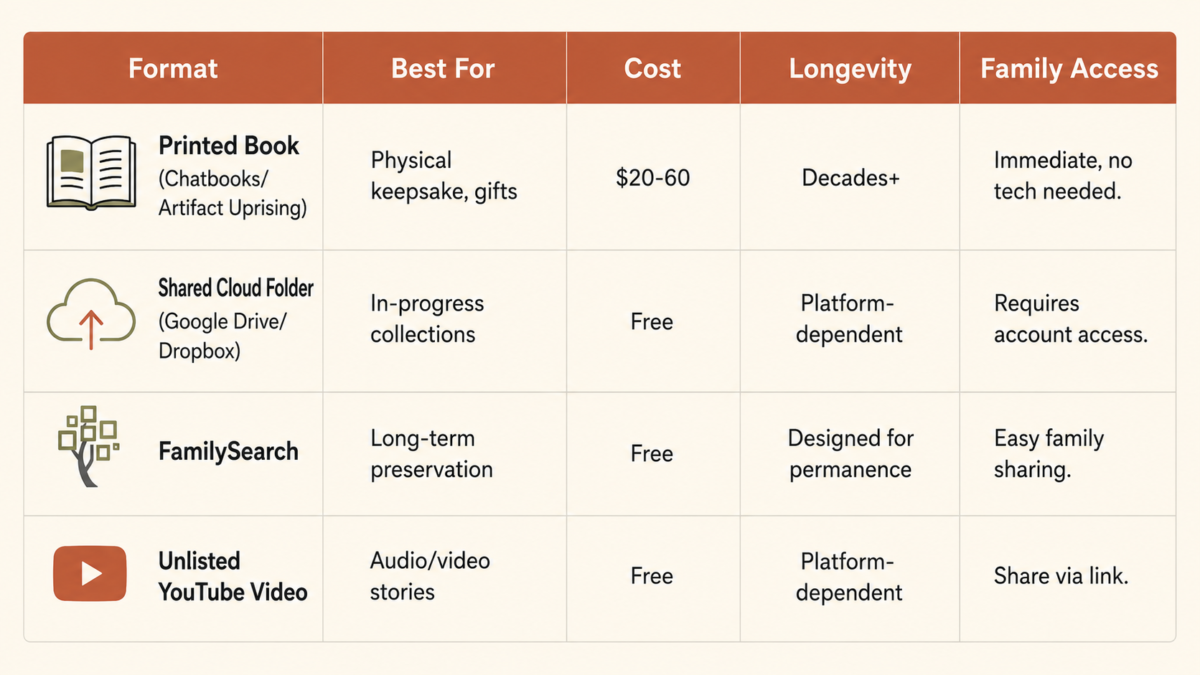
Printed books are the most reliable long-term format. Services like Chatbooks and Artifact Uprising let you upload text and photos and produce physical copies. A short printed collection is something tangible your family will have in their hands long after any app or platform disappears.
A shared cloud folder works well for an in-progress collection. If your partner or adult kids know a Google Drive or Dropbox folder exists and can access it, your material isn’t lost if something happens to you.
FamilySearch, run by the Church of Jesus Christ of Latter-day Saints, offers free personal history storage designed specifically for long-term preservation and family access. It’s one of the more purposeful platforms built for exactly this.
An unlisted YouTube video stores audio and video indefinitely, lets you share with specific people via link, and requires no special software to view.
The most meaningful legacy you can leave your children is the one they can actually find. A perfect format matters far less than an imperfect story that exists somewhere real.
The Bottom Line
The urgency here isn’t morbid. It’s practical.
A life story started today is worth more than a perfect memoir planned for someday. A voice memo that captures how you tell a story is worth more than a beautifully outlined document that never gets made. The details that feel obvious right now, the ones you’re sure you’ll always remember, are the first ones to go.
You don’t have to write everything at once. Start with one story. Use the 10 categories above as a map. Keep the goal simple: help the people who love you know who you actually were, not just the roles you played.
What kind of living legacy are you creating right now? It starts with one story written down.
If you want a ready-made set of prompts to make that easier, download the 30 Living Legacy Questions PDF. Thirty questions designed to surface the stories that matter most, in language you can answer today.
What’s one story from your life you’ve never written down? Leave it in the comments below. Sometimes naming the story is the first step to telling it.
Frequently Asked Questions About Writing Your Life Story
How do I start writing my life story when I don’t know where to begin?
Start with a single memory, not a chapter. Pick an old photo, a specific year, or one question from a prompt list, and write about just that one thing. You don’t need an outline, a title, or a plan to begin.
What should I include in my life story?
Focus on the 10 stories that reveal who you are: your childhood home, your hardest year, the decision that changed everything, who you were before you had kids, and what you want to be remembered for. Defining moments matter more than a complete chronology.
Do I have to write my life story, or can I record it instead?
You don’t have to write a single word. Voice memos, video recordings, and even recorded conversations with family members are all legitimate ways to preserve your story. The format matters far less than actually capturing it.
How long should a life story be?
It can be as short as 10 stories of a few paragraphs each. There’s no requirement to write a full memoir or autobiography. A collection of meaningful stories is more valuable to your family than an exhaustive chronicle that never gets finished.
Is it too late to write my life story in my 50s?
Midlife is actually the best time. You’re old enough to have real perspective on the choices you made and the life you’ve built, and young enough that the details are still vivid. Waiting means more forgetting, not more time.