

Table of Contents
Most people over 50 have a trip they’ve been putting off for years. Europe. A Caribbean cruise. One of those destinations they always said they’d get to eventually. But “eventually” keeps getting pushed because the answer to one basic question still feels just out of reach: what is this actually going to cost?
Building a real budget for travel after 50 is not complicated, but most guides make it feel that way. They deal in vague ranges, skip the things that matter most at this life stage, and never help you land on a number you can actually use. This post does something different.
We’ll walk through every major cost category, use the Trip Budget Calculator to turn those categories into a real monthly savings target, and get you from “I have no idea what this costs” to a clear plan. No generic advice. Real dollar ranges for adults in their 50s and 60s who want to stop guessing and start booking.
Please note this page may contains affiliate links. If you purchase something through these links, I’ll receive a commission at no extra cost to you. Affiliate links help to support my website/blog and I only recommend products I love.
Why Adults Over 50 Keep Delaying the Trip They Want Most
The problem is not a lack of desire. According to AARP’s Travel Trends 2026 report, 64% of adults over 50 expect to take at least one trip this year. Americans over 50 also spend more than $236 billion annually on leisure travel. The demographic is not checked out.
What keeps people stuck is the absence of a real number. When you don’t know what a trip will cost, planning feels risky. So you wait. “We’ll do it next year” becomes three next years, until you realize the someday trip is still exactly where you left it.
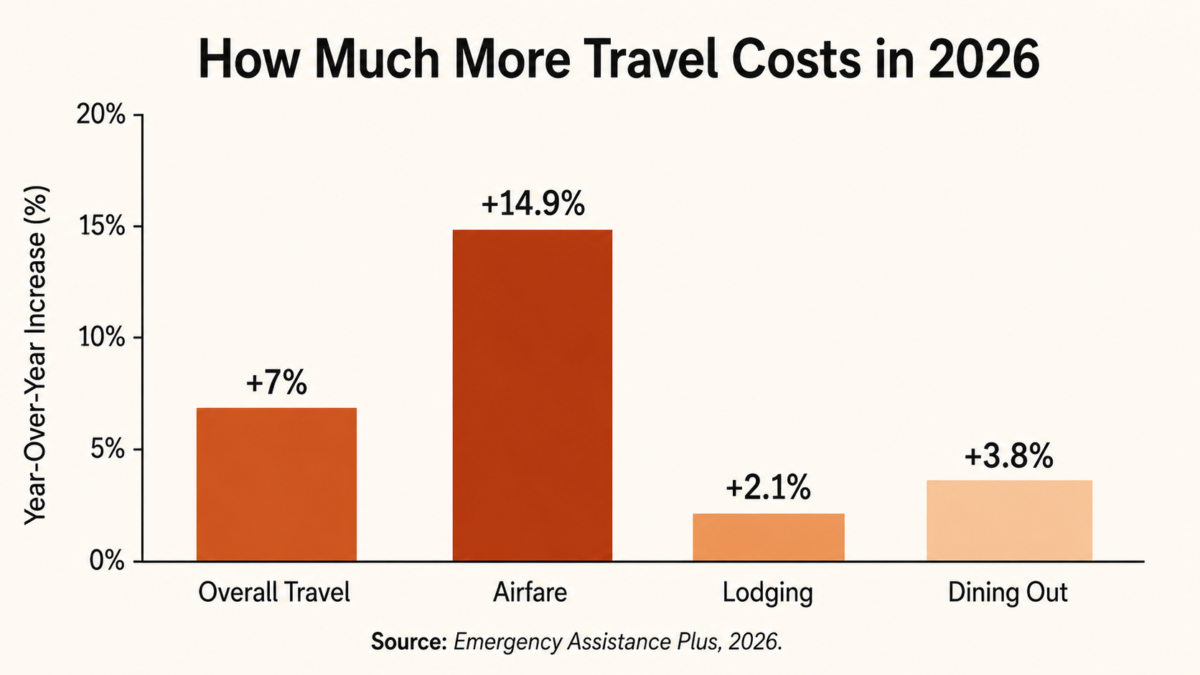
Meanwhile, travel costs are not waiting with you. Overall travel prices are 7% higher in 2026 compared to last year, with airfare up 14.9% according to Emergency Assistance Plus 2026 vacation cost data. Delay has a financial cost.
This is what we’ve come to call the someday trap, and we know it well. You can read about how we broke out of it and decided to prioritize travel before retirement rather than waiting for the “right” moment. The antidote is always the same: get a real number. And it takes less time than you think.
The 6 Cost Categories in Every Travel Budget After 50
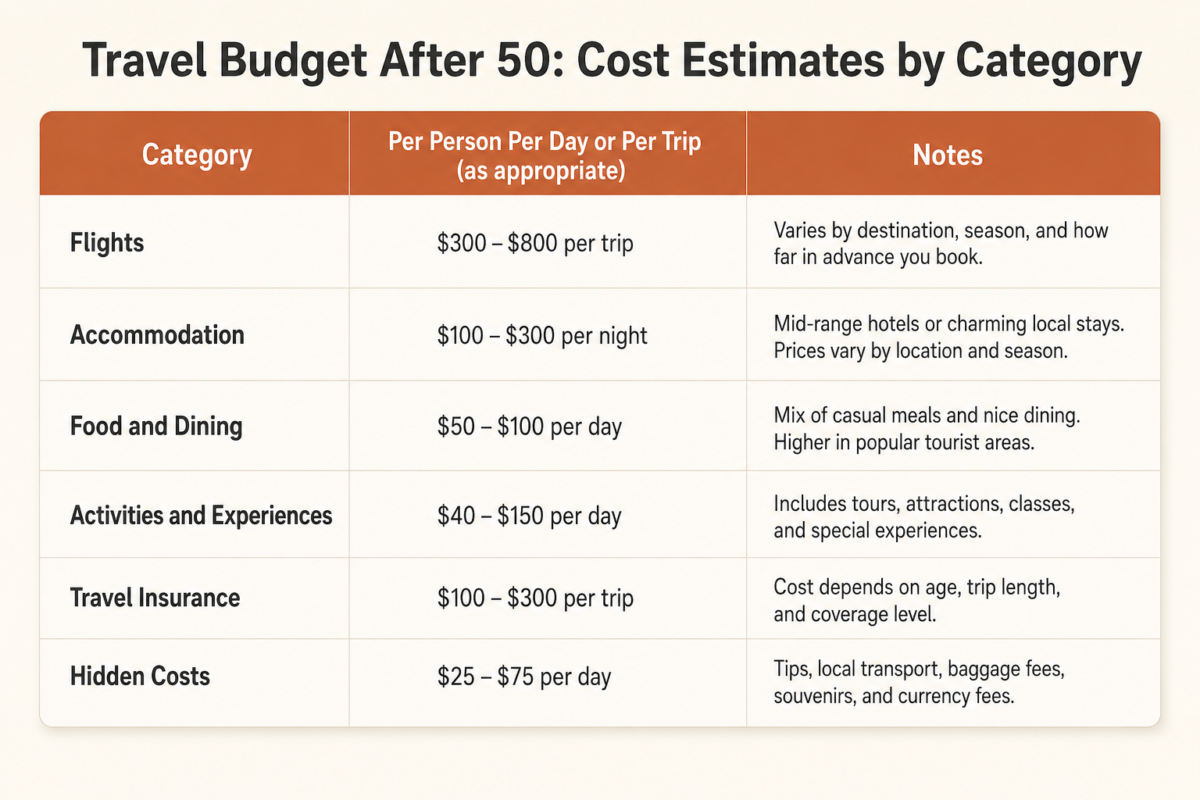
For a first big trip after 50, plan $2,500 to $5,000 per person for a one-week trip, or $4,000 to $7,000 per person for a 10-day international trip. Those numbers include flights, accommodation at $100 to $200 per night, food at $60 to $80 per day, travel insurance, activities, and a 15 to 20% buffer for unexpected costs.
Every trip runs through the same six categories. Here is what to include and what ranges to plan for at the 50+ life stage.
Category 1: Flights
International round-trip flights average $1,022 per person. Domestic flights run closer to $290. Book 4 to 6 months in advance for the best international rates. Fare-alert tools like Going or Travelzoo can cut costs by 20 to 30% compared to booking within 6 to 8 weeks of departure.
Category 2: Accommodation
Hotels average $259 per night nationally, but a realistic midlife travel range is $100 to $200 per night. At 50+, a decent bed, a real bathroom, and a safe neighborhood are worth the extra $40 per night. Build your plan around comfort, not minimalism.
Category 3: Food
Budget $60 to $80 per day per person. This is not a backpacker rate. It covers sit-down meals, a drink or two, coffee in the morning, and one “this place looks too good to pass up” dinner. Use $60 as a planning floor on domestic trips and $75 to $80 for international destinations where dining out is part of the experience.
Category 4: Activities and Experiences
Budget $50 to $100 per day per person. Think about what you actually plan to do rather than using a generic placeholder. Guided tours run $75 to $200, museum entries are typically $15 to $35, and a food tour or cooking class can run $100 to $175 per person. The experiences are often the whole point of the trip, and they deserve a real line in your budget.
Category 5: Travel Insurance
This is non-negotiable at 50+. A policy that covers pre-existing conditions, emergency medical evacuation, and trip cancellation typically costs 5 to 10% of your total trip cost. On a $7,000 trip, that’s $350 to $700. One medical evacuation from Europe can run $50,000 or more out of pocket. Skipping travel insurance is the single most expensive mistake adults over 50 make on a first big trip.
Category 6: Hidden Costs
These are the ones that blow budgets. Airport parking ($25 to $45 per day). Ground transportation at your destination, from taxis and trains to rideshares. Entry fees, tips, souvenirs, and the jet-lag recovery day where you mostly pay to exist in a hotel room. Build $20 to $40 per day per couple into this category.
After you’ve added up all six categories, add a 15 to 20% buffer on top of the subtotal. This is not extra. This is the margin that keeps a missed connection or a sick day from becoming a financial emergency.
A few logistics worth confirming before your trip: make sure your passport is current with at least six months of validity beyond your travel dates, and if domestic air travel is part of the trip, check the current REAL ID requirements before you book. For a broader look at what catches midlife travelers off guard, these travel realities after 40 are worth reading before you finalize plans.
How to Use the Trip Budget Calculator to Get Your Number in 15 Minutes
Once you have the categories, the next step is putting real numbers into a structure. That’s exactly what the Trip Budget Calculator does. Instead of staring at a blank spreadsheet, you’re working with a framework that has already thought through the categories for you.
Walk through each section using the ranges above. Your destination type and trip length will shape the inputs. A Caribbean cruise looks different from 10 days in Italy because the cost structure is different: on a cruise, meals and accommodation are mostly bundled; on an independent trip, you’re pricing each night and each meal separately.
The output you’re working toward is not just a trip total. It’s a monthly savings target. If your trip costs $9,000 and you want to travel in 18 months, you need to set aside $500 per month. That single number changes the conversation: it stops being an abstract affordability question and becomes a concrete savings goal.
What a Real Budget Looks Like for Two Common Trips After 50
Abstract categories are useful. Real numbers are better. Here’s what two of the most common first big trips actually cost for a couple over 50.
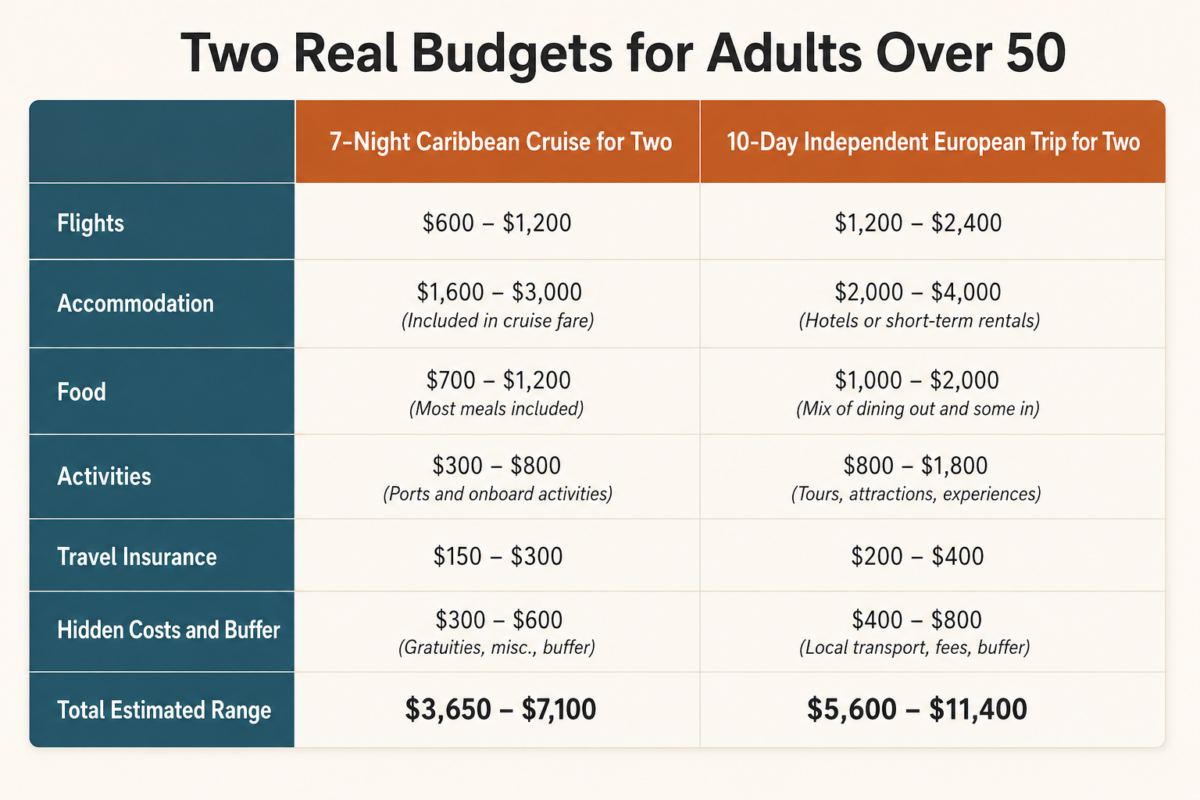
7-Night Caribbean Cruise for Two: $3,500 to $6,500
Cruise fare runs $1,500 to $3,500 depending on the cabin category, cruise line, and how far out you book. Add $400 to $800 per person for flights to the embarkation port, $250 to $450 for travel insurance, and $600 to $1,200 for onboard spending (drinks packages, excursions, gratuities).
Cruises offer one major advantage: cost predictability. Most of your expenses are fixed before you board. The main variable is onboard spending, which can escalate fast if you’re not tracking it. Set a daily onboard budget before you step foot on the ship.
10-Day Independent European Trip for Two: $8,000 to $14,000
International flights for two: $2,000 to $3,000. Hotels for 7 nights at $100 to $200 per room per night: $1,400 to $2,800. Food at $60 to $80 per day per person: $1,200 to $1,600.
Activities and experiences: $1,000 to $2,000. Travel insurance: $500 to $800. Ground transportation and miscellaneous: $400 to $800.
Independent European travel costs more upfront and demands more planning, but it gives you full control over every day. The flexibility is part of what people pay for. Simple habits that make a mid-range budget feel like considerably more can stretch either of these examples further than you’d expect.
The Biggest Budget Mistakes Adults Over 50 Make on a First Big Trip
Most first-trip budget blowouts trace back to the same short list of predictable mistakes. Knowing them in advance eliminates most of the risk.
Skipping travel insurance. Already covered, but worth repeating: one medical emergency abroad can cost more than the entire trip, many times over. At 50+, a policy with pre-existing condition coverage and emergency evacuation protection is not optional.
Underestimating food. Travelers consistently budget $30 to $40 per day and then spend $70. Use $60 as your planning floor on any trip, not as a stretch goal.
Forgetting ground transportation. Taxis, trains, and rideshares add up every single day. A $25 taxi from a European train station. A $40 rideshare from the cruise port to your hotel. Budget $20 to $40 per day per couple and you won’t be surprised.
Skipping the recovery day. A 9-hour overnight flight followed by a full day of touring sounds manageable until you’re standing in front of the Colosseum running on three hours of bad airplane sleep. A recovery day with light activity is a budget item worth including, typically $150 to $200 in hotel costs that saves the first two days of your trip.
Booking too late. The sweet spot for international flights is 4 to 6 months before departure. Waiting until 6 to 8 weeks out can add $300 to $500 per ticket. For a couple, that’s a real number.
If you want the longer view on making travel financially sustainable year after year, not just as a one-time big trip, our approach to affording travel in your 50s without draining the account is a good next read.
How to Build Your Monthly Savings Target Once You Have a Total
The math is simple. Take your total trip cost and divide it by the number of months until you want to travel. That’s your monthly savings target.
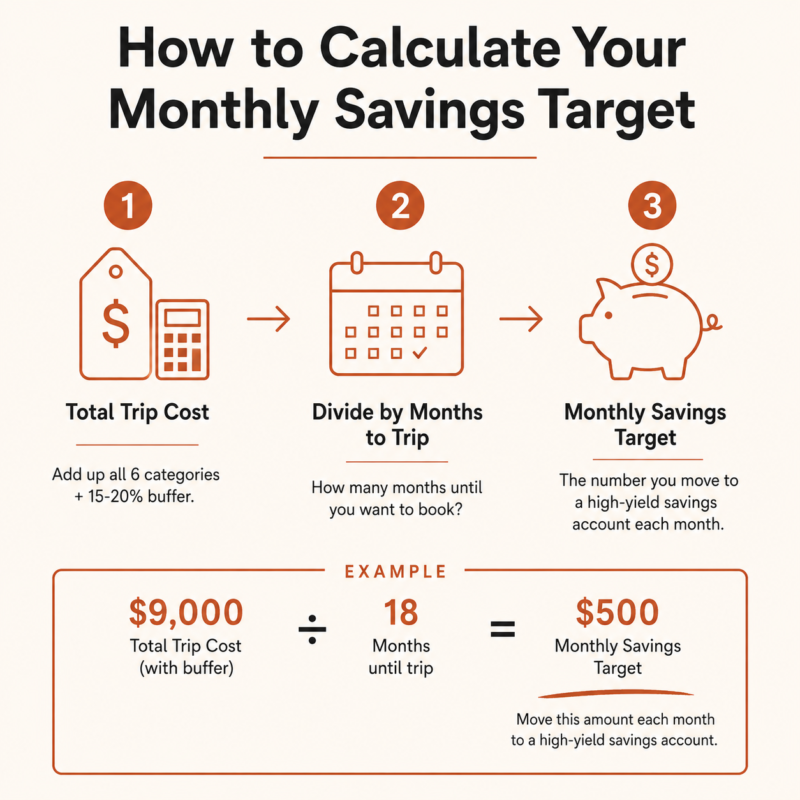
$9,000 trip in 18 months: $500 per month.
$6,000 trip in 12 months: $500 per month.
$14,000 trip in 24 months: $583 per month.
Simple numbers. Hard to argue with once you see them on paper.
Where you hold the money matters too. If the trip is within 24 months, keep the funds in a high-yield savings account or money market fund, not invested in the market. A short-term downturn should not have the power to cancel your travel plans. As Kiplinger’s retirement travel guidance notes, cash and near-cash vehicles are the right home for trip savings with a defined timeline.
One more step worth naming: the budget conversation with your partner. Agree on a total number before booking anything. Discuss what matters most, whether that’s where you stay, what you eat, or how many experiences you pack in.
Set the total together. Then book. The trip where you argued about money the whole time is not the trip you were planning for.
The Bottom Line
The trip you keep calling “someday” is not on hold because you can’t afford it. It’s on hold because you don’t have a number yet. That’s fixable in about 15 minutes.
Run the categories through the Trip Budget Calculator, get your monthly savings target, pick a date, and open the savings account. Those four steps are the only thing separating a trip that happens from one that stays in your head for another year.
What trip have you been putting off, and what would it actually take for you to finally book it? Tell us in the comments below.
Frequently Asked Questions
How much should I budget for a big trip after 50?
For a first big trip after 50, plan $2,500 to $5,000 per person for a one-week trip, or $4,000 to $7,000 per person for a 10-day international trip. Those numbers include flights, accommodation, food at $60 to $80 per day, travel insurance, activities, and a 15 to 20% buffer for unexpected costs.
What is the biggest overlooked travel expense for adults over 50?
Travel insurance is the most consistently underestimated expense. A policy covering pre-existing conditions, emergency medical evacuation, and trip cancellation typically costs 5 to 10% of your total trip cost. At 50+, skipping it is the most expensive decision you can make. One medical evacuation abroad can run $50,000 or more without coverage.
How far in advance should I book an international trip after 50?
Book international flights 4 to 6 months in advance for the best rates. Accommodation is more flexible; 2 to 3 months out works for most destinations. Fare-alert tools like Going or Travelzoo can cut flight costs by 20 to 30% compared to last-minute booking.
How do I budget for a trip as a couple after 50?
Start with a shared conversation about priorities before looking at prices. Agree on a total trip budget first, then divide by two for per-person targets. Use the Trip Budget Calculator to arrive at a number you both own. Hold the savings in a high-yield savings account or money market fund so it earns a little while you wait.
Is a cruise or independent travel cheaper for a first big trip after 50?
Cruises offer better cost predictability: a 7-night Caribbean cruise for two typically runs $3,500 to $6,500 total, with most expenses bundled upfront. Independent European travel often runs higher, $8,000 to $14,000 for two over 10 days, but gives more flexibility and control. The right choice depends on whether you value predictability or customization more.