
Table of Contents
Somewhere on a phone, buried in the voice memo app nobody opens, or on a shelf in a shoebox of old cassette tapes, there is a conversation worth having with a parent or grandparent. Most people never have it. Not because they don’t care. Because “write a family history” sounds like a book length project, and nobody has room in their week for a book length project.
That is the real blocker. It is not affection. It is not even time, not really. It is scale.
The word “history” makes people picture years of genealogical research, a family tree the size of a wall, and a finished manuscript nobody actually has to produce. So the shoebox stays closed and the voice memo app stays unopened.
Here is how to use AI to write your family history without any of that: one recorded conversation, a specific set of questions, and a narrow AI prompt that turns a transcript into something readable. No writing background required. No genealogy hobby required. Just one sitting with someone who still remembers.
Please note this page may contains affiliate links. If you purchase something through these links, I’ll receive a commission at no extra cost to you. Affiliate links help to support my website/blog and I only recommend products I love.
Why Most Family History Projects Never Get Started
The projects that never happen share one thing in common. They start as research projects instead of conversations. Someone decides to “do the family history,” pictures months of digging through records and building a family tree, and quietly shelves the idea before it starts. The size of the imagined project kills it, not a lack of caring.
The fix is to shrink the project down to something that actually fits in a week. One recorded conversation with one relative beats a full genealogical archive that never gets finished. A single 45 minute conversation about a grandmother’s childhood, captured now, is worth more to a family than a perfectly sourced family tree that gets built five years from now, after the person who could have told the story firsthand is gone.
This is the same argument behind recording your parents’ life stories before it’s too late: timing matters more than most people think, and waiting for the “right” moment to start a bigger project usually means never starting at all.
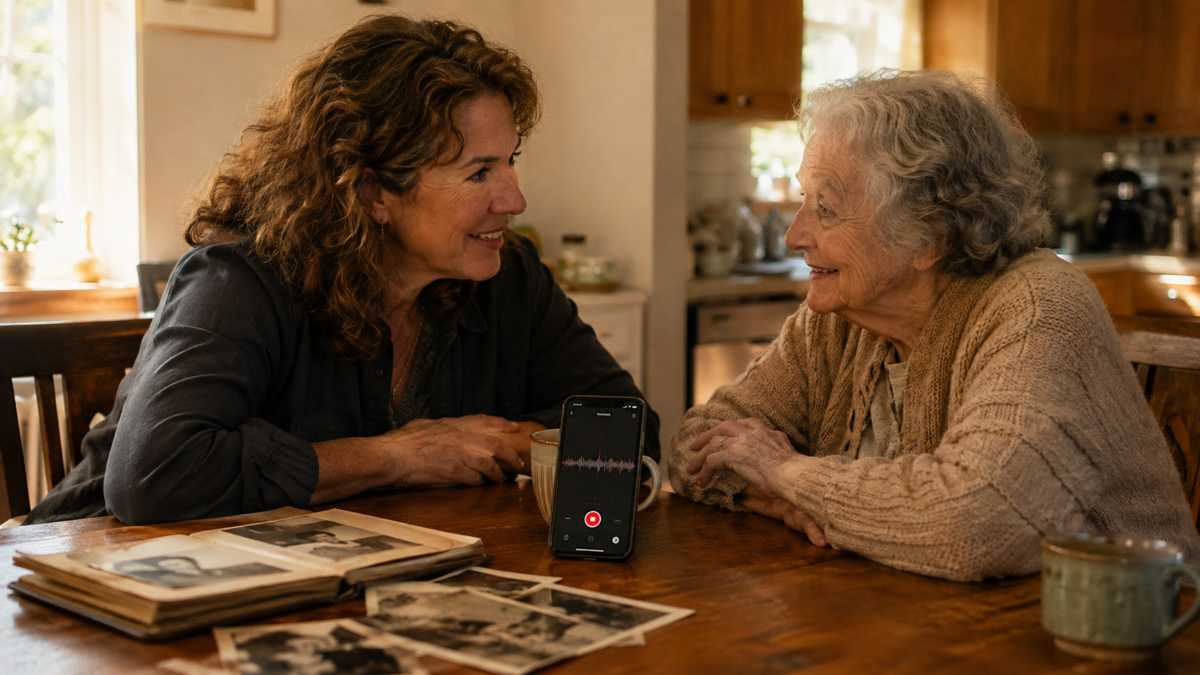
Picture the version that actually happens instead. Sunday afternoon, one relative, one phone propped against a coffee cup. Forty five minutes later there is a recording of a specific childhood memory, a specific story about how two grandparents met, or a specific account of a job that no longer exists. That is not a genealogical archive. It is one conversation, and one conversation is the entire unit of progress here.
What to Record Before You Touch AI
Skip the special equipment. A phone’s built in voice memo app is enough for one sit down conversation. Equipment was never what stopped people from doing this.
What actually helps is having a script so nobody stares at a blank page mid conversation. Our own 30 Living Legacy Questions works well here, since it gives a parent or grandparent a clear structure to talk through instead of an open ended “tell me about your life,” which tends to produce ten minutes of vague answers and an early exit.
A legacy interview built around specific questions gets specific answers, and specific answers are what make the eventual written piece worth reading.
Keep the session to one sitting, somewhere between 45 and 60 minutes. Longer sessions tend to get scheduled, postponed, and eventually shelved. A single sitting, recorded on a phone already in your pocket, is the whole first step.
How to Use AI to Write Your Family History From a Recorded Conversation
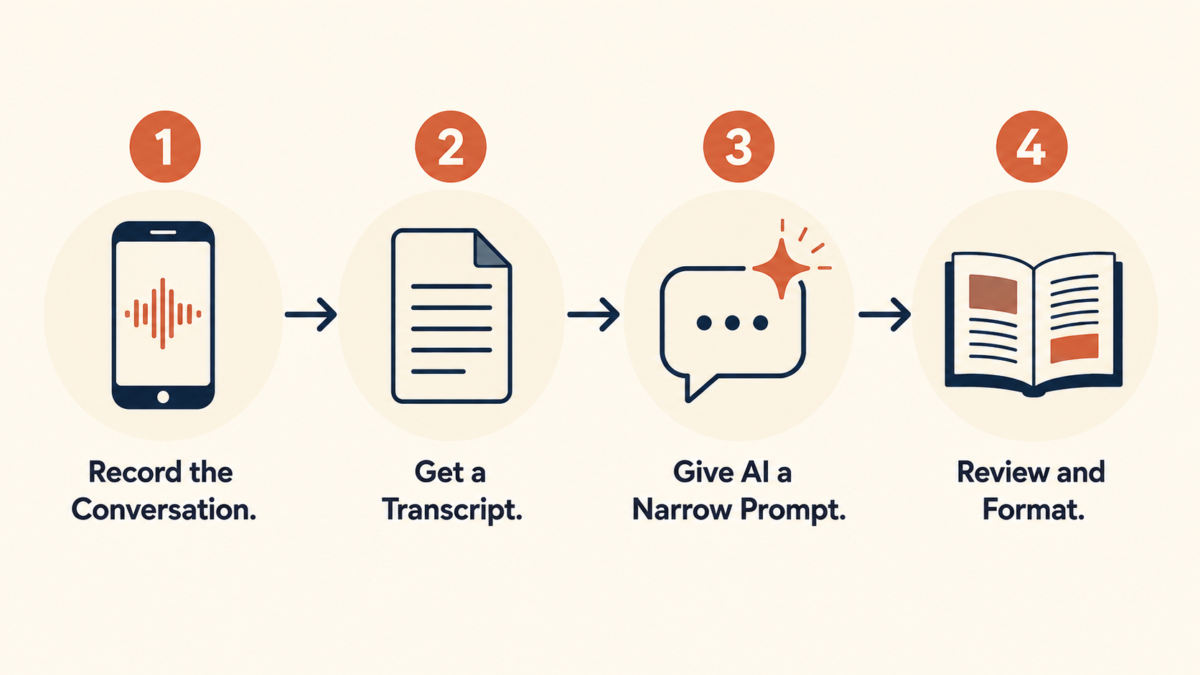
Once the conversation is recorded, using AI to write your family history comes down to two steps: get the conversation transcribed, then give the transcript to ChatGPT or Claude with a prompt that organizes and polishes only what was actually said, never inventing new details. Treat AI as an editor, not a source, and the rest of the process is simple.
Step 1: Get a Transcript
Most phones can transcribe a voice memo automatically, and free tools handle it in a few minutes if yours cannot. The transcript does not need to be perfect. It needs to exist, because AI works from text, not audio.
Step 2: Give AI a Narrow Prompt, Not an Open One
This is where most people go wrong. Asking AI to “write my family history” produces something generic, because the request is too broad and the model fills in the gaps with guesses. A narrow prompt built around the actual transcript works far better. Something close to this:
“Here is a transcript of a conversation with my [relationship]. Organize it into a readable narrative in chronological order, using only details that appear in the transcript. Do not add names, dates, or events that are not in the text. Keep their voice and phrasing where possible. Flag any spot where the transcript is unclear instead of guessing.”
That last line matters more than any other part of the prompt. It is the difference between AI acting as an editor and AI quietly acting as a source, which is exactly what the next section covers.
Here is what that actually looks like in practice.
A raw transcript line might read: “yeah so we didn’t have much growing up, my dad worked at the mill, and my mom, she uh, she took in sewing for the neighbors to help out, this was probably nineteen fifty something.”
Run through a narrow prompt, that becomes something closer to: “Money was tight growing up. My father worked at the mill, and my mother took in sewing work from the neighbors to help make ends meet, sometime in the early 1950s.”
Same information, same voice, just readable. Nothing was invented. The filler words and false starts were cleaned up, and that is all AI did.
Where AI Gets Family History Wrong (And How to Catch It)
AI models are built to sound confident, and confidence is exactly the wrong quality for a family record. When a transcript has a gap (a mumbled year, an unclear name, a detail the relative skipped), AI will often smooth right over it with a plausible sounding detail that was never actually said. Nobody flags it, because it reads fine. It just is not true.
The fix is a rule, not a feature: AI edits, it does not source. Anything that was not in the original transcript does not belong in the final piece, no matter how well it fits the story. This is the same discipline covered in how to use ChatGPT in everyday life, applied to something with higher stakes than a grocery list or an email draft.
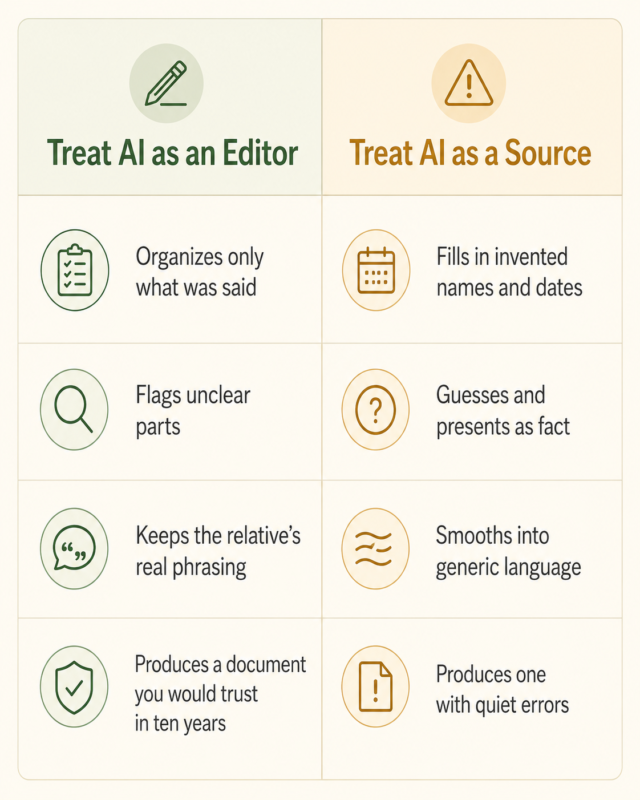
Read the AI generated draft against the original transcript line by line before calling it finished. It takes fifteen minutes and it is the only quality check that actually matters here.
Turning the Draft Into Something Your Family Will Actually Keep
A polished document sitting in a Google Docs folder nobody opens again is not much better than the unrecorded conversation. Format matters as much as content.
A few formats actually get read: a printed booklet ordered through any print on demand service, a shared PDF emailed to siblings and cousins, or a private family Google Doc that stays open for relatives to add their own memories in the margins over time.
A modest printed booklet through a service like Blurb or Mixbook typically runs $20 to $40, which is not much to pay for something a family keeps on a shelf for decades instead of losing in a folder nobody opens.
Pick whichever format matches how your family actually communicates, not whichever one sounds most official. A family that lives in a group text will actually read a shared PDF. A family that still exchanges holiday cards will actually open a printed booklet.
Add photos wherever you have them. A finished family history reads very differently next to a scanned photo of the person as a child than it does as plain text alone. If the photos themselves are old prints or slides, digitizing them first means they will not disappear before the stories they belong to get told.

The Bottom Line
One recorded conversation, one narrow AI prompt, one finished piece. That is the entire method, and right now it is sitting unrecorded on a phone somewhere. The barrier was never the writing. It was the size of the project in your head before you started, and that project just got a lot smaller.
According to FamilySearch, the platform saw 297 million visits in 2025 alone, which says something plain about how many people are actively trying to hold onto their family’s story right now. AARP’s research on grandparents backs up the emotional weight behind that number.
Passing down something meaningful is consistently one of the strongest motivations adults describe for this kind of work, not a hobby project but something closer to a responsibility they want to meet while there is still time.
If there is a parent or grandparent you keep meaning to sit down with, the 30 Living Legacy Questions PDF is the exact script to use for that conversation. It turns “I should really talk to Mom about that” into a specific, structured 45 minute conversation you can actually schedule this week, and it is free.
Get the 30 Living Legacy Questions PDF and use it as your interview script the next time you see them.
What’s one story your parent or grandparent has told you that you have never actually recorded?
Frequently Asked Questions
Can ChatGPT make up facts about my family history?
Yes, and it will do this without flagging it as a guess. AI models tend to invent plausible sounding names, dates, and details when given an open ended request. The fix is narrow prompting: give it the transcript directly and tell it explicitly not to add anything that was not actually said.
Do I need special recording equipment?
No. A phone’s built in voice memo app is enough for one sit down conversation. Equipment was never what stopped most people from doing this, the size of the imagined project was.
What’s the best AI tool for writing a family history, ChatGPT or Claude?
Either works for this specific task, since the job is organizing and polishing an existing transcript rather than open ended research. Use whichever one you already have a free account with rather than shopping around for a “better” option.
How long should the interview be?
Somewhere between 45 and 60 minutes is enough for one solid story or chapter. Longer sessions tend to get scheduled, postponed, and eventually shelved instead of finished.
What if my relative doesn’t want to be recorded?
Take notes by hand during or right after the conversation instead, then run the same AI process on the notes. The method works either way. Recording just makes the transcript step faster.