

Table of Contents
Picture this: you book a cruise for next spring, feel good about the fare, and then three weeks later you check the same sailing out of curiosity. The price has dropped $180 per person. Nobody called you. Nobody emailed you. The only reason you know is that you happened to look.
That quiet moment, the one where you realize someone who booked a week after you paid less for the exact same trip, is more common than most travelers think. Flight and cruise prices move constantly after you book, and most of that movement happens with zero notification to the person who already paid.
Here’s the good news: you’re not always owed nothing when that happens, and getting a flight price drop refund is possible on both flights and cruises if you know your actual deadline and where to look. This post walks through what you’re legally entitled to, what’s just a courtesy policy that varies by company, and the lowest-effort way to catch a price drop on the one or two big trips you book each year.
Please note this page may contains affiliate links. If you purchase something through these links, I’ll receive a commission at no extra cost to you. Affiliate links help to support my website/blog and I only recommend products I love.
What You’re Actually Entitled To (And What You’re Not)
Most articles on this topic blur two completely different things together: your legal right to cancel a reservation, and a company’s optional courtesy policy about price changes. They are not the same, and mixing them up is exactly why so many travelers end up confused about what they can actually ask for.
Can I get a refund if my flight or cruise price drops after booking? Not automatically. Airlines rarely refund cash for a price drop, usually issuing an e-credit instead. Cruise lines are friendlier: most will match a lower fare or give onboard credit if you ask before your final payment date. Your one guaranteed right is a full refund if you cancel within 24 hours of booking, for flights bought 7 or more days before departure.
That 24-hour window comes from the U.S. Department of Transportation’s 24-hour reservation guidance, and it applies to every fare class on every U.S. airline. It has nothing to do with price drops specifically. It just means if you book a flight and change your mind, for any reason, including a lower fare you spotted elsewhere, within 24 hours, you can cancel for a full refund, as long as the flight departs at least seven days out.
Separately, the DOT’s automatic cash-refund rule, in effect since 2024, requires airlines to promptly issue a refund in cash whenever one is actually owed, such as a canceled flight or a significant schedule change. That rule is about refunds you’re already owed. It is not a price-match guarantee, and it won’t help you if a fare simply drops after you’ve already flown or after your ticket is non-refundable.
Everything past those two protections, meaning any price-drop refund on a fare that’s still valid and still yours, is a courtesy policy set by the individual airline or cruise line. Courtesy policies can change without notice, differ by fare class, and are never guaranteed the way the 24-hour rule is. Knowing which category you’re in is the first real step toward a flight price drop refund, and it changes what you should expect and how you should ask for it.
Flights: How Airlines Actually Handle a Price Drop After You Book
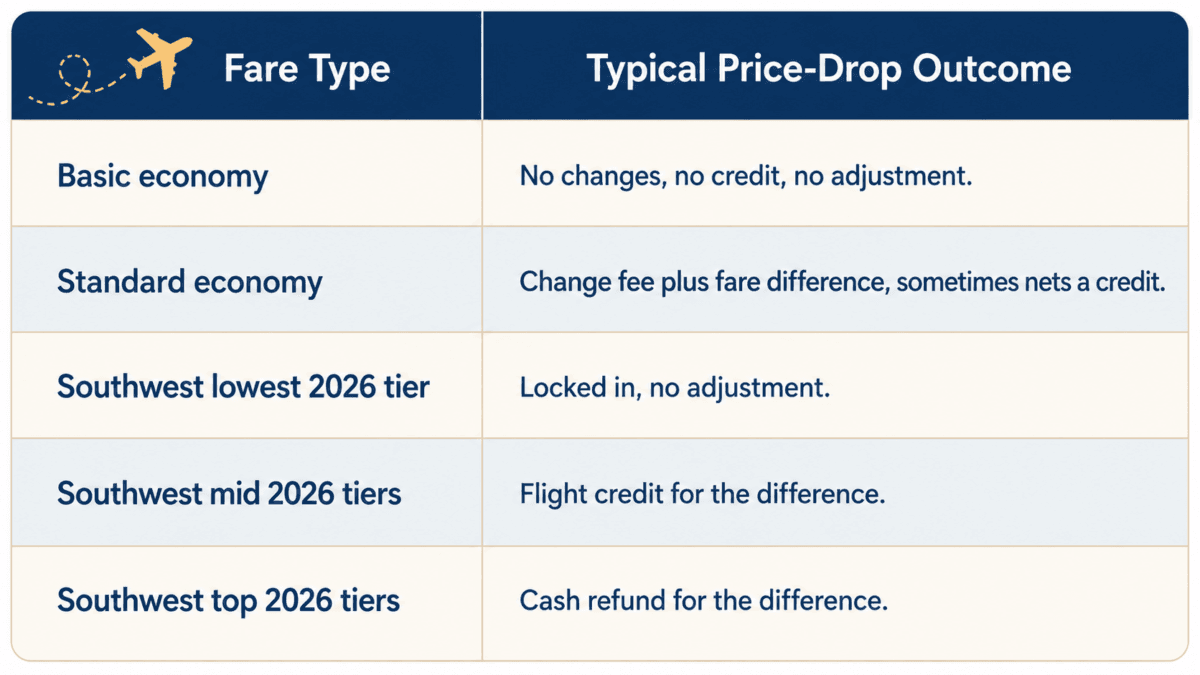
Airlines generally don’t hand back cash when a fare drops on a ticket you already own. What you get instead, if you get anything, depends heavily on the fare type and the airline.
Southwest’s 2026 fare overhaul is a useful real-world example of just how much this varies even within one airline. The carrier now runs four fare tiers, and only two of them return cash if the price drops before you fly. One tier returns a flight credit instead of cash. The lowest tier can’t be changed or adjusted at all once purchased. Three tiers, three different outcomes, same airline.
Most legacy carriers work similarly. Basic economy fares are usually the hardest case: no changes, no credit, no adjustment, full stop. Standard economy and above often allow a change for a fee plus fare difference, which sometimes nets out in your favor if the new fare is low enough, and sometimes doesn’t.
Given that landscape, the actual moves for most readers who already used AI to plan the booking itself come down to two options: check manually, or let a tool watch it for you.
Manual checking is free. Google Flights and Skyscanner both let you track a specific route and get notified of fare changes, and neither charges anything for it. The tradeoff is that you have to set it up per trip and remember it exists.
For a more hands-off approach, apps like Going and Hopper exist specifically to remove that manual step. Going sends curated fare-drop and deal alerts by email, so there’s nothing to check yourself, though its best alerts sit behind a paid membership.
Hopper shows a visual price-history graph for a specific route and flags whether a fare is likely to rise or fall, with a free tier that covers the basics and a price-freeze option if you want to lock in a fare before buying.
Both are reasonable options for someone who wants a nudge instead of a habit, though neither guarantees a cash refund. What they do is put you in a position to act fast when a fare actually does drop within a window where your airline still allows a change.
One thing worth naming honestly: the widely repeated claim that fare-tracking services save travelers $131 to $396 per flight, or succeed 98% of the time, comes from the vendors selling those services, not from an independent source. It’s worth treating those specific numbers as marketing, not fact, even while the underlying idea, that unmonitored fares quietly move against you, is real.
The U.S. Bureau of Transportation Statistics tracks fare movement at the market level and confirms the broader pattern: average fares shift from month to month on the same routes, which is exactly why a fare that looked fine on your booking day can look worse, or better, three weeks later.
Cruises: How Price-Match Policies Work Line by Line
This is the half of the trip that almost nobody covers, and it’s where the actual AI money mistakes worth avoiding start to matter, because a missed cruise price match is real money left on the table.
Cruise lines tend to be more generous than airlines here, but every one of them draws a hard line at final payment. Before that date, you generally have room to negotiate or automatically qualify for an adjustment. After it, your options shrink fast.
Royal Caribbean’s official Best Price Guarantee policy is a solid example of how this works in practice. If the cruise line drops the price on your exact sailing, cabin category, and rate type before your final payment date, you can request a price match, and if you booked within the last 24 hours, the match is essentially automatic. Once final payment has been made, that window closes.
Norwegian Cruise Line takes a slightly different approach, offering a one-time courtesy price adjustment even after final payment, but only if you’re still more than 14 days out from sailing. It’s a notable exception to the usual “final payment is the hard deadline” rule, and worth knowing if Norwegian is your line.
Princess and Carnival lean more on onboard credit than cash-back price matching. Rather than reducing what you already paid, they’re more likely to offer a credit you spend on the ship, which is still real value but isn’t the same as money back in your account.
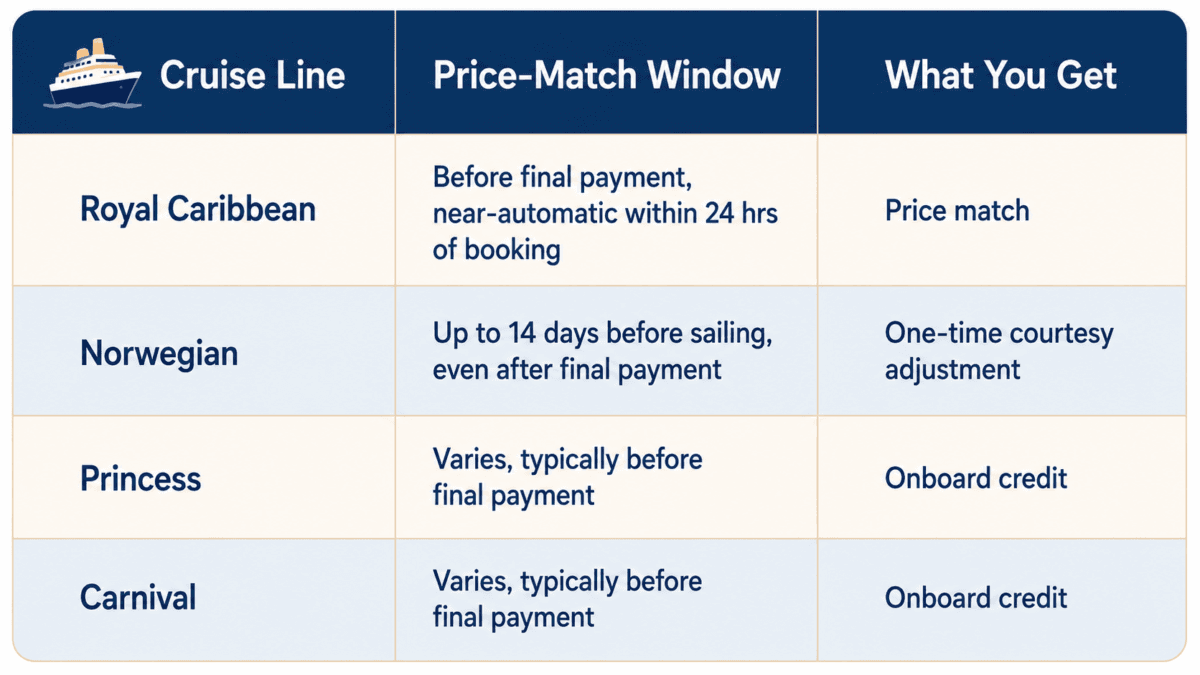
The pattern across every cruise line: know your final payment date, and treat it as the real deadline. If you’re already loyal to one cruise line, it’s worth reading that line’s specific policy once and setting a calendar reminder a week before final payment, rather than relying on memory.
The Fully-Automated Option (And Its Honest Tradeoff)
If checking fares yourself, even with an app’s help, still sounds like more than you want to manage, there’s a fully automated category worth knowing about: services like Refare, pAiback, and Junova.
The mechanic is simple. You forward your booking confirmation, the service monitors the fare on your behalf, and if it drops, they automatically file for the refund, credit, or rebooking on your behalf and take a cut, typically around 20% of whatever they recover.
That’s genuinely the most hands-off version of this entire process. It’s also worth naming the honest tradeoff plainly: you’re handing a booking confirmation, which usually includes your name, confirmation number, and sometimes payment details, to a third party you may not have heard of before this article.
For some readers that’s a completely reasonable exchange for not thinking about it again. For others, it’s a step too far for a service with no long track record.
None of these three services currently offer a verified referral or affiliate program open to bloggers, so there’s no tracking link to share here even if we wanted one, which keeps this section purely informational rather than a sales pitch. It’s simply the most automated path to a flight price drop refund if the manual and semi-automated options above still feel like too much to manage.
Your Flight Price Drop Refund Game Plan for One Trip
Here’s where the flight side and the cruise side of this actually come together into one plan, instead of two separate articles you’d have to piece together yourself.
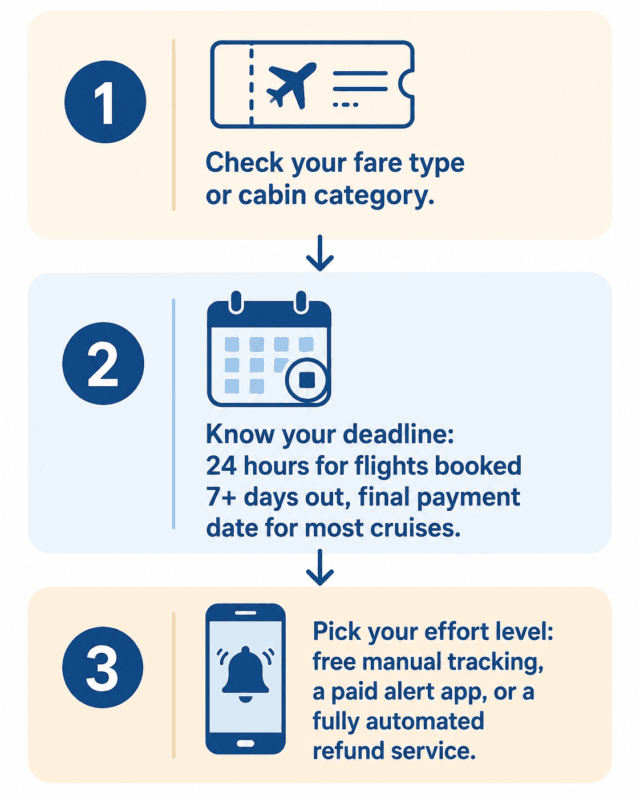
Start by identifying what you’re working with. Look at your fare type or cabin category first, because that alone tells you most of what to expect. A basic economy flight or a cruise booked well before final payment sit at opposite ends of the flexibility spectrum, and your plan should look different for each.
Next, know your actual deadline. For flights bought seven or more days before departure, you have 24 hours from booking to cancel for any reason and get a full refund, no fare rules attached. For most cruises, the real deadline is your final payment date, after which your options narrow to whatever courtesy policy your specific line offers, if any.
Finally, decide how much effort this is worth to you. If you’re only booking one or two big trips a year, a free tool like Google Flights, Skyscanner, or Hopper’s free tier is probably enough. If you travel more often or simply don’t want to think about it, a paid service like Going’s alert membership, or a fully automated option like Refare, trades a small fee or a cut of the savings for not having to remember any of this at all.
If you’re still figuring out if this fits at all into what you can reasonably spend, a flight price drop refund is a nice bonus, not a foundation to build a trip on. It works best once you’re already building the number into a real budget, so any refund you catch is extra room rather than money you were counting on from the start.
None of this requires becoming a fare-tracking hobbyist. It just requires knowing your deadline and picking one low-effort way to watch for it, instead of finding out by accident three weeks later like the traveler at the start of this post.
The Bottom Line
The fare you paid isn’t the last word, on either a flight or a cruise, as long as you know your actual deadline and pick one low-effort way to catch it. Airlines mostly deal in credit, not cash. Cruise lines are friendlier before final payment. And your one guaranteed protection, the 24-hour cancellation rule, has nothing to do with price drops at all.
If you’re already working out what a trip should cost before you book it, the Trip Budget Calculator is a useful next step. Getting a flight price drop refund is really about keeping more of a budget you already set, and the calculator helps you set that number in the first place before any of this even comes into play.
Has a flight or cruise price ever dropped on you after booking, and what did you do about it? We’d genuinely like to know in the comments.
Frequently Asked Questions
Can I get a refund if my flight price goes down?
Not as a rule. A flight price drop refund in cash is uncommon on U.S. airlines once you’ve bought a non-refundable ticket, though some now offer an e-credit for the difference depending on your fare type.
Do airlines refund the difference if the price drops?
It depends on the airline and fare type. A flight price drop refund is most likely on Southwest’s top two 2026 fare tiers, which return cash, while its base tier can’t be changed at all once purchased.
What is the 24-hour rule for flights?
U.S. law requires airlines to let you cancel a reservation within 24 hours of booking for a full refund, as long as you booked at least 7 days before departure. It applies to every fare class but has nothing to do with price drops specifically.
Does travel insurance cover price drops?
Standard travel insurance covers trip cancellation and interruption, not a fare that simply goes down after you book. A handful of old credit card price-protection perks used to cover this, but most of those have been discontinued.
Can a cruise price drop after final payment?
Rarely in your favor. Most cruise lines stop offering price adjustments once final payment is made, though Norwegian’s one-time courtesy adjustment is a notable exception if you’re still more than 14 days from sailing.