

Table of Contents
If your first real conversation with ChatGPT left you unimpressed, you are not alone, and you are not “bad at this.” Most people over 40 who try AI for the first time run into one of a handful of predictable snags, get a flat or confusing answer, and quietly decide the whole thing isn’t for them. That reaction makes sense. It’s also almost always fixable.
This post walks through the AI mistakes beginners make most often, the specific and non-technical kind, not the coding errors developers write about. Most guides on this topic are written for programmers and power users, which is exactly why they don’t help someone who just wants better results from ChatGPT without learning a new vocabulary first.
Every one of these mistakes has a simple fix, and none of them means you’re not a “tech person.” They’re just the normal bumps of learning a new tool, and once you know what they are, they’re easy to avoid.
Please note this page may contains affiliate links. If you purchase something through these links, I’ll receive a commission at no extra cost to you. Affiliate links help to support my website/blog and I only recommend products I love.
You’re Judging AI by Your First Bad Result
Here’s the mistake that causes the most people to quit before they ever get good at this: they type one question, get one so-so answer, and decide the tool just doesn’t work. Call it the one-strike rule. One bad interaction becomes a verdict instead of a data point.
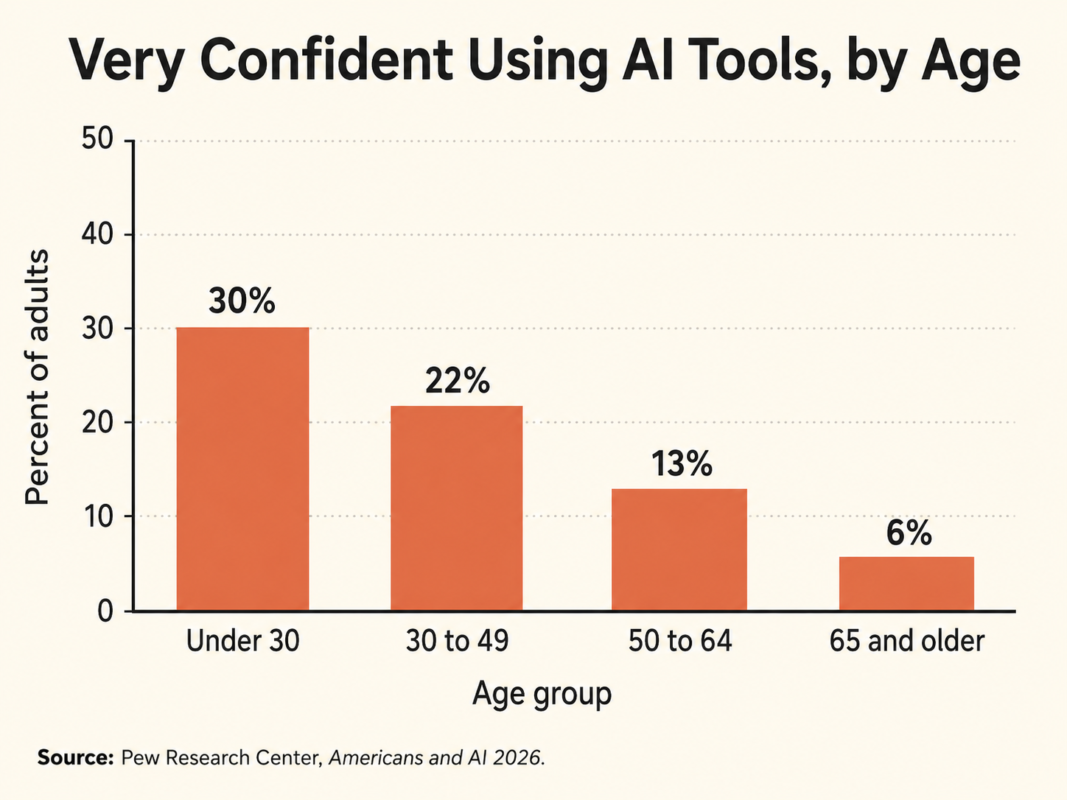
It helps to know you’re not the only one feeling unsure. According to Pew Research Center’s 2026 report on Americans and AI, roughly 6% of adults 65 and older say they feel very confident using AI tools, compared to about 30% of adults under 30.
A separate Pew analysis published the same month found that most Americans 50 and older still don’t use chatbots at all. The confidence gap isn’t a personal failing. It’s a pattern, and it’s wide enough that treating your first attempt as final judgment is setting the bar in the wrong place.
The fix is simple: treat your first prompt like a rough draft, not a verdict. Ask a follow-up. Add more detail. Try rephrasing the question a different way. If you want a gentler on-ramp before diving back in, our guide to getting comfortable with AI as a true beginner walks through what a realistic slow start actually looks like, because it’s supposed to be slow at first.
Your Prompts Are Too Vague, or Way Too Long
This is the single biggest driver of disappointing answers, and it cuts two directions. Some people type a one-line question with almost no context (“write me a retirement plan”) and get back something generic enough to be useless. Others go the opposite direction, pasting in a giant unstructured paragraph with five different questions buried inside it, and the AI answers the wrong one, or answers all five badly.
What actually works sits in the middle. Tell the tool who you are, what you want, and what a good answer would look like. Instead of “write me a retirement plan,” try something closer to: “I’m 58, plan to retire at 65, and want a simple month-by-month checklist for the next two years. Keep it to five steps.” That single change, adding real context, is often the entire difference between a forgettable answer and a genuinely useful one.
Think of it the way you’d brief a new assistant on their first day. They don’t know your history, your preferences, or what “good” looks like to you unless you tell them. AI works the same way. The tool isn’t reading your mind, it’s reading your prompt, and a thin prompt produces a thin answer almost every time.
If you want a structured way to build this habit, our beginner’s guide built for adults who don’t want to be left behind breaks prompt-writing down into a few repeatable patterns you can reuse for almost anything.
You’re Trusting the Answer Without Checking It
AI tools are confident. They will hand you a wrong answer with the same tone as a right one, which is exactly why this mistake is so easy to make. Treating AI output as settled fact, especially for anything involving your health, your money, or a legal question, is one of the riskier habits a beginner can pick up.
There’s research backing up why this matters beyond the obvious. A 2026 MIT Media Lab study found that over-reliance on AI chatbots is linked to a measurable decline in critical-thinking and misinformation-spotting skills over time.
The more people leaned on the tool to think for them, the worse they got at catching mistakes on their own. That’s not an argument against using AI. It’s an argument for using it the way you’d use a knowledgeable but occasionally wrong friend: a good starting point, not the final word.
We’ve written before about how we use ChatGPT for money questions without handing over the decision, and the same rule applies everywhere else. Treat the answer as a first draft. Verify anything that actually matters against a real, named source, a doctor, a financial advisor, or a government website, before you act on it.
This one is worth taking seriously precisely because AI sounds so sure of itself. A wrong answer delivered in a calm, complete sentence is more convincing than it should be. Build the habit of asking “how would I check this?” right after you get an answer that matters, and you’ll catch the occasional bad one before it costs you anything.
You’re Sharing More Than You Should
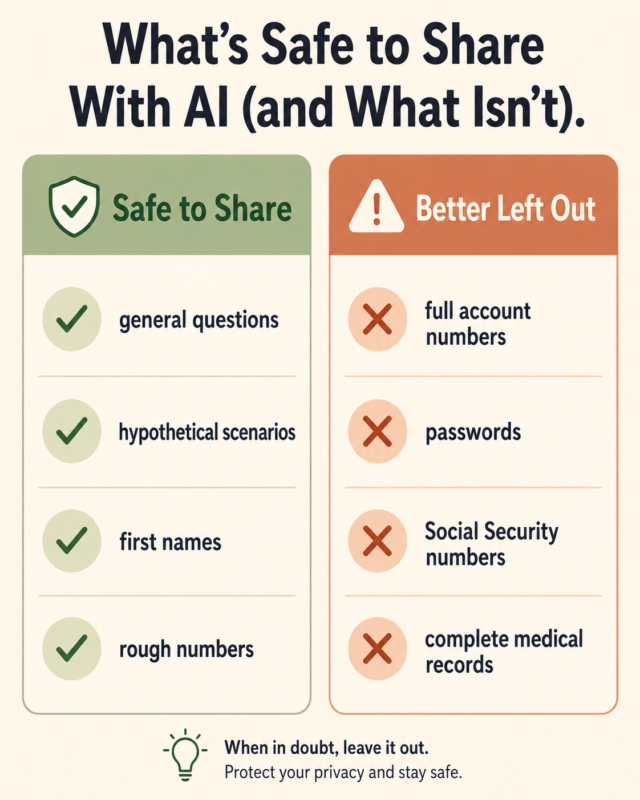
This is the mistake that gets the least attention in most “AI mistakes” articles, and it’s arguably the one this audience is most exposed to. Pasting your full account number into a chat window to “help explain your situation.” Typing out a detailed medical history because it’s faster than summarizing it yourself. Uploading a scanned document with your Social Security number still visible.
A Stanford Report piece from October 2025 laid out the privacy risk clearly: most consumer AI tools are not built, audited, or regulated the way your bank or your doctor’s office is, and conversations can be retained in ways that aren’t always obvious to the person typing.
That doesn’t mean AI is unsafe to use. It means the sharing decision deserves the same instinct you’d apply anywhere else online, which is also the same instinct scammers exploit with AI voice cloning: a little healthy suspicion before you hit send.
A quick way to think about it:
You’re Starting a New Chat Every Time Instead of Building on One
If you close the tab and start fresh every time you have a new question, you’re re-explaining your entire situation from scratch every single time. That’s slow, and it means the AI never gets the chance to actually understand your context.
Most AI tools let you continue a conversation, which means the tool remembers what you told it earlier in that same thread. Ask a follow-up question in the same chat instead of opening a new one, and you’ll notice the answers get sharper because you’re not starting over every time.
Over time, this habit can grow into something more useful: building toward a running AI knowledge base instead of starting from zero every time you need help with something familiar.
You Think You Have to Master Every AI Tool at Once
New AI tools show up in the news constantly, and it’s tempting to feel like you’re falling behind if you’re not using all of them. Beginners often bounce between ChatGPT, Gemini, Claude, and Copilot, looking for “the right one,” and end up mediocre at all four instead of genuinely comfortable with one.
You don’t need to master every tool. Pick one, spend real time with it, and let yourself get good at it before you look sideways at the others. We’ve laid out 25 everyday ways we actually use ChatGPT, almost all of which came from sticking with one tool long enough to find what it’s actually good for, rather than chasing the next new option.
The AI Mistakes Beginners Make Most Often, All in One Place
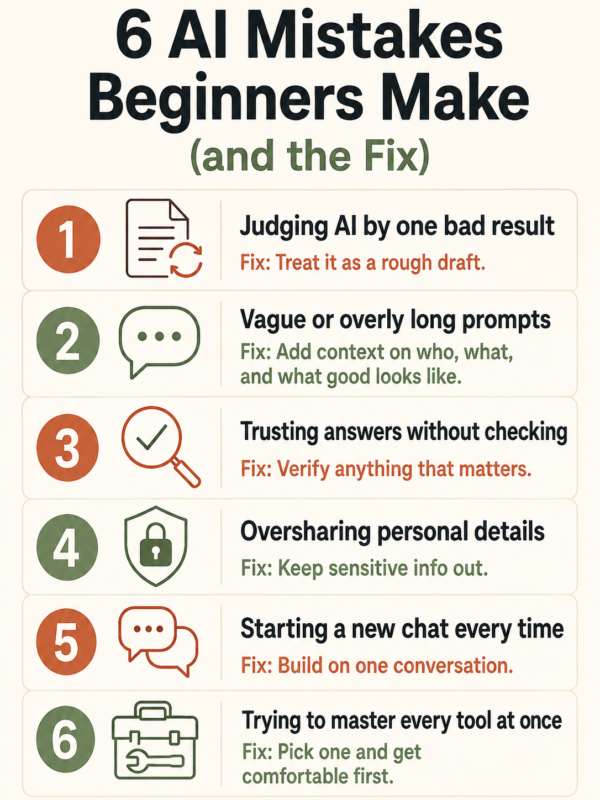
The most common AI mistakes beginners make are judging the tool by one bad first result, writing prompts that are too vague or too long, trusting answers without checking them, oversharing personal or financial details, restarting the conversation instead of building on it, and trying to learn too many tools at once.
If you only remember one thing from this post, remember this: every mistake above comes from treating a brand-new skill like it should already be easy. It shouldn’t, and it isn’t for anyone at the start. Here’s the full list in one place, so you can come back to it when you need a quick refresher instead of hunting through the whole post again.
Judging the tool by one bad first result. Writing prompts that are too vague or too long. Trusting an answer without checking it. Sharing more than you should. Starting a new chat every time instead of building on one. Trying to learn every AI tool at once instead of picking one and sticking with it. Six mistakes, six fixes, and none of them require any technical background to correct.
The Bottom Line
None of these mistakes mean you’re “not a tech person.” They’re the normal learning curve, the same one everyone goes through with any new tool, and now you know exactly what to watch for. A vague prompt, one bad first answer, an unchecked fact, an overshared detail, a chat that starts from zero every time, a tool-hopping habit. Fix them one at a time and the tool gets noticeably more useful within a few tries, not months.
If you want more of this kind of plain-English, no-jargon guidance as you get more comfortable with AI, sign up for our newsletter and we’ll send the next one straight to you.
Which of these mistakes have you already made, and which one are you fixing first?
Frequently Asked Questions
What is the most common mistake AI beginners make?
Expecting a perfect answer on the very first prompt and giving up when they don’t get one. Most people who stick with it improve their results within a few tries just by adding more context to what they’re asking.
Is it safe to share personal information with ChatGPT or other AI tools?
Avoid sharing full account numbers, passwords, medical record details, or anything you wouldn’t want stored indefinitely. Most consumer AI tools are not built to the same privacy standards as your bank or your doctor’s office, so a little caution goes a long way.
Why do I get bad answers from ChatGPT?
Vague or overly long prompts are the most common cause. Being specific about who you are, what you want, and what a good answer looks like usually fixes the problem immediately, often in the very next try.
Do I need to learn every AI tool to use AI well?
No. Picking one tool, like ChatGPT, and using it consistently will teach you far more than switching between several tools looking for the “best” one. Depth beats variety when you’re starting out.
Can I trust AI’s answers on health or financial questions?
Treat AI as a starting point for questions, not a final answer. Verify anything important with a doctor, financial advisor, or other named, qualified source before you act on it.