

Decluttering at 25 might mean clearing a closet before your next apartment lease. Minimalism after 50 can mean deciding what to do with your children’s school projects, your parents’ china, the hobby supplies you have not touched in ten years, and clothes that belong to an earlier version of you.
That is why it feels different now.
Short answer: Minimalism after 50 is less about owning the fewest things and more about choosing what deserves space in the life you are living today. The goal is not an empty house. It is a home that supports your time, energy, relationships, and next chapter.
Please note this page may contains affiliate links. If you purchase something through these links, I’ll receive a commission at no extra cost to you. Affiliate links help to support my website/blog and I only recommend products I love.
Table of Contents
- Why Minimalism After 50 Is a Different Decision
- The Three-Household Problem Nobody Warns You About
- Minimalism in Your 20s Versus Minimalism After 50
- Stop Organizing Things That No Longer Belong in Your Life
- Use the Four-Destination Test
- What to Do With Sentimental Belongings
- Set Boundaries Around Your Adult Children’s Stuff
- Do Not Wait for a Forced Move
- What Minimalism After 50 Is Not
- The Bottom Line
- Frequently Asked Questions About Minimalism After 50
Why Minimalism After 50 Is a Different Decision
By midlife, most of us are not sorting a random collection of purchases. We are sorting a life.
Our belongings may represent jobs we held, children we raised, homes we made, people we lost, plans we changed, and interests we thought would last forever. Some things are useful. Some carry real meaning. Others remain because we have never stopped long enough to decide whether they still belong.
Researchers have used the phrase “material convoy” to describe the possessions that travel with us through life and become connected to our roles, relationships, and sense of self. That helps explain why a box of old dishes can feel heavier than the dishes themselves. The weight is often emotional, not physical.
This is also why a fast, all-or-nothing cleanout can backfire. You are not weak or bad at decluttering if the decisions take time. You may simply be dealing with more history than you were at 25.
Our own ideas about living with less have changed over the years too. In our journey to intentional living, we found that simplicity became more useful when it stopped being a decorating style and started becoming a way to protect what mattered.
For us, that became real in 2022 when we sold our home and moved into a 42-foot fifth-wheel RV. Every item had to justify the limited space. We were not choosing less because it looked tidy. We were choosing what could travel with the life we wanted, and we learned how much emotional weight ordinary belongings can carry.
The Three-Household Problem Nobody Warns You About
Many people reach their 50s and discover they are storing pieces of three households at once:
- Your own household. This includes decades of purchases, paperwork, furniture, clothing, tools, hobbies, and “we might need it someday” items.
- Your adult children’s household. Their yearbooks, sports equipment, childhood boxes, college furniture, and things they want to keep but do not want in their own homes.
- Your parents’ household. Family photographs, inherited furniture, dishes, documents, and keepsakes that arrived during a move, illness, or estate cleanout.
No wonder the garage feels stuck.
The first helpful step is to stop treating everything under your roof as one giant organizing problem. Separate it by ownership. Your belongings require your decisions. Your children’s belongings require boundaries. Inherited belongings require time, context, and sometimes a conversation with other family members.

The AARP home decluttering guide makes a useful point for this season: downsizing decisions are easier when you begin before a move or health change forces a deadline. Starting now gives you room to make thoughtful choices instead of emergency choices.
Minimalism in Your 20s Versus Minimalism After 50
| The question | In your 20s | After 50 |
|---|---|---|
| What is the main goal? | Mobility and affordability | Freedom, clarity, and flexibility for what comes next |
| Where did the belongings come from? | Mostly your own recent choices | Decades of personal and family history |
| Who is affected? | Mostly you | A spouse, adult children, parents, siblings, and future heirs |
| What makes decisions hard? | Worry that you may need something later | Memory, identity, grief, obligation, and legacy |
| What does success look like? | Owning fewer things | Keeping the right things for the life you want now |
Minimalism after 50 does not need to look impressive in a photograph. It needs to make daily life easier.
That might mean one clear kitchen counter, a guest room that guests can actually use, fewer boxes to manage, or the freedom to consider a smaller home. It may even support a bigger change, such as choosing a freedom lifestyle instead of a traditional retirement.
The measure is not how little you own. The measure is how well your home serves you.
Stop Organizing Things That No Longer Belong in Your Life
One of the easiest ways to delay a decision is to buy another bin.
Bins are useful for items you have already chosen to keep. They are expensive hiding places for items you do not use, want, or have room to display.
Before you organize a category, ask:
- Would I choose to bring this into my home today?
- Does it support how I live now?
- Am I keeping it for a real person or an imaginary future version of myself?
- If this disappeared, would I replace it?
- Is the memory in the object, or can I honor it another way?
If you tend to freeze when there are too many decisions, our guide to using AI to declutter before a move includes prompts that can help you break a room into smaller steps. You do not need to be moving to use the method.
Use the Four-Destination Test
Traditional decluttering advice often gives you three choices: keep, donate, or trash. That is too blunt for many midlife decisions.
Try four destinations instead.
1. Use
These are the things that earn their place through regular use or genuine enjoyment. “Use” can include a practical tool, the serving dish you bring out for family dinners, or the chair where you read every morning.
The key is honesty. Something does not belong in this group because it could be useful. It belongs here because it is useful in your actual life.
2. Pass
These items still have value, but they may serve someone else better. Pass them to a specific family member, friend, community group, donation center, or buyer.
Whenever possible, give the item a deadline and a named destination. “I will ask Anna by Friday” is a plan. “One of the kids might want this” is storage with better public relations.
3. Preserve
Some things deserve to stay because they hold a story you want to carry forward. Preserve them intentionally.
That could mean choosing six photographs from a box of 200, keeping one quilt instead of five, scanning family letters, or writing the story behind an object so the next generation knows why it mattered.
Preserving is different from postponing. A preserved item has a home, a reason, and a size limit.
4. Release
Release includes donating, selling, recycling, and discarding. It also includes releasing guilt.
You can appreciate what an object represented without keeping it forever. You can be grateful for a gift and still let it go. You can decide that money already spent does not deserve more space, cleaning, and attention.
This is the same kind of freedom we wrote about in how minimalism helped us find more freedom. Less became valuable because of what it made room for.
Simplifying your home is often the first step toward simplifying the rest of your life. If you want practical ideas for building a freer, more intentional life after 50, join our newsletter and we’ll send new posts and useful tools straight to your inbox.
What to Do With Sentimental Belongings
Sentimental items are usually where practical advice runs into real life.
Start with the story, not the object. Ask yourself what you are trying to preserve: the person, the event, the family tradition, the craftsmanship, or the feeling. Once you know that, you can choose the best way to keep it.
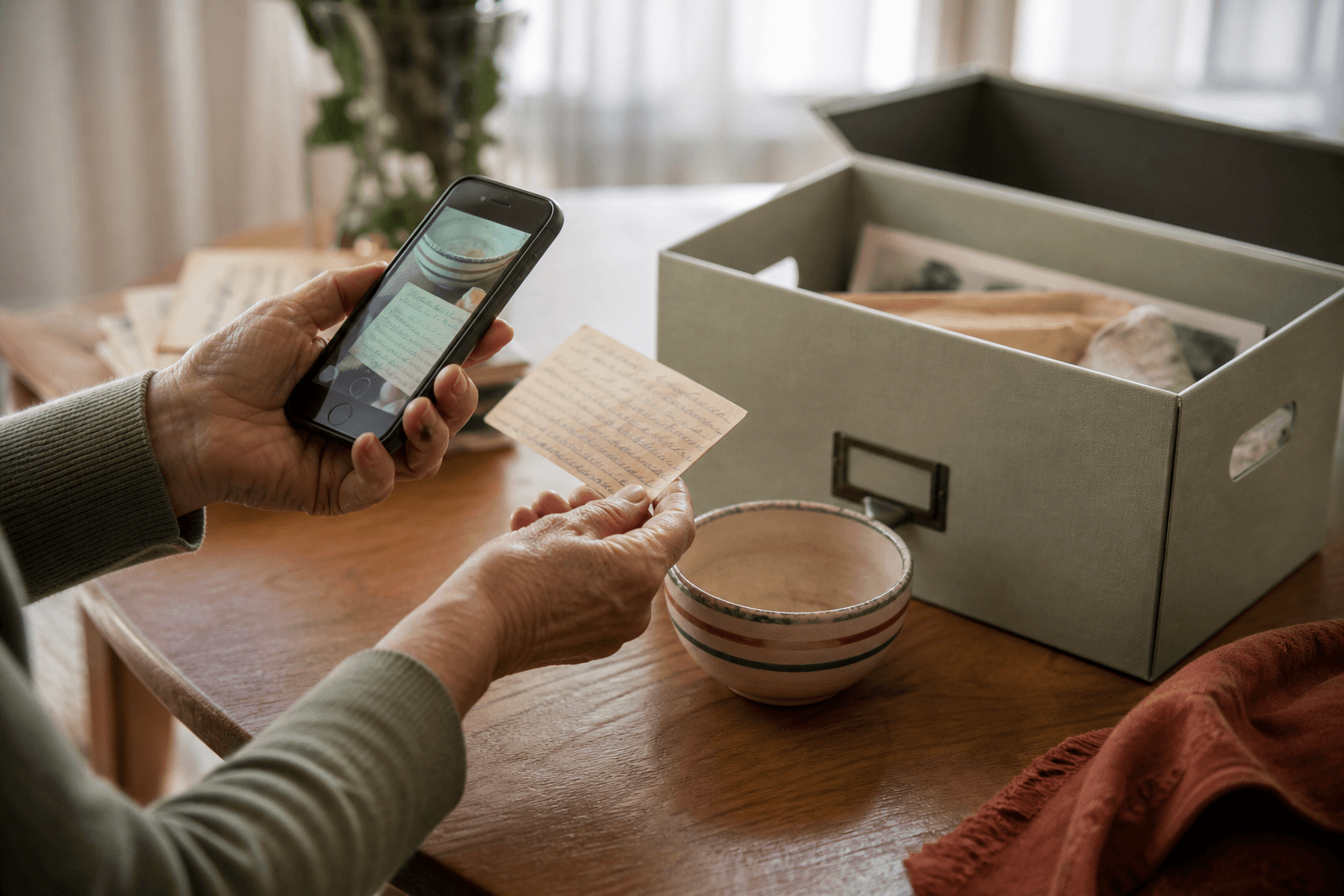
These approaches can help:
- Choose the best representative. Keep one meaningful item from a collection instead of the entire collection.
- Take a photograph. A clear photo can preserve the visual memory without requiring physical storage.
- Write down the story. A recipe card means more when someone knows whose handwriting it is and when the dish was served.
- Use the item. A family bowl on your table has a living role. A family bowl packed in a mystery box becomes a future chore.
- Set a physical boundary. Give each person one memory box, shelf, or defined amount of storage.
- Delay only the hardest decisions. A small “not yet” box is reasonable. An entire basement is not.
The goal is not to remove emotion from the process. The goal is to keep emotion from making every decision for you.
Set Boundaries Around Your Adult Children’s Stuff
Your home does not have to remain a free storage unit forever.
That does not mean putting childhood treasures on the curb without warning. It means moving responsibility back to the person who owns the belongings.
You could say:
We are simplifying the house and need you to make decisions about the boxes that belong to you. Please take what you want by October 15. If space is a problem, we can help you sort it into keep, photograph, donate, and discard. After that date, we will donate or dispose of what remains.
Choose a fair date, send a reminder, and follow through. If your child lives far away, offer one video sorting session or mail one reasonably sized box. You can be helpful without becoming permanent storage.
If several family members are involved, make the same rule for everyone. Clear expectations prevent old family dynamics from turning a garage cleanout into a referendum on who was loved most.
Do Not Wait for a Forced Move
Minimalism after 50 is most useful when it creates options before you need them.
A home with clear walkways, manageable storage, and fewer unused items is easier to maintain now. It is also easier to adapt later. The National Institute on Aging’s home safety checklist highlights practical basics such as clear walking paths, safe stairs, and easy access to frequently used items. Decluttering is not the whole safety plan, but it can remove some avoidable obstacles.
You do not need to clear the whole house this month. Start with one low-emotion area for 45 minutes:
- expired pantry food
- extra mugs and water bottles
- worn towels
- old toiletries
- duplicate tools
- paperwork you can confidently shred
Finish the full cycle before you stop. Put donations in the car. Take recycling out. Return “pass” items to the person who owns them. A bag moved from the bedroom to the hallway is not finished.
Small completed sessions build trust in your ability to make decisions. That matters more than one exhausting weekend followed by six months of avoidance.
What Minimalism After 50 Is Not
Minimalism after 50 is not:
- getting rid of everything you love
- making your home look beige and empty
- pressuring a spouse to follow your exact rules
- judging people who enjoy collections
- tossing family history without asking anyone else
- preparing to disappear from your own life
It is a way to decide what you want to carry forward.
For some people, that leads to a smaller home. For others, it simply means living better in the home they already have. For us, simplicity also became connected to travel and mobility, which is part of why minimalism and RV living worked so well together. Your version may look completely different.
That is the point. Your belongings should support your life, not define the only life you are allowed to have.
The Bottom Line
Minimalism after 50 asks a better question than “How little can I own?”
It asks, “What is worth carrying into the years ahead?”
Use what supports your daily life. Pass along what can serve someone else. Preserve the stories that matter. Release what has already done its job.
You do not have to erase your past to make room for your future. You only need to stop storing every version of both.
Frequently Asked Questions About Minimalism After 50
What does minimalism after 50 mean?
Minimalism after 50 means choosing the belongings that support your life now while thoughtfully sorting decades of possessions, family history, and old identities. The goal is not to own the fewest things. It is to keep the right things for the years ahead.
Is 50 too late to become a minimalist?
No. Minimalism after 50 can be especially useful because you have more experience with what you value and how you want to spend your time. Start with one small, low-emotion category and define what “enough” looks like for your life now.
How do I declutter after 50 without regretting it?
Avoid making every hard decision at once. Begin with obvious trash, duplicates, and items you no longer use. For sentimental belongings, photograph them, record their stories, keep the best representative items, and use a small “not yet” box for decisions that genuinely need more time.
What should I do with my grown children’s belongings?
Give each adult child a clear deadline to collect or sort their things. Offer reasonable help, such as a video sorting call or one mailed box, but make it clear what will happen to anything left after the deadline.
How do I let go of inherited sentimental items?
Identify the story or person you want to remember, then choose the smallest meaningful way to preserve that connection. Keep one representative item, take photographs, write down the history, or offer pieces to family members before donating the rest.
Do I need to downsize my home to practice minimalism after 50?
No. You can practice minimalism in any size home. The aim is to reduce the belongings, maintenance, and visual noise that compete with your time and energy. Downsizing is one possible result, not a requirement.
Where should I start decluttering after 50?
Start somewhere useful but emotionally easy, such as expired pantry food, extra toiletries, worn linens, or duplicate kitchen tools. Work for 45 minutes and remove donations, recycling, and trash from the room before you finish.
Want more practical ideas for building a freer, simpler life after 50?