

Table of Contents
People are curious about using ChatGPT for personal finance, and the questions are understandable. Can it help you figure out why your money keeps disappearing? Can it explain the difference between a Roth and a traditional IRA? Can you ask it why your budget keeps falling apart every February?
Yes, no, and yes, sort of.
ChatGPT can be a genuinely useful thinking partner for money decisions if you know what it is actually good at, what to keep private, and how to check anything it tells you before you act on it. The problem is not that people use AI for personal finance. The problem is that most of them do not have a clear framework for doing it safely.
This post gives you that framework. You will learn what ChatGPT can safely help with, what to keep off the screen entirely, how to write prompts that get useful answers without exposing sensitive information, and a simple three-step rule for verifying money guidance before you act.
Please note this page may contains affiliate links. If you purchase something through these links, I’ll receive a commission at no extra cost to you. Affiliate links help to support my website/blog and I only recommend products I love.
What ChatGPT for Personal Finance Can Actually Do
The simplest way to think about ChatGPT for personal finance: it is a very well-read thinking partner that has no access to your accounts, no fiduciary duty, and no way to know your actual situation unless you tell it.
That last part matters. ChatGPT can explain what a debt snowball is. It can describe the difference between an HSA and an FSA. It can help you build a checklist of questions to ask your CPA before tax season. What it cannot do is give you personalized, legally or professionally accountable advice based on your income, debt load, family situation, or retirement timeline.
ChatGPT is not a fiduciary. It is not a licensed financial advisor, tax professional, investment advisor, or loan officer. It can sound confident while being incomplete, outdated, or just wrong about your specific circumstances. A 2024 research paper from arXiv that tested large language models on personal finance questions found they performed unevenly across different financial domains, particularly with complex or context-dependent situations.
That is not a reason to avoid it. It is a reason to use it the right way. If you are new to AI tools in general, a good starting point is understanding how these tools work before you use them for something as important as your money. Our post to getting started with AI if you are over 50 covers the basics in plain language.
Grab a copy of our FREE AI Starter Guide for People Over 40
Safe Ways to Use ChatGPT for Budgeting and Spending Clarity
The most useful thing most people can do with ChatGPT and their budget is give it a cleaned-up summary of their spending categories, not their actual bank statements.
Here is what that looks like in practice. Instead of uploading a statement or pasting account numbers, round your monthly spending into broad categories: housing, food, transportation, subscriptions, entertainment, debt payments, and savings. Then ask ChatGPT to look for patterns.
A safe prompt might look like this: “Here are my monthly spending categories with rounded totals. Housing: $1,800. Food and dining: $600. Transportation: $420. Subscriptions: $95. Entertainment: $180. Debt payments: $350. Savings: $200. What patterns stand out, and what should I look at first?”
That gives ChatGPT enough to work with without exposing any sensitive details. It can spot where your ratios feel off, raise questions you had not thought of, or help you build a simple checklist for trimming specific categories. ChatGPT is also good at translating a vague money goal into concrete weekly steps. “I want to pay off $8,000 in credit card debt in 18 months” is the kind of goal that gets clearer when you work through the math out loud with an AI.
This fits naturally alongside other practical ways AI can reduce everyday friction. Our post on using AI in everyday life covers a lot of the same territory if you want more examples.
Use ChatGPT to Prepare Better Questions, Not Final Answers
One of the most underused applications of ChatGPT for personal finance is question preparation.
Before you meet with a financial planner, a CPA, a mortgage broker, or your HR department about benefits, spend 20 minutes with ChatGPT building a question list. Tell it the situation in general terms, ask it what assumptions a professional would want you to have thought through, and let it surface the questions you did not know to ask.
This is especially useful for decisions that feel overwhelming because you do not speak the language yet. Roth conversions, asset allocation, Medicare enrollment windows, debt consolidation options, or the tradeoffs between refinancing and paying down principal. ChatGPT can give you a plain-English explanation of each concept. That does not make you qualified to decide on your own, but it does mean you will walk into a professional conversation ready to ask better questions and understand the answers.
Treat it as the first draft of your thinking, not the final word. Ask for a comparison of two general options so you can see what the tradeoffs look like before you bring the real numbers to someone qualified. Ask it to explain terms like APR, emergency fund, debt snowball, Roth conversion, or dollar-cost averaging in plain language. The goal is to show up to the real conversation ready, not to avoid having it.
What Not to Put into ChatGPT When Talking About Money
This is the part that matters most for protecting yourself.
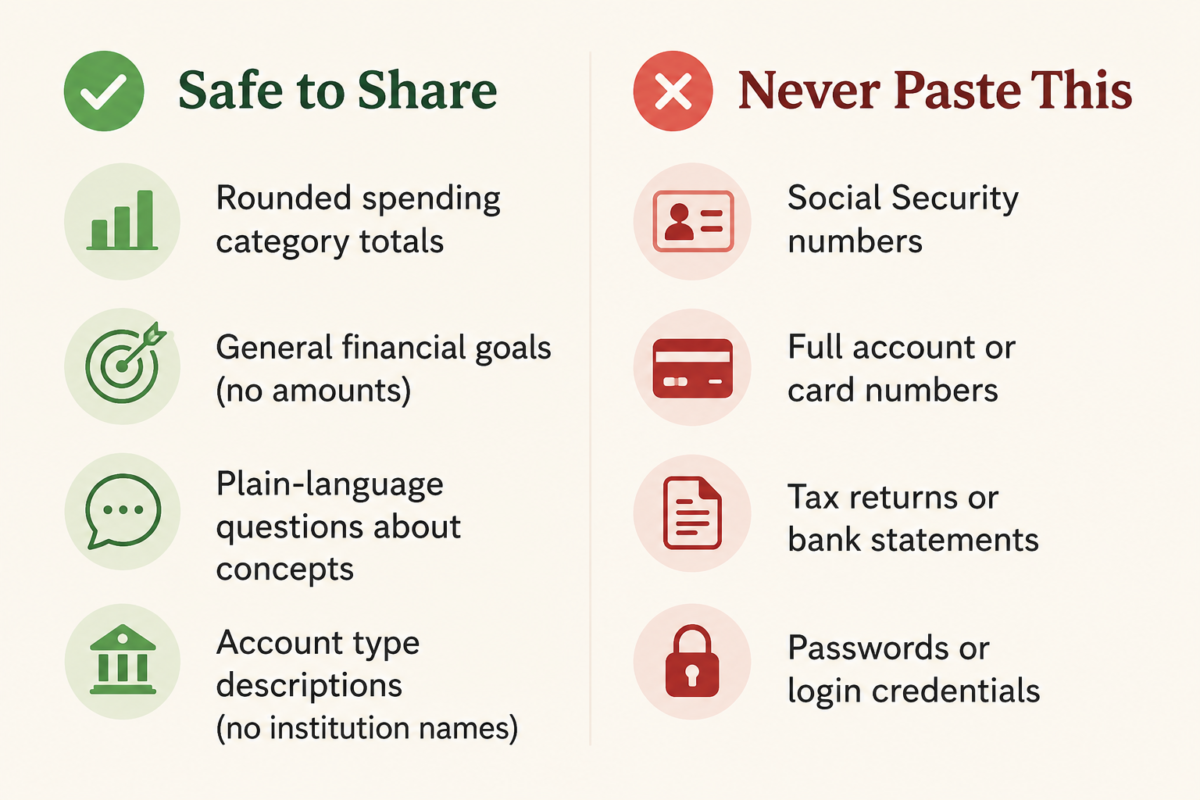
Do not paste the following into ChatGPT or any AI tool unless you have carefully read the platform’s current data and privacy settings and understand what you are agreeing to:
- Social Security numbers or taxpayer identification numbers
- Full account numbers, routing numbers, or passwords
- Full tax returns, W-2s, or 1099s
- Complete bank or credit card statements
- Signed legal documents or contracts
- Loan documents with your full personal information
- Credit card numbers or full card details
- Medical expense records with your name attached
The safe summary method described in the budgeting section above works for any money topic. Strip out names, account numbers, exact balances, and identifying details. Round numbers. Describe the situation categorically instead of specifically.
OpenAI has data controls that let you turn off training on your conversations, use Temporary Chats that are not stored, and manage memory settings. It is worth reading the OpenAI Data Controls FAQ before you use ChatGPT for anything sensitive. These settings change over time, so check the current documentation rather than relying on what you read about them a year ago.
The broader point is that AI tools make it easy to share a lot of detail quickly. That convenience is also a privacy risk if you are not paying attention to what you are typing.
How to Check ChatGPT’s Financial Answers Before Acting
ChatGPT will sometimes be wrong. It will sometimes be right but incomplete. It will sometimes give you a general answer that does not apply to your specific tax bracket, state, account type, or situation. The responsible move is to verify before acting.
Here is a practical three-step rule: pause, verify, decide.
After you get an answer, pause before acting on it. Then verify the specific numbers, dates, tax rates, account rules, or legal requirements using current authoritative sources. Then decide, ideally with a professional for anything significant.
For investment-related claims specifically, the bar for verification is higher. The SEC, FINRA, and NASAA have issued a joint investor alert warning about AI-driven investment scams, including tools that claim to offer guaranteed returns, deepfake celebrity endorsements, and AI-generated stock tips. The Investor.gov AI fraud alert is worth reading if you have any interest in using AI for investing decisions. If an AI tool is making you feel confident about investments you do not understand, that is a warning sign, not a feature.
For everyday budget and planning questions, a simpler approach works: ask ChatGPT to list the assumptions behind its answer. “What assumptions are you making here, and what should I verify before acting on this?” Then check those specific things using the source it names or a comparable authoritative one.
A Simple Safe-Use Framework for Real Life
The goal of all of this is not to make you paranoid about using AI for money questions. Most people are not at serious risk from asking ChatGPT to explain a Roth IRA or help them think through a debt payoff plan. The goal is to use it intentionally.
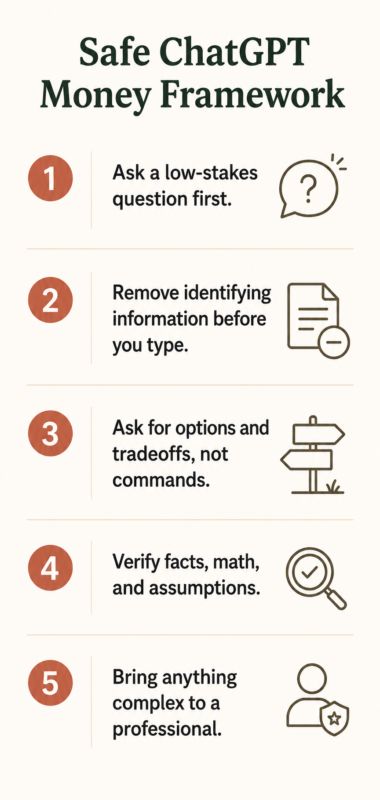
Here is the framework I use when I want to think something through with AI before making a real financial decision.
Step 1: Ask a low-stakes question first. Start with something that has no sensitive information attached. See how ChatGPT reasons. Get a feel for how it handles nuance before you rely on it for anything bigger.
Step 2: Remove identifying information before you type. Replace names with “my spouse” or “Person A.” Round balances to the nearest hundred. Describe the account type, not the institution. Share the category, not the number.
Step 3: Ask for options, tradeoffs, and questions instead of commands. “What are the tradeoffs between X and Y?” gets better information than “Tell me which one to do.” “What questions should I ask a financial planner about this?” is almost always more useful than asking ChatGPT to play the role of planner.
Step 4: Verify facts, math, and assumptions. Do not take ChatGPT’s word on rates, rules, deadlines, tax implications, or product terms. Check the source. The pause-verify-decide rule applies here.
Step 5: Bring anything complex to a professional. If the decision involves your retirement timeline, significant debt, taxes, insurance, legal documents, or estate planning, ChatGPT is a starting point, not a finish line.
If building toward financial independence is part of your plan, AI tools can support the process in meaningful ways without replacing the careful thinking the goal requires. Our post on how to use AI for financial independence goes deeper on the specific ways AI can help with the numbers and the planning.
ChatGPT is genuinely useful for personal finance when it helps you think more clearly, organize what you already know, and ask better questions before making a decision. It becomes a problem when you paste in sensitive information you should not share, skip the verification step, or treat a chatbot’s answer as the equivalent of a licensed professional’s advice.
Most of us are not in danger of doing that intentionally. The risk is that the tool is so easy and so conversational that it starts to feel like talking to an advisor. It is not. It is a capable thinking partner with real limitations, and knowing the difference makes you a smarter user.
If getting to financial independence is a goal for you, a concrete next step is getting clear on your actual freedom number. Our FREE Freedom Number Calculator walks you through the math so you know exactly what you are working toward. That is the kind of specific, personal number that ChatGPT cannot give you, but that makes every other financial conversation easier once you have it.
Grab a copy of our FREE AI Starter Guide for People Over 40
What money question have you already tried asking ChatGPT? Share it in the comments below.
Frequently Asked Questions
Can ChatGPT be my financial advisor?
No. ChatGPT can explain concepts, organize information, and help you prepare questions, but it is not a fiduciary or licensed professional. Use a qualified advisor for personalized investment, retirement, tax, insurance, or legal decisions.
What financial information should I not put into ChatGPT?
Do not paste Social Security numbers, passwords, full account numbers, tax returns, full bank statements, credit card numbers, signed legal documents, or anything that could expose your identity or accounts. Use the safe summary method: round numbers, remove names, and describe the situation in general terms.
Can ChatGPT help me make a budget?
Yes, if you use safe summaries. Share rounded category totals instead of account statements. ChatGPT can help spot patterns, suggest questions, and turn a budget goal into a concrete checklist.
Can ChatGPT help with investing?
It can explain investing terms and help you compare general tradeoffs, but it should not be used for stock picks, guaranteed-return claims, or final investment decisions. Verify any claims using current authoritative sources and consult a registered professional for your specific situation.
How do I check ChatGPT’s money advice?
Ask ChatGPT to list its assumptions, then verify the math, dates, rates, laws, and product terms using current authoritative sources. Use the pause-verify-decide rule before acting on any financial answer.