

You can know the math and still avoid the next step.
You can understand compound growth, agree that saving matters, and have a perfectly good budget template sitting untouched on your laptop. Then one old sentence shows up: “I am bad with money.” Or “I started too late.” Or “People like me never get ahead.”
That gap between knowing and doing is where limiting beliefs about money tend to hide. They sound like facts because you have repeated them for years. Most started as an attempt to make sense of something real. The trouble comes when an old explanation quietly becomes a permanent rule.
Limiting beliefs about money are learned assumptions that narrow what you think is possible or safe with earning, saving, spending, and investing. They can influence behavior, but they are not permanent facts. The useful move is to name the belief, check it against evidence, and test one small, realistic action.
Please note this page may contains affiliate links. If you purchase something through these links, I’ll receive a commission at no extra cost to you. Affiliate links help to support my website/blog and I only recommend products I love.
Table of Contents
What Limiting Beliefs About Money Actually Are
Financial psychologists often use the term “money scripts” for beliefs about money that operate in the background. You may not consciously choose them, but they can affect what you avoid, what you chase, and what feels safe.
A 2011 study by Bradley Klontz, Sonya Britt, Jennifer Mentzer, and Ted Klontz asked 422 people about 72 money-related beliefs. The researchers identified four broad patterns: money avoidance, money worship, money status, and money vigilance. Three of those patterns had significant associations with income and net worth.
That finding does not mean a better thought produces a bigger bank balance. Income, health, housing costs, access, discrimination, caregiving, debt, and plain bad luck all matter. A belief is one part of the picture. It matters because it can steer the choices available inside your actual circumstances.
Limiting beliefs about money are not diagnoses, and they do not define your character. The useful question is not, “Is my mindset wealthy enough?” It is, “What does this sentence lead me to do next?”
That is the same difference you see between a fixed story and a skill you can learn. “I am bad with money” closes the case. “I have not learned a system that works for me yet” leaves room for evidence.
Where Your Money Story Came From
Most of us learned about money long before anyone explained interest rates or retirement accounts. We watched who paid the bills, what happened when money ran short, and whether spending was discussed calmly or behind a closed door.
The Consumer Financial Protection Bureau describes financial habits and norms as the values, standards, routines, and rules people use in daily financial life. Its guidance says attitudes, emotions, social norms, and contextual cues can shape decisions from splurging on a treat to saving for retirement.
Newer research points in the same direction. In a 2025 Journal of Financial Therapy study, Timothy Todd and Han Na Lim examined how family financial socialization relates to money scripts among retirement-plan participants.
The simple takeaway is that money beliefs do not appear out of nowhere. We absorb them through what people say, what they do, and what happens around us.
Some rules were genuinely useful once. “Never waste food” may have helped a family through a hard season. “A paycheck is safety” may have kept the lights on. The problem is not that you learned those rules. The problem is applying every old rule to every new situation without checking whether it still fits.
10 Limiting Beliefs About Money That Keep You Stuck
You may recognize several of these. Pick the one that changes your behavior most often. That is a better starting point than trying to repair your entire financial life on Saturday morning.
1. “I am bad with money”
This turns a set of skills into an identity. If you are “bad with money,” opening a statement feels like proof of who you are rather than information you can use.
A more accurate sentence is: “I have made money decisions I would handle differently now.” Your small test might be reviewing one account for ten minutes and writing down only three facts. No judgment. No full budget. Just facts.
2. “I started too late”
Midlife makes this one loud. You run a calculator at 48 or 55, see a seven-figure target, and decide the door has closed.
J remembers sitting at the kitchen table in his late 40s, entering his age, savings, and income into a retirement calculator. The result felt so far away that he laughed. That number did not disappear, but it eventually became a starting point for building freedom in stages with D.
If a big target feels like a verdict, read how a discouraging freedom number can become a useful starting point. Your test is to choose one variable you can actually move this year.
3. “Wanting more freedom is selfish or greedy”
Wanting control over your time is not the same as wanting to win a status contest. The CFPB defines financial well-being partly as having the freedom to make choices that allow you to enjoy life. That is broader than earning the most or owning the most.
Try writing what “enough” would let you do for yourself and for other people. A clear purpose can separate freedom from accumulation for its own sake.
4. “If I cannot do it perfectly, there is no point starting”
Perfection makes delay feel responsible. You keep researching the ideal budget, investment approach, or side income while making no decision at all.
Replace “perfect” with “repeatable.” Test one automatic transfer small enough that it will not put a bill at risk. The amount matters less than proving you can create a routine and adjust it.
5. “People like me do not become financially secure”
This belief often carries real history. Maybe nobody in your family invested. Maybe every raise was followed by an emergency. Maybe financial advice never sounded as if it was written for your life.
Do not answer that history with a fake slogan. Look for one credible example close enough to your circumstances to teach you something, then copy one process rather than someone else’s outcome.
6. “Looking at the numbers will only make me feel worse”
Avoidance offers quick relief. It also lets late fees, unused subscriptions, or a growing balance keep moving without you.
The American Psychological Association reported in 2023 that Wendy De La Rosa’s research examines how subjective perceptions of wealth relate to spending behavior and reported stress. Feelings around money are real, but a feeling is not an account balance.
Set a five-minute timer. Look at one number, write it down, and stop when the timer ends. The goal is not to solve it. The goal is to teach your nervous system that looking and acting are separate choices.
7. “A steady paycheck is the only safe choice”
A paycheck can be valuable. Calling it the only form of safety can keep you in work that is harming your health or leave you dependent on one source of income.
D and J did not wake up fearless. They questioned the idea that traditional retirement was the only acceptable finish line and began building a freedom lifestyle in stages.
Your test might be pricing one small income idea, building a larger cash buffer, or learning what part-time work would pay. You are gathering options, not handing in a resignation letter.
8. “More money will fix every problem”
More money can fix some problems. It can buy safer housing, time, medical care, and breathing room. It cannot automatically settle a values conflict, repair a relationship, or tell you what enough means.
Write down the problem you want money to solve. Then divide the answer into “money helps directly” and “money cannot decide this for me.” Both columns may be true.
9. “If I spend anything on life now, I am failing my future”
Fear can dress up as discipline. You save so aggressively that every meal out or weekend away feels like betrayal, even when the plan can handle it.
The opposite mistake is spending without a plan because tomorrow feels uncertain. A better question is whether the expense fits a number you chose on purpose. We faced our own version of that tension when we decided not to defer every meaningful trip until retirement.
Try creating a small “life now” category. A limit can provide permission and a boundary at the same time.
10. “One bad decision proves I cannot be trusted”
One bad purchase, investment, job change, or missed payment can become evidence for a lifetime sentence. But a decision made with old information is not proof that every future decision will be the same.
Review the choice like a case file. What did you know? What did you miss? What rule would reduce the chance of repeating it? Confidence grows faster from one completed action than from waiting to feel ready.
How to Change a Money Belief Without Lying to Yourself
Replacing “I will never have enough” with “Money flows to me easily” may sound positive, but it gives you nothing to test. If the new sentence feels false, your brain dismisses it before breakfast.
Use a balanced statement instead. It should admit what is true and leave room for a choice.
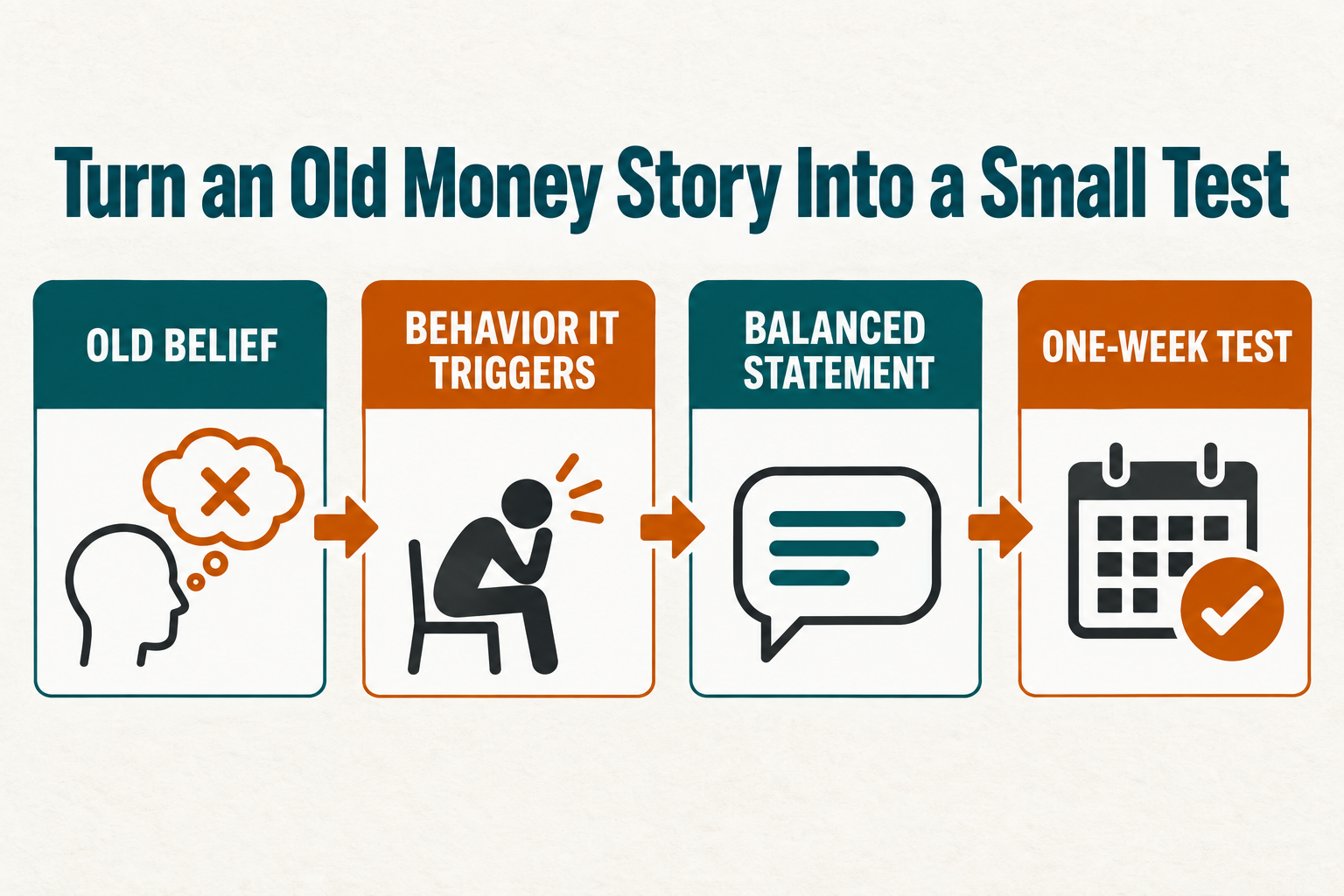
- Name the belief in the exact words you use.
- Separate current facts from predictions about the future.
- Identify the behavior the belief triggers.
- Choose one safe action that could give you new evidence.
The American Psychological Association’s 2025 overview of behavioral interventions describes how specific actions can be used within cognitive behavior therapy to test and revise unhelpful thinking. You do not need to turn this article into therapy. The everyday version is simpler: stop arguing with the belief in your head and collect a small piece of real-world evidence.
If your belief is “I cannot save consistently,” a balanced replacement could be, “I have not kept a savings habit for long, and I can test a $10 weekly transfer for one month.” The action is small on purpose. It creates information without risking rent, food, or medication money.
When Mindset Is Not the Main Problem
Sometimes the problem is not a belief. It is that rent went up, a caregiver had to reduce work hours, medical bills arrived, or the available jobs do not pay enough.
Calling every money problem a mindset problem turns a useful tool into blame. Beliefs can affect behavior, but they do not erase low wages, disability, discrimination, debt costs, unstable housing, or emergencies. A practical plan has to respect the facts in front of you.
The same applies when money triggers panic, compulsive spending, secrecy, or serious conflict with a partner. A qualified financial counselor, financial therapist, or mental-health professional may be more useful than another worksheet. Asking for the right kind of help is an action, too.
A 15-Minute Money Belief Check
To spot limiting beliefs about money in your own life, choose one sentence that showed up while you read. Give yourself fifteen minutes and fill in one row.
| Old Belief | Behavior it triggers | Balanced replacement | One-week test |
|---|---|---|---|
| I am bad with money | I avoid my statements | I can learn one account at a time | Review one statement for ten minutes |
| A paycheck is my only safety | I never examine other choices | A paycheck is one form of safety, and options add resilience | Research one low-risk income or work option |
Do not grade yourself on whether the belief disappears. Grade the experiment on whether it gave you better information.
Want more like this? Join our newsletter and discover more midlife tools and knowledge we’re actually using.
The Bottom Line
You do not need perfect optimism. You need enough honesty to stop treating an old story as a permanent rule.
Changing limiting beliefs about money starts smaller than most people expect. Pick one belief. Find the behavior attached to it. Run one safe test that respects your real circumstances. Then use what happened, not what fear predicted, to choose the next step.
What is the first sentence about money you remember hearing, and does it still deserve a vote in your life today?
Frequently Asked Questions
What are common limiting beliefs about money?
Common examples include “I am bad with money,” “I started too late,” “wanting more is greedy,” and “looking at the numbers will only make things worse.”
Where do limiting beliefs about money come from?
They can grow from family messages, culture, early experiences, periods of scarcity, work history, and emotionally charged financial events.
How do money beliefs affect financial freedom?
A belief can influence whether you avoid, overspend, underspend, delay a decision, or refuse useful help, which can change the actions you take toward greater choice.
Can you change limiting beliefs about money?
Yes. Start by naming one belief, separating facts from predictions, and testing a small behavior that gives you new evidence.
What is the first exercise for changing a money belief?
Write the sentence you repeat, the behavior it triggers, a more accurate replacement, and one safe action you can take within seven days.