

There is a particular kind of Sunday-night thought that shows up in midlife. Your life works on paper. The bills get paid, people count on you, and your job may even look successful from the outside. Still, you cannot picture doing the same thing for another 20 years.
That feeling does not mean you need to resign on Monday. Learning how to reinvent yourself at 45 can begin while your paycheck, health insurance, and daily routine stay in place. In fact, keeping those things for a while can give you the room to make a better decision.
To reinvent yourself at 45 without quitting, identify the part of your life that no longer fits, choose three possible directions, and test one for 90 days. Keep your paycheck while you talk to people, build a small work sample, try the work with real people, and review the evidence.
Please note this page may contains affiliate links. If you purchase something through these links, I’ll receive a commission at no extra cost to you. Affiliate links help to support my website/blog and I only recommend products I love.
How to Reinvent Yourself at 45 Without Starting Over
The phrase “start over” makes a midlife change sound as if the first 25 years of your working life have to be thrown away. They do not. You are carrying skills, judgment, relationships, and a much clearer sense of what drains you than you had at 25.
The U.S. Bureau of Labor Statistics reported in September 2024 that 39 percent of workers ages 45 to 49 had been with their current employer for at least 10 years. For workers ages 50 to 54, the share was 40.8 percent. That is a lot of accumulated knowledge, even if the current role no longer fits. (U.S. Bureau of Labor Statistics)
Your job title is one container for that knowledge. It is not the knowledge itself.
A project manager may be tired of corporate meetings but still love turning chaos into a clear sequence. A teacher may want to leave the classroom but still love explaining hard ideas. A contractor may want less physical work but still know how to price jobs, solve problems, and calm anxious clients.
That distinction matters when you are working out how to reinvent yourself at 45. The goal is not to become a blank page. It is to keep what still belongs to you and change the container around it.
We have already written about why people over 40 start questioning the path they are on. This is the next step: turning that private question into a small, safe test.
Start With the Part of Your Life That Feels Wrong
Before choosing a new career, business, city, or lifestyle, get specific about the friction. “I hate my life” is too broad to guide a useful decision. “I hate that my work controls every weekday and leaves me no energy for family” gives you something you can test.
Use six categories to locate the problem:
| Area | Question to ask |
|---|---|
| Work | Do I dislike the tasks, the employer, or the whole field? |
| Time | Do I need fewer hours, more control, or a different schedule? |
| Location | Would remote, local, or seasonal work change the picture? |
| Energy | Which parts of my week leave me flat, and which wake me up? |
| Meaning | Do I need my paid work to matter more, or do I need meaning outside it? |
| Money | Do I need more income, lower expenses, or less dependence on one source? |
Spend a week noticing real moments. Write down when you feel irritated, interested, useful, bored, or fully present. Do not judge the notes yet. You are looking for a pattern.
You may discover that you do not need a new profession. You may need a different manager, a four-day schedule, an internal move, one day of remote work, or a serious project outside the job. That is good news because a smaller problem is usually easier to test.
You may also discover that the whole structure is wrong. If so, the notes give you a reason that is more reliable than one terrible Tuesday. They also help you tell the difference between normal fear of change in midlife and a direction that genuinely does not suit you.
If you are asking how to reinvent yourself at 45, this audit is where the answer starts getting personal. It keeps you from solving a problem you do not actually have.
Build Three Possible Second Acts, Not One Perfect Plan
One of the worst questions you can ask is, “What should I do with the rest of my life?” It demands one perfect answer before you have tested anything.
The Stanford Life Design Lab teaches people to apply design thinking to life and career questions. Its approach includes generating ideas and prototyping parts of a possible life before making a large commitment. (Stanford Life Design Lab)
Use that idea to sketch three second acts. Each one should solve the friction you named and keep at least one useful part of your existing experience.
For example, a 47-year-old operations manager who wants more control might sketch these options:
- Move into an internal program role with fewer emergencies.
- Offer a small operations service to one local business on Saturdays.
- Teach a short workshop for new managers through a community group.
These are not commitments. They are possible directions with different levels of risk.
Make the options different enough to teach you something. If all three are versions of the same job title at a different company, you are testing employers, not a new second act. That may still be the right question, but name it honestly.
When people ask how to reinvent yourself at 45, they often assume clarity should arrive before action. Usually, clarity grows after a few real conversations and small attempts. A page full of ideas can point you somewhere. A Tuesday evening spent doing the work tells you whether you want another Tuesday like it.
Run a 90-Day Reinvention Experiment While Employed
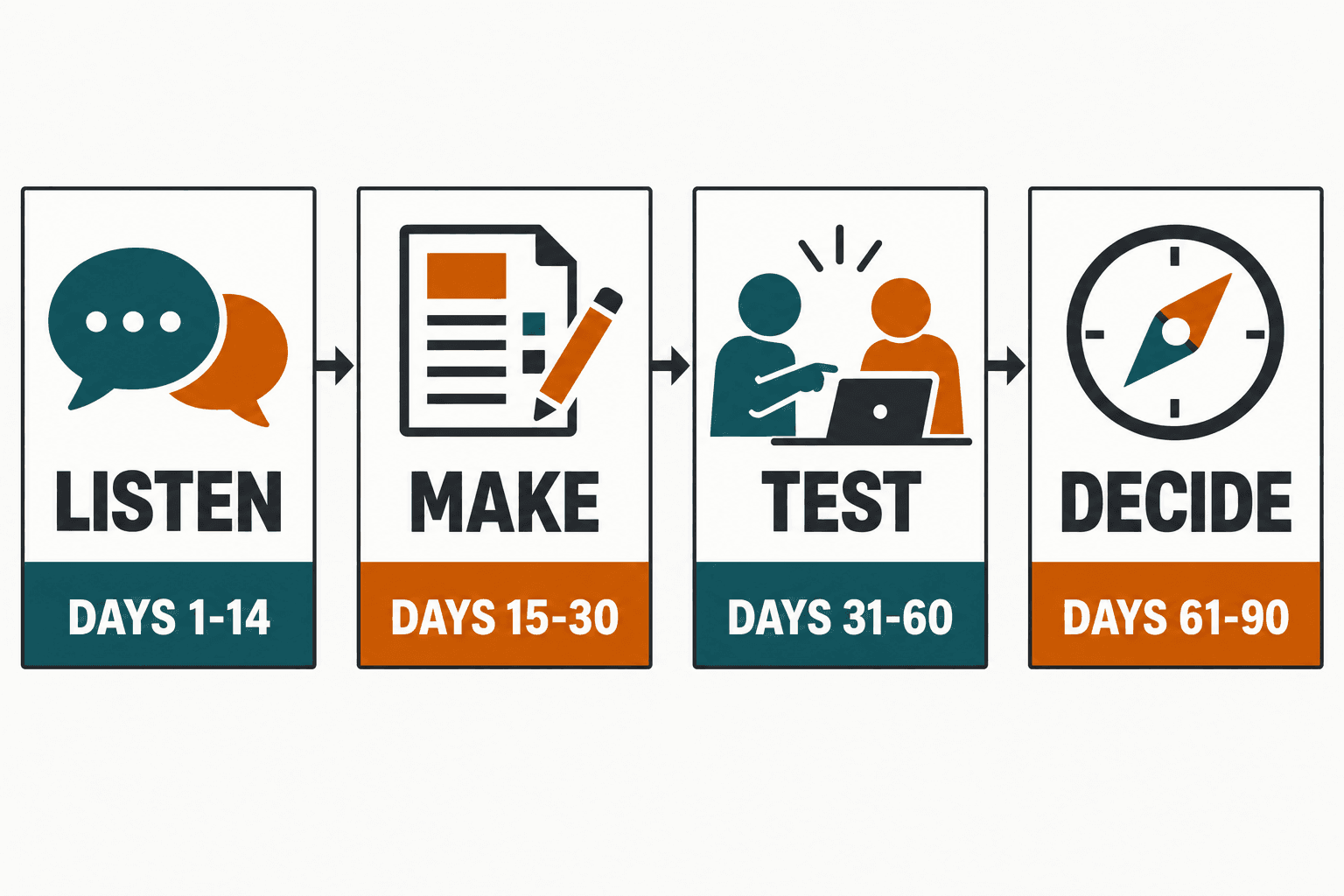
The next step is a 90-day experiment. It needs a start date, one question, a small piece of real work, and a decision date. “Research consulting” is not an experiment. “By November 30, I will help one local business map a messy process and ask whether the result was worth paying for” is.
This is how to reinvent yourself at 45 in a way that produces evidence. You replace a giant decision with four smaller learning periods.
Days 1 to 14: Learn the day-to-day truth
Talk with three people who do the work you are considering. Ask what a normal week looks like, what beginners misunderstand, which skills matter, and what they wish they had tested sooner.
Stanford Graduate School of Business describes informational interviews as a way to learn and prototype new experiences. That is the point here. You are not asking strangers to hand you a job. You are checking whether the real work resembles the version in your head. (Stanford Graduate School of Business)
Days 15 to 30: Make a small work sample
Create the smallest useful version of the work. Draft a sample plan, teach a 30-minute lesson, edit a short video, build one spreadsheet, photograph one event, or solve one problem for a friend.
Keep the scope tight. A small finished sample teaches you more than buying a course and watching six hours of lessons.
Days 31 to 60: Put the work in front of someone
Use the sample with one real person. That could mean a volunteer assignment, an internal stretch project, a short paid test, a community class, or a trial service for someone you already know.
Keep employer time, devices, data, and contacts out of the test unless you have clear permission. The point is to gather clean evidence, not create a problem at work.
Days 61 to 90: Review the evidence
At the end, rate five things from one to five: your energy while doing the work, your ability to improve, real demand, fit with your household, and the cost of going further. Write one sentence explaining each score.
J followed a version of this gradual path in his late 40s. He was self-employed in a contracting business, where income depended on continuing to work. Instead of waiting for one perfect exit, he began building a blog, a YouTube channel, and a podcast on the side. The small wins became bricks in a different foundation. You can read more about how D and J began to build a freedom lifestyle in stages.
Their later move was much bigger. They sold their house, downsized, and moved into a fifth-wheel full-time at 54. The important part for this post is what came first: learning, making, and testing alongside the work that still paid the bills.
Protect the Life You Already Built
A low-risk experiment still needs boundaries. Your current stability is funding the test, so protect it.
First, review your employment agreement and workplace policies before taking paid side work. Rules about outside work, clients, intellectual property, and conflicts vary. If the answer is not clear, ask a qualified employment lawyer. Do not assume a social media post or a coworker’s opinion settles it.
Second, talk with your spouse or partner before the experiment starts. Agree on the time, spending limit, household impact, and date when you will review it together. Two protected hours on Saturday is different from quietly disappearing every evening for three months.
Third, know what your benefits are worth. Health insurance, retirement contributions, paid leave, disability coverage, and predictable income can disappear in a career move. AARP Research found in January 2025 that 24 percent of adults age 50 and older planned a job change that year.
Among those planning a change, 16 percent planned to start a business and 12 percent planned to move from full-time to part-time work. Those paths affect more than salary. (AARP Research)
Finally, build a cash buffer around your own risks. The Consumer Financial Protection Bureau defines an emergency fund as money set aside for unplanned costs or a loss of income. It also notes that the right amount depends on your situation. (Consumer Financial Protection Bureau)
This article is not personal legal, tax, or financial advice. Before reducing hours, resigning, using retirement money, or starting a business, bring your numbers and agreements to qualified professionals who can evaluate your situation.

Learning how to reinvent yourself at 45 should create more options, not replace one trap with a new one.
It also gives you a way to practice the life you keep postponing before work makes the decision for you.
Decide What the Evidence Earned
At day 90, choose one of four outcomes.
- Stop because the real work did not fit.
- Adjust one variable and run another small test.
- Repeat the experiment at a larger scale.
- Prepare a transition with dates, numbers, and support.
Stopping is not failure. It may save you from paying for training, leaving a stable job, or building a business around work you do not enjoy.
Adjusting is often the most useful answer. Maybe you liked teaching but hated selling. Maybe the work felt good, but evenings did not. Maybe an internal transfer would solve the problem without requiring a new field.
Repeating at a larger scale means the first test earned another test. It does not mean the universe sent you a sign to resign tomorrow.
Preparing a transition comes last. At that point, you have conversations, a work sample, feedback, household input, and a clearer financial picture. You can decide what must be true before you change jobs, reduce hours, or make the new work your main work.
That is the practical difference between a fantasy and a plan. It is also why starting over in your 50s does not erase what you built. You are carrying the useful parts forward, with better evidence about where they belong.
Want more like this? Join our newsletter and discover more midlife tools and knowledge we’re actually using.
The Bottom Line
The question is not whether you can produce a brand-new identity by your next birthday. The better question is whether you can gather one useful piece of evidence this week.
That is how to reinvent yourself at 45 without treating your responsibilities like obstacles. Name the friction. Sketch three directions. Run one small test. Protect the people and stability that matter. Then let the evidence earn the next move.
What small version of your next chapter could you test before next Monday?
Frequently Asked Questions
Is 45 too old to reinvent yourself?
No. At 45, you bring years of skills, relationships, and self-knowledge. The safest answer to how to reinvent yourself at 45 is not erasing your past. It is testing how your existing strengths can support a life that fits better now.
Do I need to quit my job to start over at 45?
No. Learning how to reinvent yourself at 45 does not require an immediate resignation. You can begin with informational interviews, an internal stretch assignment, a short class, a volunteer project, or a small paid test while keeping your current income.
How can I test a new career before quitting?
Pick one uncertainty and design a small experiment around it. Talk to people doing the work, make a sample, try the work with one real person, and review your energy, ability, demand, and household fit after a fixed period.
How much money should I save before a career change?
There is no universal number. Start with your essential monthly costs, benefits, debt, dependents, and likely income gap. Build a buffer for your actual risks and consult a qualified financial professional for advice tied to your situation.
What if my 90-day experiment fails?
A failed experiment can save you from an expensive mistake. Record what felt wrong, change one variable, and decide whether to stop, adjust, or test another direction. The point is better evidence, not forcing the original idea to work.