
Table of Contents
Most of what you’ll find about full-time RV living after 50 falls into one of two buckets. There’s the highlight reel: a couple three years into full-timing, sunset photos, captions about freedom. And there’s the gear checklist: solar panels, tow vehicles, the right kind of hitch. Neither one helps you actually decide.
If you’re standing at the edge of this decision instead of three years past it, you’ve probably read a dozen pros-and-cons lists already and still don’t feel closer to an answer. That’s not because you haven’t done the reading. It’s because a flat list can’t weigh anything against your specific life: your specific savings, your specific marriage, your specific health situation.
Full-time RV living after 50 can be a great fit, but it depends on five things: your finances (can you cover it without draining retirement savings), your healthcare plan (Medicare works nationwide, but you still need a domicile state), your space needs, your relationship, and whether you have a real exit plan if it doesn’t work out. This post walks through all five, honestly, including the version where the answer is “not yet.”
Please note this page may contains affiliate links. If you purchase something through these links, I’ll receive a commission at no extra cost to you. Affiliate links help to support my website/blog and I only recommend products I love.
Why Most Advice on Full-Time RV Living After 50 Falls Short
Search “is full-time RV living right for you” and you’ll get some version of the same list every time: freedom, cost savings, less stuff to clean, downsides being maintenance and small spaces and no reliable internet. Starlink fixed the internet complaint years ago, so even that’s stale advice now.
Here’s the bigger problem. The RV lifestyle isn’t a young person’s niche anymore. The RV Industry Association’s 2025 Go RVing Owner Demographic Profile found the median RV owner’s age dropped from 53 in 2021 to 49 in 2025, which means more people your age are buying in every year, and most of the content written for them still comes from full-timers in their thirties who never had to think about Medicare, a domicile state, or what an unplanned hospital stay looks like three states from home.
That’s the real story with full-time RV living after 50. The questions are different than they were at 30, and most of what’s ranking hasn’t caught up.
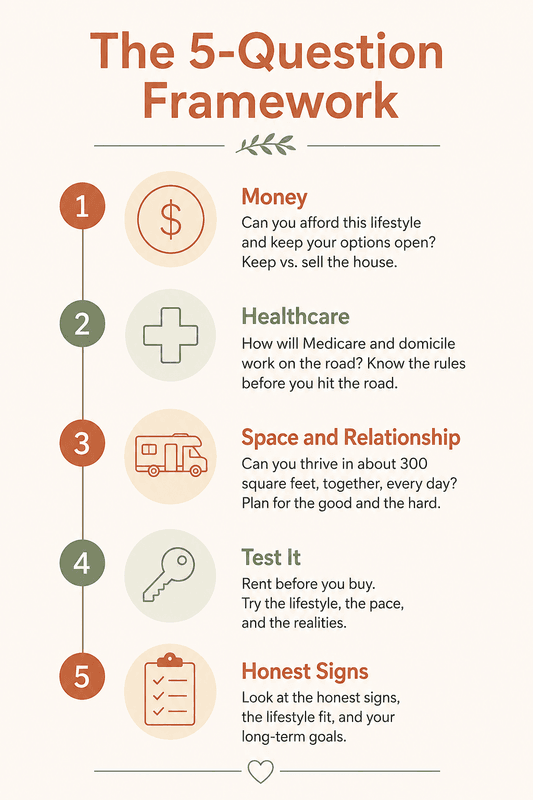
That’s the gap this framework fills. Five questions, worked through one at a time: money, healthcare, space and relationship, a low-risk way to test it, and the honest signs it’s not the right time. No scorecard, no verdict at the end. Just the information you need to answer it yourself.
The Money Question: What Keeping vs. Selling the House Actually Costs
Most “sell your house and go” content treats this as a binary. It isn’t. Keeping the house as a home base is a legitimate option, not a failure to commit, and the math is worth running honestly before you decide either way.
If you keep the house, you’re still paying the mortgage or property tax, insurance, maintenance, and utilities, whether you’re there or not. If you sell, that column disappears, but a new one opens: RV payment (or the cost of paying cash and giving up that liquidity), campground and site fees, RV insurance, and the maintenance a moving vehicle needs that a stationary house doesn’t.
U.S. News & World Report’s retirement coverage found that health insurance is consistently the single biggest line item for retirees living in an RV, often bigger than the RV payment itself. That’s the number people underestimate most.
The math behind full-time RV living after 50 isn’t the same math you’d run at 30. Retirement income, Medicare premiums, and a house that may or may not be paid off all change the equation, which is exactly why a generic “sell everything” post can’t answer this for you.
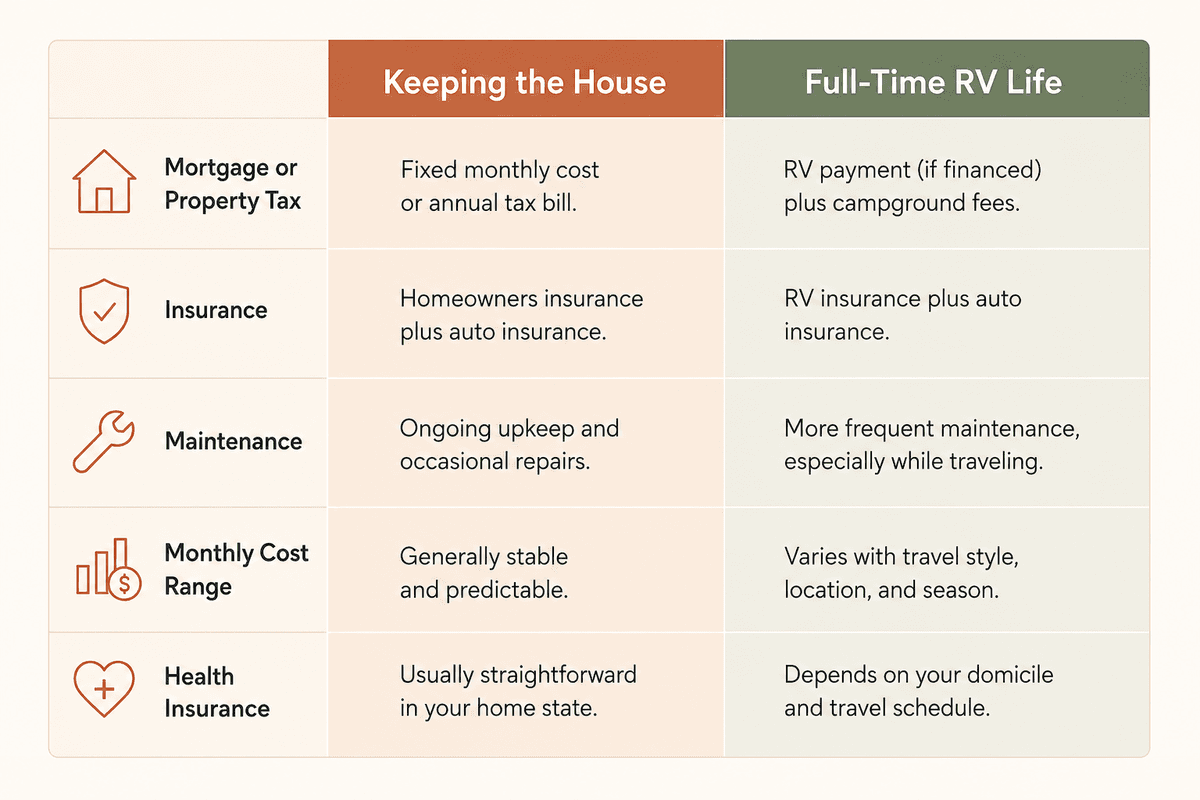
There’s no universal answer here. Someone with a paid-off house in a low-tax state might come out ahead keeping it as a home base and renting an RV for long stretches. Someone with a large mortgage and high property taxes might genuinely save money going full-time.
The point isn’t to tell you which one wins. It’s to make sure you’re running your own numbers instead of assuming. If you haven’t already worked through figuring out your real freedom number, that’s the place to start, because the RV decision is really just one version of the bigger question of what your money needs to cover.
A free net-worth and budgeting tool like Empower can make this easier. It’s not built for RVers specifically, but it’s a no-cost way to see your real financial picture in one place instead of guessing, and it’s worth setting up before you run the keep-vs-sell math for real.
The Healthcare Question: Medicare and Domicile When You Don’t Have a Fixed Address
This is the section almost no competing post covers, and it’s the one that matters most for anyone making this decision after 50 instead of at 28.
The good news first: Original Medicare (Parts A and B) covers care nationwide at any provider that accepts Medicare, according to Medicare.gov’s own coverage guidance. You don’t lose access by moving around the country.
The complication is Medicare Advantage, which is sold through private insurers and varies by state and plan, so a full-time RVer on a Medicare Advantage plan needs to think carefully about network coverage away from their home state.
That’s tied to a second decision every full-time RVer has to make and most first-timers don’t see coming: your domicile state. This is the state you legally claim as home for voting, taxes, and your driver’s license, even though you don’t live there most of the year.
It also affects your health coverage options. Groups like the Escapees RV Club specialize in walking full-timers through domicile setup, mail forwarding, and the residency paperwork that comes with it, and it’s worth reading their guidance before you pick a state based on tax rates alone.
For full-time RV living after 50, the domicile decision and the healthcare decision are tied together in a way most guides skip entirely. Get them right together, not as two separate errands.
None of this is meant to scare you off. It’s meant to make sure the healthcare question gets answered before you’re three months into full-timing and dealing with it for the first time in a parking lot with bad cell service.
The Space and Relationship Question: What Living in 300 Square Feet Does to a Marriage

The financial and healthcare questions have research behind them. This one doesn’t, and that’s honestly the harder one to answer on paper.
Living in 300 square feet with another person changes how you handle disagreement, because there’s nowhere to go cool off for twenty minutes. It changes what “alone time” means when the walls are ten feet away no matter which room you pick.
Couples who do this well tend to talk through those specifics before they’re living them: what does each of you actually need when you’re frustrated, and does the RV give you any way to get it?
We’ve written before about our own experience with RV life and minimalism, and one thing that held true then still holds true here: the version of this that goes badly usually isn’t about the square footage. It’s about moving too fast, before either person has actually sat with what daily life in that space feels like. Slower beats faster almost every time.
Test It Before You Commit: The Low-Risk Way to Find Out
You don’t have to sell the house to find out if any of this fits. Renting is the single most repeated piece of advice across everything we researched for this post, and for good reason: it’s the only way to answer “could I actually live like this” without a five-figure purchase.
Services like Outdoorsy let you rent a range of RV types by the night from individual owners, so you can try a small camper van one trip and a larger Class C the next before deciding what actually suits you. A weekend won’t tell you much.
A real shakedown trip, two to four weeks if you can manage it, is the best way to pressure-test full-time RV living after 50 before you sell anything, and it gets you closer to what day 200 actually feels like.
If national parks are part of the plan, the America the Beautiful Senior Pass is worth knowing about. As of 2026 it runs $20 a year or $80 for a lifetime pass, and it covers entrance fees at more than 2,000 federal recreation sites, which adds up fast if long stretches of your trial run happen in national parks.
Once you’ve tested it and decided to move forward for real, budgeting for travel without feeling broke becomes useful again in a new context, and RV-specific trip-planning tools like RV LIFE Pro become worth the subscription, since they route around bridge heights and weight limits that a normal map app ignores entirely.
The Honest Signs It’s Not the Right Time (And That’s Okay)
Every ranking post about this topic is structurally pro-RV-living, because it exists to sell the lifestyle or sell the RV. This section doesn’t have that incentive, so here’s the honest version.
It’s probably not the right time if there’s unresolved conflict in the relationship that the two of you haven’t worked through yet. Small spaces amplify existing tension, they don’t create new closeness out of nothing. It’s probably not the right time if there’s no financial cushion, because an unexpected repair or a slow season shouldn’t be the thing that forces you back into a lease you can’t afford.
It’s probably not the right time if you don’t have a real exit plan, meaning a clear answer to “what happens if this doesn’t work” that isn’t just “we’ll figure it out.” And it’s probably not the right time if either of you has a health situation that genuinely needs a fixed local care team rather than whatever’s nearest on the road.
None of those are permanent no’s. They’re reasons to wait, work through something first, or revisit the question again in a year. Whether it’s too late to start over at this stage of life comes up in a lot of the decisions we write about, and the answer here is the same as it is everywhere else: it’s rarely too late, but timing still matters.
The Bottom Line
Full-time RV living after 50 comes down to five real questions, not a verdict. This was never really a pros-versus-cons question. It’s whether the specific tradeoffs, money, healthcare, space, relationship, and your actual exit plan, fit this specific chapter of your life right now. They might. They might not yet. Both are honest answers, and you’re allowed to land on either one.
If the money side of this decision is still the fuzziest part for you, that’s usually the piece worth nailing down first.
Our Freedom Number Calculator walks you through what your actual number looks like, RV plans or not, so you’re deciding from real numbers instead of a guess.
If you’ve thought seriously about full-time RVing, what’s the one question that’s actually holding you back?
Frequently Asked Questions
Is full-time RV living worth it?
It depends on the same five factors covered above. For some retirees, it cuts monthly costs significantly compared to a mortgage, property taxes, and home maintenance. For others, RV payments, campground fees, and repair costs erase most of the savings. There’s no universal answer, which is exactly why running your own numbers matters more than any general verdict.
Can you get health insurance living in an RV full-time?
Yes. Original Medicare covers care nationwide at any Medicare-accepting provider, so you’re not losing access by moving around. Medicare Advantage plans are different, since they’re sold through private insurers and coverage varies by state and plan, so your domicile state and travel patterns matter more if you go that route.
What state should full-time RVers claim as their domicile?
Whichever state you’ll use for voting, taxes, and your driver’s license, chosen with healthcare access in mind and not just tax rates. South Dakota, Texas, and Florida are common choices among full-timers for tax reasons, but it’s worth checking what that state’s health coverage options actually look like before you commit to it.
How long do most people RV full-time before quitting?
There’s no reliable industry-wide statistic on this, and we’d rather say that plainly than invent one. What shows up consistently in the accounts we reviewed is that people who treat the decision as reversible, renting before buying and keeping a financial cushion, tend to stick with it longer than people who sell everything and commit all at once.
Do you need good credit to finance an RV?
Yes, the same way you would for any large vehicle purchase. Lenders look at your credit history, income, and debt-to-income ratio, and better credit typically means a lower interest rate on what’s usually a five- or six-figure loan. If you’re planning to finance rather than pay cash, it’s worth checking your credit and shopping rates before you fall in love with a specific rig.