

Table of Contents
The phone rings. It is your daughter’s voice, panicked, saying she has been in an accident and needs money sent right now, do not tell anyone, do not call her back on her regular number. Every instinct says move fast. That instinct is exactly what an AI voice cloning scam is built to exploit.
This is not a rare, futuristic threat anymore. AI voice cloning scams after 50 are now common enough that the FBI, the FTC, and AARP have all issued specific warnings about them in 2026, and the group most often targeted is exactly the audience reading this: adults who are protecting an aging parent’s savings, their own retirement, or both at the same time.
The good news is that the defense is not complicated. It does not require becoming a cybersecurity expert or distrusting every phone call for the rest of your life. It requires one word, shared the right way, and a ten-minute conversation with the people you would call family.
This post walks through why your family is a realistic target, how the cloning itself actually works, and the family safe word system that stops the scam cold, no matter how convincing the voice on the other end sounds.
Please note this page may contains affiliate links. If you purchase something through these links, I’ll receive a commission at no extra cost to you. Affiliate links help to support my website/blog and I only recommend products I love.
Why Your Family Is a Real Target for AI Voice Cloning Scams After 50
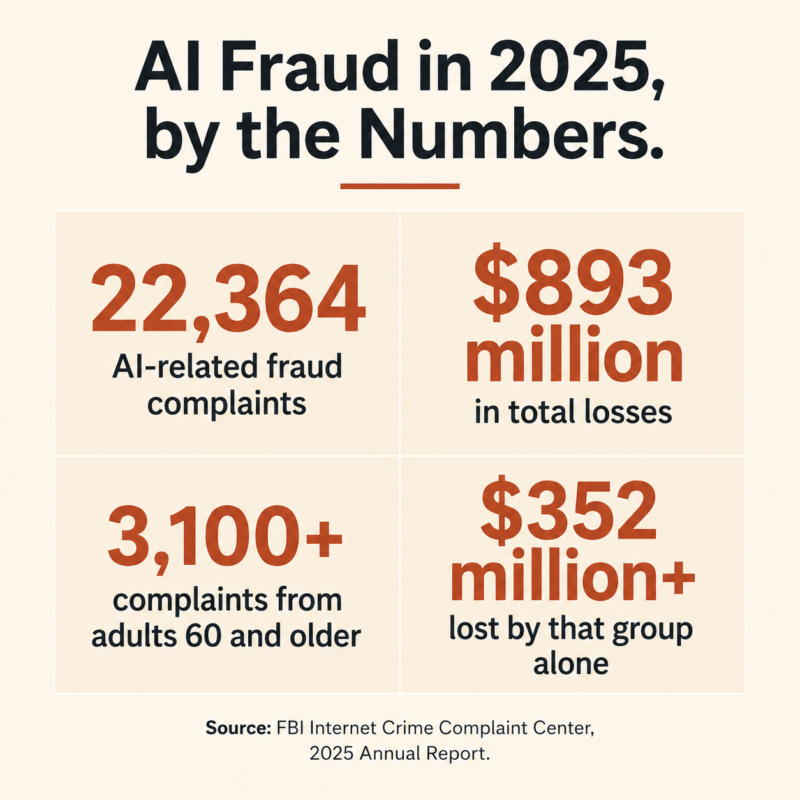
The FBI’s 2025 Internet Crime Complaint Center report logged 22,364 AI-related fraud complaints, totaling roughly $893 million in losses. Distress scams, the specific category built around a fake family emergency, accounted for more than $5 million of that on their own. Adults 60 and older filed over 3,100 of those complaints, with losses topping $352 million.
Those numbers only tell half the story, though, because midlife adults usually sit on both sides of this problem at once. If a scammer is impersonating an aging parent, you are often the one who picks up the phone. If a scammer is impersonating your own adult child, your parent might be the one who picks up.
Either direction, the call is designed to land on someone who loves the person being cloned enough to stop thinking clearly for thirty seconds. It is worth protecting, since the same financial independence progress you have spent years building is exactly what a distress scam is designed to drain in one panicked phone call.
That is long enough for a scammer to ask for gift cards, a wire transfer, or a cryptocurrency payment, and by the time anyone realizes what happened, the money is gone.
How Scammers Actually Clone a Voice in Under 3 Seconds
Here is the detail that makes this scam different from the clumsy “grandparent scam” calls of a decade ago: cloning a voice convincingly no longer takes a Hollywood budget or a stolen recording studio. It takes about three seconds of audio, and that audio is easier to find than most people assume.
A voicemail greeting. A public Instagram or TikTok video. A clip from a podcast, a YouTube video, or a work Zoom call posted online. Any of these can hand a scammer enough raw material to generate a voice clone that sounds close enough to fool a family member on a phone line, where audio quality is already imperfect and everyone is a little distracted.
This is also why “I would know my own kid’s voice” does not hold up the way it used to. Multiple 2026 industry reports describe voice cloning as having crossed what researchers call the indistinguishable threshold, meaning the human ear alone is no longer a reliable test.
The scam is not designed to fool a stranger. It is designed to fool the person who loves that voice the most, in the ten seconds before they have time to think it through. If the whole idea of AI still feels like something happening to other people, our beginner’s guide to learning AI is a calmer place to start than a scam call.
The Family Safe Word System That Actually Works
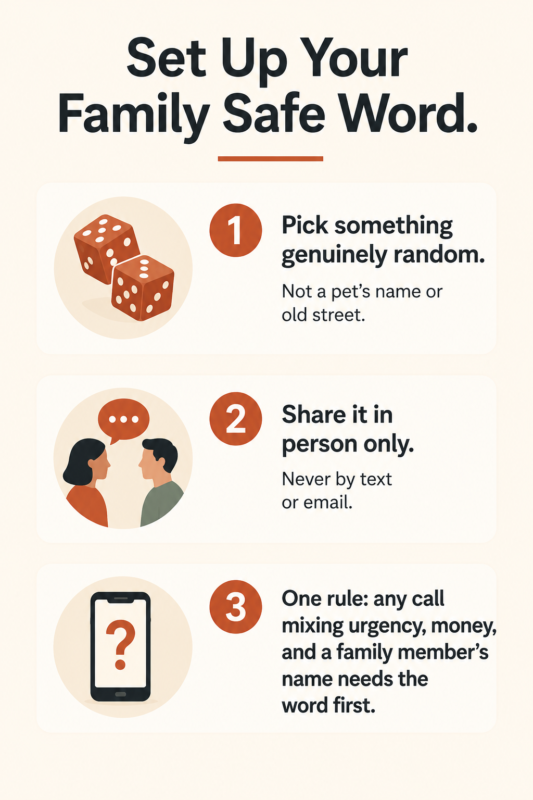
A family safe word is a random word or phrase shared only in person with immediate family, never by text or on social media. If someone calls claiming to be a relative in an emergency and cannot say the safe word, hang up and call that person directly on a number you already have. That single habit solves the problem without requiring anyone to become suspicious of every phone call forever.
A few rules make the difference between a safe word that actually works and one that gets defeated the first time it is tested.
Choose something genuinely random, not a pet’s name, a childhood street, or anything that shows up in old social media posts or photo captions. Share it only in person, at a holiday dinner, a phone call you initiated, or a family group chat that has been private for years, never by text or email where it could be screenshotted and reused.
And agree on one clear trigger for when to use it: any call that combines urgency, a request for money, and a family member’s name. If you or a parent still feel unsteady with AI tools generally, our AI for beginners over 50 guide covers the basics without the scam-call stakes attached.
That last part matters more than people expect. A safe word only works if everyone agrees to actually ask for it, even when the voice on the other end sounds exactly right and even when asking feels awkward or rude in the moment. Practice saying it out loud once, as a family, so it does not feel strange the one time it actually matters.
What to Do If You Get “The Call”
If the phone rings and the voice matches but the safe word does not come, or the caller dodges the question entirely, treat that as your answer.
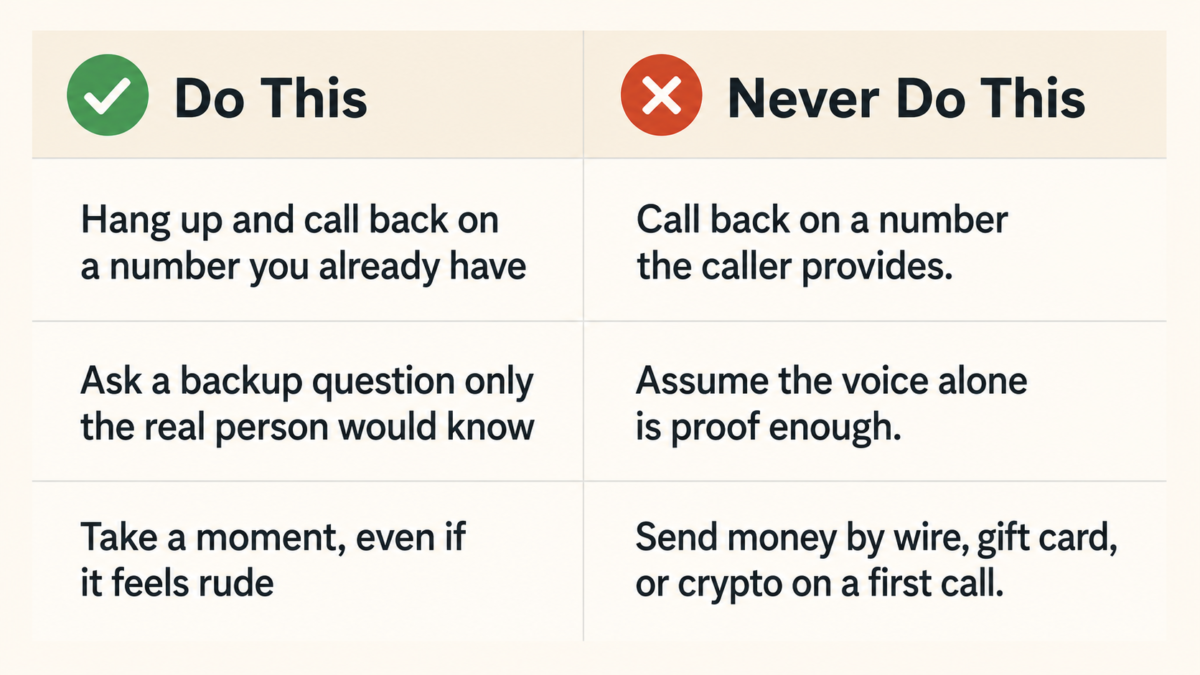
Hang up and call the person back directly, using a phone number you already have saved, never one the caller provides or texts you during the call. If you reach them and they are fine, you have your answer in under a minute. If you cannot reach them right away, that is unsettling, but it is still safer than sending money based on a single unverified call.
Ask a backup question only the real person would know, something that would never appear in a public post or a voicemail greeting, if the safe word conversation feels impossible to start naturally. And treat any request for a wire transfer, a gift card, or cryptocurrency on a first emergency call as a hallmark warning sign on its own, according to the FTC’s guidance on family emergency scams, regardless of how the voice sounds.
The Conversation to Have This Week (With Parents and With Kids)
The hardest part of this system is usually not the safe word itself. It is bringing it up with an aging parent without sounding like you are scaring them, or with adult kids without sounding paranoid.
A simple way in: frame it as protecting each other, not as a lecture about technology. Something like, “There’s a new kind of phone scam going around where someone can make their voice sound exactly like mine or yours.
We’re picking one word as a family so we always know it’s really us calling, just in case.” That framing works in both directions, a parent protecting their own savings and an adult child protecting a family that could just as easily be impersonated themselves.
Keep the conversation to about ten minutes. Pick the word together, agree on the one trigger for using it, and say it out loud once so it is not the first time anyone has heard it during an actual stressful moment. AARP recommends treating this the same way you would a fire drill: uncomfortable to bring up once, easy to forget about after.
This same conversation is a natural moment to talk more broadly about using AI carefully, not just defensively. If your household already leans on ChatGPT for budgeting or planning, our guide to using ChatGPT for personal finance without risking bad advice and our roundup of 25 everyday ChatGPT examples are both worth a look while everyone is already thinking about how these tools show up in daily life.
Protecting Your Digital Trail Before It’s Used Against You
None of this requires disappearing from social media or podcasts. It does mean being aware that public-facing audio, a YouTube channel, a podcast clip, or videos with the sound on, adds to the pool of material a scammer could pull from.
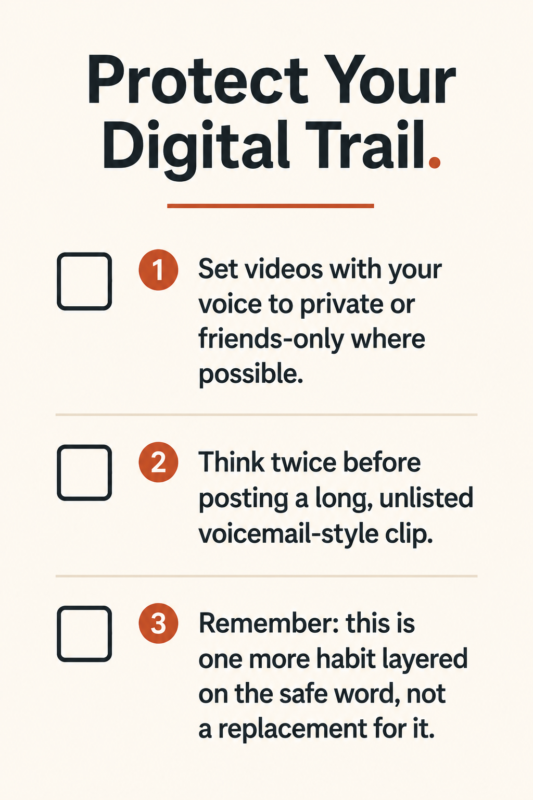
A reasonable middle ground: set videos with your voice to private or friends-only where the platform allows it, and think twice before posting a voicemail-style greeting or a long unlisted clip publicly. This is not about paranoia. It is one more small habit layered on top of the safe word system, not a replacement for it.
The Bottom Line
This kind of scam is not something you can out-listen or out-smart in the moment, and that is exactly the point. The defense that actually works is not vigilance. It is a system you set up once, before the call ever comes: one random word, shared only in person, tied to one clear rule for when to use it.
Ten minutes with your family this week is a fair trade for that kind of protection.
If you want more practical, no-hype ways to use AI wisely at this stage of life, from scam prevention to everyday tools that actually save time, join our newsletter and we will keep sending them your way.
Have you and your family already picked a safe word, or is tonight the night you finally do it?
Frequently Asked Questions
How much audio does someone need to clone a voice?
As little as three seconds, often pulled from a public social media video, a voicemail greeting, or a video call clip, according to multiple 2026 reports on AI voice cloning cases.
What does an AI voice cloning scam call usually sound like?
It typically opens with a family member sounding distressed, in jail, in an accident, or stranded, followed quickly by pressure to send money fast and not tell anyone else, per the FTC’s Family Emergency Scams guidance.
Can you tell an AI-cloned voice from a real one just by listening?
Not reliably. Recent industry reporting describes voice cloning as having crossed the indistinguishable threshold, meaning the human ear alone is no longer a dependable test.
What should I do if I get a call like this?
Hang up and call the person back directly on a phone number you already have saved, not one the caller provides, and ask for your family’s safe word before sending anything, per FTC guidance.
Who is most often targeted by these scams?
The FBI’s 2025 Internet Crime Report shows adults over 60 filed more than 3,100 AI-related fraud complaints with losses over $352 million, though the initial call often goes to an adult child first, since that person is frequently the listed emergency contact.