

Table of Contents
You are sitting in urgent care at 9pm on a Saturday, and the nurse asks what medications you take. You know most of them. Not all of them. The dosage on the little pink pill escapes you completely, and your phone is at 4% battery with the patient portal app buried three screens deep behind everything else. A one-page health snapshot in your wallet or your car would have ended that guessing game in about ten seconds.
That moment is more common than most people admit. Health information after 40 tends to live everywhere at once: a patient portal here, a photo of a prescription label there, a sticky note in a kitchen drawer, and a lot of trust placed in memory that is being asked to hold more than it used to.
None of that is a character flaw. It is just what happens when the number of doctors, medications, and appointments creeps up while the system for tracking them never got built.
A one-page health snapshot fixes the specific problem of scattered information, not the bigger problem of managing your health. It is a single sheet with the details a nurse, a new doctor, a pharmacist, or a family member would actually need in the first ninety seconds of a conversation.
You do not need a binder. You do not need a subscription. You need about thirty minutes and a willingness to stop trusting your memory with things it was never built to hold onto perfectly.
This is not a medical form and it is not a substitute for the records your doctor keeps. Think of it as the fast-reference layer that sits on top of everything else, the page you hand over or pull up when there is no time to explain your entire history from scratch.
Please note this page may contains affiliate links. If you purchase something through these links, I’ll receive a commission at no extra cost to you. Affiliate links help to support my website/blog and I only recommend products I love.
What Is a One-Page Health Snapshot?
A one-page health snapshot is a single-page summary of the health information you would need to hand someone in an emergency, a new appointment, or a trip: your conditions, medications, allergies, providers, and a few key numbers.
It is not a full medical record and it is not meant to replace the one your doctor’s office keeps. It is meant to be fast, current, and usable by someone else if you cannot speak for yourself.
The difference between a snapshot and a full personal health record matters more than it sounds like it should. MedlinePlus describes a personal health record as a complete history you or your provider maintains, and it can run for pages: every visit, every test result, every note, built mainly around the provider’s workflow rather than a fast handoff in an unfamiliar waiting room.
A snapshot is deliberately smaller. It exists to answer one question fast: what does this person need to know about me right now?
That distinction is what makes it useful for three very different moments. A new doctor who has never seen you before gets oriented in under a minute instead of flipping through years of portal history.
A pharmacist double-checking an interaction gets your full medication list without you trying to remember dosages out loud. And someone helping you during a medical event, whether that is a spouse, an adult child, or a stranger who found you unconscious, gets exactly what they need without guessing.
Why Adults Over 40 Need One Simple Health Page
By your 40s and 50s, the amount of health information worth tracking has usually grown past what memory alone can hold. Preventive screenings start stacking up. Prescriptions get added, adjusted, or swapped. Supplements creep in one at a time until nobody remembers the full list. Family history becomes more relevant, not less, as parents age and patterns start to show up.
The CDC’s family health history toolkit exists for exactly this reason: the details that matter most to a doctor, like what a parent or sibling was diagnosed with and at what age, are the details people are least likely to have written down anywhere. None of this happened overnight, which is exactly why it is easy to miss how much has piled up.
Travel and caregiving raise the stakes further. A trip means you are further from your usual providers and more likely to need urgent care somewhere unfamiliar.
Caregiving for a parent means juggling two sets of medical details in your head instead of one. And even something as routine as a new doctor’s intake form gets easier when you are copying from a single page instead of reconstructing your history from a mix of portals, old paperwork, and half-remembered dates.
There is also a quieter benefit that shows up outside the doctor’s office entirely. The same kind of scattered-information fatigue that makes health records hard to track also shows up in ordinary daily energy, the way afternoons start to feel foggy and effortful for reasons that never quite add up.
A health snapshot will not fix that on its own, but it removes one more source of low-grade friction from a system that is already carrying a lot.
Honestly, most people do not build one of these until something forces the issue: a scary appointment, a parent’s hospitalization, a trip where a lost bag also meant a lost list of medications. It all comes down to whether you build the page before you need it or scramble for the information while you need it. The first version costs thirty minutes. The second version costs a lot more.
What to Include in Your One-Page Health Snapshot
The content of the page matters more than the format. Whether you build it in a document, a printable template, or a plain sheet of paper, these are the categories worth including.
Start with the basics: full name, date of birth, and one emergency contact with a phone number. Add current conditions and major diagnoses, written plainly rather than in medical shorthand you might not remember how to spell under pressure.
List every medication and supplement, including the dose, and note any allergies or reactions next to them, since an allergy buried in a separate section gets missed exactly when it matters most.
Cleveland Clinic’s guidance on medication lists points out that even pharmacists cannot catch a dangerous interaction they never see written down, which is the whole argument for keeping this list current instead of trusting it to memory.
From there, add your primary doctors, your pharmacy, and the basics of your insurance: the plan name and a phone number is usually enough. Include major surgeries or procedures with rough dates, since a provider seeing you for the first time will often ask.
Finally, add a short list of baseline numbers: your last known blood pressure, any lab results that get monitored regularly, and your vaccination and screening dates.
These are the same kind of numbers you would want on hand before starting a strength training program built around your current fitness level or a conversation with a new specialist, since both depend on knowing where you actually stand rather than where you assume you stand.
What Not to Put on the Page
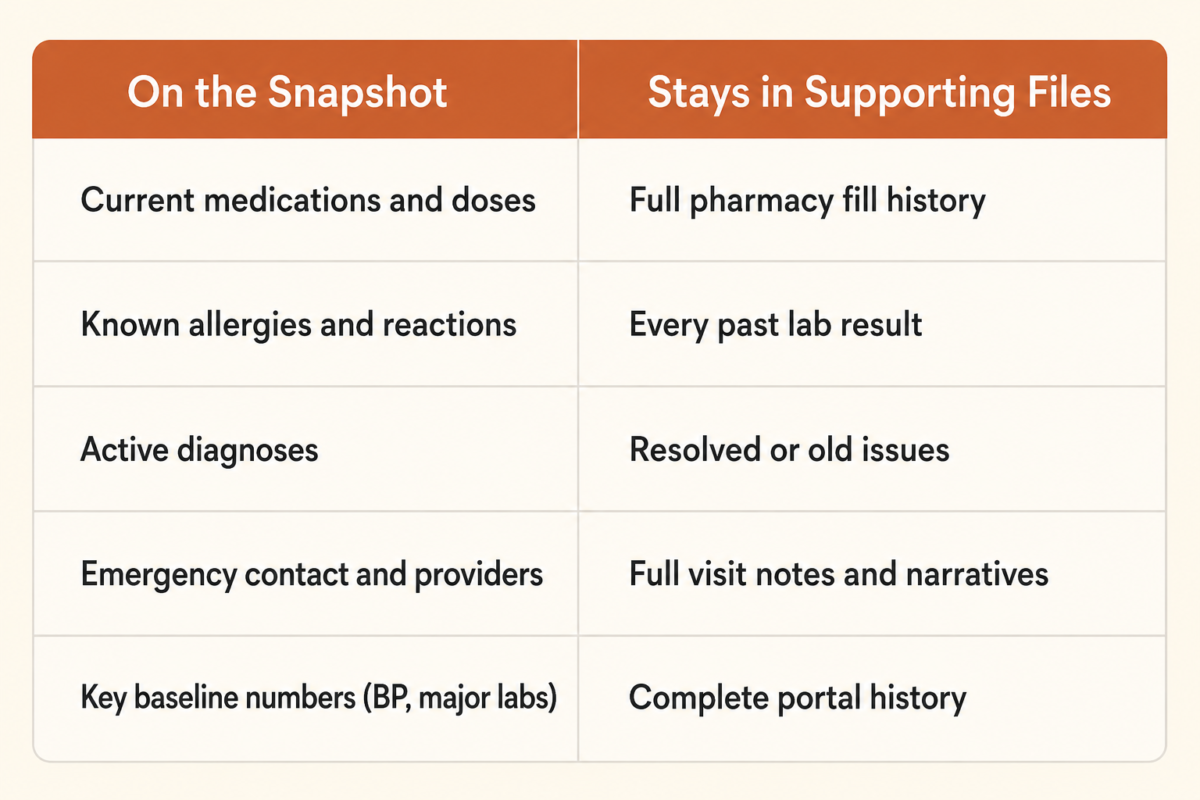
The temptation, once you start building this, is to keep adding. Resist it. A page that tries to hold everything stops being fast to read, which defeats the entire purpose. Every lab result you have ever had, full visit notes, long narratives about how a condition developed, and old issues that resolved years ago all belong somewhere else, not here.
A useful rule: if it would not change what someone does in the first ninety seconds of looking at the page, it does not belong on the page. Supporting documents, whether that is a folder of lab PDFs or a photo album of prescription labels, can live in a separate file. The snapshot’s entire value comes from being short enough to actually get read.
How to Build It in 30 Minutes
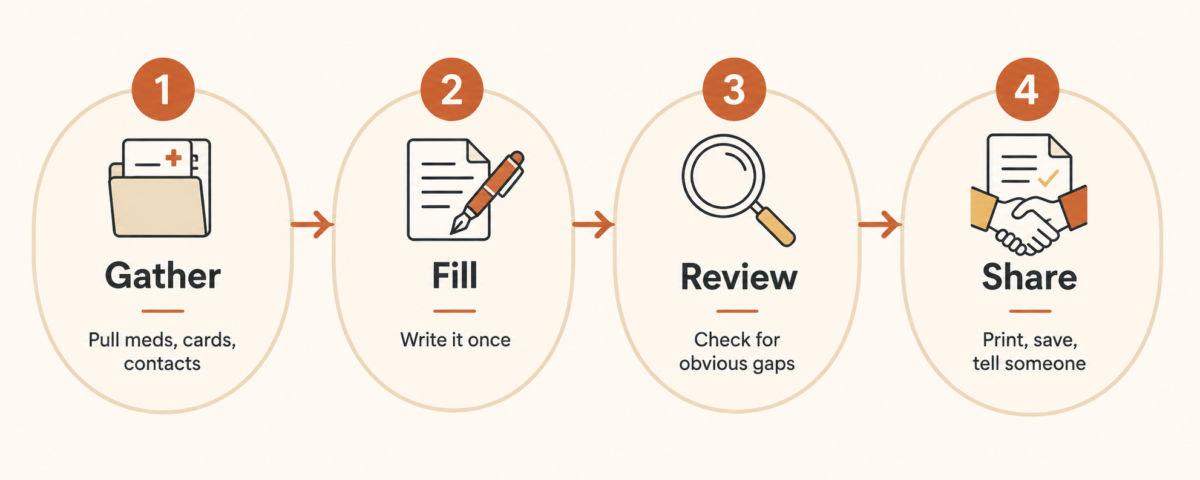
Building the first version takes less time than most people expect, mostly because the hard part is not writing, it is gathering. Set aside half an hour and pull together your medication bottles, a recent portal screenshot or lab summary, your insurance card, and a list of your current providers.
Having everything physically in front of you removes most of the guessing, and it turns what feels like a research project into something closer to copying from a stack of papers onto one page.
Fill the page once, in whatever format is easiest for you. A simple document works fine, and if you already keep notes digitally, a personal AI-organized system for storing what matters can help you turn scattered notes into a clean one-page layout faster than starting from a blank document.
Once it is filled in, look for the obvious gaps: a medication you forgot, an allergy you meant to add, a doctor’s phone number you do not actually have saved anywhere. Do not aim for perfect on the first pass. A snapshot with three blanks you fill in over the next week is still miles ahead of no snapshot at all.
When it is done, print one copy and save one digital copy somewhere you can find quickly, then tell one person you trust where both live. That last step gets skipped more than any other, and it is the one that matters most if you are ever the one who cannot explain where to find it. A health snapshot nobody else knows exists is only half as useful as one somebody can actually reach.
When to Update Your Health Snapshot
A health snapshot that never gets updated slowly turns into a liability instead of a help, since an old medication list can be more dangerous than no list at all.
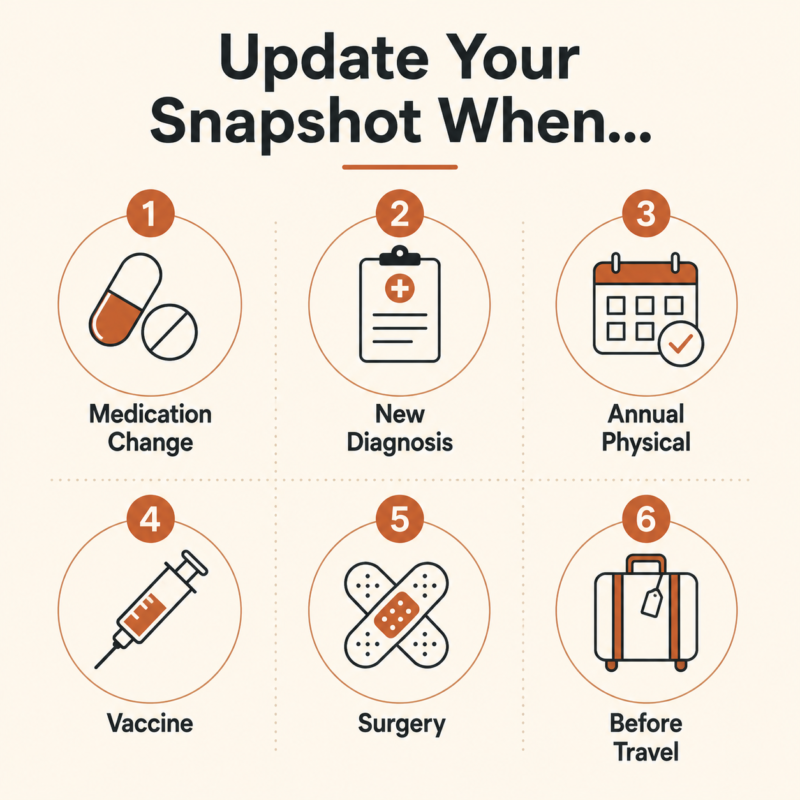
The fix is not complicated. Update it after any medication change, a new diagnosis, an annual physical, a vaccine, a surgery, or a meaningful change in a lab result. Update it before travel too, since that is often when you need it most and have the least time to fix it last minute.
The National Institute on Aging’s guidance on getting your affairs in order makes the same case for a wider set of documents: the value of any important record depends entirely on whether it reflects your current reality, not the reality from two years ago.
A quarterly check works well for most people, even if nothing has changed. It takes two minutes to confirm the page is still accurate, and two minutes is a small price for not discovering a gap during an actual emergency.
If you keep an old version for reference, store it separately and clearly labeled as outdated, so nobody grabs the wrong one by mistake. The same steady maintenance rhythm that keeps other longevity habits sticking, a little bit, on a predictable schedule, is what keeps this one useful instead of becoming another abandoned document.
Set the reminder now, while you are thinking about it. Put it on the same calendar where you already track appointments, tied to something you will not skip, like the start of a new season or a recurring bill. A habit that depends on remembering to remember rarely survives past the first month.
The Bottom Line
None of this requires becoming a more organized person overnight. It requires one sheet of paper, thirty minutes, and a willingness to stop asking your memory to do a job it was never built for.
Build the first version this week, even if it has a blank or two you fill in later. A snapshot with a gap is still more useful than the version that only exists in your head.
If you want more of this kind of practical, no-fluff midlife health thinking, join our newsletter for the next one.
What is the one piece of your own health information you would struggle to recall right now if someone asked?
Common Questions About Your Health Snapshot
Is a one-page health snapshot the same as a personal health record?
No. A personal health record can be long and detailed, covering your full medical history across every provider you have seen. A snapshot is a quick-reference summary meant to be read in under two minutes, not a replacement for the complete record your doctor’s office keeps.
Should I print my health snapshot?
Yes. Keep one printed copy somewhere accessible, like a wallet, a bag, or a kitchen drawer, and one secure digital copy as a backup. Paper does not need a charged phone or an app login to work in an emergency.
How often should I update it?
Update it after any medication change, a new diagnosis, an annual physical, a vaccine, a surgery, or a significant lab change, and always before travel. A quarterly check, even when nothing has changed, keeps small gaps from turning into bigger ones.
Should supplements be included?
Yes. Supplements can interact with medications or matter during a procedure, and they are exactly the kind of detail people forget to mention out loud when a provider asks what they are taking.
Where should I store it?
Somewhere secure but easy to reach quickly, and somewhere at least one trusted person knows about. A snapshot that only you know how to find defeats half the purpose.