

Table of Contents
The concept of finding your freedom number for financial independence is straightforward: calculate the portfolio balance that covers your living expenses indefinitely, then build toward it. But when most people run the numbers for the first time in their late 40s or early 50s, the result feels like a door slamming shut.
Monthly expenses: $4,200. Times 12. That’s $50,400 a year. Multiply by 25, because that’s what the formula says. The answer that comes back is $1.26 million.
You sit there for a second.
58% of American workers say they feel behind on retirement savings, according to Bankrate’s 2025 Retirement Savings Survey. If that calculation just felt like bad news, you are in very large company. And if you are reading this at 47 or 52 or 58, you are not looking at a dead end. You are looking at a starting point that most people are using wrong.
Several adjustments shift the math specifically in favor of midlife adults. The standard formula ignores Social Security offsets, shorter retirement horizons, and the most powerful catch-up contribution window most people have never heard of. This post walks through all of it.
Please note this page may contains affiliate links. If you purchase something through these links, I’ll receive a commission at no extra cost to you. Affiliate links help to support my website/blog and I only recommend products I love.
What Is a Freedom Number in Financial Independence Planning?
Your freedom number is the invested portfolio balance that could fund your living expenses indefinitely, without a paycheck. Reach it, and work becomes a choice rather than an obligation.
The math behind it comes from the 4% rule, a guideline developed by financial planner William Bengen in 1994. His research found that a well-diversified portfolio can sustain a 4% annual withdrawal over a 30-year retirement without running out of money. Flip that logic around: if you multiply your expected annual spending by 25, you get the portfolio size where a 4% withdrawal exactly covers your costs.
That is the formula. What it does not tell you is that for midlife adults, several inputs to that formula are different in ways that work to your advantage.
It is also worth separating the idea of financial independence from the traditional concept of retirement. As we wrote about in why we chose a freedom lifestyle instead of waiting for retirement, reaching your freedom number does not necessarily mean stopping work entirely. It means you’re no longer financially required to do it. That distinction matters when you run the numbers, because you may be building toward something different than a full stop at 65.
How to Calculate Your Freedom Number in Two Steps
The calculation itself is simple. Where most people go wrong is the inputs.
Step 1: Estimate your annual spending in retirement.
Use expected spending, not current income. Most people spend less in retirement than they earned while working. Commuting costs, work clothing, childcare, and many professional expenses drop away. A reasonable starting point for most midlife adults is 70-80% of current annual expenses, though your specific situation will vary based on your mortgage status, travel plans, and healthcare needs.
Step 2: Multiply that number by 25.
Expected annual spending of $4,000 per month is $48,000 per year. Multiply by 25 and your freedom number is $1.2 million. At $3,000 per month the number is $900,000. At $5,000 per month it is $1.5 million.
The most common mistake is using gross income instead of projected spending. Your freedom number does not need to replace your entire salary. It only needs to fund the life you actually plan to live.
To run a personalized calculation based on your specific expenses and goals, use the Freedom Number Calculator on this site.
The Midlife Adjustments That Make Your Number Smaller
This is where freedom number planning for midlife adults diverges from the generic FI advice written for 28-year-olds.
Social Security as a concrete dollar offset.
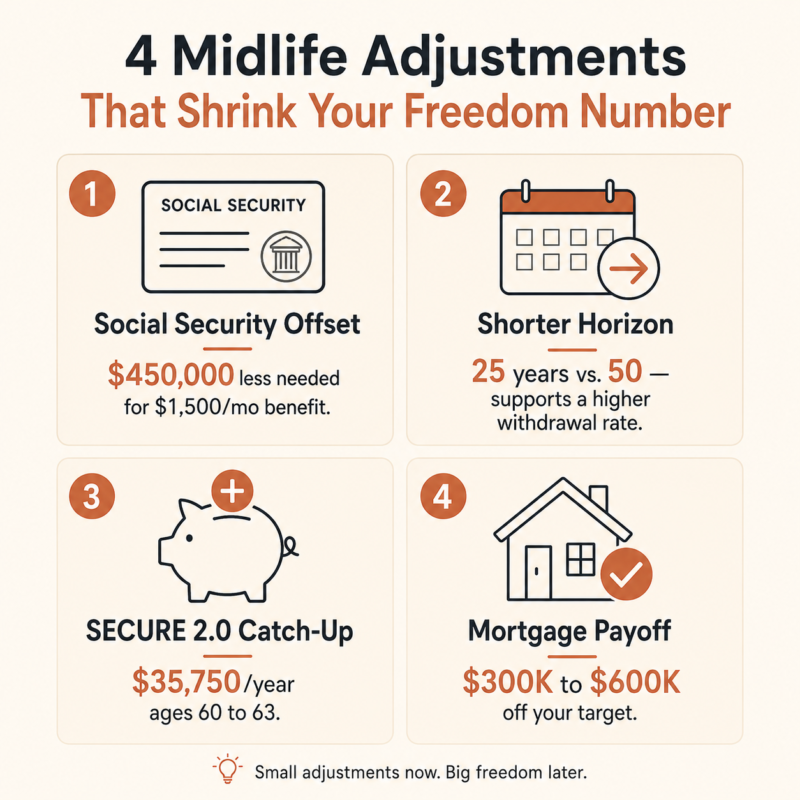
Most FI content mentions Social Security as a vague modifier. Here is what it actually means in numbers: if you will receive $1,500 per month from Social Security at age 67, that is $18,000 per year your portfolio does not have to generate. At a 4% withdrawal rate, $18,000 per year requires $450,000 in portfolio assets to sustain it. Which means your freedom number is effectively $450,000 smaller than the 25x formula shows, before you change a single other variable.
You can find your estimated Social Security benefit at ssa.gov using your earnings history. Run that number before you accept the raw 25x calculation as your target.
A shorter retirement horizon changes the math.
Bengen’s original 4% research was built around a 30-year retirement. If you are 52 and targeting financial independence by 62, you are funding roughly 25 years, not 50. That shorter horizon supports a slightly higher withdrawal rate with strong historical success rates, which means your required portfolio may be smaller than the formula suggests for someone who is 30 years old today.
2026 catch-up contributions under SECURE 2.0.
This is the midlife-specific advantage most people have not heard of.
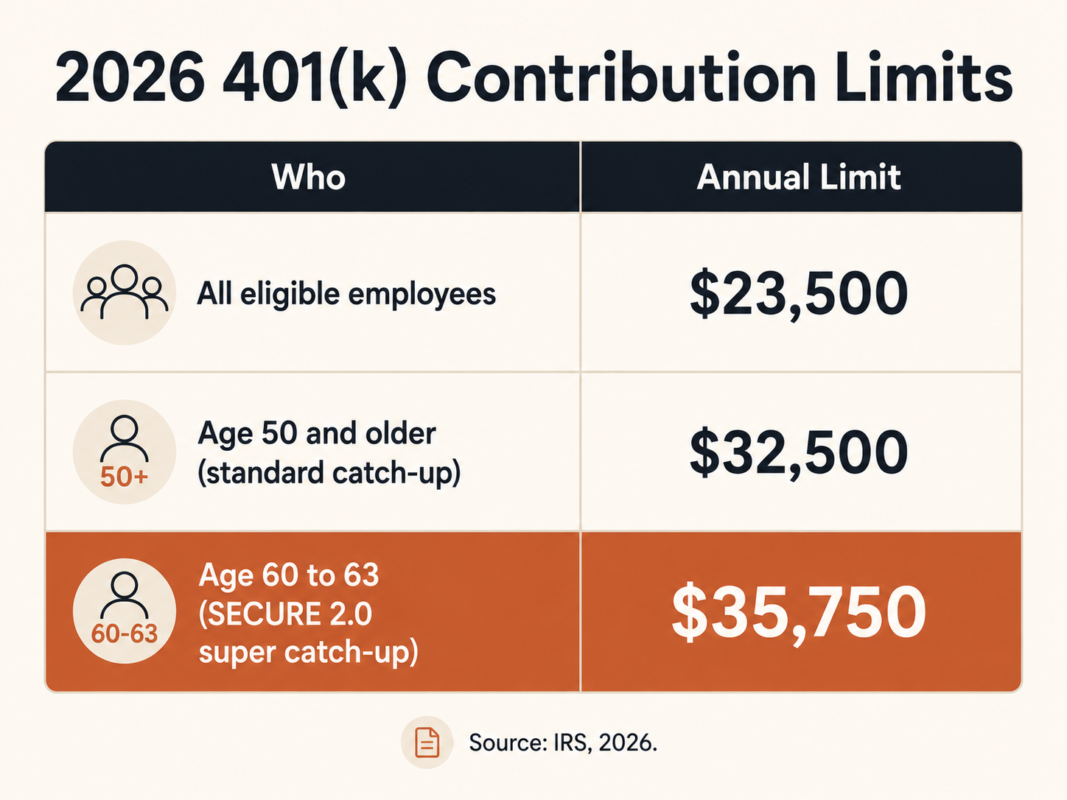
The IRS 2026 401(k) limits look like this:
- Standard limit (all ages): $23,500
- Age 50 and older catch-up: $32,500 total ($23,500 plus a $9,000 catch-up)
- Age 60 to 63 super catch-up (SECURE 2.0): $35,750 total
If you are between 60 and 63, the super catch-up allows $35,750 per year into a tax-advantaged account. Run that for four years and you have added more than $140,000 in contributions before any investment growth. Congress created this window specifically for people who feel behind, and most of the people who qualify for it do not know it exists yet.
Mortgage payoff timing.
If your home will be paid off by your target date, your monthly housing cost drops substantially. Run your numbers with and without mortgage debt to see how much it shifts. For many midlife adults, housing represents $1,000 to $2,000 per month in current expenses. Removing that from your projected retirement spending can reduce your freedom number by $300,000 to $600,000.
For a broader framework on what moves the needle most in the years before you hit your number, the choices that matter most in the decade leading up to financial independence are worth reading alongside this.
What If Your Number Still Feels Out of Reach?
If you ran the adjusted calculation and the number still feels large, you are not looking at failure. You are probably looking at two intermediate milestones worth understanding before you make any decisions.
Coast FI.
Coast FI means you have already saved enough that if you stop making new contributions entirely, your existing portfolio will compound to cover your freedom number by your target retirement age. The sprint is over. Compounding takes over the rest of the journey.
The shift here is significant: once you reach Coast FI, your income only needs to cover current living expenses. Any job that does that qualifies, including a lower-stress one, a part-time one, or a lower-paying one you would actually enjoy. Because you are no longer depending on that income to fund the future, the job requirements change completely.
Barista FI.
Barista FI is the model where part-time or reduced income covers your current expenses while your investments continue to grow. Work becomes genuinely optional at any given moment, even if you choose to keep doing it. You are not retired in the traditional sense, but you are also not trapped.
Both milestones matter because they shift the question from “can I hit my full number” to “what does partial freedom look like and when can I get there.” As the research on whether it’s too late to start over in your 50s makes clear, work you would genuinely choose to do, on your own terms, is a different thing entirely from work you cannot afford to leave.
The Three Variables That Move Your Number Most
Most financial advice says to save more and spend less. Those are real levers, but they are vague. Here is what the math actually looks like in dollars.
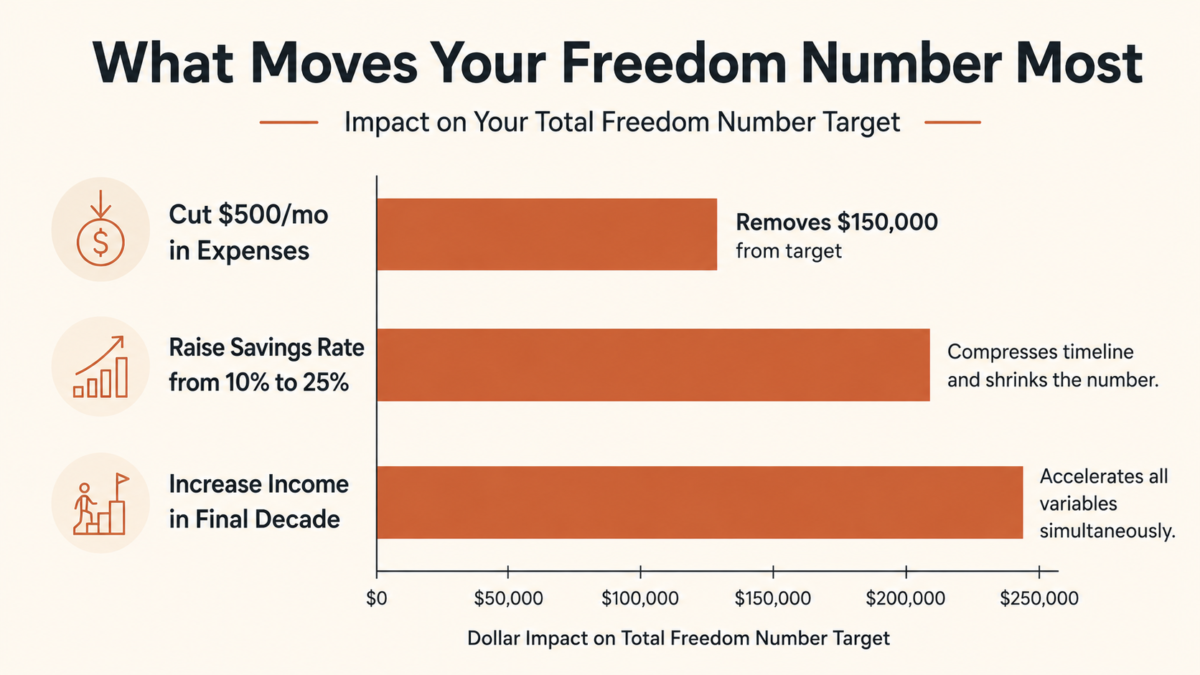
Expenses. Every $500 per month you reduce from your expected retirement spending removes $150,000 from your freedom number. That is not a rounding error. Drop your projected monthly spending from $4,500 to $3,500 and your target falls by $300,000. This is why lifestyle design before reaching your number matters as much as the investment growth itself.
Savings rate. Moving from a 10% savings rate to a 25% savings rate compresses the timeline in two directions at once. You are adding more money, and you are also living on less, which means your freedom number is smaller. Both effects reinforce each other. The timeline shortens faster than most people expect.
Income in the final years. Earning more in the 8 to 10 years before your target date touches every part of the equation simultaneously. It adds to savings, it can accelerate debt payoff, and it builds the portfolio at the exact window when compounding has the most to work with. Northwestern Mutual’s 2026 Planning and Progress Study found Americans believe they need $1.46 million to retire comfortably, up 15% from the prior year. The people closing that gap fastest are not doing it through investment returns alone.
On the income side specifically, AI-assisted tools for budgeting, income analysis, and financial planning have become genuinely useful for midlife adults who did not grow up using them. We covered the specific use cases in how AI applies to financial independence planning.
The Number Is a Starting Point, Not a Score
Here is something worth saying plainly: you are already ahead of most people just by running this calculation.
Most Americans do not have a specific savings target. They are saving what they can and hoping it adds up. The person who knows their number can adjust it, aim at it, and track progress. The person who avoids it cannot do any of those things.
Knowing the number also changes your relationship to spending decisions, job decisions, and timing decisions. Every financial choice you make from here has a context it did not have before. That context is not a weight. It is a map.
The path we chose to build toward ours is worth reading for context if you want to understand how this thinking plays out over time: why we prioritized travel before retirement covers some of the specific trade-offs and how we ran the numbers at different life stages.
The Bottom Line
You started with a number that felt like a wall.
Now you know it is adjustable. Social Security subtracts from it. The SECURE 2.0 super catch-up at ages 60 to 63 is one of the most powerful savings windows most midlife adults have never used. Mortgage payoff restructures your expense base. Coast FI and Barista FI are real milestones, not consolation prizes.
The next step is running your actual number with those midlife adjustments applied. Our FREE Freedom Number Calculator on this site does exactly that.
What’s the first adjustment you are going to make to your freedom number after reading this?
Frequently Asked Questions
What is a freedom number in financial independence?
Your freedom number is the invested portfolio balance that covers your living expenses indefinitely, without a paycheck. Calculate it by multiplying your expected annual retirement spending by 25. For example, if you plan to spend $50,000 per year, your freedom number is $1.25 million.
How do I calculate my freedom number?
Estimate your expected annual spending in retirement, then multiply by 25. If you expect to spend $4,000 per month, that is $48,000 per year, which gives you a freedom number of $1.2 million. Use the Freedom Number Calculator on this site to get a number personalized to your expenses and timeline.
Is it too late to reach financial independence in my 50s?
No. The same framework applies on a shorter timeline. Midlife-specific advantages include Social Security as a real dollar offset to your required portfolio, 2026 catch-up contributions that allow up to $35,750 per year after age 60, and intermediate milestones like Coast FI and Barista FI that represent genuine progress toward a freedom number even before it is fully reached.
What if my freedom number still feels impossible to reach?
Two intermediate milestones are worth knowing. Coast FI means you have already saved enough that compounding will finish the job without new contributions. Barista FI means part-time income covers current expenses while investments continue to grow. Either milestone means work is genuinely optional, which is a different life even if the full freedom number is still a few years away.
How does Social Security affect my freedom number?
Social Security reduces what your portfolio must generate. If you will receive $1,500 per month at age 67, that covers $18,000 per year in living expenses. At a 4% withdrawal rate, that means you need $450,000 less in your portfolio than the basic 25x formula shows. Always factor your estimated Social Security benefit into the calculation before setting a final target.