

Table of Contents
The difference between fixed mindset vs growth mindset usually shows up in ordinary moments. You try something new and it feels awkward. You get feedback and feel exposed. You miss a workout, struggle with a tool, avoid a hard conversation, or catch yourself thinking, “I am just not that kind of person.”
That one sentence can quietly shrink a life.
By midlife, most of us have a long file of evidence about who we think we are. Good with people. Bad with money. Not athletic. Not creative. Too old for technology. Too late to start again. Some of those labels came from real experiences, but that does not mean they deserve permanent authority.
This guide explains fixed mindset vs growth mindset in plain English, with real-life examples and practical ways to shift your thinking without pretending change is easy.
Please note this page may contains affiliate links. If you purchase something through these links, I’ll receive a commission at no extra cost to you. Affiliate links help to support my website/blog and I only recommend products I love.
What fixed mindset vs growth mindset really means
A fixed mindset assumes your ability, intelligence, talent, or identity is mostly set. If something is hard, fixed mindset turns that friction into a verdict: “I am not good at this.”
A growth mindset assumes skills can develop through practice, better strategies, feedback, support, and time. It does not say you can become anything instantly. It says your first attempt is not the final measurement of who you are.
Psychologist Carol Dweck helped bring this idea into mainstream conversation through her work on mindset. Verywell Mind’s overview of mindset describes the basic split clearly: fixed mindset treats traits as stable, while growth mindset sees room for development. The important part is not the label. The important part is what you do after a mistake.
Fixed mindset asks, “What does this prove about me?” Growth mindset asks, “What does this teach me?”
No one has a growth mindset in every area. You might be open and experimental with travel, but rigid about money. You might be confident at work, but shut down when learning technology. That is normal. Mindset is often area-specific, and it usually gets loudest where your identity feels most tender.
If you are wrestling with whether it is too late to change, our post on starting over in your 50s pairs well with this idea. Midlife does not erase possibility. It does ask you to be more honest about the next step.
Fixed mindset vs growth mindset examples in real life
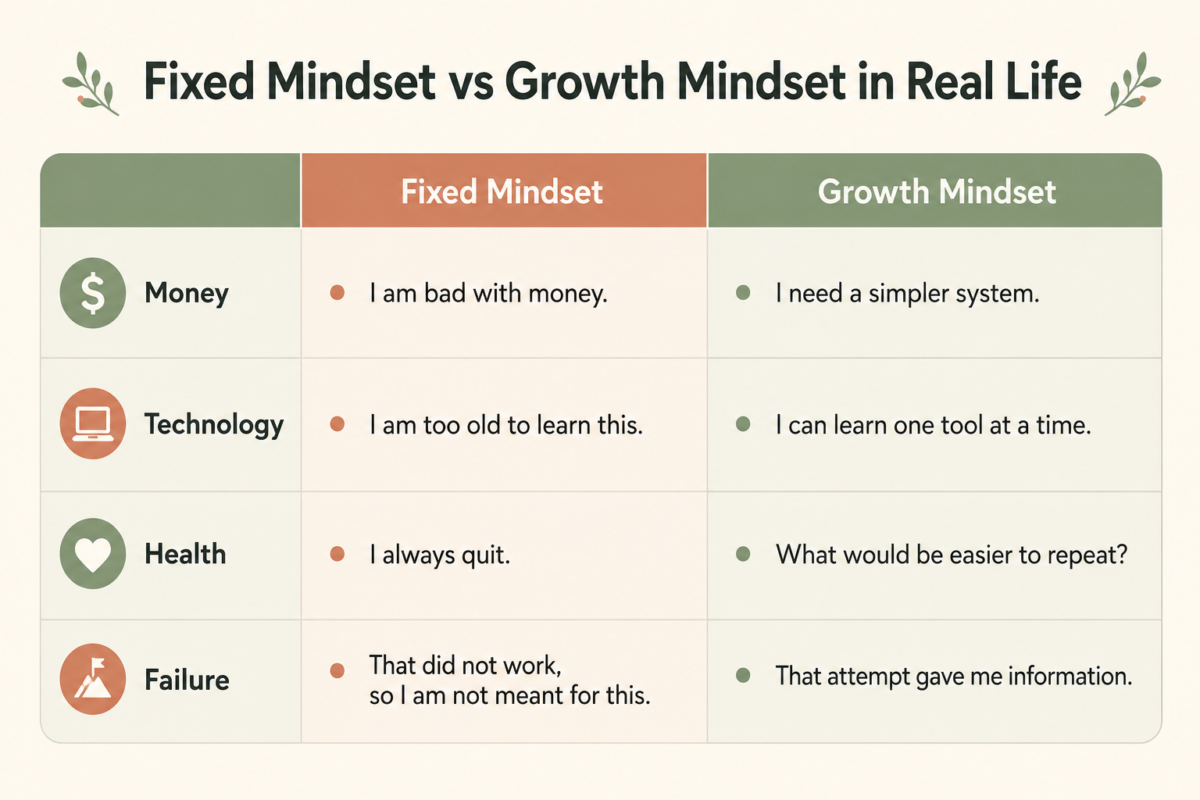
Definitions are useful, but examples are where this starts to click. A fixed mindset often sounds reasonable because it uses familiar evidence. A growth mindset does not deny the evidence. It interprets it differently.
With money, fixed mindset says, “I am bad with money.” Growth mindset says, “I need a simpler system and more practice checking in.” That is a completely different starting point.
With technology, fixed mindset says, “I am too old to learn this.” Growth mindset says, “I can learn one tool at a time.” If AI, video, or online tools feel intimidating, our guide to using AI to reinvent yourself after 40 is a good example of turning a broad fear into a manageable learning path.
With health, fixed mindset says, “I always quit.” Growth mindset says, “My old approach did not fit my real life. What would be easier to repeat?”
With failure, fixed mindset says, “That did not work, so I am not meant for this.” Growth mindset says, “That attempt gave me information.”
Notice the difference. Growth mindset is not softer. It is more useful. It gives you something to adjust besides your entire identity. That is why fixed mindset vs growth mindset matters so much when you are trying to change something that already feels personal.
Why fixed mindset feels so convincing in midlife
Fixed mindset can feel especially believable after 40 or 50 because you have history. You have old report cards, job experiences, family patterns, body changes, financial stress, relationship stories, and a few attempts that did not go the way you hoped.
That history can harden into identity. “I tried before” becomes “I cannot.” “I was embarrassed once” becomes “I should avoid that.” “I was never taught” becomes “People like me do not do this.”
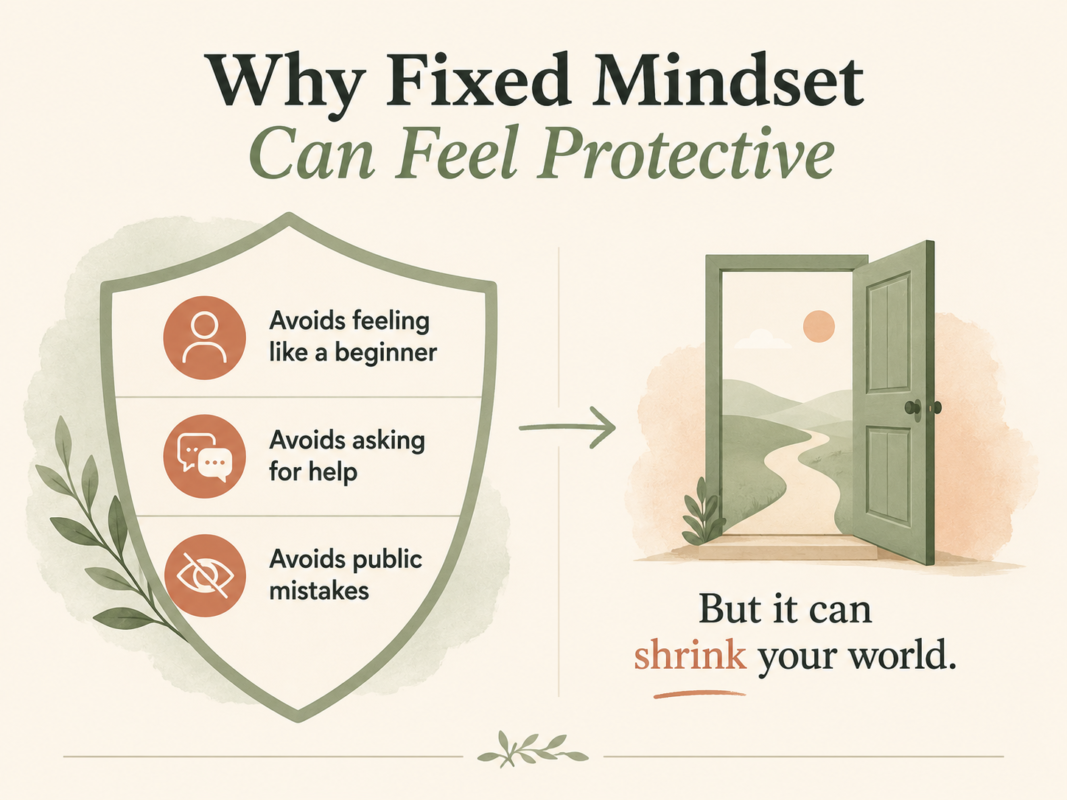
Honestly, fixed mindset can feel protective. If you decide you are not capable, you never have to risk being a beginner again. You do not have to ask for help. You do not have to feel clumsy in public. You do not have to face the uncomfortable gap between what you want and what you currently know how to do.
That protection has a cost.
It keeps you from learning the tool, applying for the thing, improving your health, changing your money habits, starting the creative project, or having the conversation. It keeps your world smaller while pretending to keep you safe.
If fear of change is part of the loop, our guide on overcoming fear of change in midlife goes deeper on why familiar discomfort can feel safer than an unfamiliar next step.
What growth mindset is not
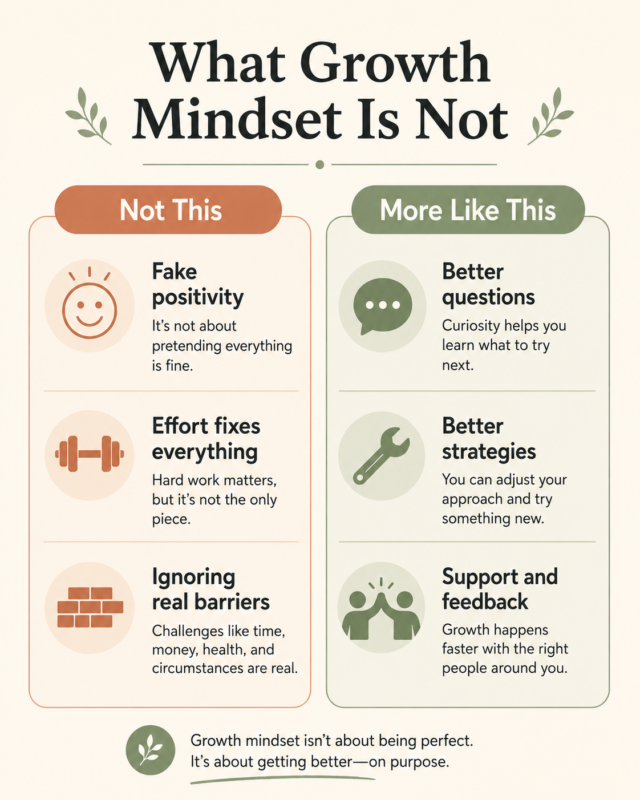
Growth mindset gets watered down when people turn it into a slogan. It is not fake positivity. It is not pretending every barrier is imaginary. It is not blaming people for struggling when health, money, systems, caregiving, discrimination, exhaustion, or lack of support are real.
It is also not “effort fixes everything.” Effort matters, but effort with the wrong strategy can keep you stuck. If you have ever tried harder at the same broken routine and felt worse, you already know this.
The 2019 National Study of Learning Mindsets, published in Nature, found that mindset interventions can help in some contexts, but context matters. The Education Endowment Foundation’s Changing Mindsets trial adds useful caution: teaching growth mindset language alone is not a magic switch.
That nuance is good news. It means you do not have to force yourself into cheerful self-talk. A real growth mindset asks better questions:
- What skill is missing?
- What support would help?
- What strategy needs to change?
- What did this attempt teach me?
- What is the next small test?
That is grounded. That is adult. That is much more useful than telling yourself to believe harder.
How to shift from fixed to growth without forcing it
The shift starts with noticing your language. Fixed mindset often hides inside words like always, never, just, and too late.
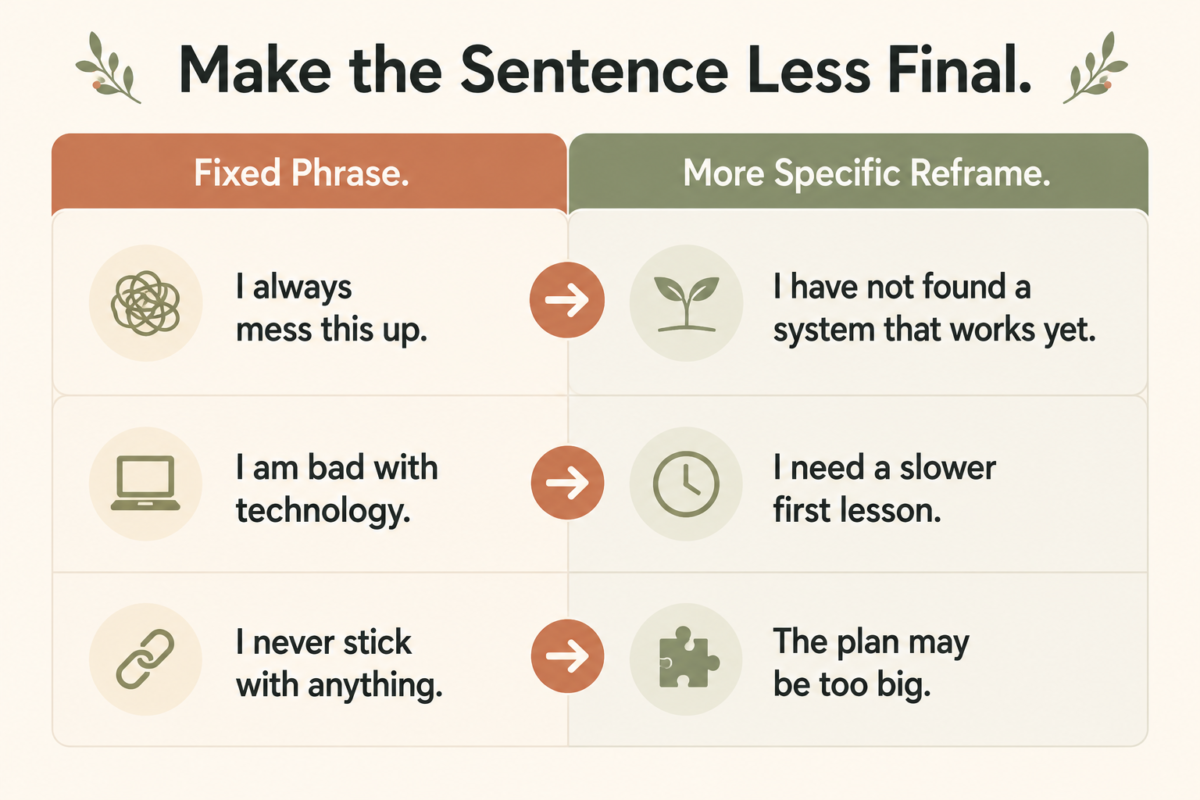
“I always mess this up.” “I never stick with anything.” “I am just not disciplined.” “It is too late for me to learn that.” Those sentences sound final. Most of the time, they are not facts. They are interpretations.
The first move is to make the sentence more specific. “I always mess this up” becomes “I have not found a system that works for this yet.” “I am bad with technology” becomes “I need a slower first lesson and a reason to practice.” “I never stick with anything” becomes “I tend to quit when the plan is too big.”
Specificity gives you room to move.
The second move is to replace self-judgment with an experiment. Instead of deciding what a setback means about you, ask what you can test next. Could you reduce the goal? Change the time of day? Ask someone to explain it differently? Use a checklist? Try for seven days instead of forever?
This is where mindset connects to goals. Our post on setting purposeful goals is a helpful next read because growth mindset needs a place to land. A vague wish is hard to practice. A small goal gives you feedback.
A simple growth mindset practice for the next 7 days
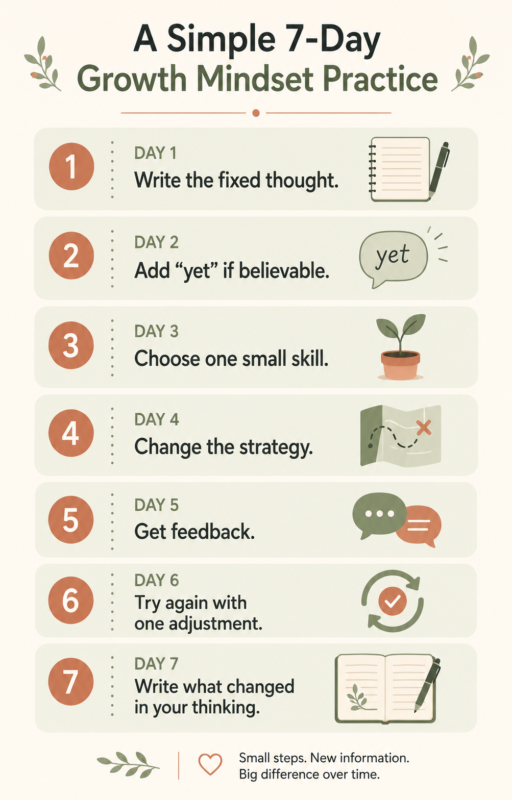
You do not need to rebuild your whole identity this week. Start with one sentence you catch yourself saying.
On day one, write down one fixed-mindset thought. Do not dress it up. Write the honest version: “I am too old for this,” “I am bad at follow-through,” or “I should already know how to do this.”
On day two, add one word or phrase that makes it less final. “I have not learned this yet.” “I have not found the right system yet.” Only use yet if it feels believable enough to work with. Forced optimism usually backfires.
On day three, choose one small skill connected to that sentence. If the sentence is about technology, learn one feature. If it is about fitness, do one repeatable movement. If it is about money, look at one account for five minutes.
On day four, ask what strategy would make it easier. On day five, get one piece of feedback or outside input. On day six, try again with one adjustment. On day seven, write down what changed in your thinking, not just what changed in the outcome.
The point is not to prove that everything worked. The point is to build evidence that you can respond differently. In real life, fixed mindset vs growth mindset is less about a perfect attitude and more about what you do with the next attempt.
What is the difference between fixed mindset and growth mindset?
A fixed mindset assumes your abilities, intelligence, or identity are mostly set. A growth mindset believes skills can improve through practice, better strategies, feedback, and support. The difference shows up most clearly after setbacks: fixed mindset treats mistakes as proof, while growth mindset treats them as information.
Bottom line: your first answer does not have to be final

A fixed mindset keeps setbacks attached to identity. A growth mindset turns setbacks into information. That one shift can change how you learn, how you recover, how you ask for help, and how much of your second act you are willing to explore.
You do not have to become endlessly optimistic. You do not have to ignore real limits. You only have to stop treating every hard thing as proof that you are done growing.
If you are working on a bigger second-act shift, our post on why people over 40 reinvent their lives is a natural next step. Mindset is not the whole change, but it often decides whether you even let yourself begin.
What is one sentence you have been treating like a fact, even though it might only be an old story?
If you enjoyed this article, consider subscribing to our newsletter to get more topics like this delivered to your email when it is published.
FAQ
What is a fixed mindset?
A fixed mindset is the belief that your abilities, intelligence, or traits are mostly permanent. It often shows up as avoiding challenges, fearing mistakes, or treating feedback as a personal judgment.
What is a growth mindset?
A growth mindset is the belief that skills and abilities can develop through learning, practice, strategy, feedback, and support. It does not mean everything is easy or that effort alone is enough.
Can adults develop a growth mindset?
Yes. Adults can practice a growth mindset by noticing fixed-mindset language, trying small experiments, asking for feedback, and separating identity from temporary results.
Is growth mindset just positive thinking?
No. Growth mindset is not fake optimism. It is a practical way to ask what can be learned, changed, practiced, or supported after a challenge.
What is a simple fixed mindset vs growth mindset example?
Fixed mindset says, “I am bad with technology.” Growth mindset says, “I have not learned this tool yet, and I need a simpler first step.”