

RV life gets sold with a simple promise: trade the mortgage for the open road and spend less doing it. That can happen. It can also go the other direction fast when campground nights, fuel, insurance, repairs, and health coverage start landing in the same month.
The RV payment is only one line. Your first-year total depends much more on how often you move, where you sleep, what you already own, and how much uncertainty your budget can absorb.
Full-time RV living costs depend mostly on campsite choices, miles driven, insurance, repairs, and health coverage. A paid-off rig can still carry thousands in monthly living and travel expenses. Build your budget from a fixed-cost floor, then add campground nights, fuel, maintenance reserves, and a buffer for the first year.
Please note this page may contains affiliate links. If you purchase something through these links, I’ll receive a commission at no extra cost to you. Affiliate links help to support my website/blog and I only recommend products I love.
Table of Contents
- Full-Time RV Living Costs Start With How You Travel
- Build the Fixed-Cost Floor First
- Add the Costs That Rise Every Time You Move
- The Repair Fund Is Part of the Monthly Budget
- Three First-Year RV Budget Scenarios
- Run a 90-Day Test Before You Commit
- Where You Can Cut Without Making RV Life Miserable
- Bottom Line
- Frequently Asked Questions
Full-Time RV Living Costs Start With How You Travel
There is no honest single answer to full-time RV living costs. A couple parked for three months on a monthly rate lives in a different financial world from a couple changing states every four days.
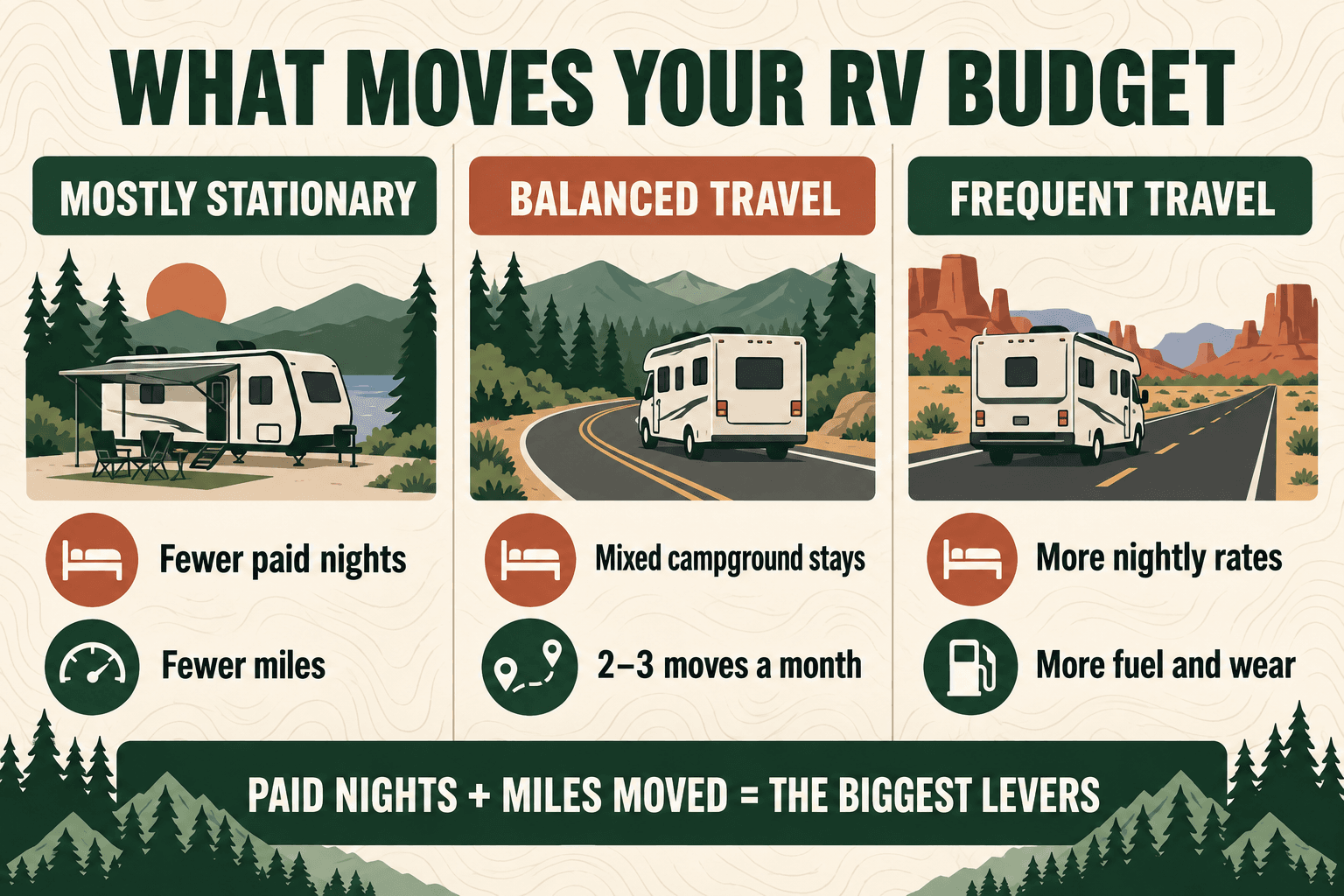
That difference matters more than whether your rig is 28 feet or 32 feet. The two numbers that move the budget fastest are paid campground nights and miles driven. Every extra move can add fuel, tolls, meals on the road, reservation fees, and wear on both the RV and tow vehicle.
Start by deciding which of these descriptions sounds most like the life you actually want.
- Mostly stationary: One or two monthly stays, short regional moves, and occasional public-land camping.
- Balanced travel: Two or three moves a month, a mix of private parks and public campgrounds, plus several free or low-cost nights.
- Frequent travel: Weekly moves, popular destinations, more nightly-rate bookings, and higher annual mileage.
This is where fantasy and planning separate. If your dream depends on waking up somewhere new every few days, build the frequent-travel budget first. You can always spend less. Starting with the cheapest possible version only hides the life you said you wanted.
If you are still deciding whether the lifestyle itself fits, read our guide to whether full-time RV living after 50 is right for you before you spend hours perfecting a spreadsheet.
Build the Fixed-Cost Floor First
Your fixed-cost floor is the money that leaves whether you drive 1,000 miles or stay parked all month. This is the part of full-time RV living costs that deserves attention before you price a single campground.
List the RV loan and tow-vehicle payment if you have them. Then add insurance, registration, roadside coverage, internet, phone service, mail forwarding, memberships, storage, and health coverage. These full-time RV living costs continue in quiet months too. Include subscriptions you plan to keep. A streaming service still counts even when the scenery improves.
Insurance needs a real quote. The Texas Department of Insurance, in guidance updated July 21, 2025, tells people who live in an RV full time to consider full-timers coverage. A recreational policy may not treat the RV like your home or cover personal property and liability the way you expect.
Domicile adds another small but important category. Full-time travelers still need a legal address for licenses, voting, taxes, banking, and insurance. As one current example, Escapees lists mail forwarding starting at $110 per year in addition to membership. Shipping, scanning, vehicle registration, and state-specific fees can raise the actual total.
Health insurance can dwarf those smaller lines if you leave an employer plan before Medicare. HealthCare.gov directs shoppers to the Marketplace used by their state and provides current 2026 plan data for comparison. Check more than the premium. A narrow provider network tied to your domicile area can be awkward when you spend most of the year elsewhere.
Do not copy someone else’s health-insurance number into your plan. Preview plans for your household, expected income, domicile ZIP code, prescriptions, and preferred doctors. Then confirm how routine and emergency care work outside the home network.

Add the Costs That Rise Every Time You Move
Variable expenses are where full-time RV living costs become slippery. Campground fees, fuel, tolls, propane, laundry, and travel-day food can look harmless one at a time. Together, they decide whether a month feels easy or expensive.
Price campgrounds from a route you might really drive. Do not use the cheapest park you found three states away as your national average. Pull twelve likely stops across the seasons you expect to travel, then note the nightly, weekly, and monthly rates. Add electricity when the monthly rate excludes it.
Fuel needs the same treatment. Use your rig’s real towing or driving mileage, not the number on a sales page. Multiply planned miles by current fuel prices from the U.S. Energy Information Administration’s weekly data, then add local driving after you unhitch or park.
Here is the simple version:
Monthly travel fuel = planned miles ÷ real miles per gallon × current price per gallon
If you tow a trailer 900 miles in a month at 9 miles per gallon and fuel costs $4.00, towing fuel alone is $400. That does not include sightseeing, grocery runs, or a long drive to an appointment.
The IRS business mileage rate is not an RV budget and should not be used as one. Still, the 2026 rate of 76 cents per mile after July 1 is a useful reminder that fuel is only part of operating a vehicle. Tires, maintenance, depreciation, and insurance travel with every mile too.
This is why slower travel changes several lines at once. Fewer moves can mean lower fuel use, fewer tolls, less wear, and access to weekly or monthly campground pricing. Slow travel is not just a lifestyle preference. It is a budget setting.
The Repair Fund Is Part of the Monthly Budget
A repair is not an exception to full-time RV living costs. It is a normal expense with rude timing.
Build two sinking funds if you tow: one for the RV and one for the tow vehicle. Motorhome owners still need separate thinking for the house systems and the chassis. Tires, brakes, batteries, seals, slide mechanisms, water pumps, refrigerators, and air conditioners do not coordinate their failures for your convenience.
The right monthly amount depends on the rig’s age, condition, warranty, complexity, and how much work you can safely handle yourself. The point is not to find a universal percentage. The point is to stop calling predictable wear an emergency.
Add an emergency-lodging line too. If the RV goes into a shop, your home goes with it. A repair bill can arrive beside several hotel nights, restaurant meals, pet fees, and transportation costs.
One practical approach is to get prices for four ugly but believable events: a tire replacement, a major tow-vehicle repair, an appliance failure, and seven hotel nights. You may not need all four in year one. Seeing the numbers tells you whether your reserve can handle the year you hope not to have.
Three First-Year RV Budget Scenarios
The table below turns full-time RV living costs into a planning exercise, not a national average. It excludes the purchase price of the RV, RV and vehicle loan payments, personal debt, income taxes, and health-insurance premiums because those vary too widely to hide inside one example.
| Monthly Category | Mostly Stationary | Balanced Travel | Frequent Travel |
|---|---|---|---|
| Campgrounds and electricity | $750 | $1200 | $1950 |
| RV and vehicle insurance | $225 | $275 | $325 |
| Maintenance sinking funds | $350 | $500 | $700 |
| Internet and phones | $225 | $250 | $300 |
| Propane and laundry | $90 | $130 | $180 |
| Domicile, mail, memberships | $60 | $75 | $100 |
| Emergency and setup buffer | $250 | $350 | $500 |
| Example monthly total | $1,950 | $2,780 | $4,055 |
| Example annual total | $23,400 | $33,360 | $48,660 |
Those totals are not promises. They are a way to expose assumptions. Replace every line with quotes and route math from your own plan, then add groceries, dining, entertainment, medical care, pets, storage, debt, and taxes.
The first year deserves a larger buffer than later years. You may buy hoses, adapters, leveling gear, kitchen items, memberships, and replacement parts that do not repeat annually. You are also learning which campground style and travel pace you can tolerate.
What jumps out is the spread. The frequent-travel example spends $35,160 more per year than the mostly stationary example before health coverage, debt, and ordinary living expenses. That gap comes mainly from movement and paid nights, not from fancy kitchen gadgets.
Want more like this? Join our newsletter and discover more midlife tools and knowledge we’re actually using.
Run a 90-Day Test Before You Commit
You do not need to sell the house to learn whether your numbers work. Build a 90-day test around the season and region you are most likely to travel.
Start with your current spending. Mark what disappears when you leave, what follows you, and what gets replaced by an RV version. The mortgage may disappear after a sale, but storage, mail service, campground rent, and higher travel fuel may show up in its place.
Then price the route. Our guide to planning a first RV trip with AI can help organize stops and questions, but verify every fee on the campground or agency website. Search engines and chat tools are good at finding possibilities. They are not the reservation desk.
Get an insurance quote that clearly states full-time use. Preview health plans if your employment coverage would end. Price your internet setup where you will actually travel. Check whether your storage unit, home-base expenses, or family obligations remain.
Now add 15 percent to the estimate. That is not a prediction that everything will go wrong. It is room for the first year to teach you something without forcing a credit-card decision.
Finally, put the annual RV total beside the rest of your plan. If retirement timing is part of the decision, our explanation of how to figure out your Freedom Number can help connect lifestyle spending to the income your savings must support. This is planning math, not individual financial advice.
Where You Can Cut Without Making RV Life Miserable
The best savings on full-time RV living costs usually do not come from refusing every meal out or tracking propane to the penny. They come from changing the shape of the trip.
Stay longer. Weekly and monthly rates can beat a string of nightly reservations, and fewer moves reduce fuel and wear. Travel in shoulder seasons when weather and crowds still work for you. Mix private parks with public campgrounds and occasional free stays instead of expecting one style to carry the whole year.
If you are a U.S. citizen or permanent resident age 62 or older, the National Park Service says the Senior Pass may reduce some expanded amenity fees, including certain camping fees. The annual pass is $20 and the lifetime pass is $80 as of the agency’s January 7, 2026 update. Not every campground or concessioner participates, so check the specific site.
Cancel fewer reservations. A perfect route on paper can become expensive when weather, family needs, repairs, or simple fatigue change the plan. Leave breathing room between must-book destinations.
Keep the lifestyle honest too. Our own move toward minimalism and RV living points to the bigger trade: fewer things can create room for more experiences, but the experiences still need a budget. Minimalism is not a coupon code for fuel, repairs, or campgrounds.
Bottom Line
The useful question is not, “Is RV life cheap?” It is, “Does the version of RV life we want fit our income, reserves, and tolerance for surprise?”
Build the fixed-cost floor. Price a real route. Fund repairs before they happen. Then test the number against the life you actually want, not the cheapest version someone else managed for one month.
Which line in your first-year RV budget feels least predictable right now: campgrounds, repairs, insurance, or health coverage?
Frequently Asked Questions
Is full-time RV living cheaper than owning a house?
It can be, but only when campsite costs, travel pace, repairs, insurance, and storage remain below the housing expenses you replace. Compare full annual totals, not an RV payment against a mortgage payment.
How much should I save before living in an RV full time?
Keep a separate repair and emergency reserve in addition to your monthly operating budget. The right amount depends on rig age, warranty, vehicle condition, and income stability. Price several believable failures before choosing the reserve.
What expenses do new full-time RVers forget?
Commonly missed costs include full-timer insurance, domicile and mail service, campground electricity, tolls, laundry, propane, connectivity, storage, and emergency lodging. First-year setup purchases can add another layer.
Does health insurance work while traveling full time?
Coverage depends on the plan and provider network. Review plans for your domicile state and check out-of-area, prescription, routine-care, and emergency rules before enrolling. Confirm details with the insurer rather than relying on a general RV guide.
What lowers full-time RV living costs the most?
Moving less often and reducing paid campground nights usually have the largest effect because they cut fuel, nightly fees, tolls, and wear at the same time. The exact savings depend on your route and rig.