
In This Article
A few years ago, a friend of ours lost her grandmother without ever recording a legacy interview. The woman had lived through things worth knowing: the Depression, a wartime factory job, a first love who went overseas and never came back. None of it had ever come up at dinner. Our friend found out from a cousin who had read it in an old letter, years too late to ask a single follow-up question.
The stories were there the whole time. They just never got asked for.
A legacy interview is one of the simplest ways to change that pattern. It doesn’t require a production company, a film crew, or anyone to be particularly comfortable on camera. It requires a phone, a quiet room, and the willingness to sit down and ask.
Families who do it tend to describe it as one of the most worthwhile things they’ve ever done. Families who don’t tend to say they wish they had.
Here is what a legacy interview actually is, why it matters more than most people expect, and how to start one before the window closes.
Please note this page may contains affiliate links. If you purchase something through these links, I’ll receive a commission at no extra cost to you. Affiliate links help to support my website/blog and I only recommend products I love.
What a Legacy Interview Actually Is
A legacy interview is a recorded conversation, audio or video, where a family member shares their life story in their own words: childhood memories, key decisions, lessons learned, and advice for the people who come after them. It is a simple way to preserve someone’s voice and perspective before those stories are gone.
That definition sets it apart from a few things people often confuse it with. A memoir is written, which means the person has to be comfortable putting words on a page, and most people aren’t. A scrapbook is visual but silent. A job-style interview focuses on skills and accomplishments rather than life experience.
A legacy interview is something else entirely: a conversation designed to capture a whole person, not a resume or a photo album.
The format is flexible. Video works well when someone is comfortable on camera. Audio-only is just as valuable and often puts people more at ease. Some families transcribe the recording afterward and turn it into a written document.
There is no single right way to do it. The only requirement is that it gets recorded in some form, because a conversation that lives only in someone’s memory is still fragile.
The person being interviewed doesn’t have to be elderly. Some of the best legacy interviews happen with people in their 50s and 60s, when they’re still sharp and articulate about decisions they made decades ago, and close enough to those experiences to describe them with real specificity.
If you’ve ever kept a travel journal as a way of holding onto a trip, the impulse is the same: something captured now is actually yours, and something left for later has a way of disappearing. We explored that instinct in our piece on travel journaling and memory-keeping.
Why Legacy Interviews Matter More in Midlife Than You’d Think
There’s a version of the someday trap that applies to family stories, and it works exactly the way it does with bucket-list travel and retirement plans. Most people in their 40s and 50s still have at least one parent, grandparent, or older relative whose stories are fully recoverable. The person is here. Still lucid. Still capable of describing what life looked like from the inside of it.
But that window closes faster than it feels like it will. Cognitive decline can arrive gradually and then suddenly. Illness changes what someone is able to talk about, and how long they have the energy for it.
Sometimes people pass before the conversation ever gets scheduled. What’s left afterward is fragments: a detail someone misremembers, a photo with no name on the back, a story that got started at a family dinner and never finished.
Midlife is often the first time people get genuinely serious about this. They start thinking about where they came from, what they want to pass on, and what they’d regret not having captured.
We’ve written about this reorientation in the context of choosing experiences over things. The same logic holds here: the story you could have recorded last year is one thing, and the story you can still record this weekend is something else. One of those windows is open.
A legacy interview moves the conversation from someday to this week. That’s the whole point.
What Actually Happens During a Legacy Interview
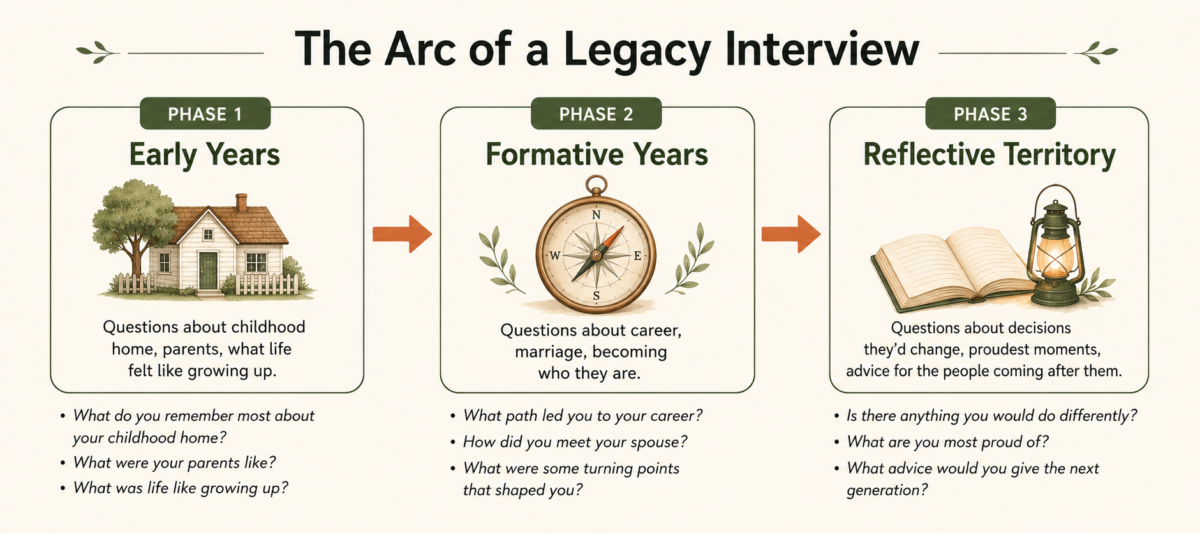
Most legacy interviews follow a loose arc. They start with the early years: where the person grew up, what their parents were like, what home felt like before they had much say in it. They move into the formative years: how the person found their work, met their partner, became the version of themselves that the people around them know.
They end in reflective territory: the decisions they’d make differently, the things they’re most proud of, the advice they’d give to someone standing where they once stood.
Most run somewhere between one and three hours total, often broken into 45-60 minute sessions. Shorter sessions keep the person from getting worn out and give the conversation room to breathe rather than feeling like a deposition.
Multiple sittings also mean the subject has time between sessions to remember things they didn’t think of during the first one, which almost always improves what comes later.
The questions that produce the richest answers are open-ended and specific. “What was your house like when you were eight?” gets far more than “What was your childhood like?” “Tell me about the year you decided to leave that job” gets more than “What’s your biggest regret?”
The Legacy Project, a gerontology initiative that has studied intergenerational memory practices for decades, documents how structured life review benefits both the person being interviewed and the family members doing the asking. The act of telling the story matters for the teller, not just for the listener.
If the bigger questions about meaning and purpose that tend to surface during these conversations are on your mind too, our post on navigating what you actually want your life to mean covers some of that same territory. Legacy interviews have a way of clarifying things for everyone in the room.
DIY Legacy Interview vs. Hiring a Professional
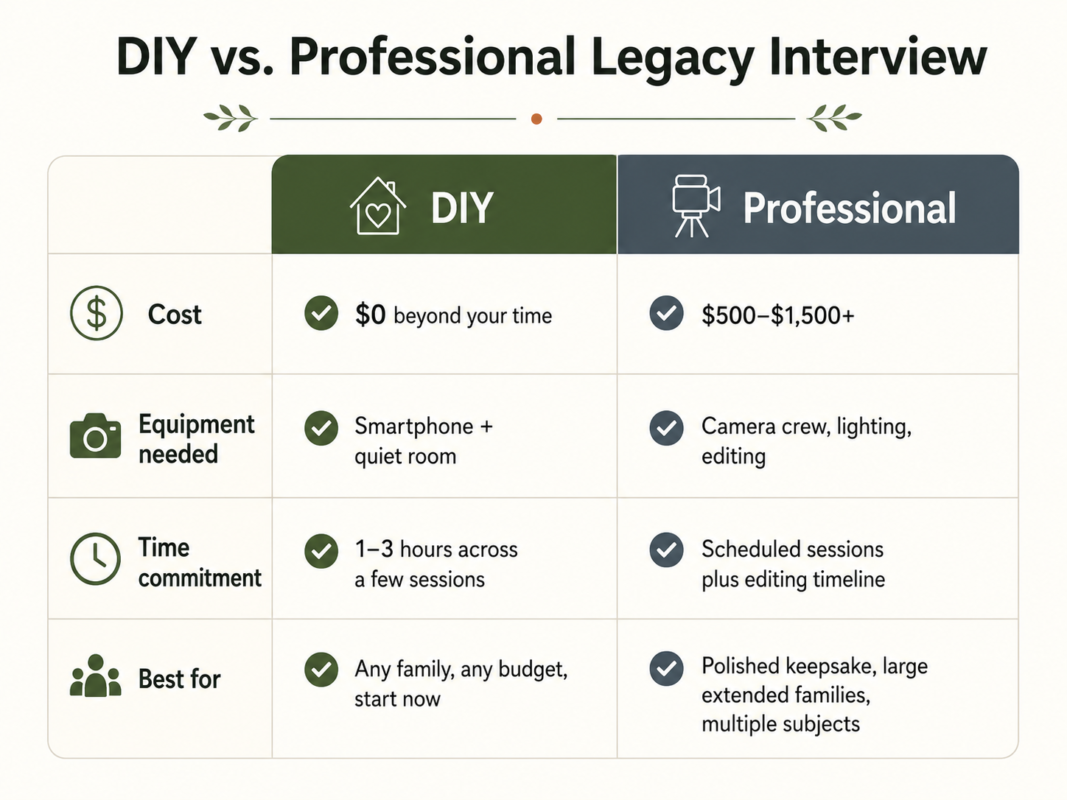
Professional legacy video services span a wide price range, but a few hundred dollars is typically the floor, and $1,500 or more is common for a full recorded and edited package. At that level, you get professional lighting, camera work, and a finished product that looks and sounds like something you’d be proud to hand down. For families who want a polished, cinematic keepsake, or who have multiple subjects and branches to record, that investment can be worth it.
For most families, the barrier is real. Cost is one part of it. Setup is another: scheduling a production company, preparing for a formal session, finding a time when everyone’s calendar aligns. That friction is often exactly why legacy interviews never happen. The planning becomes the obstacle.
A DIY legacy interview costs nothing beyond your time. A smartphone placed on a table in a quiet room with decent light captures audio clearly enough to be listened to decades from now. The substance of what gets said matters far more than the production value.
FamilySearch, one of the largest genealogy organizations in the world, has published detailed guidance on conducting meaningful family interviews with nothing more than a phone and a prepared list of questions. Their approach emphasizes preparation and presence over equipment.
There are situations where professional help makes sense: a large extended family who wants a finished documentary to share across multiple branches, or a subject whose limited energy makes a streamlined professional process the kinder option. But for most people, starting with what they have is better than waiting for the perfect setup that never arrives.
One small detail worth knowing: simple props help. A digital picture frame loaded with old family photos, for example, can spark stories during a legacy interview in the same way it does when sharing travel memories with family at home. Looking at a photograph of a person or a place is often all it takes to open a story the subject hasn’t told in years.
How to Start Your Own Legacy Interview This Week
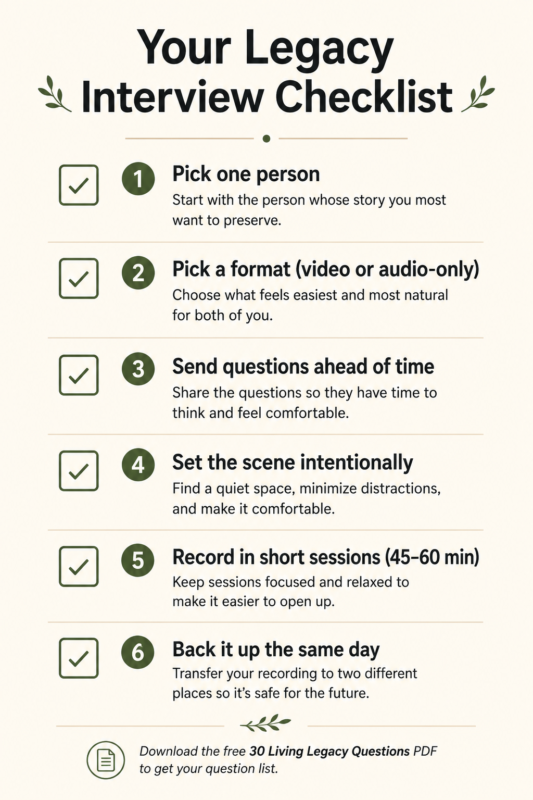
The hardest part of a legacy interview isn’t the recording. It’s the starting. Most families get stuck in the planning phase and never make the call. Here’s a simple path forward.
Pick one person. Not an ambitious multi-person project. Not the whole family reunion. One person whose stories you’d most regret not having. Treating this like a small, intentional goal rather than a major production is the difference between something that happens and something that doesn’t, a principle that applies to most things worth doing in midlife, as we’ve written about in the context of building purposeful habits that actually stick.
Pick a format. If the person is camera-shy, audio-only is completely fine. A voice memo app on your phone, recorded in a quiet room, captures everything that matters. Don’t let format become the reason it doesn’t happen.
Send questions ahead of time. Don’t arrive and surprise the person with an interview. Share five to ten questions a few days before so they have time to think. This makes the conversation richer and puts the subject at ease before the recording starts.
Set the scene intentionally. A quiet room, low foot traffic, natural light if you can get it. Turn off notifications on both phones. Make the person comfortable, whether that means their kitchen table, a favorite chair, or somewhere that carries personal meaning for them.
Record in short sessions. Forty-five to sixty minutes is enough for one sitting. You can schedule another. Let the conversation end when it’s ready, not when the time runs out.
Back it up the same day. A recording that lives on one phone is one dropped phone away from being gone. Copy it to cloud storage and a second device before the day is over.
If you’re not sure what to ask, that’s exactly what our free 30 Living Legacy Questions PDF is for. It’s a ready-made starting list for people who want to do a legacy interview but don’t know where to begin. Download it, pick a few questions that feel right, send them ahead of time, and sit down this weekend.
Frequently Asked Questions
What is a legacy interview?
A legacy interview is a recorded conversation, audio or video, where a family member shares their life story in their own words: childhood memories, key decisions, lessons learned, and advice for the people who come after them. It is a simple way to preserve someone’s voice and perspective before those stories are gone.
How is a legacy interview different from an oral history?
They overlap, but oral history usually focuses on historical events and broader social context, while a legacy interview centers on one person’s personal story, values, and the memories and relationships they want passed down to family.
How long should a legacy interview be?
Most run one to three hours total, often broken into 45-60 minute sessions so the person being interviewed doesn’t get worn out and can actually enjoy the conversation. Multiple shorter sessions almost always produce better recordings than one long, exhausting one.
Do I need professional equipment to record a legacy interview?
No. A smartphone in a quiet, well-lit room is enough for a meaningful recording. Professional gear adds polish, but it adds nothing to the substance of what gets said. The stories are what matter, and those don’t require a film crew.
What if the person I want to interview doesn’t want to be on camera?
Audio-only works just as well, and for many people it’s easier. Without a camera, there’s nothing to be self-conscious about, and the conversation often flows more naturally. Some of the most meaningful recordings families have are audio-only, because the voice itself carries so much.
The Bottom Line
A legacy interview isn’t a project for wealthy families or for end-of-life planning. It isn’t something you need to hire anyone to do. It’s a conversation, a phone, and the decision to sit down with someone who matters to you and ask the questions you’ve been putting off.
The stories most worth keeping are already there, inside the people you already know. They just need someone to ask for them before the chance closes.
If you’re ready to start but don’t know what to ask, download our free 30 Living Legacy Questions PDF.
It gives you exactly what you need to walk into your first legacy interview this weekend, no production company required.
What family story do you wish you had recorded while you still had the chance? And what’s one conversation you could actually have this week? Let us know in the comments.