
Table of Contents
Nearly half of Americans say they regret not recording a conversation with someone close to them who has since died. That figure comes from a 2026 YouGov survey, and it is the kind of number that sits quietly in the back of your mind every time you drive home from your parents’ house thinking, “next time.”
The thing is, most people don’t do this because it sounds harder than it is. You picture equipment you don’t have, questions you’re not sure how to ask, a parent who might find the whole thing awkward. And so you keep meaning to record your parents’ life stories, and you keep putting it off, visit after visit, until the visits get shorter or less frequent and the window starts to close.
Here’s what actually happens when you sit down and do it: it’s easier than you thought, and they usually love it. The setup takes five minutes. One simple question does most of the opening work. What comes out of that hour is often something you didn’t expect. A story you’ve never heard. A detail that reframes something about your family. The kind of thing you’ll be genuinely glad you have.
This guide gives you a simple, no-special-gear approach to getting that first conversation on record, what to ask when you get there, and what to do with it afterward.
Please note this page may contains affiliate links. If you purchase something through these links, I’ll receive a commission at no extra cost to you. Affiliate links help to support my website/blog and I only recommend products I love.
Why You Should Record Your Parents’ Life Stories
That YouGov number is worth sitting with. According to that 2026 survey, only about a third of Americans have ever documented a conversation with a loved one. Of those who did, 77% still wished they had recorded more. This isn’t niche regret. It’s nearly universal.
For people in their 40s and 50s especially, the window is actively narrowing. Many of us are what Pew Research calls the “sandwich generation”: managing aging parents at the same time we’re raising kids or launching them into their own lives. It’s a lot to carry. And in the middle of all that, preserving the early-life memories of the people who shaped us often gets filed under someday.
The best time to record your parents’ life stories is while you still have the chance to have that conversation. That window doesn’t stay open.
If you’ve already been thinking about the kind of living legacy you want to create in your own life, this is the other side of that conversation. It’s not just about what you leave behind. It’s also about whose stories you’re responsible for keeping while there’s still time to keep them.
How to Set the Stage (Without Making It Weird)
The biggest barrier to getting started isn’t equipment. It’s the awkward energy that comes with making a conversation feel like an official project.
Pick a familiar spot. Your parent’s kitchen table works better than a living room arrangement set up for filming. The backyard, a slow car ride somewhere that meant something to them, folding laundry together. Any of these can work just as well. The goal is to make this feel like talking, not performing.
One-on-one usually goes better than interviewing both parents at once. When one person is present, they tend to fill the silence with stories. When two are in the room, they correct each other, defer to each other, or split the narrative, and the best material gets lost in the back-and-forth.
Block at least an hour. The most interesting things often surface thirty or forty minutes in, once your parent stops narrating and starts actually remembering.
Always ask before you record. Keep it direct: “Do you mind if I record this so I don’t forget anything?” Most people say yes without a second thought when asked simply and honestly. If you’ve been wondering why midlife is such a natural time to think about legacy work, conversations like this one are part of the answer.
What to Actually Bring (A Beginner’s Setup)
You don’t need anything you don’t already own.
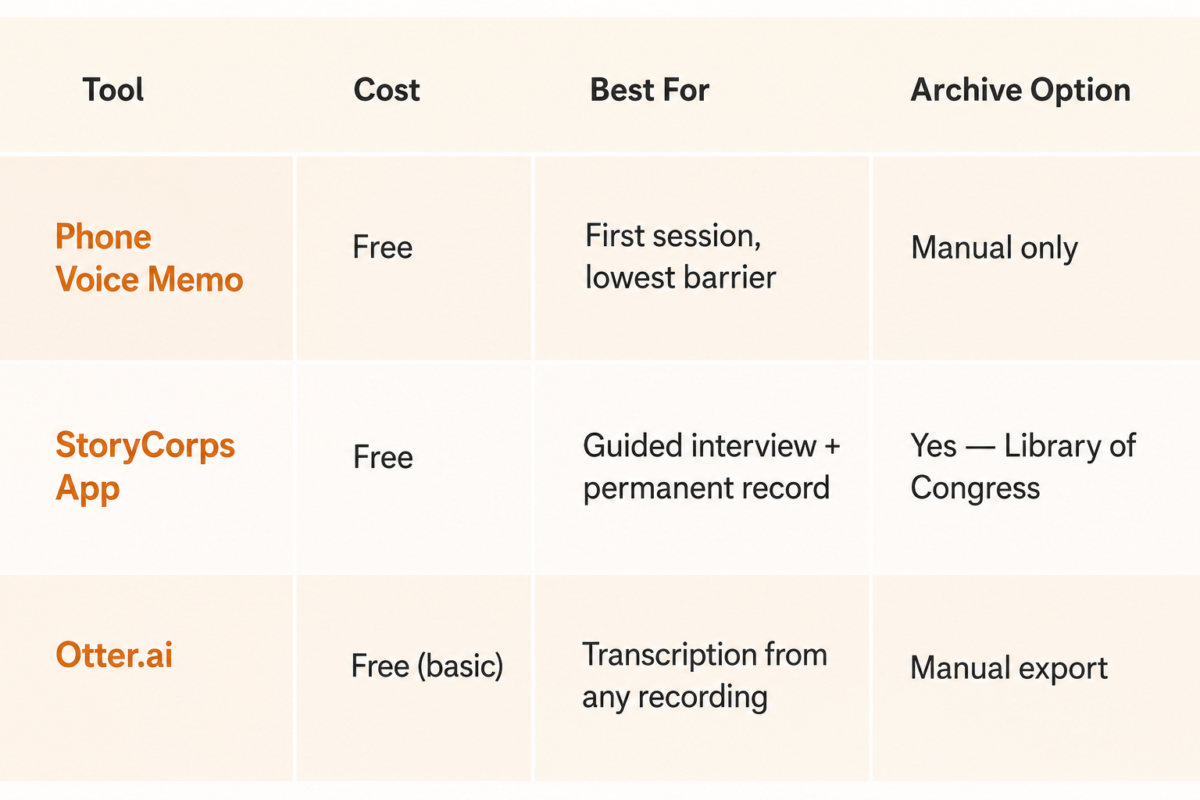
Your phone’s voice memo app is enough for a first session. The audio quality is fine for personal use, transcription, and sharing with family members. If you’ve never done this before and want to lower the stakes as much as possible, a charged phone is all you need to record your parents’ life stories in a form that will actually survive.
Two free tools are worth knowing about. The StoryCorps app walks you through a structured interview and can archive your recording with the Library of Congress at no cost. That’s a real option for families who want something more permanent and shareable. Otter.ai handles free audio transcription: it turns a recorded conversation into searchable, shareable text within a few minutes of uploading.
If you want noticeably better audio without adding real complexity, a small wireless mic makes a genuine difference. We’ve found the DJI Mic Mini to be a clean, simple option: it clips to a shirt and connects directly to your phone. For a broader look at what’s worth owning for projects like this, our guide to minimalist gear for documenting life covers exactly that.
Questions That Actually Get Stories Flowing
Lists of questions rarely work as well as one good opening.
Instead of presenting a question sheet the moment you sit down, start with something concrete: an old photo, a physical object from their past, a specific memory you’ve always been curious about. Or open with a direct, easy question. “What was your first job?” or “How did you and Mom meet?” These aren’t deep or philosophical. They’re specific enough to anchor the conversation somewhere real, and they tend to open doors fast.
From there, let it move. The best questions follow what’s already being said. If they mention a town they lived in as a kid, ask what the house looked like. If they name a person, ask what that person was like. You’re not conducting a formal interview so much as staying curious and keeping the thread alive.
According to caregiving researchers at A Place for Mom, questions that focus on concrete events, the house someone grew up in, their school years, the first job they took, tend to surface much richer detail than abstract questions about values or feelings. The concrete gives people somewhere to stand while they remember.
When the conversation slows or needs a nudge, a good question list makes a real difference. The FREE 25 Questions to Ask Your Parents download is built for exactly this kind of conversation: not a formal questionnaire, just a set of prompts you can keep nearby and reach for when things go quiet. The kind of purposeful reflection those conversations invite often surfaces things neither of you expected to find.
If They Don’t Want to Talk (Yet)
Not every parent is immediately comfortable being recorded. Some feel exposed. Some quietly associate being asked about their past with being old, or sick, or studied. And some just don’t understand why you’re asking now.
Don’t push. And definitely don’t frame this out loud as something you want to do before it’s too late. That framing, however honest it is internally, is the fastest way to make someone close down.
Try a different entry point. Looking through an old photo box together, taking a slow drive to a neighborhood that meant something to them, or asking about a specific object in their house can open things up when a direct sit-down doesn’t. A lot of people are much more likely to talk when their hands are busy and the conversation isn’t the main event.
It’s also fine to record your parents’ life stories in short sessions over months rather than one long interview. A fifteen-minute conversation on a Sunday afternoon is worth more than a formal hour-long session that never happens. The goal isn’t to complete a project. It’s to start one.
What to Do With the Recording Afterward
Getting the recording is only the first step. Doing something useful with it is what makes the effort stick.
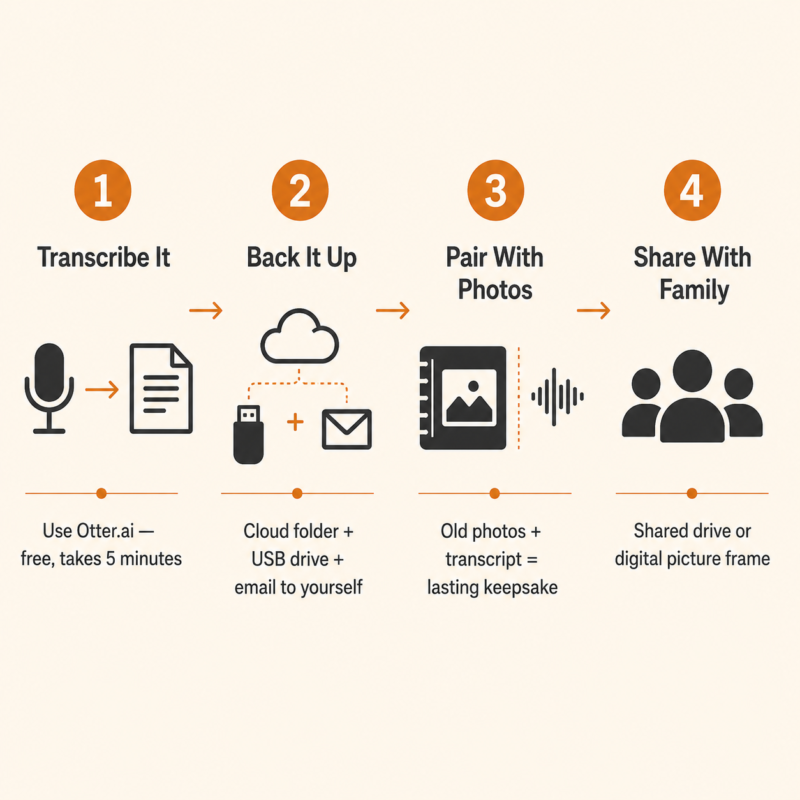
Run it through Otter.ai to get a written transcript. Free, takes a few minutes, and it turns a single audio file on your phone into something searchable and easy to share with the rest of the family via email or a shared folder. Once you have the text, save it in more than one place: a cloud folder, a USB drive at a relative’s house, an email to yourself. Audio files disappear. Redundant copies don’t.
Pair the recording or transcript with old photos and you have the beginning of something the whole family can come back to. A digital picture frame loaded with photos from the era your parent was describing is a simple, lasting way to make the story visible and revisited rather than buried in someone’s downloads folder.
The bar here is low on purpose. The goal isn’t a polished archive. It’s a record that exists, that people can find, and that can grow over the time. One conversation is better than none.
The Bottom Line
Most people who regret not having this conversation didn’t fail because they didn’t care. They failed because they assumed there was more time, and then there wasn’t.
The decision to record your parents’ life stories is not a complicated one. A familiar spot, a charged phone, one easy opening question. What comes out of that conversation often surprises both of you: stories you’ve never heard, connections you didn’t know existed, a voice in a recording you’ll be grateful to have years from now.
If you’re ready to start this weekend, the FREE 25 Questions to Ask Your Parents download is the question list we built for exactly this kind of conversation. Bring it to your next visit as your backup prompt sheet, and let the conversation find its own way.
If you sat down with your mom or dad this weekend, what’s the one question you’d actually want answered?
Frequently Asked Questions
What questions should I ask my parents about their life?
Start with easy, open-ended topics: their childhood home, their first job, how they met your other parent, and the people who shaped who they became. Concrete anchors work better than big philosophical questions. The FREE 25 Questions to Ask Your Parents download gives you a full list to pull from when the conversation needs a nudge.
What’s the best way to record an interview with an aging parent?
Your phone’s voice memo app works fine for a first try. If you want guided prompts, the StoryCorps app walks you through a structured interview and can archive it with the Library of Congress at no cost. Always ask your parent’s permission before you start recording.
How long should a life story interview be?
Aim for about an hour, but don’t force it. The most meaningful stories often surface thirty to forty minutes in, once your parent settles into the conversation and stops narrating. It’s completely fine to stop early and pick it back up on another visit.
What if my parent doesn’t want to be recorded or talk about the past?
Don’t push. Try a quieter, lower-pressure setting, such as folding laundry together or a drive somewhere familiar, and let the conversation start there instead of with a recorder. Some people open up once they realize you’re genuinely curious, not running a project.
How do I turn the recording into something my family can actually keep?
Run the audio through a free transcription tool like Otter.ai to get a written version, then back it up in multiple places. Pairing the transcript with old photos from the same era gives you something concrete to share with family. A digital picture frame is one of the simplest ways to make it visible and revisited rather than forgotten in a folder.