
Table of Contents
Pull up your phone right now and scroll back two weeks in your camera roll. What do you actually see? Probably nothing dramatic. A grocery run. A screenshot from a work call. Your kid’s last soccer game. A late night finishing something for the job that didn’t quite get done during the day. Ordinary days, one after another.
Here’s the question worth sitting with: if this is the living legacy you’re building right now, today, this week, is it the one you’d actually choose?
Most legacy advice skips right past that question. It points you toward someday: write a will, record an interview, leave a letter for your kids to find later. All of that matters. But your living legacy isn’t waiting for someday. It’s being built right now, in the ordinary stuff. How you spend your evenings. Who gets your full attention and who gets the leftovers. What you do with a free hour when nobody’s watching.
The good news is you don’t need a five-year plan or a complete life overhaul to figure out where you stand. You need about ten minutes and an honest look at your last few weeks. That’s the living legacy audit, and it’s exactly what we’re walking through below.
Please note this page may contains affiliate links. If you purchase something through these links, I’ll receive a commission at no extra cost to you. Affiliate links help to support my website/blog and I only recommend products I love.
What a Living Legacy Actually Means (And Why It’s Different From a Will)
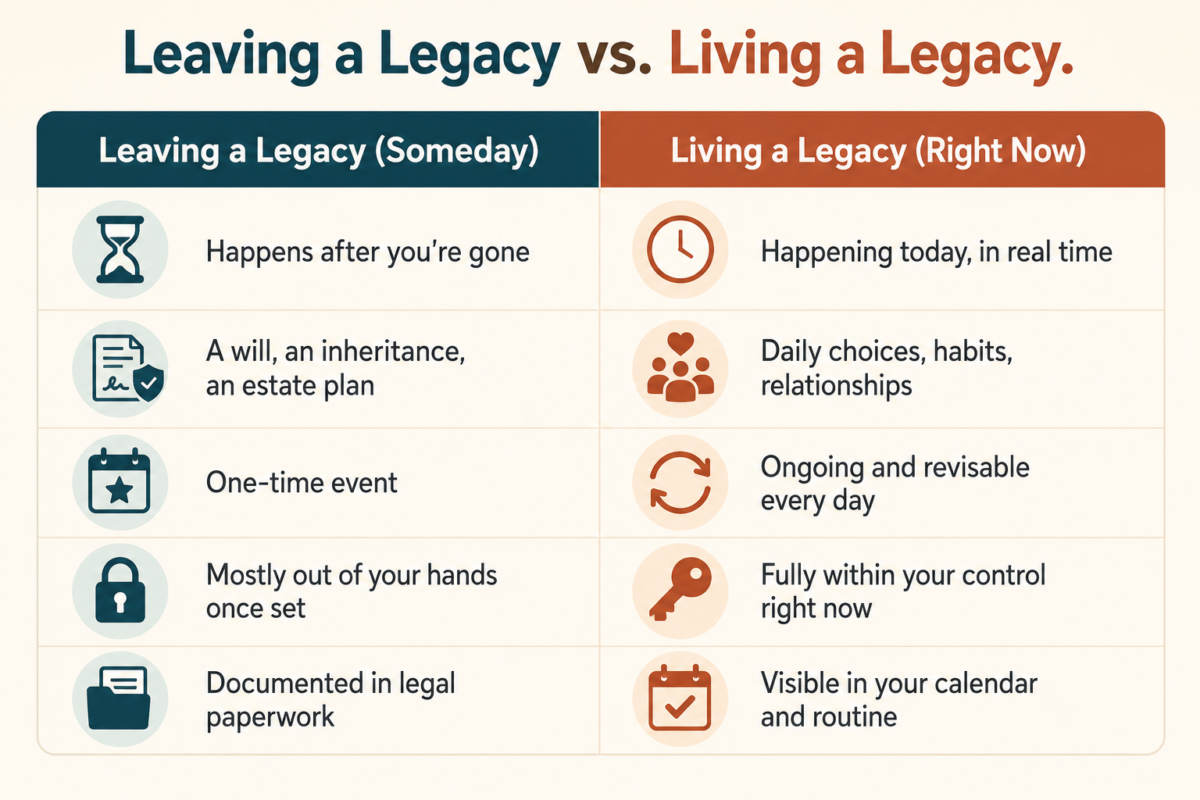
When most people hear the word “legacy,” they picture something that happens after they’re gone. A will. An inheritance. Maybe a charitable fund with a family name on it. That’s a real thing, and it matters. But it’s only half the picture, and it’s the half you have the least control over while you’re alive.
A living legacy is the other half. It’s the impact you’re having on the people around you right now, through your daily choices, your habits, and your relationships, not what gets handed down after you’re gone. Unlike a will, you’re creating a living legacy whether or not you’re paying attention to it. The only question is whether you’re creating it on purpose.
Why this surfaces so strongly in your 40s and 50s isn’t an accident. Psychologist Erik Erikson described a stage of adult development called generativity versus stagnation, where adults in midlife either find ways to contribute to the next generation, through mentoring, creating, or caring for others, or settle into a kind of stuck self-focus. According to Concordia University’s Lifespan Development resource, this stage typically shows up between roughly ages 40 and 65, which is exactly the stretch where a lot of people start asking what their life actually adds up to.
If you’ve read our earlier post on why midlife is the perfect time to think about legacy, you already know we think this stretch of life is the sweet spot for legacy work. This post is the next step: a way to see exactly what legacy you’re already creating, before you decide whether to change anything.
The Living Legacy Audit: A 10-Minute Exercise
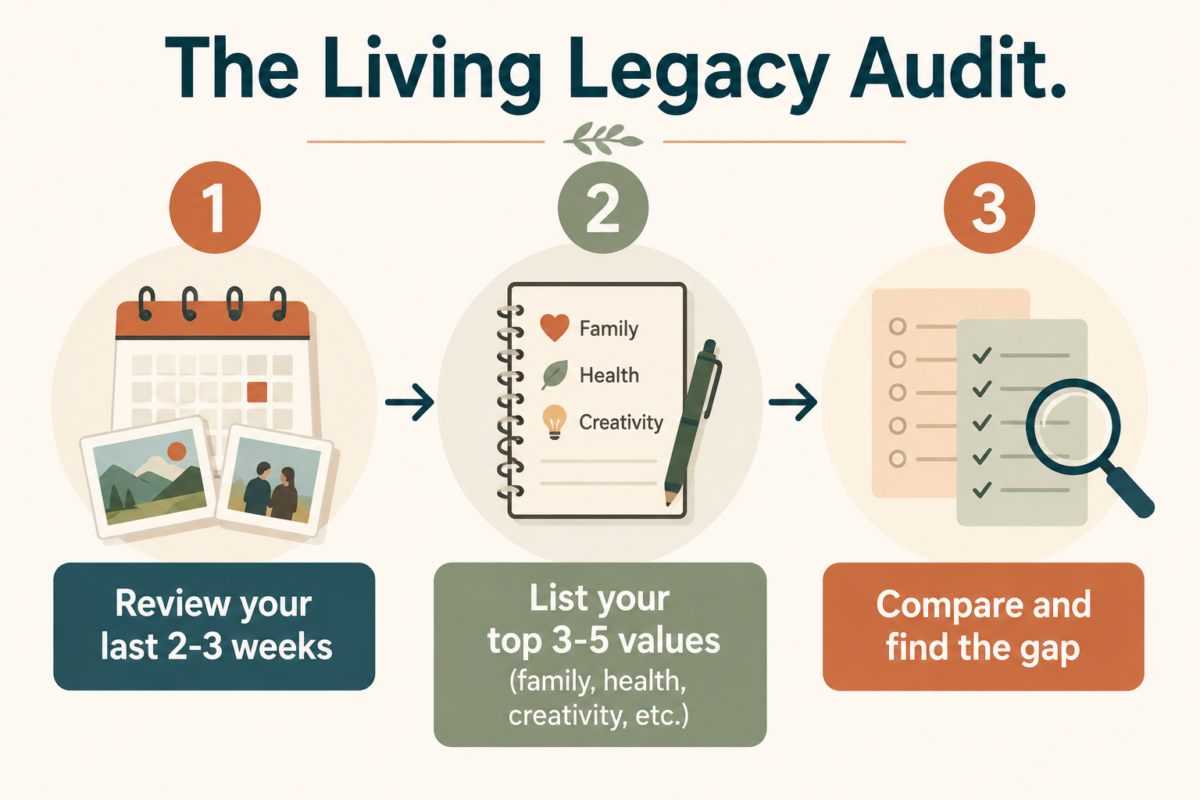
Here’s the audit. Grab your phone, a notebook, or whatever you actually use to track your time, and work through three steps.
Step one: pull up your calendar and photos from the last two or three weeks. Don’t judge it yet. Just look at where your time and attention actually went.
Step two: write down the three to five things you’d say matter most to you. Family. Health. Creative work. Faith. Whatever’s true for you, not what sounds good on paper.
Step three: compare the two lists. Where do they line up? Where’s the gap?
That gap is the whole point of this exercise. Maybe your stated values are family, creativity, and growth, but the last two weeks were dominated by work email, errands, and scrolling before bed. That doesn’t mean you’re failing. It means you’ve found exactly where to start.
If you’ve never sat down and written out what actually matters to you, our post on setting purposeful goals for a fulfilling life is a good place to start before you run this audit. The clearer your list of values, the more useful the comparison.
This kind of audit isn’t a one-time thing. Run it every few months and you’ll start to notice patterns: seasons where you’re closer to the life you want, and seasons where work or stress pulled you further away. Either way, you’ll know. And knowing is the part most people skip.
Why This Hits Different in Midlife
If you’d run this audit at 25, you might have shrugged off the gap. There’s plenty of time, you’d think. At 45 or 55, that math changes.
Research on end-of-life regret backs this up. A systematic review published in Frontiers in Psychology found that long-term regrets cluster heavily around relationships and authenticity, things like not spending enough time with family or not being true to yourself, far more than regrets about specific mistakes or failures. That’s not a guilt trip. It’s useful information. It tells you exactly where to focus if you want to close the gap while you still have decades to work with.
If you’re honest with yourself, midlife is often the first time that gap becomes visible. Your kids are older and need you differently. A parent’s health shifts and you start thinking about your own. A milestone birthday makes the math feel real in a way it didn’t at 30.
Our post on the deeper work of figuring out what you’re here to do goes further into that search, but the audit above is the starting point. It’s hard to figure out what you’re here to do until you know what you’re actually doing right now.
There’s also a practical reason this stage matters. At 25, the gap between your stated values and your actual days is mostly theoretical. By 45 or 55, that gap has compounding effects. Years of saying “family matters most” while working sixty-hour weeks add up to a specific story, whether or not it’s the one you meant to write. Catching it now still leaves time to write a different ending.
Closing the Gap Without Blowing Up Your Life
Here’s where a lot of legacy content goes wrong. It jumps straight from “here’s the gap” to “quit your job and move to a cabin.” That’s not realistic for most people, and it’s not even necessary.
Closing the gap usually doesn’t take one big decision. It takes a handful of small, repeatable shifts. A few examples:
- A recurring weekly call with a parent or sibling, even just fifteen minutes, instead of a once-a-year catch-up.
- Thirty minutes blocked off twice a week for a creative project you keep saying you’ll get to “eventually.”
- Mentoring someone, formally or informally, in something you already know how to do.

None of these require quitting anything. They’re the kind of changes that fit inside a normal week, and over months and years, they’re what actually shift the legacy you’re living.
Pick one. Just one. Trying to overhaul five things at once is how most people give up by week two. A single small shift, repeated for a month, tells you more about what’s possible than a week of trying to do everything differently.
Our post on how people over 40 have reinvented their lives has a few stories worth reading if you want proof that bigger changes are possible too, when you’re ready for them. But you don’t have to start there. You can start with one small shift this week.
Our post on choosing experiences over accumulating more stuff covers a related idea: a lot of what crowds out the things that matter is just stuff, obligations, and commitments said yes to without much thought. Clearing some of that out makes room for the small shifts above.
What This Audit Sets Up (And Why We’re Telling You Now)
Once you know what living legacy you’re already creating, the next natural question is how to make sure none of it gets lost. The conversations, the stories, the reasons behind decisions you made.
We’re not going to oversell that here. It’s a deeper project, and one we’ll come back to. But the audit above is step one for a reason. You can’t record, share, or pass down a legacy you haven’t actually looked at yet.
Think of it this way. The audit shows you what’s true right now. The next step, whenever you’re ready for it, is making sure that truth doesn’t just live in your head and your calendar. Family stories, the reasons behind big decisions, the small habits that meant more than anyone realized at the time. Those things get lost fast once nobody’s around to ask about them. The good news is that none of that has to happen today. Today, the audit is enough.
If you want to go deeper, grab our 30 Living Legacy Questions PDF. It walks through the kind of reflection that turns this audit into something more lasting: the start of the stories and values the people you love will want to have.
Frequently Asked Questions
What is a living legacy?
A living legacy is the impact you have on the people around you while you’re still here, built through your daily choices, habits, and relationships rather than what you leave behind after you’re gone. Unlike a will or estate plan, it’s something you’re creating right now, whether you’re paying attention to it or not.
What’s the difference between living a legacy and leaving a legacy?
Leaving a legacy usually refers to what happens after you’re gone: money, property, a name on something. Living a legacy is what’s happening today, in how you spend your time and treat the people around you. Both matter, but only one is something you can actively shape this week.
How do I know what legacy I’m currently creating?
Run the ten-minute audit above. Look at your calendar and photos from the last two or three weeks, write down what you’d say matters most to you, and compare the two. The gap, or the alignment, between them is your answer.
Is it too late to change the legacy I’m building?
No. The whole point of a living legacy is that it’s ongoing. Unlike a will, which only takes effect once, you get to revise a living legacy every single day. The audit above works just as well at 65 as it does at 45.
What are some examples of a living legacy?
A weekly call with an aging parent. Time set aside for a creative project. Mentoring someone newer in your field. The way you show up for your kids on an ordinary Tuesday. None of these show up in a will, but they’re often what people remember most.
The Bottom Line
Your living legacy isn’t a someday project. It’s being built right now, in the ordinary days that don’t feel like they’re going to matter later. The ten-minute audit above won’t tell you anything you don’t already know on some level. What it does is make it visible, so you can decide on purpose instead of by accident.
If someone looked at your calendar from the last two weeks, what would they say mattered most to you?