

It was day two of a trip I’d been planning for six months. We were in Europe, finally doing the thing we’d talked about for months. And I was asleep by 4pm.
Not tired. Not pushing through jet lag. Flat out. D had to wake me up for dinner and I was barely there for that either. The first two days of that trip were basically a write-off, and I spent them fighting a body that had completely mutinied on me. If you’re in your 40s or 50s and you’ve noticed travel hitting differently than it used to, you know exactly what I’m talking about. These travel tips after 40 are everything I’ve figured out since then, across multiple trips, about what’s actually slowing you down and what to do about it.
Just a quick heads-up: some of the links in this post are affiliate links. As an Amazon Associate I earn from qualifying purchases. This means if you click on a link and buy something, I might receive a small commission at no extra cost to you. I only recommend tools and gear that I’ve actually used in the trenches of travel or that I genuinely believe will help you navigate your own journey. Your support helps keep this site running, and I appreciate it.
Why Travel Hits Harder After 40 (It’s Not Just Age)
The first thing you need to know is that you’re not imagining it. Something actually changes.
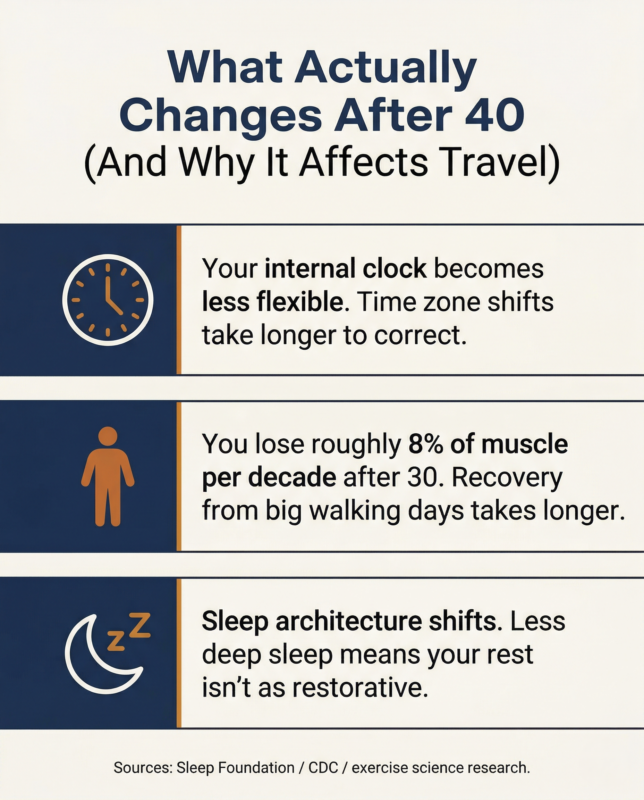
Your circadian rhythm gets less flexible as you age. That internal clock that used to snap back after a red-eye takes longer to recalibrate now. Your muscle recovery slows down. Your sleep architecture shifts, meaning you spend less time in deep sleep, so the rest you’re getting isn’t as restorative.
Combine all of that with the fact that you’re losing roughly 8% of your muscle mass every decade after 30, and your body is working harder to do the same physical things it did at 28.
Here’s the honest picture:
| What Changes After 40 | The Travel Impact |
|---|---|
| Adults 40+ take 5–10 days to recover from long-haul jet lag (Sleep Foundation, 2024) | Under-40s bounce back in 3–5 days. That gap is real. |
| 1 to 1.5 days of recovery needed per time zone crossed (CDC Yellow Book, 2024) | A 6-time-zone Europe trip means potentially a full week to adjust |
| 8% muscle mass lost per decade after 30 (exercise science consensus) | Big walking days have a bigger tax the morning after |
| 29% of adults 50+ cite health as a barrier to travel (AARP, 2025) | Second only to cost. This is a real and recognized challenge. |
| 95% of adults 50+ say travel is good for their mental health (AARP, 2024) | The reason to figure this out is worth it |
None of this means travel gets worse after 40. It means your body has new rules. And once you understand the rules, you can work with them.
Travel Tips After 40: The Jet Lag Fix That Actually Works
The most common advice you’ll find is “adjust to the new time zone when you land.” Push through. Stay awake. Eat at local meal times.
That’s fine. But it starts too late.
What actually moved the needle for me was starting before I got on the plane. About 3 to 5 days before departure, I start shifting my sleep schedule toward the destination time zone. If I’m heading to Europe, that means going to bed an hour earlier each night, getting morning light exposure as soon as I wake up, and cutting off screens and bright light earlier in the evening. I’m not fully adjusted before I leave, but I’m pointing in the right direction.
On the flight itself, I skip the alcohol. I know. But alcohol wrecks your sleep quality even when you do manage to sleep on the plane, and it dehydrates you on top of that. I drink water, try to sleep if it’s a night flight, and take a low-dose melatonin to help nudge my system in the right direction. Nature Made Melatonin makes a clean melatonin I’ve been using for a while. Nothing fancy, just effective.
The math on jet lag is worth understanding. The CDC notes it takes roughly 1 to 1.5 days to adjust for every time zone crossed. A transatlantic Europe trip can mean 5 to 7 time zones. If you wait until you land to start adjusting, you’ve already lost most of your first week fighting a battle that started before you deplaned.
Your Body Needs More Recovery Days. Build Them In.
This one caught me off guard for a long time.
I’d plan a full day of sightseeing in a European city, walk 10 or 12 miles, feel great that evening. Then wake up the next day and feel like I’d been hit by a bus. That tax didn’t exist in my 30s. I could walk all day and wake up ready to do it again. Now? Not always.
The average tourist in a major European city walks somewhere between 8 and 10 miles per day. If you haven’t been walking that at home, your body will let you know by the morning after. And if you stack back-to-back high-mileage days without a break, the cumulative effect compounds fast.
My fix is building reset days into the itinerary intentionally. Every 3 to 4 days, we plan a lighter day. Not a sit-in-the-hotel day, just no major walking tours, no 10-mile sightseeing runs. A slow morning, a long lunch, maybe a museum with a lot of sitting involved. Let the legs catch up before pushing again.
Compression socks have also made a real difference on long travel days and flights. I’ve been using Sockwell for a while now and they keep the swelling and leg fatigue down significantly on long hauls. I was skeptical for years. I’m not skeptical anymore.
If you want to go deeper on the physical foundation side of this, our Beginner’s Guide to Longevity Habits After 40 covers the full picture.
The Pre-Trip Fitness Move Most People Skip
This is the one I almost never see mentioned anywhere. And it might be the most practical thing in this entire post.
If you’re going on a trip where you’re going to walk 8 to 10 miles a day, you need to be walking something close to that before you leave. You can’t go from a desk job and weekend errands to 10 miles a day in Rome and expect your body to handle it without a fight. It won’t.
I start building my walking base about 4 weeks before a big trip. Nothing extreme. A daily walk that I extend over time, working up toward 4 to 5 miles before departure. That’s it. No gym program, no formal training plan. Just consistent movement that prepares my legs and feet for what’s coming.
Footwear matters here too. You need shoes that can actually handle the miles. Something with real arch support and cushion. If you show up to Paris in stylish shoes that feel fine for a few hours, you will regret it by day two. HOKAs have been the answer for me. I wear them on the plane and they’re the first thing I reach for on walking-heavy days.
The rule I tell anyone who’ll listen: if you can’t walk 5 miles comfortably at home, you won’t walk 5 miles comfortably in Rome. So do the prep work at home first.
Buffer Days Are Non-Negotiable After 40
This is the simplest change I made, and it had the biggest single impact on how trips feel.
Arrive one day before your itinerary starts. Fly home one day before you need to be functional.
That’s the whole rule.
The arrival buffer is for your body, not for sightseeing. Sleep in. Eat locally. Walk around the neighborhood. Let your system figure out where it is before you start asking it to perform on a schedule.
The return buffer is for your sanity. Coming back from a 10-day international trip and walking into a full workday the next morning is rough. One extra day changes everything. You unpack, you sleep in your own bed, you decompress, you feel human again before the week starts.
It costs you one extra day on each end. It saves you a full week of functioning at half capacity. The math isn’t complicated.
If you’re rethinking how travel fits into your life overall, this post on why we stopped waiting for retirement to travel might resonate
The Supplement Stack Worth Taking
I’ll keep this practical. Here’s what D and I actually bring and why.
Creatine monohydrate. This one has become a non-negotiable for us. D and I both take it before and during travel, and the reason is straightforward: jet lag is essentially your brain and body trying to function while sleep-deprived. A 2024 study by Roschel et al. found that creatine supplementation significantly improved cognitive performance in sleep-deprived adults. That’s exactly the situation you’re in when you’re crossing 6 time zones. Orgain Creatine Monohydrate is what we use. Clean formula, good absorption. You can also find solid options like Optimum Nutrition or Thorne on Amazon. We’ve written a full post on why we added creatine to our midlife routine if you want the longer version.
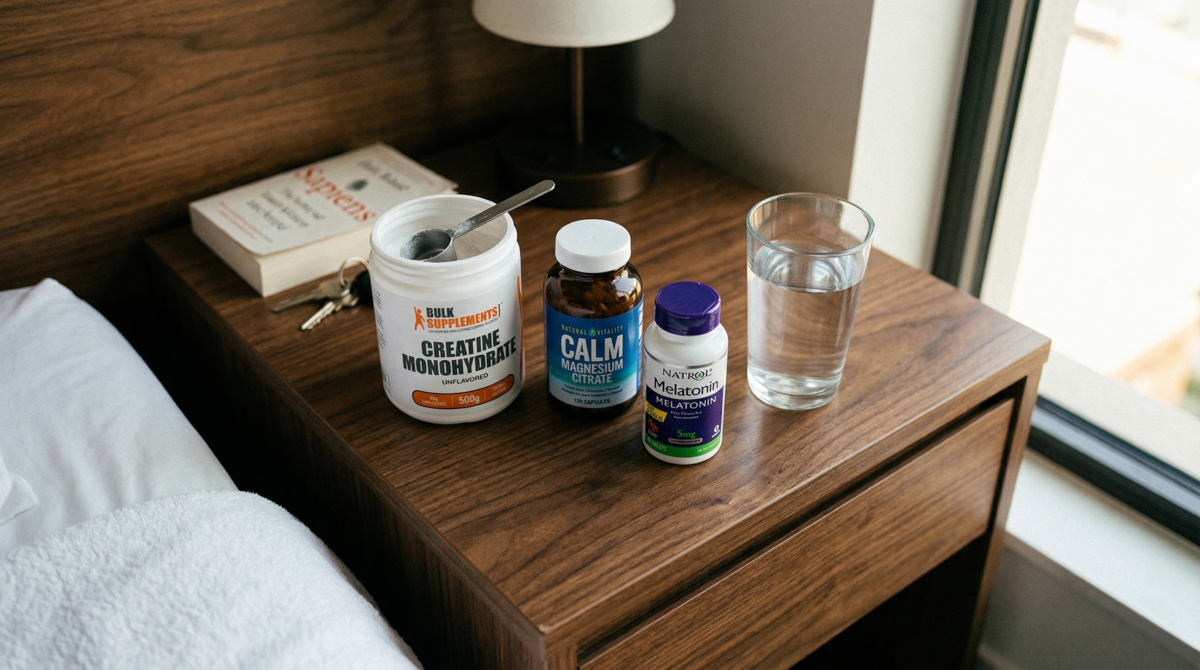
Magnesium and melatonin. Magnesium supports muscle recovery and sleep quality. Melatonin handles the time zone nudge. We use BIOptimizers Magnesium and Nature Made Melatonin and I trust the quality. These two have been in our travel kit for years.
Bottom Line: Travel Better, Not Less
I don’t want to travel less as I get older.
What I want is to stop showing up to trips already behind and spending the first few days fighting my own biology. The adjustments in this post aren’t restrictions. They’re the things that make the trips actually work the way they’re supposed to.
Once you account for jet lag prep, recovery days, fitness before you go, and buffer days on both ends, travel doesn’t get harder. It gets better. You enjoy it more because you showed up ready for it instead of winging it the way you did at 32 when your body could absorb anything.
Before-You-Go Travel Prep Checklist for the 40+ Traveler
4 weeks before departure:
- Start a daily walking routine, building toward 4 to 5 miles per day before you leave
- Make sure your travel shoes are broken in and ready for mileage
3 to 5 days before departure:
- Begin shifting your sleep schedule toward the destination time zone (about 1 hour earlier per night for eastward travel)
- Cut off screens and bright light earlier in the evening
- Start taking creatine monohydrate if it’s part of your travel stack
48 hours before departure:
- Avoid alcohol the day before you fly
- Pack compression socks in your carry-on
- Confirm your travel insurance is active
Day of travel:
- Hydrate aggressively. The cabin air is drying you out the entire flight.
- Skip alcohol on the plane
- Take low-dose melatonin if it’s a night flight
- Wear compression socks for the flight
First day at the destination:
- Get outside and get morning sunlight as early as possible
- Push through to local bedtime. Avoid napping if you can.
- Keep dinner on the lighter side
What’s the biggest thing that’s changed about how you travel now that you’re in your 40s or 50s? Is it jet lag, physical recovery, pacing, or something else entirely? Drop it in the comments. I’m genuinely curious what’s slowing people down out there.