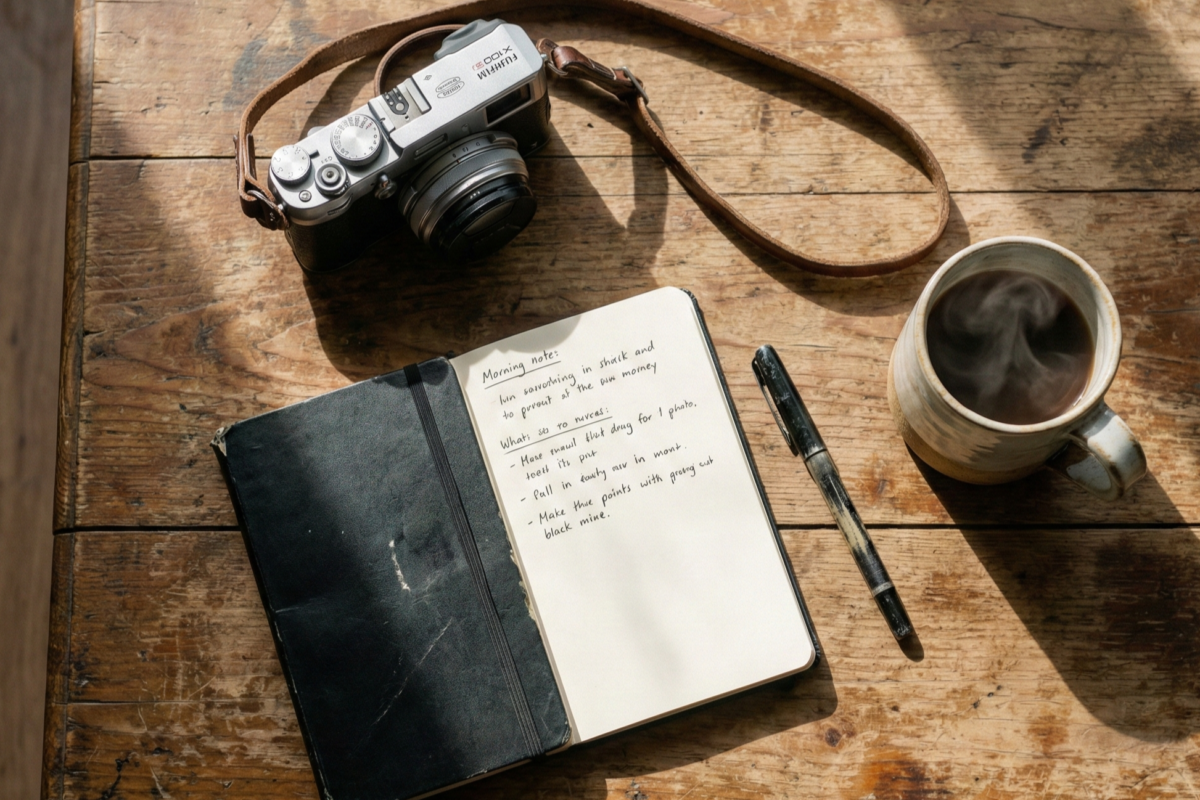
We have a tendency to romanticize the tool more than the work. I call it the “National Geographic Delusion.” You convince yourself that you need a cinema camera, a shotgun microphone, and a Pelican case full of lenses just to capture a weekend trip to the coast. But the reality is much quieter. The heavier your gear, the less you will use it. If you want to capture the texture of your days—the way your kid laughs, the sound of rain on a tin roof, the steam rising off a morning coffee—you don’t need a production crew. You need minimalist gear for documenting life that removes the friction between seeing a moment and keeping it.
The best documentation system is the one that is invisible. It should feel less like “production” and more like breathing. Over the last decade of travel and journaling, I have stripped my kit down to the essentials. This isn’t about having the most expensive specs. It is about having tools that are reliable, tactile, and ready before the moment fades.
Just a quick heads-up: some of the links in this post are affiliate links. As an Amazon Associate I earn from qualifying purchases. This means if you click on a link and buy something, I might receive a small commission at no extra cost to you. I only recommend tools and gear that I’ve actually used in the trenches of travel or that I genuinely believe will help you navigate your own journey. Your support helps keep this site running, and I appreciate it.
The Philosophy: Removing the Barrier to Entry
There is a simple rule I live by: Friction kills consistency.
If you have to unzip a backpack, swap a lens, and check your white balance, you have already lost the candid nature of the moment. You become a director, not a participant. The goal of documenting everyday life isn’t perfection; it is preservation.
We need to build a system that works in two tiers. Tier 1 is what is always in your pocket. Tier 2 is the intentional step-up for when you want to create something richer.
Tier 1: The Essentials (Always On You)
The most powerful archiving tool is the device you are holding right now. But most of us use it passively. To turn a smartphone into a documentation powerhouse, we need the right software.
The “Archive” Apps
You need a central hub. This is where the photos, the stray thoughts, and the locations live.
- For Apple & Android: Day One. This is the gold standard. It pulls in your photos, location data, and even the weather automatically. The beauty of Day One is the “On This Day” feature. It forces you to revisit your memories, creating a feedback loop where you actually enjoy what you documented years ago.
- For Android: Journey. If Day One isn’t your speed, Journey is a fantastic alternative that syncs beautifully across platforms and offers a clean, distraction-free interface.
The “Quick Capture” Audio Apps
Audio is the most underrated trigger for memory. A photo shows you what someone looked like; a recording shows you who they were.
- For Apple: Just Press Record. I love this app for one reason: speed. It has a widget on your lock screen. Tap it once, and you are recording. It also transcribes your audio instantly, meaning you can search for a specific conversation later by text.
- For Android: Google Recorder. If you have a Pixel, this is magic. The real-time transcription is shockingly accurate, and it differentiates between speakers. It turns a chaotic dinner conversation into a readable script.
Tier 2: Minimalist Gear for Documenting Life (Dedicated Tools)
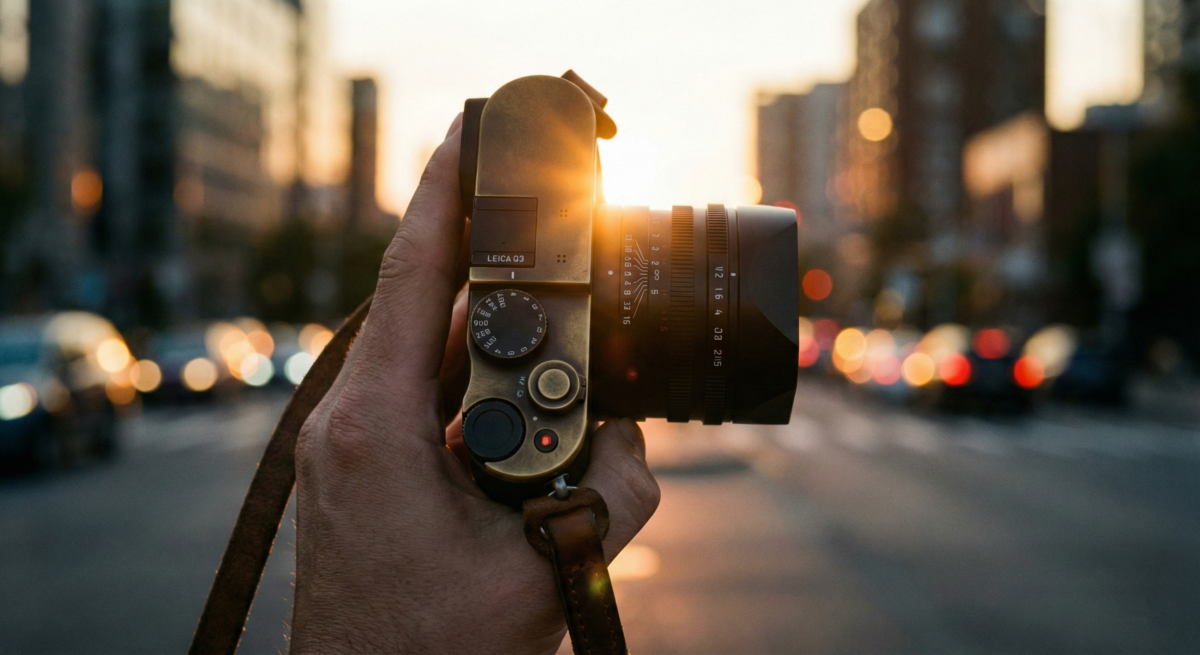
Sometimes, the phone isn’t enough. It has notifications. It has emails. It pulls you out of the moment. Dedicated tools allow you to step into a “creator” mindset without adding bulk.
The “Soul” Cameras
We aren’t looking for massive DSLRs here. We want large sensors in small bodies.
- Fujifilm X100V This is my top pick. It has a fixed lens and physical dials for shutter speed and aperture. It feels mechanical and real. The “Film Simulations” mean the JPEGs look incredible straight out of the camera. You don’t need to edit them. That saves you hours of computer time.
- Ricoh GR IIIx This is the ultimate stealth camera. It is smaller than your phone but houses a massive APS-C sensor. It has a feature called “Snap Focus” that lets you bypass autofocus entirely and shoot instantly. It is the king of street photography and candid family moments.
- DJI OSMO Pocket 3 This small pocket size camera is known for its ease for capturing video, but it is also able to capture great pictures using it’s 1” sensor. It also is easy to capture smooth video due to it’s 3-axle gimbal with the ability to easily switch from recording you talking to camera to forward and what you see.
The Audio Upgrade: DJI Mic System
Bad audio ruins a video faster than bad lighting. But holding a dictaphone in someone’s face feels formal. The modern solution is wireless, wearable microphones.
- DJI Mic 2 This is the pro choice. The standout feature is 32-bit float recording. In plain English, this means it is nearly impossible to distort the audio. Whether you are whispering in a library or shouting at a concert, the audio is usable. It comes with a charging case and connects directly to your phone or camera via a simple adapter.
- DJI Mic Mini If the Mic 2 feels like overkill, the Mini is the size of a coin. You can clip it onto your kid’s collar or hide it on a table centerpiece. It is incredibly unobtrusive.
- The Workflow: I clip one of these on my subject (or myself) and record the ambient sound of a hike or a city walk. Later, I overlay that high-quality audio on top of my video clips. It makes the memory feel three-dimensional.
The Invisible Gear (Storage & Workflow)
You can have the best camera in the world, but if your files are a mess, they might as well not exist. This is the unsexy part of minimalist gear for documenting life, but it is the most critical.
The 3-2-1 Backup Rule
Don’t learn this the hard way.
- 3 copies of your data.
- 2 different media types (e.g., your laptop drive and an external drive).
- 1 copy offsite (Cloud storage).
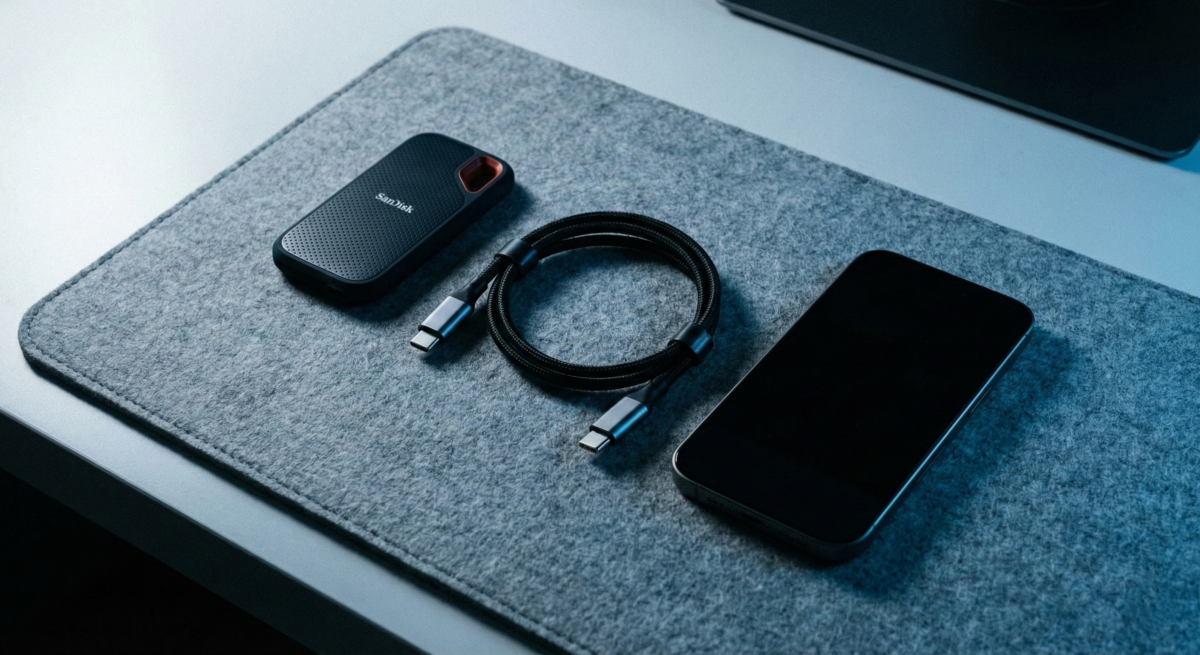
The Hardware: SanDisk Extreme Portable SSD
Stop buying those fragile spinning hard drives. The SanDisk 2TB Extreme Portable SSD is a solid-state drive. It is fast, tiny, and rubberized. You can drop it, spill coffee on it, and toss it in a bag without worry.
The Analog Element
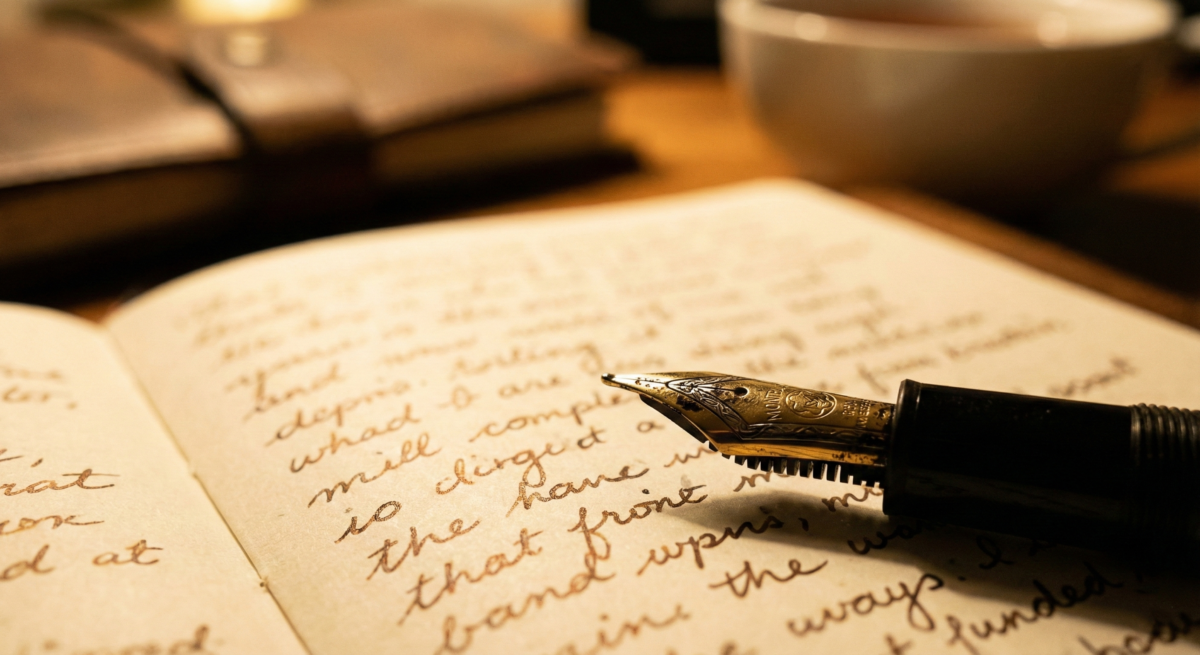
We cannot talk about documentation without mentioning paper. There is a different cognitive process that happens when you write by hand. It slows you down. It forces you to synthesize your thoughts rather than just transcribing them.
- Traveler’s Company Notebook (Passport Size): It fits in a back pocket. The leather ages beautifully, picking up scratches and stains that become part of the story.
- The Pen: A simple Kaweco Sport fountain pen or a Fisher Space Pen. The Fisher writes upside down and in the rain. It’s the “rugged” option for the analog writer.
The Ritual: Schedule A Sync
Gear is useless without a habit.
Get into a regular schedule of a weekly sync where you:
- Import photos from the your camera to your computer
- Pull audio files from the DJI mics.
- Select the best 5 photos of the week and add them to Day One.
That’s it. I don’t edit everything. I don’t make a movie every week. I just curate the highlights. This keeps the backlog manageable and ensures that my “minimalist” gear doesn’t create maximum clutter.