

The decision to live with less can feel clean and exciting until you reach the sell pile. The couch is too big to ship. The good jacket might be worth something. The box of old camera gear has buyers somewhere, but where? If you are trying to sell stuff when downsizing, choosing an app for every object can become a second job.
We know the larger decision. In 2022, we sold our home and moved into a 42-foot fifth-wheel RV. Our published story about that move describes the hard part: deciding what deserved the space. This guide tackles a narrower question, where belongings that are ready to leave can go.
We have not documented using every service below, so the platform comparison rests on their published terms, not a claim that we tested them all.
Start with the item, not the app. Try Facebook Marketplace for bulky furniture and local pickup, eBay for shippable specialty items, Poshmark for clothes worth listing yourself, and ThredUp Clean Out when saving time matters more than controlling the sale. Check current fees, estimate what you would keep, and set a deadline.
Please note this page may contains affiliate links. If you purchase something through these links, I’ll receive a commission at no extra cost to you. Affiliate links help to support my website/blog and I only recommend products I love.
Table of Contents
Sort by Size, Value, and Deadline
Before you make an account anywhere, separate the items into three rough groups. The first is too large or awkward to ship: furniture, exercise equipment, a lawn mower.
The second is small enough to ship and specific enough that someone might search for it: a camera lens, a collectible, a replacement part. The third is clothing and accessories. Each group needs a different route.
That first sort makes it easier to sell stuff when downsizing because you can stop asking one marketplace to solve every problem.
Then ask what the item is likely to return after fees, shipping you pay, packing materials, and the time it takes to photograph it and answer messages. The original price is rarely useful. You cannot get that money back by keeping a chair in the garage for another year.
Your deadline matters as much as the item. Someone moving in six weeks can wait for a niche buyer. Someone handing over keys on Friday cannot. If the item is valuable and you have time, list it carefully. If it is ordinary and the move is close, a quick local sale or donation may be the better outcome.
If you need to sell stuff when downsizing on a short clock, choose a realistic exit date before the first listing goes live.
This is where our four-destination test for minimalism after 50 helps. Choose what to use, pass along, preserve, or release before you debate which app to open. Selling belongs under release, and it does not have to be the route for every item.
Where to Sell Stuff When Downsizing
There is no single winner for a whole house. Choose the route that matches what a buyer would expect to find there and how much work you are willing to do.
The simplest way to sell stuff when downsizing is to send each type of item to the place where its next owner is likely to look.
| Route | Try it for | Your work | Main tradeoff |
|---|---|---|---|
| Facebook Marketplace | Furniture and bulky local items | Photos, messages, pickup plan | Local no-shows and payment safety |
| eBay | Shippable specialty goods | Detailed listing, packing, shipping | Category-based fees and returns |
| Poshmark | Clothes and accessories worth listing | Photos, pricing, shipping | Seller fee on each sale |
| ThredUp Clean Out | Clothing you want to hand off | Sort and send accepted items | Less control over pricing and timing |
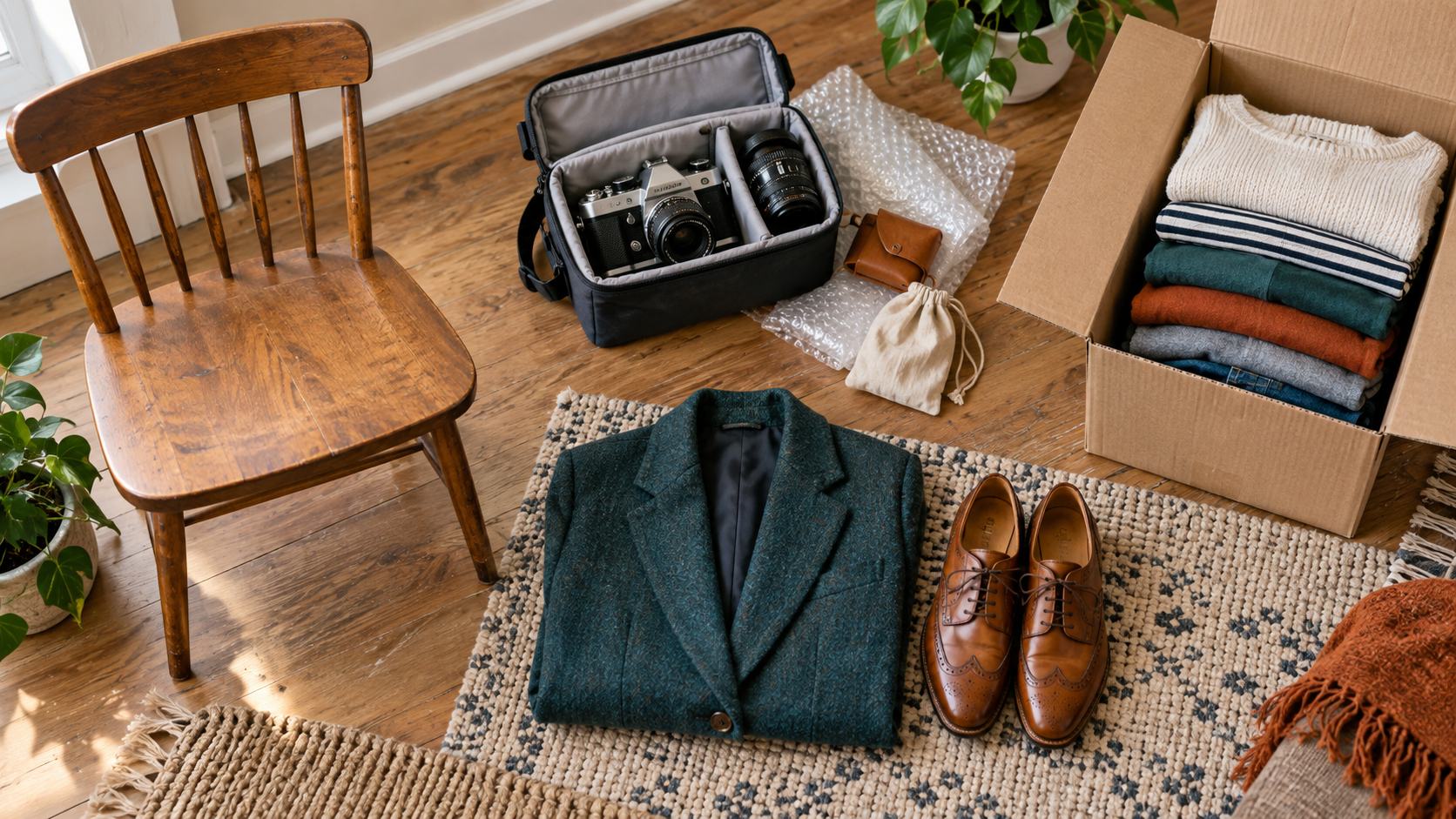
Facebook Marketplace: bulky things a local buyer can collect
A dining table usually makes more sense as a local pickup than as a shipping project. Facebook Marketplace gives nearby buyers a way to find furniture and household items, and you can describe the dimensions, wear, and pickup terms in the listing. That is a fit judgment, not a promise that the item will sell quickly.
When you sell stuff when downsizing, a clear pickup plan can save more time than rewriting a clever listing title.
Take honest photos in daylight. Include a close view of scratches and a tape-measure photo for anything that must fit through a doorway. Say whether the buyer must bring help to load it. A vague listing invites a long exchange of questions you could have answered up front.
The biggest cost here may be your time. Set a first price, a date to reduce it, and a final date to pass the item on. The Federal Trade Commission’s seller-scam guide warns about fake payment notices, overpayment stories, and requests for verification codes. Check a payment inside your own account before handing over an item. Do not share a code that arrives by text.
eBay: specific items worth finding a distant buyer
If the buyer for an old lens or an unusual kitchen tool probably lives outside your ZIP code, eBay is worth considering. It reaches people searching for particular items, but you take on the work of describing condition, packaging the item, and sending it safely.
For small specialty goods, the best way to sell stuff when downsizing may mean accepting a little shipping work to reach the right buyer.
Look up completed sales for the same model and condition before naming a price. A listing price is an ask; a completed sale is evidence of what someone actually paid.
Photograph the serial number when relevant, flaws from more than one angle, and everything included in the box. Those details protect the buyer’s expectations and reduce avoidable back-and-forth.
Read eBay’s current U.S. selling-fee page before you list. Its final value fee changes with the category and total sale amount, and a per-order fee can apply. Optional upgrades and other conditions can add costs. A single percentage quoted in an old blog post will not tell you what your item will net.
Poshmark: clothes you will photograph and ship yourself
Poshmark fits a different pile: clothing, shoes, and accessories that justify a separate listing. You control the photos and asking price, and you handle the listing and shipment. It is easier to evaluate one good jacket than a bag of twenty basic T-shirts.
If clothing is your main chance to sell stuff when downsizing, decide which pieces merit that individual attention.
As of this September 2026 check, Poshmark’s seller guide says it charges $2.95 for sales under $15 and 20% of the sale price for sales of $15 or more. It provides a prepaid shipping label. Check the guide again when you list because fees and shipping terms can change.
Here is a simple test. If a jacket sells for a hypothetical $50 under that published 20% fee, the fee is $10 and the amount before any other seller-paid costs is $40. That is arithmetic, not a forecast of what your jacket will sell for. If photographing, listing, and managing a $50 sale feels worthwhile, Poshmark may fit. If not, the low-effort route deserves a look.
ThredUp: distinguish Clean Out from Direct Listing
ThredUp’s Clean Out service suits someone who would rather send eligible clothes away than manage each listing. ThredUp handles inspection, photos, pricing, and selling. You give up some control, and not every item earns a payout.
Its current Clean Out page describes Standard and Premium services with different terms, processing periods, and consignment windows. Read the current options for your items before you send a bag, especially what happens to things that are not listed or do not sell.
There is a second ThredUp route now. In June 2026, ThredUp announced Direct Listing as an open beta, with the seller making the listing and a different fee model. That does not replace Clean Out. If Direct Listing appears in your account, compare its current terms with Clean Out and Poshmark. Beta features and availability can change.
ThredUp is for apparel, shoes, and accessories, not the dining table. Its main question is whether you want to trade control over price and timing for less listing work. If the answer is yes, check what its current earnings estimate says for the brands you actually own.
For anyone trying to sell stuff when downsizing, that trade can matter more than a headline fee.
Work Out What You Actually Keep
The sale price is not the same as the money that makes it into your pocket. Write a plain equation on a scrap of paper:
To sell stuff when downsizing with a clear head, compare the amount you keep rather than the number printed on the listing.
Money kept = sale price – platform fees – seller-paid shipping – packaging and other direct costs.
Then add one more question: how much work will this take? The $40 in the Poshmark example above is before any optional seller-paid costs and before your time. A $35 local sale might be easier if the buyer collects a bulky item. A specialty item might deserve a wider buyer pool and careful shipping even if the fee is higher.
Do not compare platforms using a tidy table of fixed payouts. eBay fees vary by category and sale total. Poshmark charges differently below and above its $15 threshold. ThredUp Clean Out’s final payout depends on what gets accepted and sold, its service terms, and pricing changes.
Facebook Marketplace arrangements can differ between local pickup and any checkout or shipping option available to you. The fee pages on the day you list are more useful than a stale percentage.
For the house-to-fifth-wheel decision we documented, every item had to justify scarce space. That experience is a useful check here too. You are selling to support a life with fewer things, not building an inventory business by accident.
Want more like this? Join our newsletter and discover more midlife tools and knowledge we’re actually using.
Give the Sell Pile an End Date
A sell pile can live in the corner for months because each item represents a possible few dollars. Give it a calendar instead. The following is a practical example, not a claim about how quickly items sell.
You can sell stuff when downsizing and still decide that some things have reached the end of their selling window.
On day one, choose ten items with a real chance of selling. Photograph and list the best five. Put a small note beside each with its minimum acceptable amount and its final date. During the next week, respond to reasonable questions, adjust a listing with poor photos, and lower a price if your deadline calls for it.
At the end of two weeks, decide again. Some items may need a longer window because they are unusual and valuable. Others can move to a local charity, a family member, or a free group. A missed sale is not the same as a failed downsizing. Your space and time have value too.
If the room itself feels too big to start, our guide to breaking a room into smaller choices with AI can help you make the first sort. Do the choosing yourself; use the tool to make the next step small enough to take.
Protect Yourself and Keep Records
Selling locally means dealing with people you do not know. The FTC describes fake mobile-payment notices, buyers who claim to have overpaid and ask for a refund, and requests for a Google Voice verification code.
Its advice is clear: do not accept a mobile payment from someone you do not know, do not refund a supposed overpayment, and never share a verification code. A public meeting place can be useful for a portable item. For a large piece collected at home, consider having another adult present and agree on pickup details in advance.
Keep a basic record for higher-value items: what you paid if you know it, sale price, platform fees, shipping, and date. According to the IRS guide to Form 1099-K and personal-item sales, a personal item sold for less than you paid generally creates no taxable gain, while a gain can be taxable.
You may still receive a Form 1099-K. The tax treatment depends on the facts of your sale, so use IRS guidance or a tax professional if you are unsure.
That record also tells you whether a platform worked for your household. If three hours of messages produced a small payout, you can choose differently for the next item. If one carefully described collectible sold without drama, you have a useful pattern.
Make Room for What Comes Next
The goal is not to squeeze the last dollar out of every object. It is to make a clear decision about what stays, what sells, and what can move on without you managing it for another season.
When you sell stuff when downsizing, the finish line is a lighter home, not a perfect sales record.
We felt that tension when our home gave way to the fifth-wheel. Some belongings carried real memories, and some simply occupied space we needed for the life we were choosing.
We have written about what minimalism made room for in our own lives. Your version may be a smaller house, a move closer to family, or one garage that finally holds the car.
Start with five items. Pick a route for each. Put a date beside the sell pile. What is one thing in your home that deserves a new owner, but still has not made it out the door?
Frequently Asked Questions
What is the best place to sell furniture when downsizing?
Facebook Marketplace is a sensible first test for furniture you want a local buyer to pick up. Photograph dimensions and wear clearly, use a safe public meeting plan when practical, and set a date to move on if the listing does not sell.
Is Poshmark or ThredUp better for clothes?
Poshmark fits clothing you are willing to photograph, price, list, and ship yourself. ThredUp Clean Out takes more of that work off your hands, but you give up some control over pricing and timing. ThredUp Direct Listing is a separate beta option, so check its current availability and terms.
Does eBay charge a fee when you sell used items?
Usually, yes. eBay’s final value fee depends on the category and total amount of the sale, and a per-order fee can apply. Its current fee page is the place to check before you price an item.
Should I try to sell every item before a move?
No. Estimate what you would keep after fees and shipping, then decide whether that amount is worth the photos, messages, packing, and wait. Give unsold items a deadline and another destination.
Do I owe tax when I sell old personal belongings?
The IRS says personal items sold for less than you paid generally do not create a taxable gain, while a gain can be taxable. A Form 1099-K can still arrive. Keep records of your purchase and sale amounts and use IRS guidance or a tax professional for your situation.