
Table of Contents
You don’t need a ring light. You don’t need a creator personality or a content calendar or a studio corner carved out of the guest room. To make your first short video, you need one small message, a phone, and a commitment to spend maybe 15 minutes actually trying it.
That sounds simple. It isn’t always.
If you’re in your 40s or 50s and you’ve been circling this idea for months, you know the loop: you think about what to say, then you think about how you’ll look, then you remind yourself you’d need to learn an editing app, and somehow an hour passes and you’ve watched 12 tutorial videos about lighting equipment instead of filming anything. Every tutorial assumes you already want to post consistently, build an audience, and optimize for the algorithm. None of them talk to the person who just wants to get the first one done.
This post is for that person. Here’s a phone-only workflow for getting your first short video recorded without overthinking gear, scripts, or how you look on camera.
Please note this page may contains affiliate links. If you purchase something through these links, I’ll receive a commission at no extra cost to you. Affiliate links help to support my website/blog and I only recommend products I love.
How Do You Make Your First Short Video?
To make your first short video, choose one small message, write a 3-line script covering problem, lesson, and next step, record vertically on your phone with natural light, and keep the final clip around 30-60 seconds. Trim only the awkward starts and stops, then publish, save it as practice, or send it privately to someone you trust. The first one is a rep, not a performance.
Why Making Your First Short Video Feels Harder Than It Should
The technology is the least of it. Anyone with a smartphone made in the last five years can record a clear, usable short video. The real barrier is emotional: you’re putting a version of yourself on screen and asking someone to watch it.
That’s a different kind of pressure than writing a blog post or sending an email. Most creator advice is built around people who have already made peace with being on camera, whether through practice or personality. If you’ve never done it before, you’re trying to learn the craft and manage the discomfort at the same time, and that’s a lot to ask of one 30-second clip.
Here’s a reframe worth holding onto: the first video is not a performance test. It’s a practice rep. You’re learning how your voice sounds, how the framing works, and what it feels like to say something out loud on purpose. The goal isn’t to get it right. The goal is to get it done.
If you’ve been thinking about starting a channel or experimenting with short-form content, most of what you’ll read about starting a YouTube channel after 40 focuses on channel strategy, growth, and consistency. All of that matters. Later. The first question is simpler: can you film one 30-second clip and watch it back without hitting delete?
Choose One Small Message Before You Touch the Camera
Here’s where most people go wrong on the first video: they try to say too much.
Short videos are not documentary films. They’re one-point conversations. One thing you learned, one mistake you made, one small observation that stuck with you, one tip that would’ve saved you 20 minutes. If your idea takes more than two sentences to set up, it’s too big for a 30-60 second first attempt. The narrower the point, the easier it is to film without rambling, and the easier it is for someone watching to follow along.
Some prompts that work well for a first idea:
- One thing I learned this week that changed how I approach [topic]
- One mistake I made and what I would do differently next time
- One tip I wish I had known before [starting / doing / going to X]
- One small change that made a real difference for me
Pick one. Don’t combine two. The narrower the point, the more useful the video becomes, and the faster the filming goes.
You can also start with something personal rather than instructional. A short travel memory, a funny thing that went sideways, a moment with a family member. It doesn’t have to be useful to the internet. It just has to be real and specific enough to mean something.
Use This 3-Line Script to Make Your First Short Video
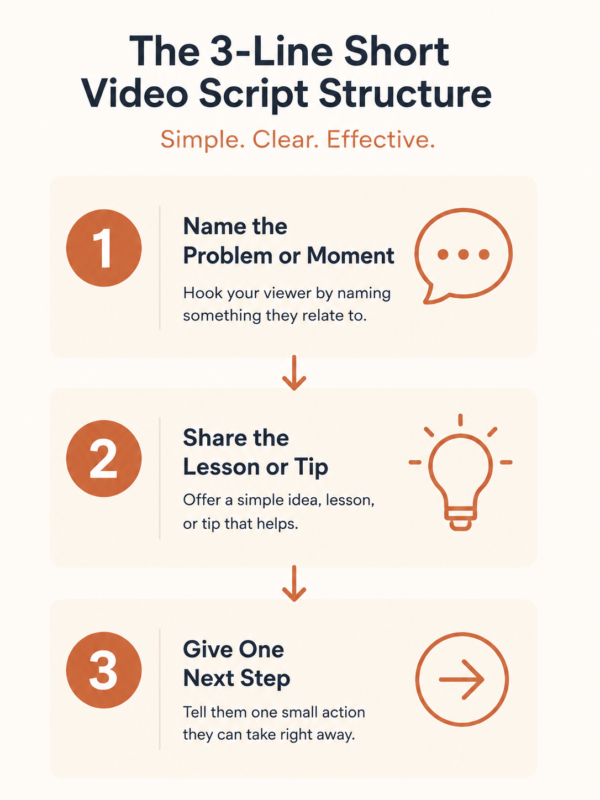
Three lines. That’s the whole structure.
Line 1: Name the moment or problem. Set the scene briefly. “I’ve been filming travel videos for two years and the one thing I still get wrong is audio.” Or: “If you’ve ever stood in front of the camera and gone completely blank, this is for you.”
Line 2: Share the lesson, tip, or observation. This is the center of the video. What do you know now that you didn’t before? What’s the one thing the viewer should walk away with?
Line 3: Give the viewer one next step. Not a sales pitch. Just an action. “Try this at home.” “Ask yourself that question tonight.” “If this helped, save it for later.” Something specific and small.
Write those three lines on a sticky note or a scrap of paper. Film from the note, not from memory. Nobody can tell, and it keeps you from looping back on yourself mid-clip.
Here’s an example using a travel tip:
- Line 1: “Every time I fly, I used to overpack my carry-on and then spend 20 minutes rearranging at the gate.”
- Line 2: “Now I pack the carry-on last, after the checked bag is already done, and I only put in what I’d need if the checked bag got lost.”
- Line 3: “It changed how I pack completely. Try it on your next trip.”
That’s 30-40 seconds of content. Clear, personal, useful, done.
Record It on Your Phone Without Making It a Production
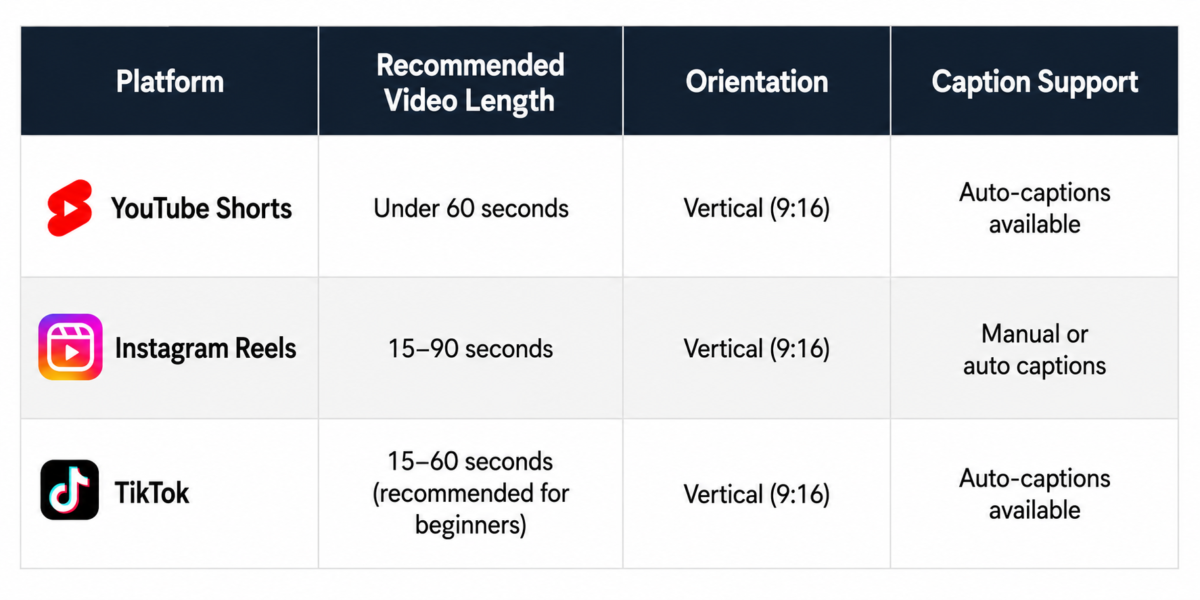
Set the phone to portrait orientation, vertical. That’s the standard for YouTube Shorts, Instagram Reels, and TikTok. Landscape video on a short-form platform gets pillar-boxed and looks dated in a way that vertical framing never does.
Find a window and face it directly so the light falls on your face, not behind you. YouTube’s own Shorts guidance confirms that natural light is enough for published creators, and professional lighting is optional even for regular posting. Don’t worry about exact positioning. If the light is decent and the audio is reasonably clear, the video will work.
Set the phone at eye level or slightly above. Below eye level changes how you come across, and rarely in a flattering direction. A stack of books, a box, or any raised surface works fine as a stand. You don’t need a tripod for the first rep, but when you’re ready to add one, a minimal setup covers months of consistent video without complicating the workflow.
Record two or three practice takes before the final one. Not to get them perfect, just to settle in. The first take is almost always stiff. The second is looser. The third is usually usable.
If you want to add B-roll, footage of something other than yourself talking, keep it simple: your hands, a notebook, a travel photo, a coffee cup, something outdoors. This kind of thinking carries over directly from phone photography: framing, light, and what’s in the background matter more than which phone you’re using. That’s as true for video as it is for still photos.
Edit Only What Helps the Viewer Understand
For the first video, “editing” means trimming. Cut the beginning where you were still settling in. Cut the end where you stopped talking but the camera kept recording. Drag a handle, and you’re done. That’s a clean video.
If your phone has a built-in captions feature, use it. Most do now, and this is not an optional extra for social video. Instagram’s creator guidance makes clear that most Reels are watched without sound, which means a video without captions loses a large share of its audience before the first line finishes. Turn them on, check them for errors, and leave them.
Do not add music, transitions, text animations, or filters on the first try. None of those things will improve a video that doesn’t have a clear message. They will make the editing process dramatically longer and give you more things to second-guess. Keep it clean. A simple clip that says one thing clearly is worth more than ten overproduced clips that say nothing.
Publish, Save, or Send It Privately: All Three Count
Here’s what most creator advice gets wrong about the first video: it positions publishing as the only valid outcome.
It isn’t. Recording the video at all breaks the fear loop. If the clip is decent and you feel okay about it, post it to YouTube Shorts or wherever you’ve been thinking about. If it doesn’t feel ready, save it and watch it back in a day. If you want a reaction from someone you trust, send it privately. All three of those outcomes count as a win for the first video because all three mean you made it.
The goal of the first rep is to learn what it actually feels like, not to grow an audience. You’ll learn more from watching your own 30-second clip once than from reading another article about short-form video strategy. And once you’ve done it once, the second one costs a fraction of the effort.
If you want to keep going after the first one, the gear list is shorter than you’d expect. Take a look at what’s in a minimal kit for documenting your life if you want a starting point that won’t slow you down with decisions. Gear is a later-stage problem, not a barrier to starting.
Whatever you decide to do after the first one, it’s not a commitment to a content career. It’s a single rep. And like most things worth doing in the second half of life, the honest answer to whether it’s too late is almost always no, as long as you actually start. The beginner gear can wait. The first video can’t.
The Bottom Line
Short videos don’t require a creator identity or a camera setup or a strategy session. They require one small idea, a vertical phone, and the willingness to hit record once.
The first one is supposed to be imperfect. That’s not a problem to solve. That’s how this works.
Try it this week. Record one 30-60 second clip using the 3-line script. You don’t have to post it. Just make it, watch it back once, and see what you learn from it.
What’s the first short video idea you’ve been sitting on? Tell us in the comments.
And if you want more like this, practical tools and honest takes for midlife people designing their second act, join our Newsletter.
Frequently Asked Questions
Do I need special gear to make my first short video?
No. A phone, natural light, and a quiet room are enough for the first rep. A tripod and microphone can help later, but they are not required to start. Gear is a later-stage problem, not a reason to delay the first recording session.
How long should my first short video be?
Aim for 30-60 seconds. That’s long enough to share one useful idea and short enough to avoid rambling. Most short-form platforms perform well with videos in that range, though specs vary slightly by platform.
What should I say in my first short video?
Use a simple structure: name the moment or problem, share one lesson or tip, give one next step. Keep the idea small enough that you can say it clearly in two or three sentences without circling back.
What if I feel awkward on camera?
That’s normal, and it mostly goes away with repetition. Treat the first video as practice. Record two warm-up takes, then one final take. You don’t have to post it for it to count as progress.
Should I edit my first short video?
Edit only for clarity. Trim the beginning and end, add captions if possible, and skip effects and transitions that slow you down. The goal for the first one is a clean, watchable clip, not a polished production.