
Table of Contents
Something shifts in your 50s that nobody really prepares you for. Not a crisis exactly, more like a quiet reckoning. The career you built, the goals you chased, the identity you grew into start to feel like they belong to a version of you that you’ve already outgrown. And in the space where all that certainty used to live, a question moves in: what does purpose after 50 actually look like?
It’s not the same question you asked at 25. Back then, purpose meant figuring out what to do with your life. At this point, you’ve already done a lot. The question is less about discovering yourself from scratch and more about being honest about what still fits.
This is a harder question than it looks, partly because so much of the conventional advice on finding purpose was written for people in their 20s and 30s. But the research on midlife meaning is actually pretty encouraging, once you stop looking for the map and start paying attention to what you’ve already got.
So let’s get into it from a realistic angle: not a self-help framework, not a grand declaration, just a practical look at how people in their 50s and 60s are building lives that actually feel like theirs.
Please note this page may contains affiliate links. If you purchase something through these links, I’ll receive a commission at no extra cost to you. Affiliate links help to support my website/blog and I only recommend products I love.
Why the Old Answers Stop Working
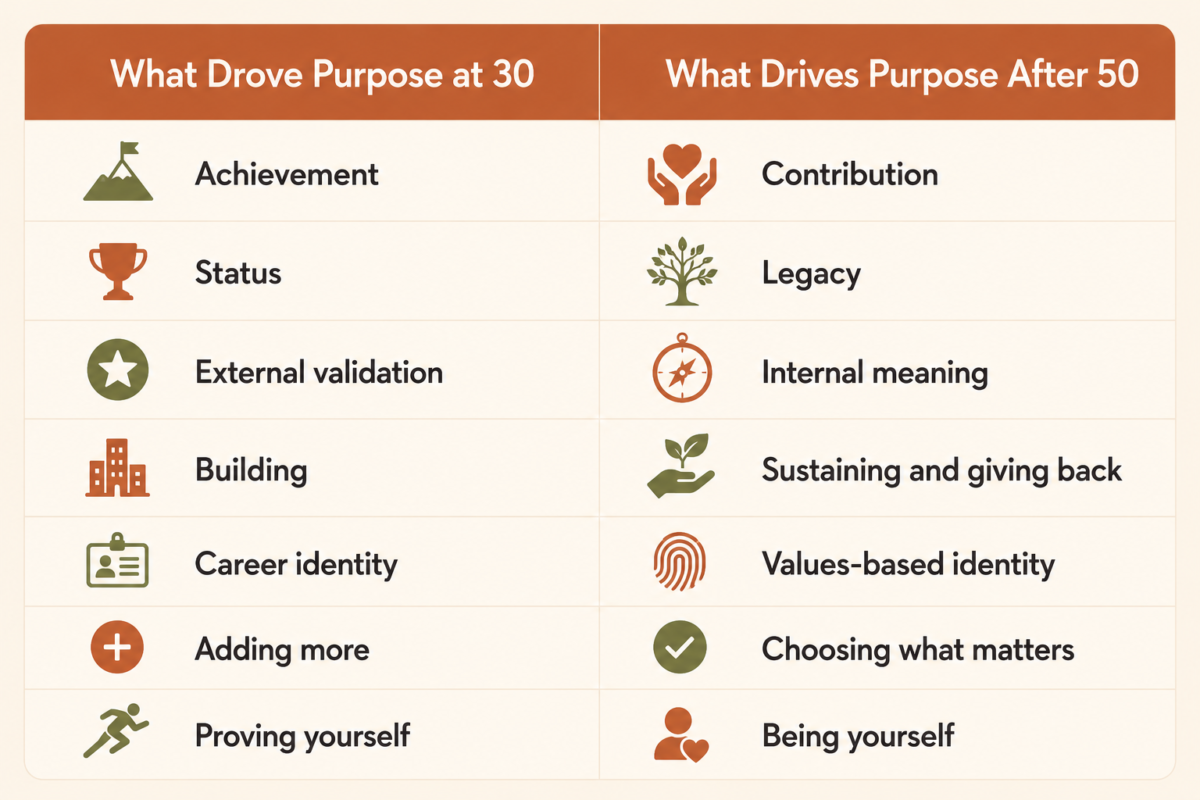
There’s a well-documented pattern where people arrive at midlife having checked off a remarkable number of boxes and still feel a low-level restlessness they can’t quite name. Psychologist Erik Erikson described this as the “generativity vs. stagnation” tension: the sense that the next chapter should be about contributing something beyond your own advancement. When you’re 28, the primary motivator is building. By 50, something deeper tends to take over.
The problem isn’t that you’ve run out of drive. It’s that the original framework for that drive, centered on status, achievement, and external validation, often starts to feel hollow in ways it didn’t before. A 2025 piece in The Guardian noted that midlife is the point where the gap between the life you’re living and the life you actually want tends to become undeniable.
That’s not a crisis. It’s useful information.
What Purpose Actually Looks Like After 50
Here’s a working definition worth keeping: purpose is the feeling that what you’re doing matters, to someone, in some way that you care about.
That definition is deliberately broad. Because for some people at 50, purpose is a second career. For others it’s a deeper commitment to family. For others still, it’s making art, building a community, spending more time outdoors, or finally saying yes to the things they’d spent decades saying “someday” to.
What the research consistently shows is that purpose after 50 is less about a grand declaration and more about the daily experience of feeling connected to something worth doing. Kiplinger reported in 2024 that people who score high on purpose measures in their 50s and 60s tend to have lower rates of cognitive decline and better physical health outcomes over time. Purpose isn’t just a feel-good concept. It has measurable effects on how long and how well people live.
If you want to discover your life’s purpose at this stage, the most useful starting point usually isn’t a personality test or a coaching framework. It’s a more honest conversation with yourself about what you’ve been avoiding and what keeps pulling at you.
The Three Threads Worth Following
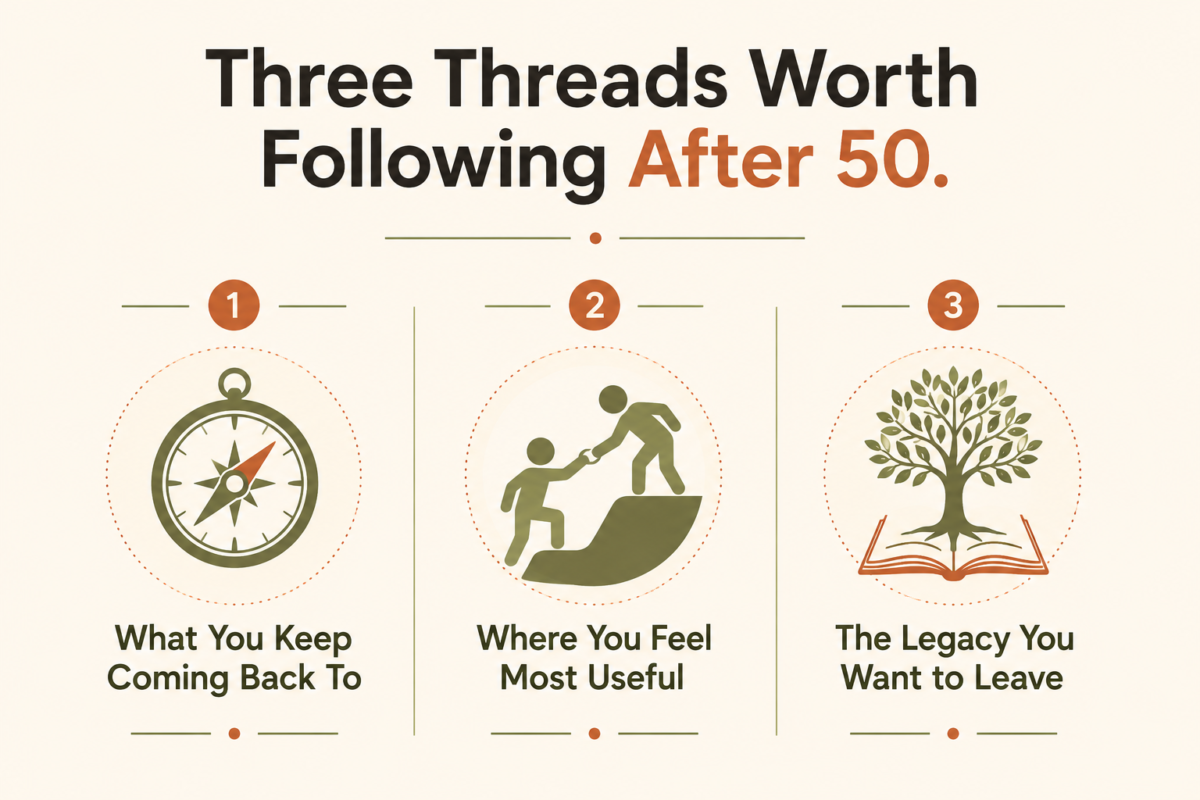
Most people in their 50s who feel stuck on purpose are actually circling around a few recurring themes. Think of these as threads, not answers. Just starting points worth pulling on.
The thing you keep coming back to
Not what you’re good at, and not what pays well, but what you find yourself thinking about in the margins of your day. The hobby you’ve kept up for 20 years. The cause you can’t stop reading about. The skill you’ve been quietly building without any particular agenda.
Pay attention to what’s been persistent. Persistence over time usually means something.
The place where you feel most useful
This one shifts with age. Where you once wanted to be at the center of the action, you might now get more out of supporting someone else’s growth or contributing to something that will outlast you. A 2025 piece in The Guardian found that volunteering rates among adults over 50 correlate strongly with reported sense of meaning, and that the relationship isn’t just statistical. People consistently describe it as a key turning point.
The version of your life you want to leave behind
This requires some honesty about what you’d regret not doing. Not in a morbid way. In a clarifying way. When you think about your living legacy and what it looks like right now, what shows up?
How to Test Your Direction (Without Blowing Up Your Life)
One of the most consistent mistakes people make when trying to find purpose after 50 is going too big too fast. They quit their job, commit to a major life change, or declare a new identity before they’ve tested whether it actually fits. That’s not necessary, and it’s usually counterproductive.
The better approach is closer to what a researcher does: run small experiments and pay close attention to what you learn.
This means volunteering before committing to a second career in nonprofits. It means taking a weekend workshop before enrolling in a degree program. It means having honest conversations with people already doing what you’re drawn to, so you get a real picture instead of an idealized one.
For the practical side, setting purposeful goals in small, testable increments beats writing a five-year plan. The goal isn’t to get it right on the first try. It’s to generate enough real information about yourself to make better decisions.
And if you’re wondering whether it’s too late to start over entirely, the honest answer is: usually not. And sometimes the second act is better precisely because you’ve already cleared the learning curve.
Legacy and Meaning Without the Pressure
There’s a version of the “purpose” conversation that feels like a lot of pressure. Like you’re supposed to have a mission statement, a TED Talk someday, a clearly defined calling. That version isn’t very useful.
A more realistic framing: legacy is built in ordinary moments, and meaning is less about what you do than about whether you’re present for it.
The San Francisco Chronicle ran a piece in 2023 on midlife reinvention that noted the people reporting the highest levels of fulfillment at 60 weren’t necessarily the ones who had made the biggest external changes. Many had made smaller but more intentional ones. The common factor was deliberateness, not scale.
The habits and energy required to show up for what matters are also worth protecting. If your health and energy aren’t where you want them, that’s worth addressing in parallel with the purpose question, not after it. There’s a reason the research on longevity habits after 40 overlaps so consistently with research on mental wellbeing: the body and your sense of purpose are not separate systems.
A Realistic Path to Purpose After 50
Purpose after 50 rarely arrives as a revelation. More often it shows up as a gradual clarity: a slowly accumulating sense that some things matter more than others and that you’d rather spend your time on the ones that do.
If you’re looking for a concrete place to start, here’s a version that actually works:
- Write down three things you’ve been putting off that still pull at you. Don’t filter for practicality on the first pass.
- Pick one and spend 90 days giving it real attention. Not just thinking about it, but doing something toward it.
- At the end of those 90 days, notice what you learned. Not whether you “succeeded,” but whether the activity generated more energy than it cost.
That’s a test worth running. The results will tell you more about your actual direction than any framework will.
A 2026 piece in The Guardian cited a midlife researcher who noted that adults in their 50s who are actively engaged in purpose-finding, even at an exploratory stage, report significantly higher life satisfaction than those who have either given up or are waiting for clarity to arrive on its own.
Clarity tends to come from doing, not from waiting.
Final Thoughts
Here’s the thing about purpose after 50: you don’t have to arrive at a definitive answer to start living better.
The people who seem to navigate this chapter best aren’t the ones who found a perfect mission statement. They’re the ones who stayed curious, kept experimenting, and didn’t confuse confusion with failure. You have more to work with now than you did at 30: more clarity, more self-knowledge, more freedom from the expectations that used to run the show.
That’s worth something.
What’s one thing you’ve been putting off that keeps coming back to you? Share it in the comments below.
If you want to keep exploring, sign up for our newsletter. We write about midlife freedom, intentional living, and the practical side of designing the second act for people who are ready to stop waiting and start building.
Frequently Asked Questions
How do you find purpose after 50?
Finding purpose after 50 starts with paying attention to what’s already pulling at you rather than starting from scratch. Look for recurring themes in your interests, the places where you feel most useful, and the things you’d regret not doing. Small experiments work better than big overhauls. Test ideas before committing to them, and measure by energy generated rather than immediate success.
Is it too late to find your purpose at 50?
No. The 50s and 60s are often when people have the most clarity about what actually matters. You’ve had enough experience to know what doesn’t fit, and enough life ahead to build something that does. The research on purpose and aging consistently shows that adults who pursue meaning in midlife tend to have better health and cognitive outcomes over time.
What are signs you’ve lost your sense of purpose?
Common signs include persistent low-level restlessness even when nothing is obviously wrong, a growing sense that your daily activities feel obligatory rather than meaningful, difficulty getting motivated for things that used to engage you, and a nagging feeling that you’re going through the motions. These aren’t pathological signs. They’re usually a signal worth paying attention to.
Can volunteering help with purpose after 50?
Yes. Adults over 50 who volunteer regularly report higher levels of purpose and life satisfaction than those who don’t. The most effective volunteering isn’t just showing up: it’s finding roles where your specific experience and skills genuinely contribute to something you care about. The contribution has to feel real to generate meaning.
How is purpose after 50 different from purpose at 30?
At 30, purpose is often about building: career, identity, family, financial stability. At 50, the building phase is largely complete, and the question shifts to legacy, contribution, and what you want the next few decades to actually feel like. It’s less about what you can achieve and more about what you want to matter.