
Table of Contents
At some point in your 40s or 50s, a question shows up that you didn’t go looking for. It might hit during a parent’s hospital stay, a milestone birthday, or a quiet Tuesday when the kids are grown and the house feels different than it used to. The question is some version of: what am I actually leaving behind?
If you’re starting to think about legacy in midlife, you’re not having a midlife crisis. You’re having a midlife moment of clarity, and it’s one of the most useful things that can happen to you between the ages of 40 and 65.
Most legacy advice either skips straight to estate planning (wills, trusts, who gets the lake house) or goes so vague it’s useless, the kind of “just be a good person and it’ll all work out” line that doesn’t tell you what to do on a Tuesday afternoon. Neither one is much help.
This post will walk through what legacy actually means once you take the word back from the financial planners, why your 40s through 60s are the right window to start, and one specific thing you can do today that takes less than an hour.
Please note this page may contains affiliate links. If you purchase something through these links, I’ll receive a commission at no extra cost to you. Affiliate links help to support my website/blog and I only recommend products I love.
What Legacy Really Means (And What It Doesn’t)
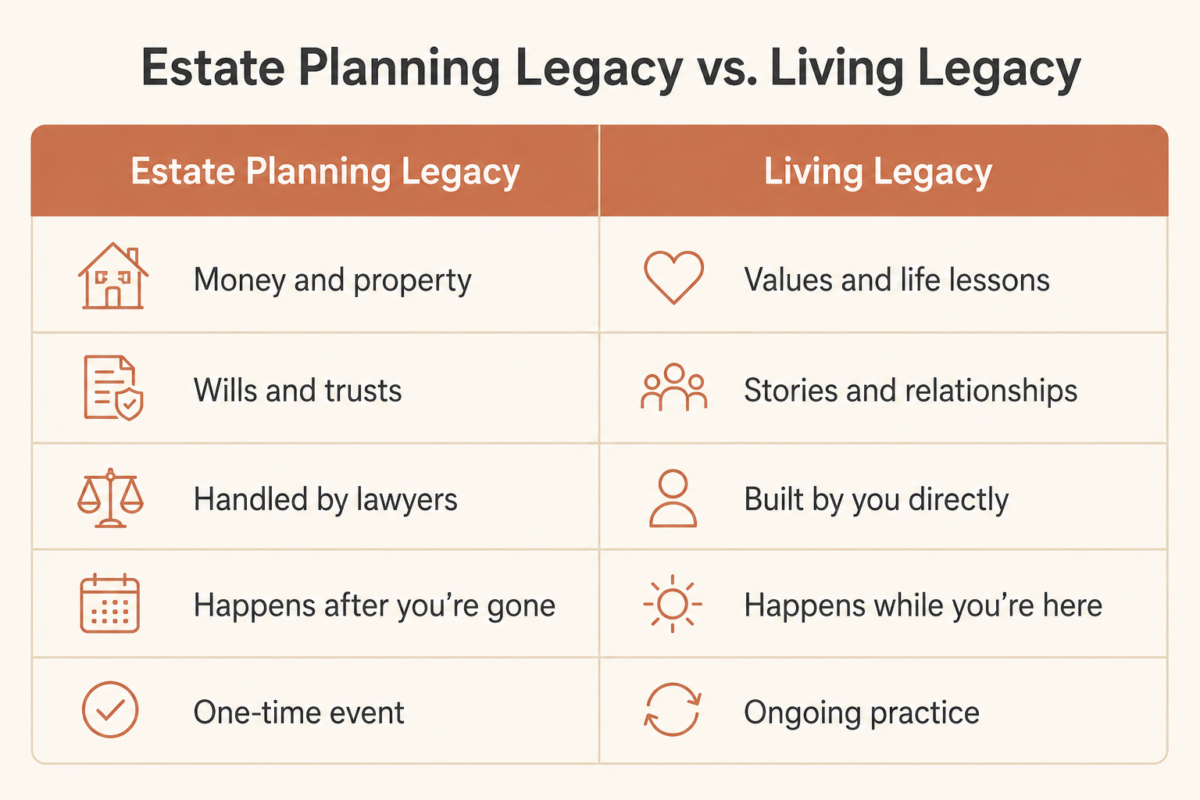
Ask most people what “legacy” means and you’ll get one of two answers. Either it’s a financial term (your will, your life insurance, who inherits the house) or it’s so abstract it could mean almost anything, “the impact you have on the world.” Both answers are technically true. Neither one is useful enough to act on.
Here’s the more useful version: your legacy is the sum of what you pass on while you’re still around to shape it. That includes your money, sure. But it also includes what you taught your kids without meaning to, how you handled your worst year, the stories only you can tell, and the small habits and traditions that quietly outlast you.
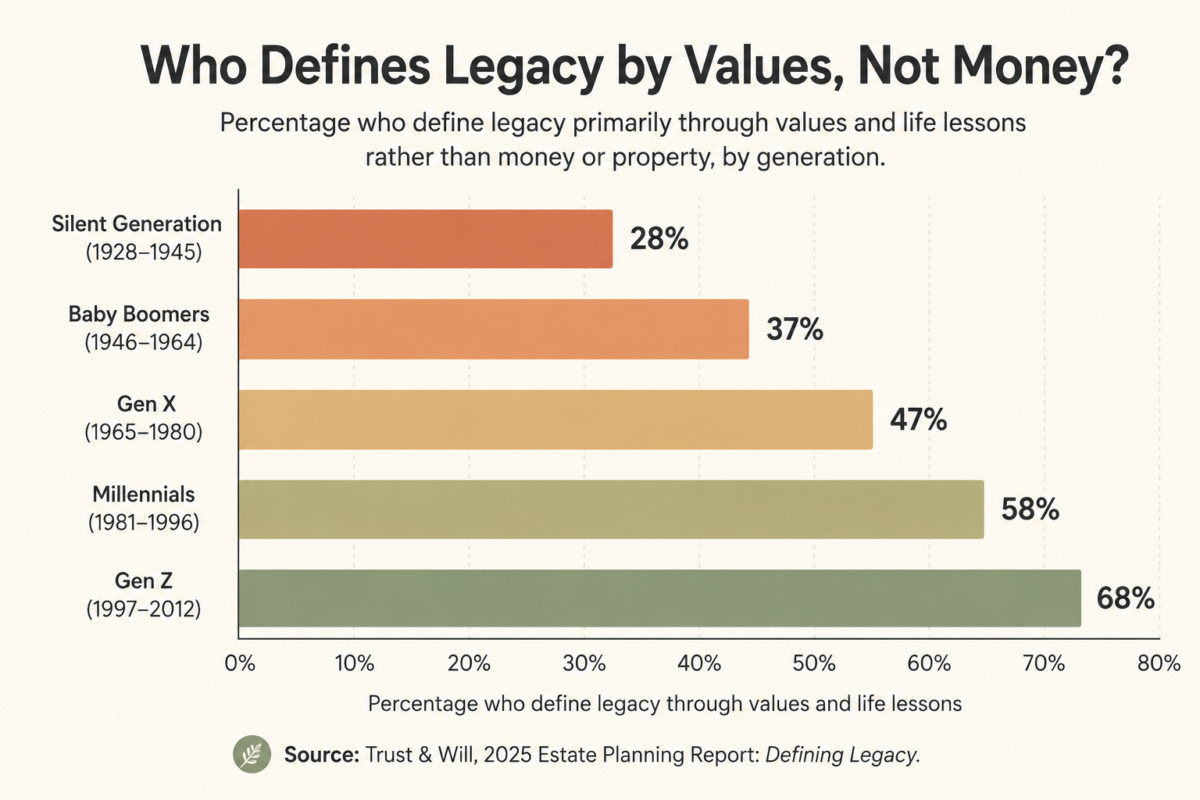
A 2025 report from Trust & Will found that 19% of adults now name values and life lessons, not money or property, as the most meaningful legacy they can leave (Trust & Will, 2025 Estate Planning Report: Defining Legacy). That number is even higher among younger adults, which says something important: the definition of legacy is shifting away from a document and toward a daily practice.
This matters if you’ve been putting off purpose work in midlife because it felt like a “someday” project. Legacy is the same kind of work. It isn’t a folder of paperwork your kids find after you’re gone. It’s something you build while you’re still around to enjoy watching it take shape.
Why Midlife Is the Sweet Spot for Thinking About Legacy
Midlife is the natural window for legacy work because you have enough lived experience to know what matters and enough time ahead to act on it. Psychologist Erik Erikson named this life stage one of generativity, the drive to leave a mark. Starting now lets your values, stories, and relationships compound for the people who matter most.
There’s a reason this question tends to show up in your 40s and not your 20s. Erikson described a stage of adult development he called generativity versus stagnation, and it usually lands somewhere between 40 and 65. Generativity is the pull to create or care for something that outlasts you: raising kids, mentoring someone at work, building something useful, or simply telling your story so it doesn’t disappear (Wikipedia, “Generativity”). The alternative, stagnation, is coasting through the years without that sense of contribution.
Midlife is also a strange kind of sweet spot. A 25-year-old usually hasn’t lived enough yet to know what actually mattered. An 80-year-old often wishes they’d started this work decades earlier. Somewhere in the middle, you’ve got three things working in your favor at once: enough lived experience to know what you value, enough time horizon left to do something about it, and, on most days, enough energy to follow through.
Research on regret backs up the “start now” part too. Psychologists Neal Roese and Amy Summerville studied what people regret most over a lifetime, and the pattern holds up again and again: people regret what they didn’t do far more than what they did, and that gap grows the longer they wait (Roese and Summerville, Personality and Social Psychology Bulletin, 2005). Inaction ages worse than almost any mistake.
If you’re in the middle of the kind of reinvention a lot of midlife adults go through, legacy thinking fits right alongside it. You’re already asking what the next chapter looks like. This is just one more piece of that same question, and arguably the part that matters most to the people you’ll leave it with.
The Five Forms of a Living Legacy
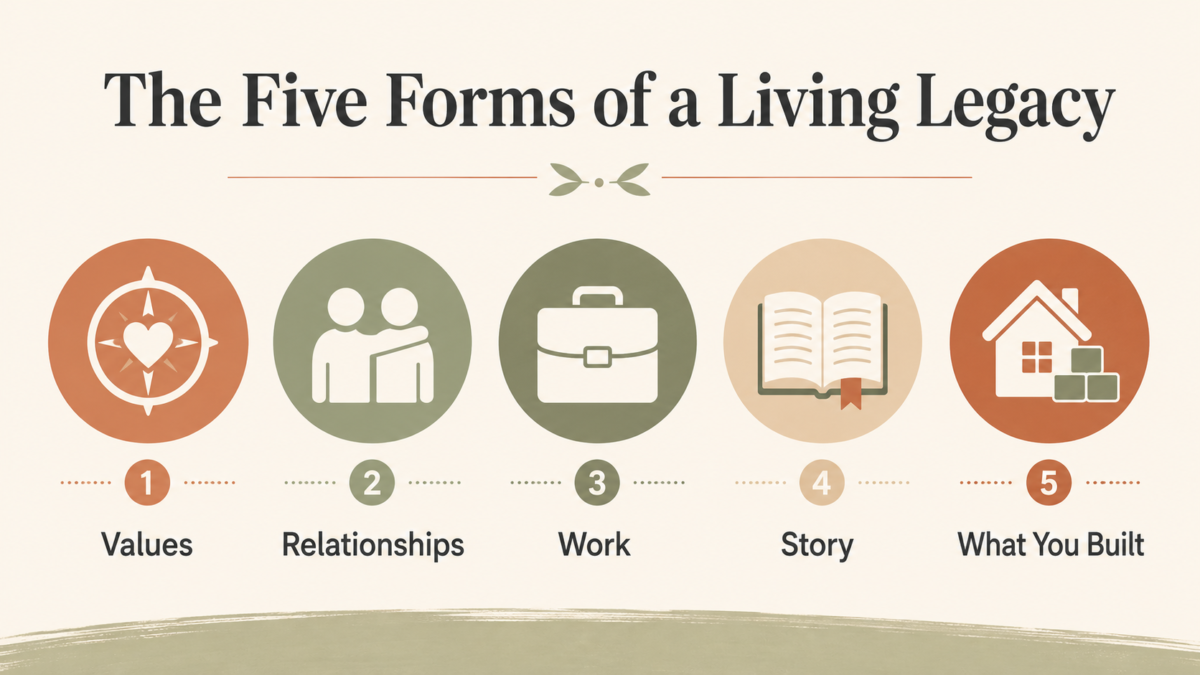
When people hear “legacy,” they usually picture one thing: money. But a living legacy, the kind you build and shape while you’re still here, breaks down into five distinct forms. None of them require a net worth. All of them require a little intention.
Values
Your kids, your team at work, the people closest to you: they already know what you stand for, whether or not you’ve ever said it out loud. They’ve picked it up from how you handle money, how you act when you’re stressed, and what you apologize for versus what you let slide.
If you want to start here, write down the three values you most want to be known for. Then ask your spouse or your oldest kid what three values they’d actually pick for you. The gap between those two lists, if there is one, tells you exactly where to focus.
Relationships
A living legacy includes the people who shaped you and the people you’ve shaped in return. Most of us carry a mental list of people we owe a real thank-you to and never get around to it.
Pick one person from that list and tell them, specifically, what they did and why it mattered. Not a generic “thanks for everything.” The actual moment. People remember specifics for the rest of their lives.
Work
Whatever you do for a living, or used to do, it made something better, easier, or possible for someone else. That’s worth writing down before it fades into “just a job” in your own memory.
Write one paragraph describing the thing your work made better, even if it feels small. Future you, and possibly your kids, will be glad you did.
Story
This is the form most people skip entirely, and it’s the one small artifacts that turn into living legacy can help with. Photos, recordings, and old trip journals all carry pieces of your story, but most of them sit untouched in a drawer or a cloud folder nobody opens.
Record five minutes of audio on your phone answering one question: what’s a moment from your life that nobody else was there for? That single recording is more valuable to your family than almost anything you could buy them.
What You Built
This is the practical layer: habits, traditions, the Sunday dinner routine, the way your family handles a crisis, the systems you set up that quietly keep things running. These things feel permanent while you’re alive and vanish fast once you’re not around to maintain them.
Pick one tradition your family has and write down where it came from and why you started it. Future generations keep traditions a lot more reliably when they know the story behind them.
Common Objections (And Why They Don’t Hold)
“I haven’t accomplished anything legacy-worthy.”
This objection only makes sense if legacy means money, fame, or a building with your name on it. Once you shift to the values-and-relationships definition, the bar drops to something every adult has already cleared. You’ve raised a kid, kept a friendship for twenty years, or learned something the hard way that someone younger could use. That’s the material. The Trust & Will data backs this up: nearly one in five adults already define legacy this way, and the share is growing fastest among younger generations, which means the standard is moving toward you, not away from you.
“Legacy is for retirees.”
This one gets the timing backwards. Erikson’s generativity research places the drive to build something lasting squarely in midlife, not retirement. Waiting until retirement to start often means waiting until your parents are gone, your kids are grown and less interested in your stories, and your own memory of the early details has started to fade. The window doesn’t open at 65. It’s already open.
“I don’t have time.”
This is the big one, and it’s also the one the regret research speaks to most directly. The things people wish they’d done are rarely big. They’re the five-minute recording that never got made, the conversation that kept getting postponed, the tradition nobody wrote down. None of the five forms above require a free weekend. They require about an hour, total, spread across a week.
If you’re already designing the next twenty years on purpose instead of drifting into them, this fits the same mindset. You’re not adding a new project to your plate. You’re making sure the life you’re already building gets remembered the way you actually lived it.
One Thing to Do This Week
You don’t need to tackle all five forms of a living legacy this week, or even this month. Pick one. Just one.
If you’re not sure which, start with Story. It’s the form most people have the least of, and it’s the one that disappears fastest if you wait. Five minutes of audio, one specific memory, recorded on a phone you already own. That’s the whole assignment.
If Story doesn’t grab you, Values is the next best entry point. The exercise where you write down three values and compare notes with someone close to you takes about fifteen minutes and tends to surface something worth talking about over dinner.
This kind of reflection is exactly the experience-based version of building a life that tends to matter more in hindsight than anything you could have bought instead. If you want a structured way to keep going after this week, our FREE 30 Living Legacy Questions PDF walks through one prompt from each of the five forms, so you’ve always got a next question ready when you’ve got a few spare minutes.
The Bottom Line
Legacy isn’t a word that belongs to your estate attorney. It’s the values your kids picked up from watching you, the story only you can tell, and the small things you built that are still running long after you stop thinking about them.
Midlife isn’t too early to start this work, and it isn’t too late either. It’s the window. You’ve got enough life behind you to know what matters and enough ahead of you to do something about it.
Pick one form. Give it an hour this week. That one hour is what thinking about legacy in midlife actually looks like in practice, not a grand plan, just one true thing written down or recorded before you forget it.
What’s one story from your life that your kids or grandkids don’t know yet, and what would it actually take for you to tell it to them this week?
If you want a head start, grab the 30 Living Legacy Questions PDF and answer the first one tonight.
Frequently Asked Questions
What does legacy mean in midlife?
At midlife, legacy means the values, stories, relationships, and work you intentionally build for the people who outlive you. It’s less about wealth transfer and more about how you live the next twenty years.
When should you start thinking about legacy?
Most adult-development research places the legacy window between ages 40 and 65. Starting in your 40s gives you time to record stories, mentor others, and shape values while you’re still actively living them.
How do I leave a legacy beyond money?
Focus on the five non-financial forms: the values you stand for, the relationships you nurture, the work that improved something, the story of your life on record, and the traditions you build at home.
What is a living legacy?
A living legacy is the version of your legacy you build while you’re alive: recorded stories, mentorship, written-down values, family traditions, and active relationships. It doesn’t wait for estate documents to do its job.
Is 50 too late to start thinking about legacy?
No. Adult-development research places the meaningful legacy window at ages 40 to 65. Fifty sits right in the middle of that window, with two or three productive decades still ahead.