
In Episode 33 of Current Thoughts, “The 10-Year Window,” I asked a question that sounds dramatic until you sit with it: what if retirement is too late to start living?
Answer Block: In the 10 years before retirement, you should start practicing the life you keep postponing. That means protecting your health, reducing the cost of your lifestyle, testing smaller versions of your retirement dreams, strengthening relationships, and building an identity that does not depend entirely on work.
Table of Contents
Key Takeaways
- Full retirement age is a benefits rule, not a permission slip to begin your real life.
- Health, mobility, work, family, and the economy can all change your retirement timeline before you are ready.
- The 10-year window is the time to test travel, simplify expenses, build strength, and practice a normal Tuesday that does not revolve around work.
- Retirement planning should include money, but it should also include relationships, purpose, physical ability, and freedom of movement.
- A smaller life can create a bigger life when the trade is intentional.
Please note this page may contains affiliate links. If you purchase something through these links, I’ll receive a commission at no extra cost to you. Affiliate links help to support my website/blog and I only recommend products I love.
Why Is Retirement Age Not The Same As Permission To Live?
Retirement age tells you when certain benefits become available. It does not tell you when your actual life is allowed to start.
That distinction matters because a lot of people quietly turn a benefits rule into a life strategy. The Social Security Administration says people born in 1960 or later have a full retirement age of 67, and benefits claimed at that age equal 100 percent of the monthly benefit. That is useful for planning Social Security, but it is not a moral law about when travel, rest, purpose, or freedom can begin (Social Security Administration).
The old script says: work hard now, save money, keep your head down, and one day you finally get your time back. On paper, that sounds responsible. In real life, it assumes you will arrive at retirement with the same energy, health, curiosity, and freedom you have now.
That is a lot of trust to put into a future date.
The transcript frames this plainly: retirement age is not a permission slip. It is a benefit state. If you are 45, 52, 58, or 61, and the whole plan is basically “I will start living when I retire,” then the better question is this: what if the life you want has to be built before retirement?
What Is The 10-Year Window Before Retirement?
The 10-year window is the decade before traditional retirement age when you still have time to build the habits, relationships, health, and lifestyle you want later.
It is not a panic decade. It is the period when you stop treating retirement like a magical doorway and start treating it like something you train for.
If you want to travel later, the 10-year window is when you start taking smaller trips now. If you want to be active later, this is when you walk, stretch, lift what you can, get checkups, and protect your sleep. If you want to downsize later, this is when you start asking what you own, maintain, insure, store, and pay for because it truly matters.
The episode makes the idea simple: the next 10 years do not have to be dramatic, but they do need to be honest. You do have to stop pretending that a delayed life automatically becomes a better one.
The 10-year window is where you run experiments. A weekend RV rental, one intentional trip, or a month in a different town can reveal what is real and what was fantasy before you make a permanent decision.
Why Should Health Be Part Of Retirement Planning?
Health belongs in retirement planning because your body is the vehicle for every experience you are saving for later.
That sounds blunt, but it is the part most retirement conversations soften too much. The CDC’s National Center for Health Statistics reported that U.S. life expectancy at birth reached 79.0 years in 2024, up from 78.4 in 2023. At age 65, remaining life expectancy was 19.7 years for the total population (CDC NCHS Data Brief No. 548).
Those numbers are good news, but lifespan and usable energy are not the same thing. Being alive longer does not automatically mean you get 20 extra years of comfortable walking, hiking, airport days, RV driving, city wandering, or grandkid chasing.
Some dreams have a physical window.
That is not meant to scare anyone into panic. It is meant to bring the plan back into the body you actually live in.
Pew Research Center’s 2025 report on aging well found that older adults’ experiences are tied to physical health, mental health, cognitive health, financial outlook, and social connection. Pew also reported that adults ages 75 and older were more likely than those ages 65 to 74 to say it was difficult to carry out everyday physical activities, 28 percent compared with 18 percent (Pew Research Center).
That is why the 10-year window starts with health. Not because you need to become obsessive. Because every delayed dream is still going to ask something from your body.
Why Is Waiting Until 67 A Fragile Life Plan?
Waiting until 67 is fragile because retirement timing is not fully under your control.
A lot of people plan as if they get to choose the exact exit. They imagine the calendar will cooperate, the job will stay stable, health will hold, parents will not need care, markets will behave, and the company will still want them there.
Real life is less tidy.
The 2026 EBRI and Greenwald Research Retirement Confidence Survey found a clear gap between worker expectations and retiree reality. Workers expected to retire at a median age of 65, while retirees reported a median actual retirement age of 62.
EBRI also reported that 46 percent of retirees left work earlier than planned, and 41 percent of those early retirees cited a hardship such as a health problem or disability (EBRI and Greenwald Research).
That does not mean everyone should rush into early retirement. It means the plan should not depend on everything lining up perfectly.
Your body, company, family, or the economy can change the timeline. When your whole vision depends on reaching one official age with everything intact, that vision is more fragile than it feels.
The better approach is to build options before you need them: work you could keep doing by choice, a lower-overhead life, and a health routine that gives you a better shot at moving through the life you want.
How Should Money Fit Into The 10-Year Window?
Money matters, but it should not be the only retirement question you ask.
This is where the conversation can get tense, because the “just live now” version can become reckless fast. Nobody needs to drain a 401(k), ignore bills, or pretend consequences are not real.
The Federal Reserve’s 2024 household economics report, published in 2025, found that only 35 percent of non-retired adults thought their retirement saving was on track. For ages 45 to 59, the share was 42 percent. For non-retirees age 60 and older, it was 50 percent (Federal Reserve).
So if you feel behind, you are not some rare failure. Sometimes the answer is more money: earn more, save more, plan better, or talk to a real advisor instead of guessing. But sometimes the answer is that your life is too expensive to feel free.
If every dollar is already spoken for and every raise disappears into a bigger lifestyle, retirement becomes an impossible rescue mission. You are asking a future account balance to save you from a life that costs too much to maintain.
This is where practical minimalism matters. Not the fake version where everything is beige and you own one spoon. The useful version asks what you can remove, shrink, sell, or simplify.
A smaller life can create a bigger life if the trade is intentional.
How Do You Practice Retirement Before You Retire?

You practice retirement by building small versions of the life you say you want before the job structure disappears.
For decades, work gives people a script. It tells them when to wake up, where to go, who to talk to, what problems to solve, and why they matter. Then retirement arrives and the script changes overnight.
The 10-year window is when you start asking better questions. Who are you without the job title? Who are you when you are not busy? Who are you when nobody is impressed? What does a normal Tuesday feel like when work is not swallowing the day?
That Tuesday question matters more than the fantasy version of retirement. Travel is wonderful, but most of life is ordinary mornings, meals, phone calls, errands, hobbies, movement, neighbors, friends, family, and small rituals that make a day feel like yours.
Pew’s 2025 aging well report found that 70 percent of older adults said they had people they could turn to for support all or most of the time, while 35 percent said they felt lonely or isolated at least sometimes. Among older adults living alone, that lonely or isolated share rose to 51 percent (Pew Research Center).
That is why relationships belong in the plan. If you want people in your life later, tend to them now. Stop assuming connection will still be waiting when your schedule finally clears.
What If You Plan To Work Past 65?
Working past 65 is not automatically sad. Having no choice, no identity outside of work, and no idea what you would do if work stopped is the sad version.
This distinction matters because the older workforce is growing. Pew Research Center reported in 2023 that about 19 percent of U.S. adults ages 65 and older were employed, compared with 11 percent in 1987. Pew also cited Bureau of Labor Statistics projections that adults 65 and older would make up 8.6 percent of the labor force in 2032, up from 6.6 percent in 2022 (Pew Research Center).
Some people keep working because they like the structure, the people, the usefulness, and the income. There is nothing wrong with that. The risk is building a life where work is the only thing holding your identity together.
During the 10-year window, the goal is to build options. That might mean shifting into less draining work, building a part-time income stream, reducing expenses, or developing hobbies and relationships that do not disappear when your calendar changes.
Work can stay in the picture. It just should not be the only picture.
What Should You Actually Do In The 10 Years Before Retirement?
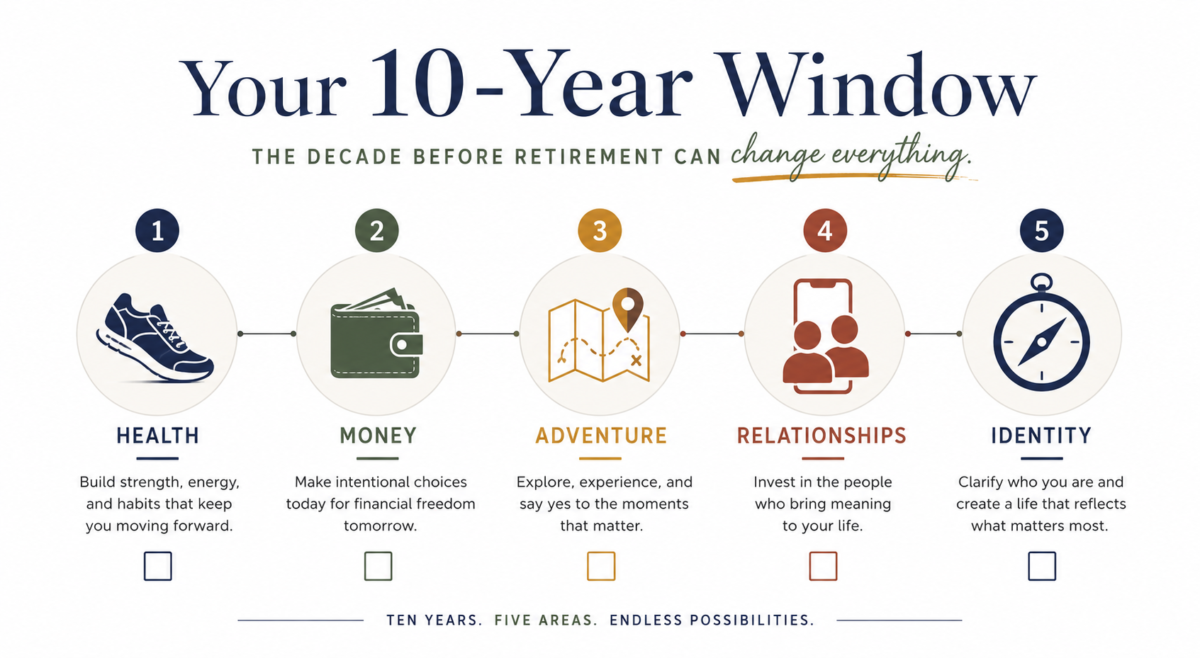
Start with five audits: health, money, adventure, relationships, and identity.
First, look at health. Ask what your future life requires from your body. If you want to travel, walk more now. If you want energy, protect your sleep. If you have been avoiding appointments, make them.
Second, look at money. Ask more than “how much have I saved?” Ask what your life costs. Audit the house, cars, insurance, storage, debt, subscriptions, and habits. Look for the quiet expenses that buy comfort while selling freedom.
Third, look at adventure. What is the smaller version of what you keep saving for retirement? Plan one intentional trip, rent the RV before buying one, or spend real time in a place before turning the fantasy into a permanent decision.
Fourth, look at relationships. Who do you want in your life 10 years from now? Are you acting like that now?
Fifth, look at identity. Pick one identity to build outside of work: host, volunteer, learner, creator, mentor, hiker, neighbor, or beginner.
The goal is not to blow up a life that works. The goal is to stop postponing every meaningful part of your life until an official date says you are allowed to begin. We went deep on this in building a freedom lifestyle instead of traditional retirement, and if you’re asking whether it’s too late to start over, the honest answer might surprise you.
FAQ
Is the 10-year window only for people who are financially ready to retire?
No. The 10-year window is useful even if you feel behind, because it focuses on health, spending, relationships, work options, and small experiments, not just account balances.
If money is tight, the window may matter even more. Simplifying overhead and building options can give you more room to breathe while you keep working on the financial side.
Should I start traveling before retirement if I have not saved enough?
Start with smaller, realistic versions of the travel you want. The point is not to spend recklessly, but to learn your pace, budget, health needs, and preferences before retirement.
What if I expect to work past 65?
Working past 65 can be a good choice if it gives you purpose, structure, or income. The risk is depending on work because you have no other identity, no backup plan, and no room to choose.
What is the first step if retirement feels overwhelming?
Pick one honest audit: your health, your monthly overhead, your relationships, your work identity, or one delayed dream. Start with the area that would hurt most if nothing changed for another decade.
Does building a retirement life mean quitting my job early?
No. Building a retirement life means testing the life you want while you still have time, energy, income, and flexibility. For many people, that means small changes, not a dramatic exit.