
Table of Contents
I remember sitting at the kitchen table one night, staring at a retirement calculator on my laptop. I punched in my age, my savings, my income. The number it spit back at me was so far from where I needed to be that I actually laughed out loud.
Not because it was funny. Because it was absurd.
I was in my late 40s, self-employed, and the financial world was telling me I needed to somehow save hundreds of thousands of dollars in the next 10 to 15 years just to have the privilege of sitting on a couch and watching TV. That’s when something clicked for me. I didn’t want to spend the next decade in panic mode chasing a number I’d probably never hit. I wanted to build a freedom lifestyle instead of retirement, a life I didn’t need to retire from in the first place.
And that’s exactly what my wife and I started doing.
Please note this page may contains affiliate links. If you purchase something through these links, I’ll receive a commission at no extra cost to you. Affiliate links help to support my website/blog and I only recommend products I love.
The Retirement Plan Most People Have Isn’t Working
Here’s the thing nobody wants to say out loud: the traditional retirement model is broken for most people. It was built for a world where you worked 40 years at the same company, got a pension, and died at 72. That world doesn’t exist anymore.
Look at the numbers.
| The Retirement Reality for Americans 50+ | |
|---|---|
| Have zero retirement savings | 1 in 5 Americans over 50 (AARP, 2024) |
| Median retirement savings at age 55 | Under $50,000 vs. the recommended 8x annual salary (Annuity.org, 2025) |
| Afraid they’ll outlive their savings | 67% of adults 55+ (Harbor Life Settlements, 2025) |
| Have no formal retirement plan | 67% of Americans aged 50 to 74 (Prudential, 2024) |
If you’re reading those numbers and feeling a knot in your stomach, I can sympathize with you cause I’ve been there.
But here’s what I want you to hear: it’s not your fault. The model itself is broken. It was designed for a completely different economy and a completely different life expectancy.
The answer isn’t to panic and deprive yourself for the next 15 years hoping to catch up. The answer is to stop playing a game you can’t win and start building something different.
Why a Freedom Lifestyle Instead of Retirement Works Better
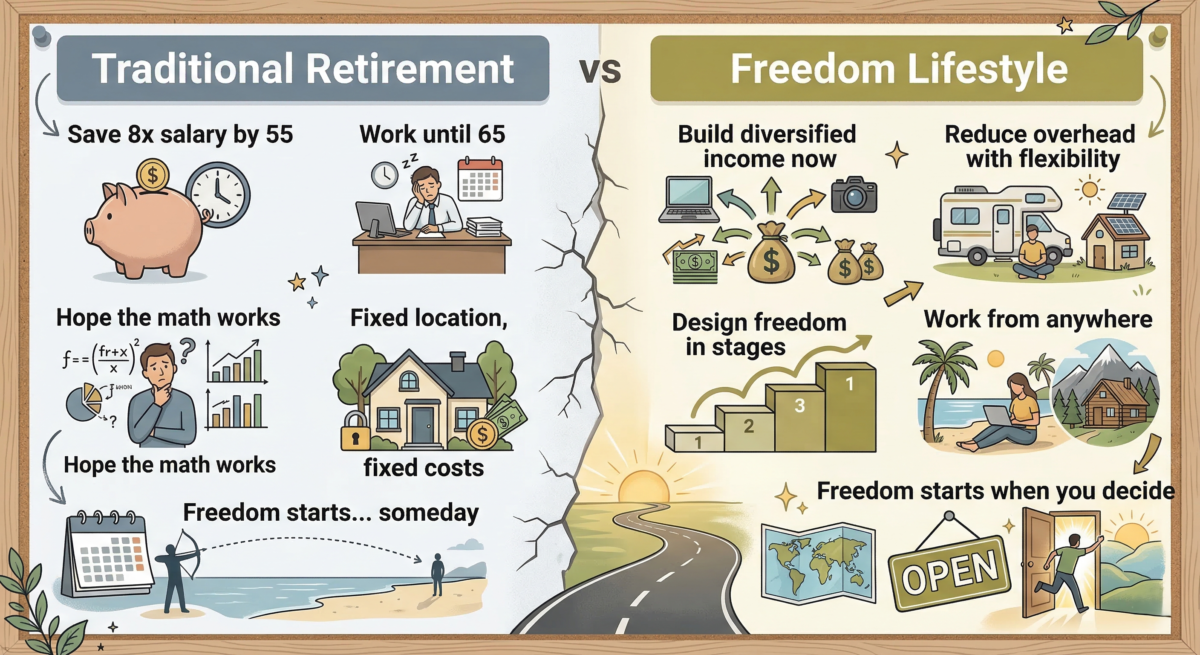
Retirement means you stop working at some magic age because you have enough money to never work again. That’s the promise. And for most of us, it’s a fantasy.
A freedom lifestyle instead of retirement is something different. It means having enough control over your time, your location, and your income that you stop needing to work the way you currently do. On your timeline. Not the government’s, not your employer’s, not some calculator’s.
The biggest difference? Freedom is something you can build in stages.
You don’t need $2 million sitting in an index fund. You need a structure where your income isn’t 100% dependent on showing up somewhere you don’t want to be, doing work that drains you, for a paycheck that barely covers the lifestyle you’re trying to maintain.
Tim Ferriss wrote about this years ago in The 4-Hour Workweek. He called them “mini-retirements,” short, intentional seasons of freedom scattered throughout your life instead of one giant retirement at the end when your knees don’t work.
When I first read that concept, it hit me hard. Why are we deferring everything good to a finish line most of us will never cross?
We wrote about this same idea in The Someday Trap: Why We Prioritized Travel Before Retirement. The idea that “someday” is a dangerous word when you’re in your 50s. Someday might not come the way you’re imagining it.
The Three Pillars of a Freedom-Based Lifestyle
Alright, so if the goal isn’t a retirement number, what is it? I think it comes down to three things. Three pillars that, when you start building them, change everything about how your life works.
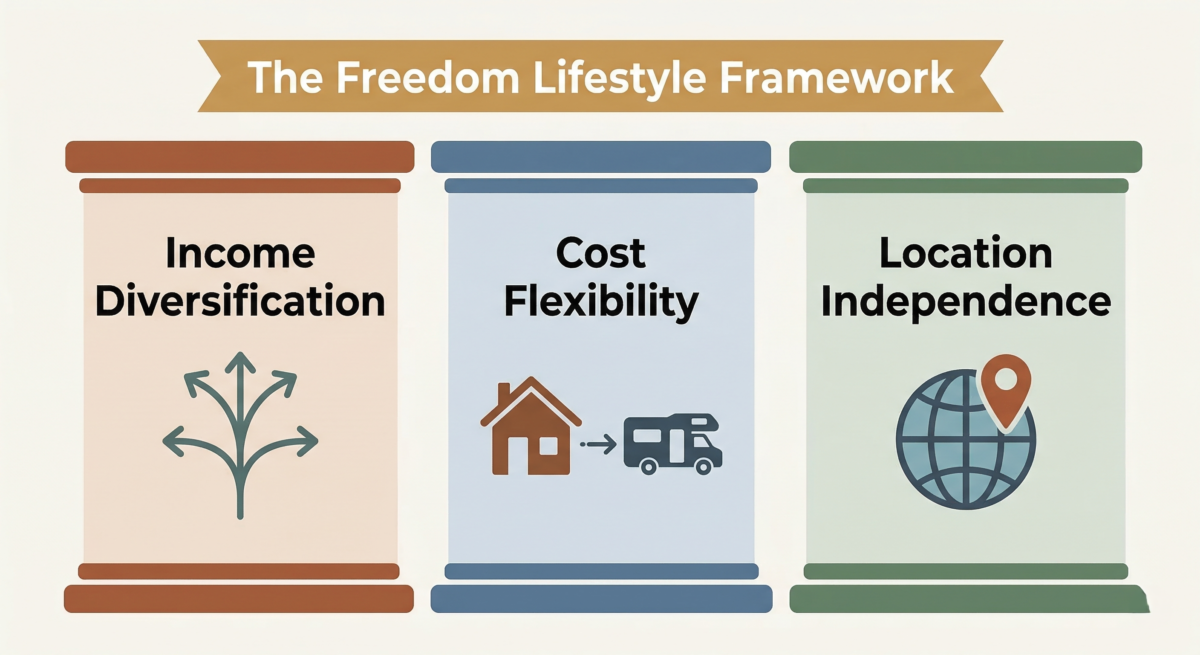
Pillar 1: Income Diversification
This is the big one. If 100% of your income disappears when you stop showing up to one job or one client, you’re not free. You’re dependent. And dependency is the opposite of freedom.
The goal isn’t to replace your income overnight. That’s unrealistic. The goal is to start building at least one additional income stream that isn’t tied to your physical presence. Something that makes money whether you’re at a desk or sitting on a beach.
For us, that’s been content creation, a blog, YouTube, a podcast, and affiliate marketing. But it could be consulting, coaching, digital products, an online shop, or a dozen other things. The point is to reduce your dependency on a single source of income over time.
If you’re interested in the tools that make this possible, I use Descript and Davinci Resolve for video and podcast editing and Spotify for podcast hosting. Canva Pro handles most of my design work. These tools have made it realistic for one person to run a content operation without a team, and that matters when you’re building this alongside a day job.
Pillar 2: Cost Flexibility
Here’s something most retirement advice ignores completely. The traditional retirement calculation assumes you’re going to maintain a fixed, suburban-American lifestyle forever. Same mortgage, same bills, same overhead, for decades.
But what if you didn’t?
If your lifestyle is flexible, if you can move, downsize, or travel slowly, you need far less money to sustain freedom. Full-time RV living, slow travel, location-independent living, these aren’t just lifestyle choices. They’re financial strategies.
We’ve written about this in detail in Embracing Minimalism and RV Living: A Journey to a Life Filled with Experiences. When you cut your fixed overhead, you completely change the math on what freedom costs. And that’s not a sacrifice. For us, it was an upgrade.
If RV living is on your radar, tools like Harvest Hosts give you access to unique overnight stays at wineries, farms, and breweries across the country. It’s one of those memberships that pays for itself fast.
Pillar 3: Location Independence
When you can work from anywhere, you can live anywhere. And when you can live anywhere, your cost of living, your quality of life, and what a good day looks like all change completely.
Even a partial version of this counts. Working remotely three days a week. Traveling two months a year. Spending winters somewhere warm and affordable.
People often assume that kind of mobility requires a massive savings account. But once you understand how to afford travel in your 50s without feeling broke, you realize it is more about flexibility than raw wealth. You don’t have to sell everything and hit the road tomorrow. But you do need to start thinking about where you work as a variable, not a fixed point.
This is where content creation and online income really shine. A laptop, decent internet, and a willingness to learn, and you can run a real business from a coffee shop in Portugal or an RV park in Montana.
What This Actually Looks Like in Practice
I know frameworks and pillars sound great in theory. So let me get specific about what this has looked like for us.
My wife and I didn’t wake up one morning and “retire.” We redesigned. I was running a contracting business, making decent money but trading all my time for it. No savings cushion to speak of. No pension. No corporate safety net. If I stopped working, the money stopped.
So I started building on the side. A blog. A YouTube channel. A podcast. All focused on the life we were actually living, traveling, downsizing, figuring out what midlife reinvention and starting over at 50 actually looks like. I started learning about SEO, affiliate marketing, email lists. It was slow. It was frustrating at times. But every small win was a brick in a different kind of foundation.
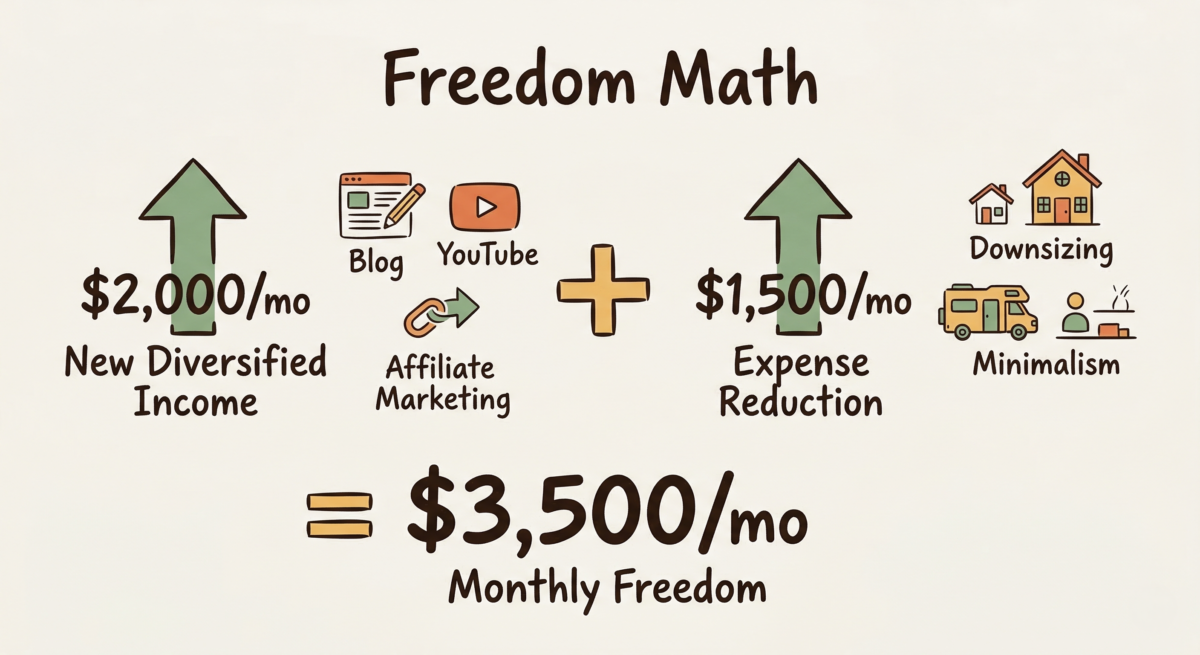
Here’s the freedom math that changed my thinking:
| The Freedom Math | Monthly Impact |
|---|---|
| New diversified income (affiliate revenue, content, side consulting) | +$2,000 |
| Expense reduction (downsizing, flexible living) | +$1,500 saved |
| Total breathing room created | $3,500/month |
That’s not retirement money. That’s freedom money. That’s the difference between being stuck and having options.
If you’re wondering whether it’s even realistic to start something new at this stage, I wrote about that honestly in Is It Too Late to Start Over in Your 50s? Here’s My Honest Answer. Short version: no, it’s not too late. But it does require being honest with yourself about what you’re willing to change.
How to Start Building Your Freedom Lifestyle
So if your looking to build your freedom lifestyle then here are five things you can do starting this week that will put you on a completely different path than the one you’re on.
- Audit your income dependency. Ask yourself: what percentage of my income disappears if I can’t show up to my current job or client tomorrow? If the answer is “all of it,” that’s your starting point. That’s the vulnerability you need to address first.
- Figure out your freedom number. Not the retirement number. The freedom number. How much monthly income do you need to have real options? To not feel trapped? For most people, that number is way lower than what the retirement calculators tell you, especially if you’re open to Pillar 2 (cost flexibility).
- Start one alternative income stream. Just one. Content creation is the most accessible path I know for people in our age group because it’s built on what you already have: life experience, opinions, and stories. But pick whatever fits you. The point is to plant the seed now.
- Run your freedom math. What would your monthly expenses look like if you had location flexibility? If you downsized? If you didn’t have a mortgage? Run those numbers and compare them to your current overhead. The gap between those two numbers is your opportunity.
- Set a 90-day pilot. Not a life overhaul. Just a defined season where you test one element of a freedom lifestyle. Start a blog. Try working remotely for a month. Experiment with downsizing one area of your life. Give yourself permission to test without committing to everything at once.
Final Thoughts
At the end of the day, this comes down to one question: are you going to spend the next 10 to 15 years chasing a number you’ll probably never hit, or are you going to start building a life that gives you freedom now? People constantly ask me what should you do in the 10 years before retirement, and my honest answer is to stop preparing for an ending and start redesigning your present.
I’m not telling you to be reckless. I’m not saying throw your 401(k) out the window and buy a van. What I am saying is that the traditional retirement path has failed most of us, and building a freedom lifestyle instead of retirement is a better way to think about your future.
Freedom isn’t a finish line you cross at 65. It’s a structure you build, one pillar at a time, starting whenever you decide to start.
For my wife and me, that decision changed everything. Not overnight. Not without hard moments. But the direction of our lives shifted the day we stopped planning for “someday” and started building for now.
If you’re honest with yourself, you already know whether the path you’re on is working. And if it’s not, you don’t have to wait for permission to try something different. Even something as simple as how you watch movies starts to feel different when you’re designing your days intentionally.
If this you liked this post, we write about these kind of things only more personal, the real stories, the mistakes, and the wins. It’s free.
What does freedom look like for you? Drop a comment below. I’d love to hear where you are in this process and what’s holding you back.