
Table of Contents
When we finally booked our return to the Mexican Riviera on the Carnival Panorama, I spent weeks in the “research loop.” I scoured forums, watched YouTube walk-throughs, and planned our dining rotation down to the minute.
But there was one topic that kept popping up in the reviews, usually accompanied by all-caps rage: The Smart Elevators.
People hated them. They called them confusing, slow, and “the worst part of the ship.”
Naturally, I was skeptical. How hard could an elevator be?
Please note this page may contains affiliate links. If you purchase something through these links, I’ll receive a commission at no extra cost to you. Affiliate links help to support my website/blog and I only recommend products I love.
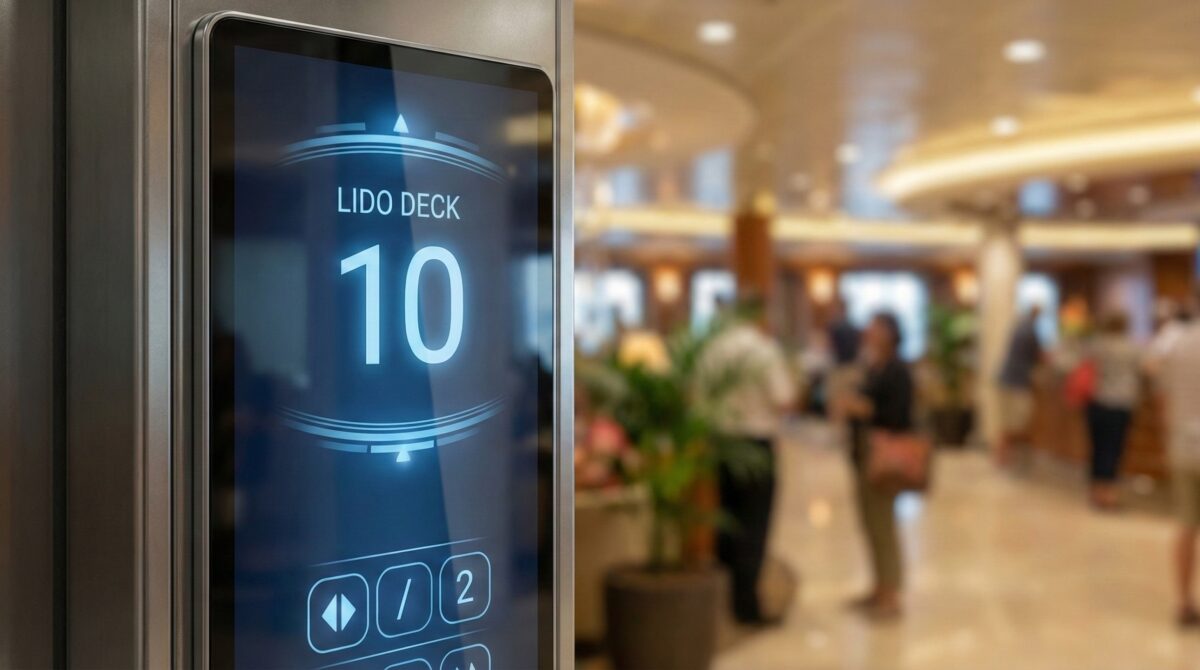
Fast forward to Embarkation Day. We had just boarded, cocktails in hand, ready to head from the Lobby up to the Lido Deck. We walked up to the shiny touch screen, I pressed “10,” the screen flashed “Car A,” and we stepped inside.
The doors closed. And then… nothing happened.
My wife looked at me, then looked at the wall where the buttons usually are. “So… how do we tell it to go?” she asked, a little panic setting in as the metal box stayed perfectly still.
That was the moment I realized: We are doing this wrong.
If you are sailing on the Panorama (or her sisters, the Horizon and Vista), you are going to encounter the “Destination Dispatch” system. If you fight it, you will lose. But if you learn the rules of the game, it might just be the most efficient way to travel at sea.
Here is why you (and everyone else) are likely using them wrong, and the one trick that changed our entire week.
The “Where Are the Buttons?” Panic
The first thing you have to get used to is the lack of control.
On a traditional ship, you get in, you see a panel of buttons, and you press your floor. It feels proactive. You are in charge of your destiny.
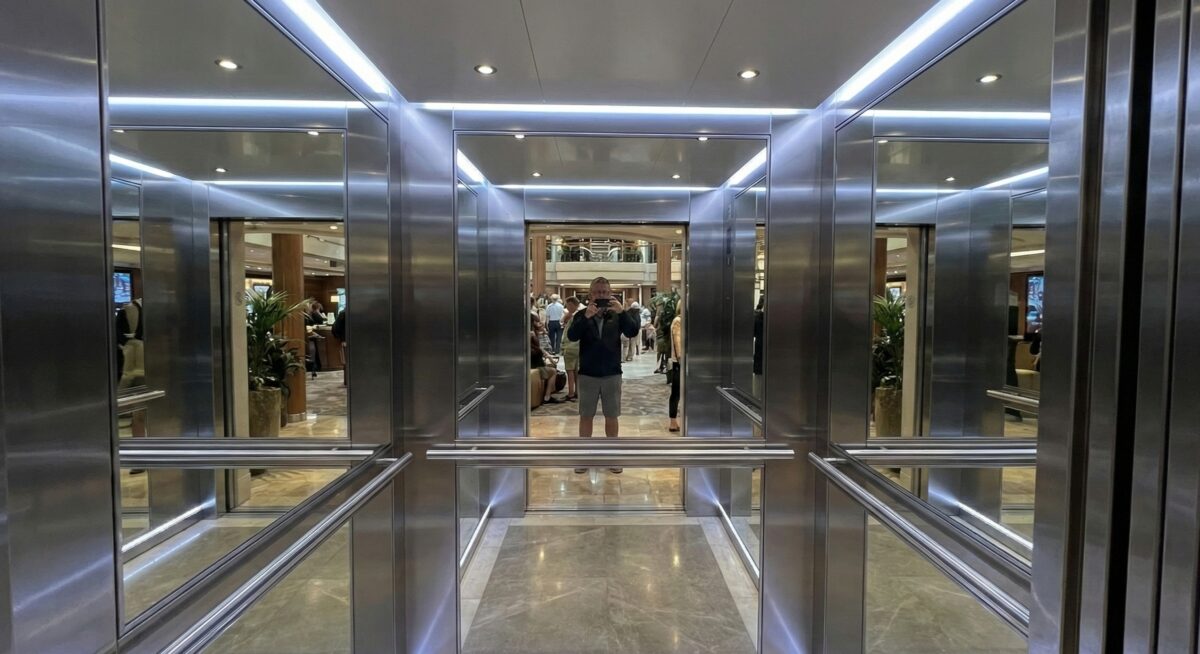
On the Carnival Panorama, the elevators are smooth, metallic, and button-less. It feels remarkably like being trapped in a very expensive closet.
The system relies on you making your choice before you enter the vehicle. It uses an algorithm to group passengers going to the same area. Think of it like Uber Pool. The computer wants to put everyone going to Deck 10 in one car, and everyone going to Deck 3 in another, rather than stopping at 3, 4, 7, and 9 on the way to 10.
Conceptually, it’s brilliant. But in practice, human psychology gets in the way.
The #1 Mistake On Smart Elevators: The “One Press” Fallacy
By Day 2, I started observing other passengers while waiting in the lobby (mostly because the lobby is picturesque and great for people-watching). I noticed a pattern that explained 90% of the complaints I read online.
A family of four would walk up to the screen. The dad would press “Deck 10.” The screen would say “Car B.”
All four of them would squeeze into Car B.
This is the fatal error.
The system is smart, but it isn’t psychic. When you press the button once, the computer allocates space/weight for one person. It assumes a single rider. If four people squeeze into a car that the computer thinks is only carrying one, the car hits weight capacity faster than the algorithm expects. It stops to pick up more people on Deck 4, realizes it’s full, and everyone gets cramped and angry.
The Fix: Press for Every Person
When my wife and I figured this out, it changed the game. If it’s just the two of us, I press “Lido” twice.
If we are traveling with friends, we press it for every single body in our group.
This tells the computer, “Hey, I have four humans here.” It might assign us a different car, or it might not stop at the next floor because it knows the car is technically “full” based on our input. Once we started doing this, our rides were noticeably faster and less crowded.
Embarkation Day vs. Mid-Week Bliss
I have to be honest: Embarkation Day on the Panorama is elevator anarchy.
Nobody knows how the system works yet. Kids are pressing every button on the screen just to see the lights flash (which summons fifty different elevators). People are holding doors open, which confuses the sensors.
On that first afternoon, we actually gave up and took the stairs up to Deck 10. It was a workout, but at least we kept moving.
However, by Wednesday? The vibe shifted. The only people yet to figure out the smart elevators seemed to all be going to the main dining room for breakfast the same time as my wife and me.
Once the collective population of the ship figured out the rhythm, the system sang. We would tap our deck, walk to the assigned letter, and zip from Deck 3 to Deck 10 in under 30 seconds with zero stops. It felt futuristic. It felt premium.
The “Split Up” Strategy
There is one side effect of the smart system that became a running joke for us: The Separation.
Sometimes, I would press Deck 5, and it would assign me “Car A.” My wife would press Deck 5 a second later, and it would assign her “Car C.”
The old instinct is to say, “No, let’s just squeeze into Car A together.” Don’t do this. (See: The #1 Mistake above).
Instead, we turned it into a game. We leaned into the separation.
“See you on the other side!” I’d say as the doors to Car A slid shut.
It became a race. Who would get to the Alchemy Bar first? (Spoiler: It was usually her). Seeing her inner child come out as she competitively mashed the button to try and beat my elevator time was a highlight of the evenings. It added a little spark of fun to the mundane act of transit.
A Note on Accessibility
While I’m looking at this through the lens of efficiency, I realized something else while watching a guest on a mobility scooter.
This system is actually superior for accessibility.
Because you select your floor in the lobby, the doors stay open a little longer for you. More importantly, once you are inside, you don’t have to struggle to reach a button panel that might be too high or blocked by other passengers standing in front of it. You just roll in, park, and enjoy the ride.
The Verdict
So, are the Carnival Panorama smart elevators a design flaw or a feature?
They are a feature, but they have a learning curve.
If you go in expecting a traditional experience, you will be frustrated. If you try to outsmart the system by cramming a family of six into a single-person assignment, you will be cramped.
But if you play by the rules, press for every person and accept the occasional “race” against your spouse, it’s actually a incredibly efficient way to get around a massive ship.
Plus, it gives you a great excuse to order that second drink at the Alchemy Bar while you wait for your partner to catch up.